What Is Agentic AI? How It Connects Sales, Finance, and Operations in 2026
Agentic AI for sales connects GTM, finance, and ops through autonomous workflows, clean enrichment, and CRM sync to improve execution and forecasts in 2026.
Agentic AI for sales is no longer something you only see in a concept deck stapled to a venture pitch. Across B2B organizations in 2026, AI adoption in sales has moved well past the early-adopter phase. A growing majority of sales teams now use some form of AI in their daily workflows, and a significant share of individual reps have already interacted directly with an AI agent. The move from passive copilots to autonomous, goal-driven agents is changing how B2B teams research accounts, qualify leads, keep CRMs current, and forecast revenue. The bigger payoff shows up when those sales agents stop acting like point tools and start coordinating with finance and operations.
Below is a clear breakdown of what agentic AI is, how it differs from the automation most teams already run, and why shared orchestration across sales, finance, and operations is shaping up to be the most consequential RevOps shift of this decade. Here is what we will cover:
- Agentic AI fundamentals and how they differ from traditional automation
- Cross-functional agent collaboration across sales, finance, and ops
- Data quality and enrichment as the prerequisite for agent reliability
- Building agentic GTM workflows with practical B2B examples
- Comparison table of traditional automation vs. agentic AI
- FAQs covering the most common questions about agentic sales
What Agentic AI Actually Means (and What It Is Not)
IBM defines agentic AI as a system that can accomplish a specific goal with limited supervision, extending generative AI by using large language models to operate in dynamic environments. Red Hat draws a practical line: agentic AI is about "doing" rather than just "creating," meaning it can initiate actions, generate its own prompts, and chain steps together from a single request. MIT Sloan frames these systems as semi- or fully autonomous: they can perceive, reason, and act without a human driving every click.
In business terms, the difference is easy to spot. A traditional chatbot answers a question. A generative AI tool drafts an email. An agentic AI system does the work around the email: it researches the prospect, checks ICP fit, enriches contact data, drafts a tailored sequence, logs activity in your CRM, and then pushes a signal into finance for pipeline forecasting. It chooses the next step based on the goal and the context, instead of waiting for your next prompt.
Traditional Automation vs. Agentic AI
Most B2B teams already run workflow automation: Zapier triggers, CRM rules, scheduled reports. Agentic AI is not just "more automation"; it is a different operating model. Here is the comparison:
| Dimension | Traditional Automation | Agentic AI |
|---|---|---|
| Decision-making | Rule-based (if/then) | Reasoning-based (LLM-driven) |
| Adaptability | Breaks when inputs change | Adapts to new data in real time |
| Scope | Single task or linear sequence | Multi-step, cross-functional workflows |
| Human involvement | Requires manual setup for every branch | Operates with minimal supervision |
| Data handling | Moves data between fixed fields | Enriches, validates, and interprets data |
| Example in sales | Auto-assign lead to rep by territory | Research account, score fit, personalize outreach, update CRM |
| Example in finance | Send invoice on deal close | Reconcile revenue, flag anomalies, adjust forecast |
| Agentic AI replaces rigid if/then logic with adaptive, goal-oriented reasoning. |
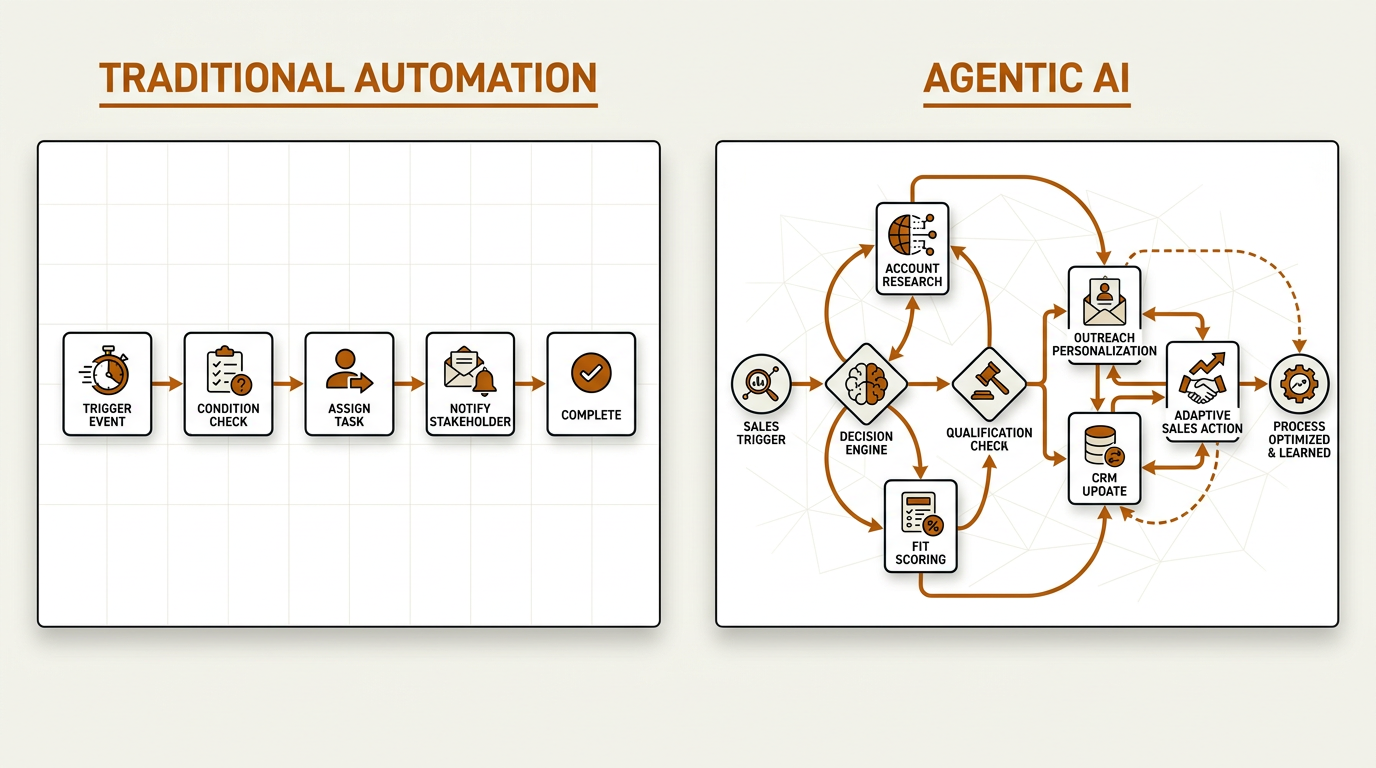
Unlike fixed automation rules, agentic AI reasons, branches, and self-corrects across every step.
How AI Agents Collaborate Across Sales, Finance, and Operations
Agentic AI gets materially more valuable when sales agents are not trapped inside the sales silo. Picture a common workflow: a sales agent spots a high-intent prospect, enriches firmographics, and qualifies the account against your ICP. That same chain can kick off an operations agent to confirm inventory or service capacity, while a finance agent pulls payment history from public filings and pre-computes deal terms. Nobody has to bounce between tabs or ping finance in Slack to "take a look" at a deal.
Sales teams that embrace agentic workflows for prospecting consistently outperform peers still relying on manual research and static lead lists. That advantage is not just about speed to meeting. It shows up later: cleaner forecasts, faster deal-desk approvals, and fewer handoffs that rely on tribal knowledge instead of shared systems. Airwallex reports that moving from rigid automation to adaptive, reasoning-based agents can reduce manual finance processing workloads by up to 90% in some cases.
What This Looks Like in Practice
- Prospect research: An agentic sales workflow pulls from LinkedIn, news, and technographic databases, then turns it into a rep-ready briefing. Platforms like Bitscale support this through AI for prospect research and enrichment pipelines.
- Lead qualification: Instead of a static score that goes stale the moment it is calculated, an AI agent weighs intent signals, funding events, and tech stack fit in real time. See the best intent data tools in 2026 for the signal sources that make this possible.
- CRM updates: Agents capture call notes, move deal stages, and attach enriched contact records without the rep babysitting Salesforce.
- Forecasting: Finance agents ingest pipeline data, weight it by deal health signals, and surface risk flags ahead of the weekly commit call.
- Pipeline management: Operations agents track delivery timelines and flag capacity constraints that could push closed-won deals off schedule.
Why Clean Data and Enrichment Are Non-Negotiable
Most teams miss the real failure mode with agentic AI: they obsess over the agent layer and shrug at the data layer. An autonomous agent making decisions off stale, incomplete, or duplicated CRM records does not save time; it manufactures expensive mistakes at machine speed. If prospect records do not have verified work emails, accurate job titles, or current company details, your agents will personalize to the wrong person, misqualify leads, and contaminate the forecast.
Enrichment is the floor, not the ceiling. Before an agent acts, the data it reasons over needs to be current, validated, and grounded in business context. That is why sales intelligence solutions belong in the "infrastructure" category, not the "nice-to-have" category. Bitscale, for instance, provides B2B contact and company enrichment, work email and phone lookup, and buying-signal detection that feeds directly into agentic workflows. Without that layer, autonomous sales workflows will still hallucinate, because the context they are given is wrong.
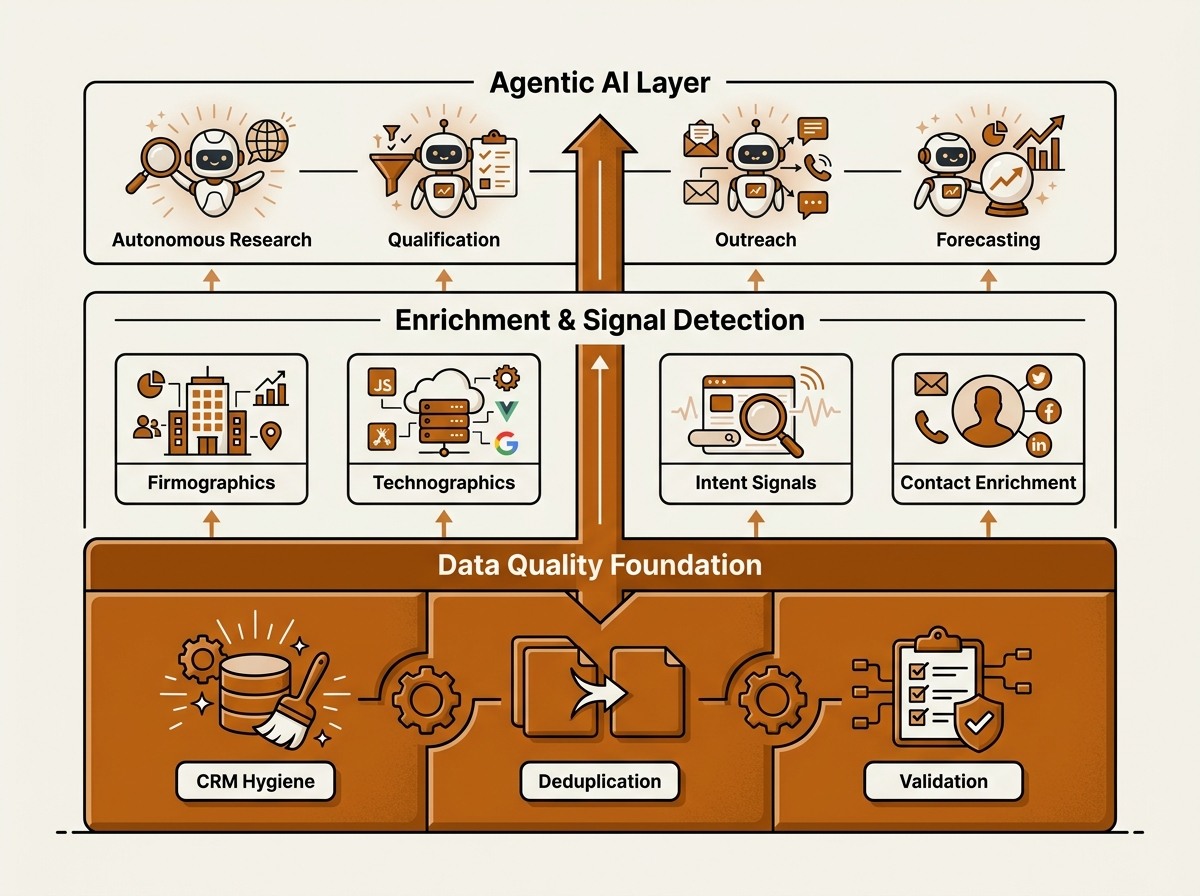
Agentic AI is only as reliable as the data stack powering it.
Building Agentic GTM Workflows: A Practical Framework
Investment in agentic AI continues to grow rapidly as organizations move from isolated AI tools toward autonomous workflow systems that can execute complex business processes. That curve is being pulled upward by teams shipping real workflows, not running endless pilots. If you are building agentic GTM workflows now, this framework holds up in the real world.
Start With a Single High-Impact Workflow
Trying to automate the entire revenue engine on day one is how projects die in committee. Start with the workflow that has the most manual drag and the cleanest success metric. For many B2B teams, that is prospect research and lead qualification. A sales AI agent that researches 500 accounts overnight and returns the 40 that match your ICP gives SDRs back a week of effort every sprint. Bitscale's AI Agent is designed around that exact motion: enrichment, prospect intelligence, and CRM synchronization in one workflow.
Connect the Agent to Your Existing Stack
Agentic workflows break down when they live outside your CRM, outbound tools, and reporting layer. The agent needs read/write access to the system of record, or you end up with "AI output" that never makes it into execution. Bitscale supports CRM sync and outbound tool integrations so enriched records, qualification scores, and personalized messaging land where reps already work. Getting clear on what B2B sales means for your org helps you map agent actions to the right stages, SLAs, and handoffs.
Layer in Cross-Functional Agents Gradually
After your sales agent is producing consistent outputs, extend the chain. Add a finance agent that watches deal velocity and flags stalled opportunities so forecasts get updated before they are wrong in public. Add an operations agent that checks fulfillment capacity before a rep commits to a delivery date. Keep each agent tightly scoped, define inputs up front, and set human review checkpoints for high-stakes decisions. The goal is not instant autonomy; it is earned trust backed by measurable accuracy.
What Sets Agentic Sales Apart From Sales AI Copilots
Sales AI copilots (email drafters, call summarizers, meeting schedulers) are helpful, but they are fundamentally reactive: they move when you ask. Agentic sales flips that posture. An agent can monitor your pipeline, notice that a champion at a target account just changed jobs, enrich the new contact details, draft a re-engagement sequence, and queue it for review. That difference matters because copilots optimize tasks, while agents coordinate workflows across systems, including top AI platforms for B2B sales. If your team is still deciding where to start, that comparison is a useful baseline.
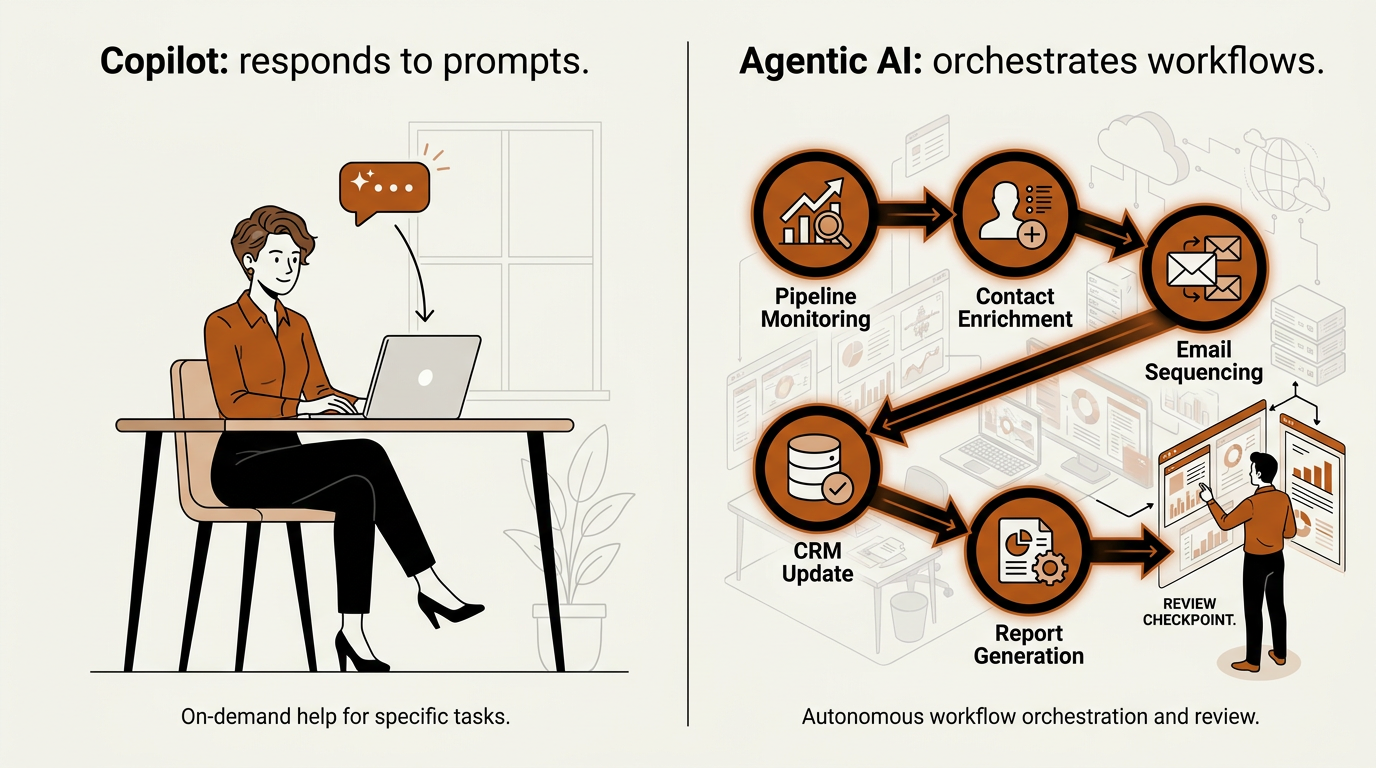
Copilots react to prompts; agentic AI autonomously orchestrates multi-step sales workflows end to end.
Key Takeaways
- Agentic AI for sales is not a buzzword. It is an architecture that can reason, act, and adapt across multi-step B2B workflows.
- The best ROI comes from connecting agents across sales, finance, and operations, rather than running them as isolated tools.
- Clean, enriched data is table stakes. Without it, autonomous agents scale errors instead of removing them.
- Start with one high-impact workflow (prospect research or lead qualification), connect it to your CRM, then expand in controlled steps.
- Platforms like Bitscale provide the enrichment, workflow automation, and CRM sync layer that agentic GTM workflows rely on.
Frequently Asked Questions
What is agentic AI in simple terms?
Agentic AI describes systems that can pursue a goal with minimal human supervision. Unlike chatbots or copilots that wait for prompts, agentic AI can interpret context, decide what to do next, and execute multi-step actions on its own (IBM, 2026).
How does agentic AI for sales differ from traditional sales automation?
Traditional sales automation runs on rigid if/then rules (for example, assigning a lead by territory). Agentic AI for sales uses LLM-driven reasoning to research prospects, judge fit, personalize outreach, and update CRM records, adjusting as new data comes in instead of following a fixed script.
What are examples of sales agents in B2B workflows?
Common examples include agents that enrich prospect lists with firmographic and intent data, agents that qualify inbound leads against ICP criteria in real time, and agents that monitor pipeline health and flag at-risk deals for sales managers.
Why is data enrichment important for agentic AI workflows?
Agents can only make good decisions with good inputs. Stale emails, wrong job titles, or missing firmographics translate directly into misqualified leads and wasted outreach. Enrichment platforms like Bitscale help keep records verified and current, which is essential when you are running autonomous sales workflows.
How can a GTM team get started with agentic AI today?
Start with one workflow where manual effort is highest, such as prospect research or lead qualification. Connect the agent to your CRM and outbound tools so the output shows up where reps actually work. Platforms with built-in enrichment and CRM sync (like Bitscale) reduce integration overhead and can show results in weeks rather than quarters.