12 Best GTM Agencies in 2026: Top Partners for Revenue Growth
12 best GTM agencies in 2026 compared across outbound, RevOps, enrichment, and pipeline generation, so you can pick the right partner for your stage.
Finding the best GTM agencies in 2026 has very little to do with hiring someone to run ads or crank out blog posts. Go-to-market now lives or dies on coordination: outbound prospecting, RevOps, CRM workflows, data enrichment, and the mechanics of turning accounts into pipeline. Many companies struggle to translate go-to-market strategy into repeatable pipeline generation. The challenge is rarely a lack of ideas. It is usually a combination of fragmented systems, inconsistent execution, poor data quality, and limited operational capacity. That execution gap is exactly where the right partner earns their keep.
This comparison looks at 12 agencies and technology partners across the GTM spectrum, from full-service revenue growth shops to focused outbound and sales development teams. If you are a seed-stage startup standing up your first outbound motion, or a scaling B2B company considering an outsourced sales team, the breakdown below is meant to help you pick a partner that actually matches your stage and budget.
How GTM Agencies Differ from Marketing, Lead Gen, and RevOps Firms
"GTM agency" gets used as shorthand for a few different categories, and that is where a lot of bad buying decisions start. A traditional marketing agency is usually paid to move brand and demand: content, paid media, conversion work, and site optimization. A b2b lead generation agency tends to sell outputs like contact lists or booked meetings, often without owning the surrounding pipeline strategy. A revops agency (or revenue operations consultancy) is built for CRM architecture, reporting, and process design, but it rarely runs outbound day-to-day. A real go to market agency sits in the messy middle, stitching sales development, demand gen, enrichment, outbound prospecting, and CRM management into one revenue motion. The stronger ones also bring buying signals and automation so reps spend time on accounts showing real intent. If you want the tooling side of that stack, start with the best RevOps tools available today.
Quick Comparison: All 12 GTM Partners at a Glance
| Partner | Primary Focus | Best For | Pricing Model | Delivery Type |
|---|---|---|---|---|
| Bitscale | Prospecting automation, enrichment, CRM sync | Teams that need outbound infrastructure they can scale | SaaS subscription | Platform (self-serve + workflows) |
| Clay | Data enrichment, waterfall lookups | Ops-heavy teams building tailored workflows | SaaS subscription | Platform (self-serve) |
| Apollo.io | Sales intelligence, sequencing | SMBs that want an all-in-one prospecting suite | Freemium / SaaS | Platform (self-serve) |
| CIENCE | Outsourced SDR, multi-channel outbound | Mid-market teams that want managed pipeline generation | Retainer | Managed service |
| Belkins | Appointment setting, outbound | B2B teams that want meetings as the headline deliverable | Retainer / per-appointment | Managed service |
| Cognism | EMEA-focused data, compliance | European expansion and GDPR-sensitive orgs | SaaS subscription | Platform + data |
| Lusha | Contact data, quick enrichment | Reps who need fast phone/email lookups | Freemium / SaaS | Platform (self-serve) |
| Instantly.ai | Cold email at scale | Startups running high-volume outbound | SaaS subscription | Platform (self-serve) |
| Kalungi | Full-service B2B SaaS marketing | SaaS companies operating without a CMO | Retainer | Managed service + fractional CMO |
| Ironpaper | B2B demand gen, inbound + ABM | Growth-stage B2B with complex sales cycles | Project / retainer | Agency |
| ColdIQ | AI-native outbound execution | Tech teams that want AI-driven prospecting | Retainer | Managed service |
| SaaSHero | GTM consulting for SaaS | Early-stage SaaS refining positioning + outbound | Project / retainer | Consulting + execution |
| Comparison based on publicly available information as of June 2026. |
1. Bitscale: The Automation Layer for Scalable GTM
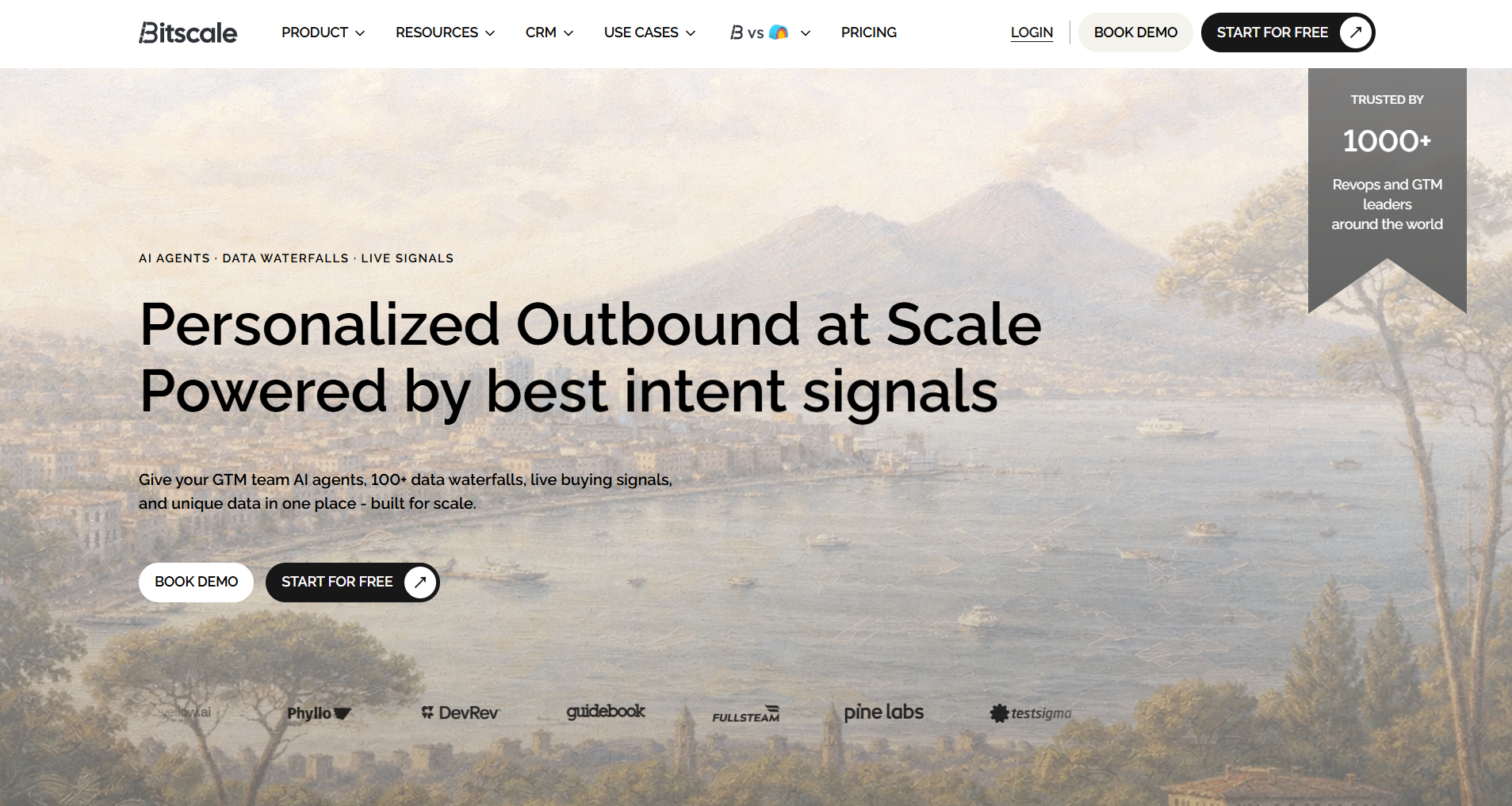
Bitscale provides ready-made workflows for prospecting, enrichment, and CRM synchronization.
Bitscale is not a traditional gtm agency in the "we run it for you" sense. It is the tech layer agencies and in-house teams use to scale prospecting: contact and company enrichment, work email and phone lookup, intent signal tracking, and CRM sync. While Bitscale is not a traditional agency, it is included because many modern GTM teams and agencies use it as the infrastructure layer behind prospecting, enrichment, and outbound execution. Agencies bring the strategy and the human execution; Bitscale is the infrastructure that makes those efforts repeatable instead of artisanal. With its ready-made sales workflows, revenue teams can move from a raw account list to enriched, sequenced prospects in minutes, not days.
Strengths: AI prospect research that surfaces buying signals before outreach. Waterfall enrichment across multiple data sources. Native integrations with outbound tools and CRMs. Pre-built workflow templates that cut out manual data wrangling. Ideal customer: B2B revenue teams (5 to 500 reps) that want to build a scalable GTM automation stack without staffing a full ops function. Limitation: Bitscale is a platform, not a done-for-you service. If you have no internal sales capacity, you will still need a managed partner alongside it.
2. Clay: Workflow-Driven Enrichment for RevOps Teams
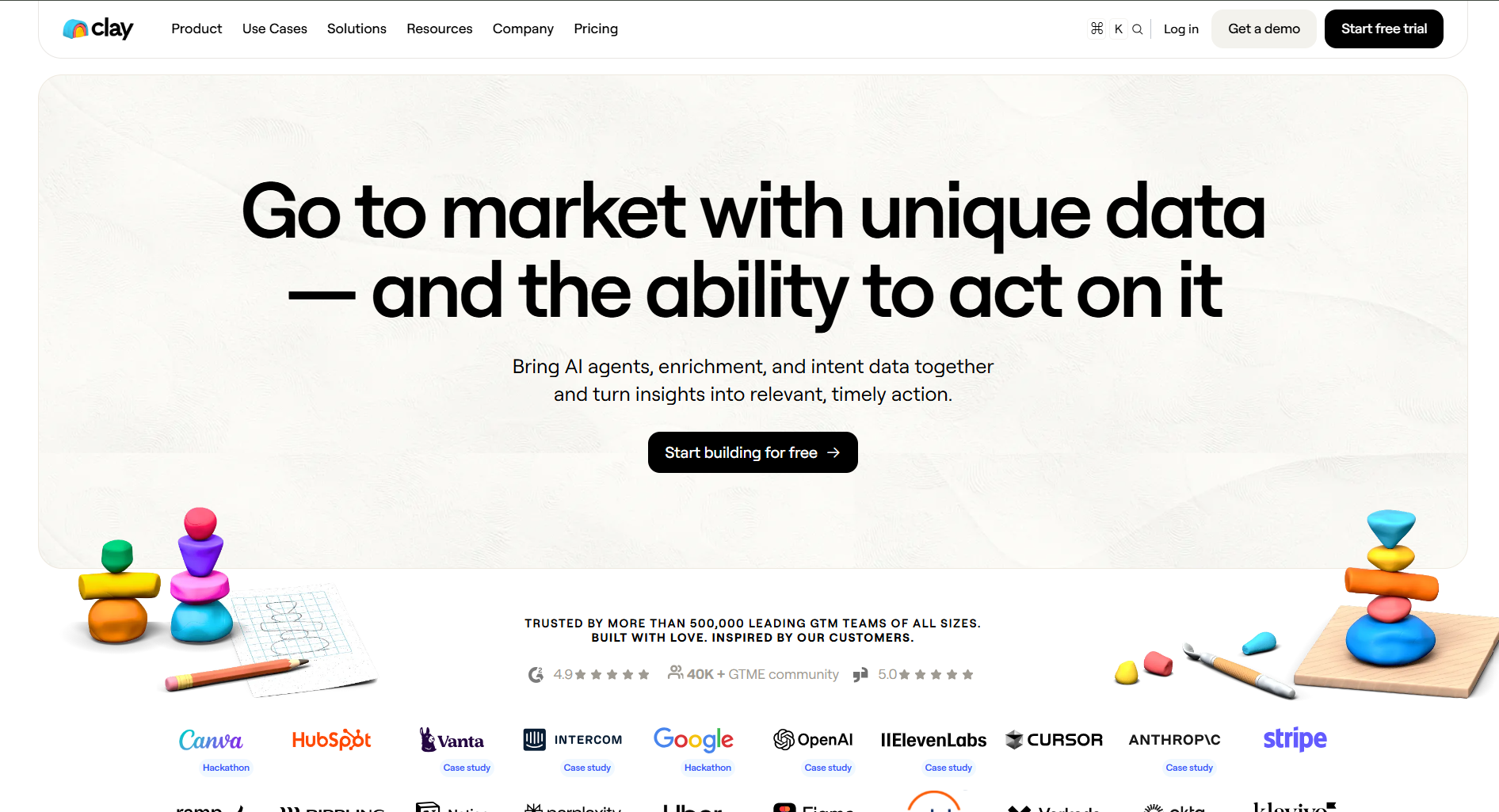
Clay's spreadsheet-style interface lets ops teams chain dozens of enrichment providers.
Clay has turned into a go-to for RevOps teams that like building their own systems. Its waterfall enrichment runs through multiple providers in sequence, which can lift match rates for emails, phone numbers, and firmographic fields. That flexibility is the point, and it is also the cost: Clay rewards the person who thinks in formulas and API calls, and it punishes teams that want a simple "upload list, get leads" experience. Pricing scales on credits, so heavy enrichment volumes can get pricey fast. In practice, Clay works best when it is wired into a CRM and an outbound sequencer, not treated like a standalone database.
3. Apollo.io: The All-in-One Sales Prospecting Platform
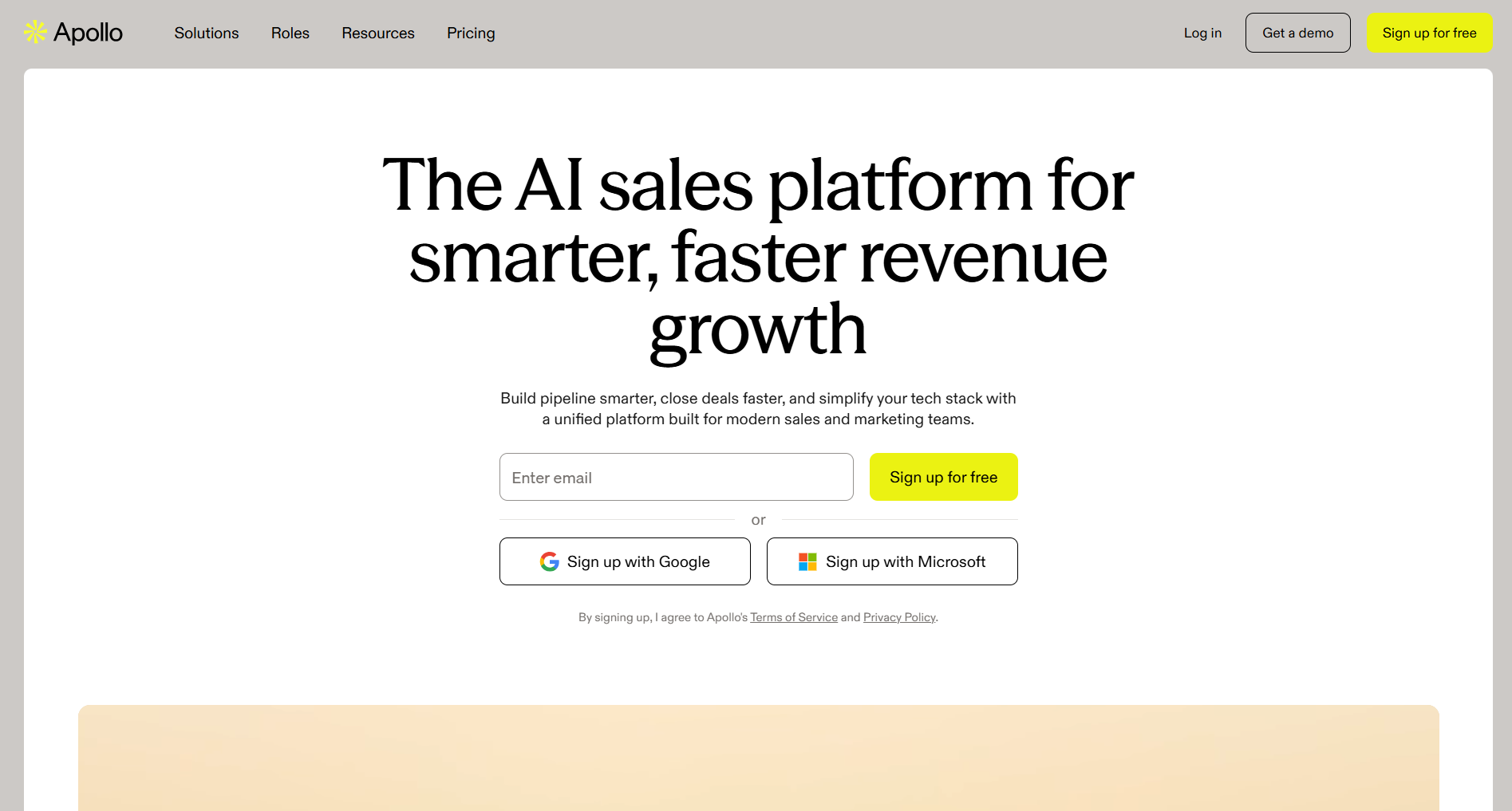
Apollo combines a large B2B database with built-in email sequencing.
Apollo.io sits in a useful middle ground: it can replace a lightweight prospecting agency for some teams, and it can also be the self-serve starting point for outbound. Its large B2B contact database, plus built-in sequencing, intent data, and a generous free tier, is why so many startups default to it. The enrichment product helps fill CRM gaps automatically. The tradeoff shows up in edge cases: data accuracy can be uneven in niche verticals and outside North America. Enterprise teams also tend to outgrow Apollo as segmentation and routing get more complex. For SMBs launching their first outbound motion, though, it is still one of the cleanest value plays.
4. CIENCE: Managed Outbound and Pipeline Generation
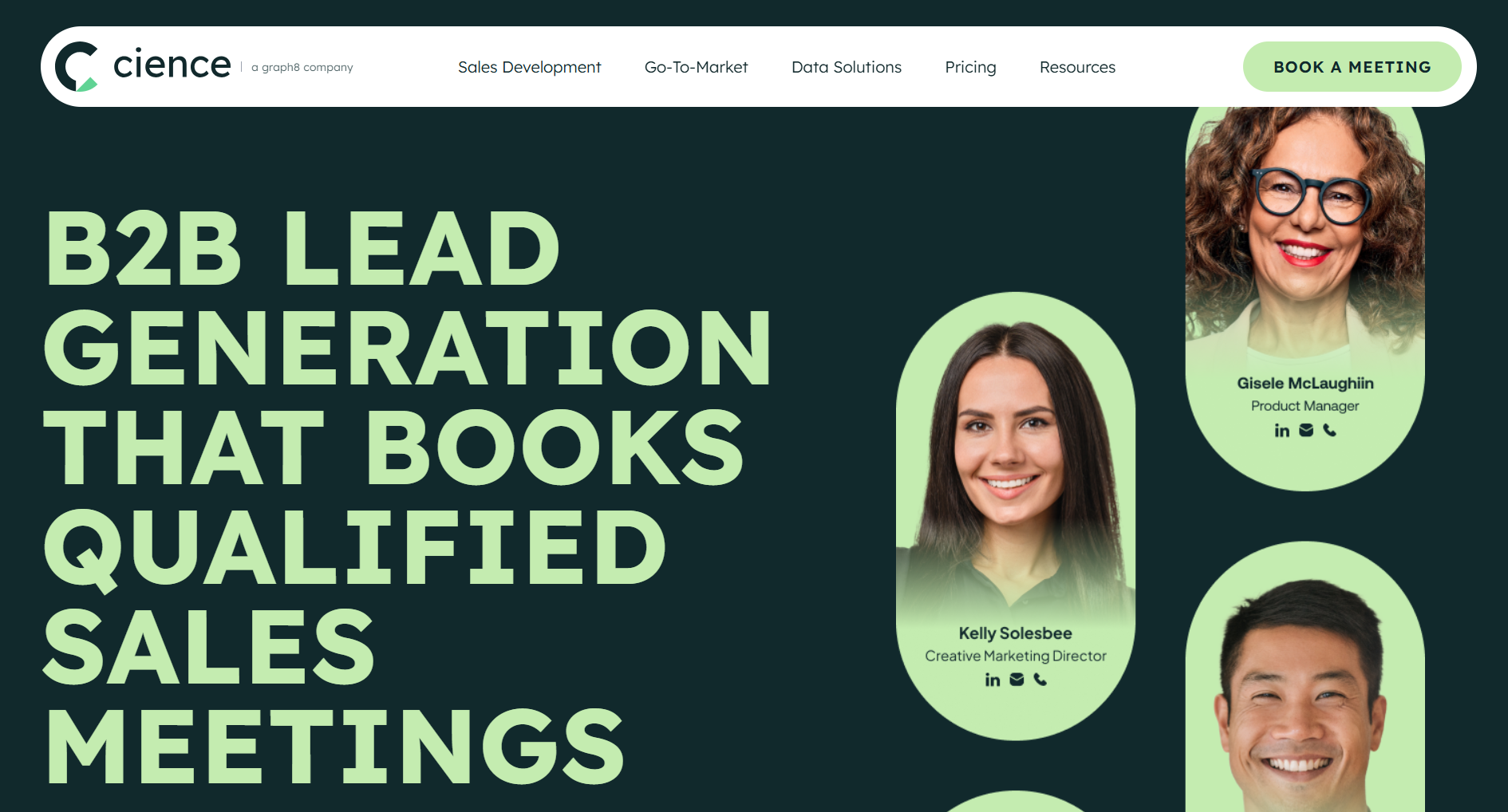
CIENCE offers outsourced SDR teams with multi-channel outbound execution.
CIENCE is one of the more established names in outsourced sales development. The model is straightforward: they staff dedicated SDR teams to run phone, email, and LinkedIn outreach for you. Their pricing starts at a meaningful monthly retainer, which is what you would expect from a human-heavy delivery model. The upside is speed to pipeline without the hiring, training, and management overhead. The downside is control: messaging nuance is harder to tune, and iteration cycles can be slower than an in-house team that sits with product marketing. CIENCE tends to fit mid-market companies pushing into new segments where they need volume outreach quickly but do not have the headcount.
5. Belkins: Appointment Setting with a Performance Edge
Belkins focuses on delivering qualified appointments to sales teams.
Belkins stands out because it is more willing than most outbound shops to peg compensation to appointments delivered. Their offering bundles research, copywriting, deliverability management, and SDR execution into a single package. If your internal scorecard is meetings booked, that alignment is appealing. Belkins also has experience across IT services, SaaS, and professional services. The watch-out is meeting quality: it can vary, and the handoff from their SDRs to your AEs needs real process. Teams that treat onboarding as optional usually feel it later in the meeting-to-opportunity conversion rate.
6. Cognism: EMEA Data and Compliant Prospecting
Cognism specializes in phone-verified mobile numbers for European markets.
If your GTM motion is aimed at European buyers, Cognism is hard to ignore. Their Diamond Data product focuses on phone-verified mobile numbers and leans heavily into GDPR and international compliance. The enrichment capabilities plug into Salesforce, HubSpot, and Outreach. Cognism is not a b2b growth agency so much as a data backbone, but European contact coverage is where it earns its reputation. North American data is improving, though it still trails competitors like Apollo and Lusha. Pricing is enterprise-oriented, so it fits teams with real budgets, not experiments.
7. Lusha: Fast Contact Lookups for Individual Reps
Lusha's browser extension gives reps instant access to verified emails and direct dials.
Lusha wins when "I need this contact right now" is the job. A rep can sit in LinkedIn and pull a verified email and phone number in seconds using the browser extension. Lusha also offers bulk enrichment and API access for teams that want to enrich CRM records at scale. Where it does not compete is orchestration: compared to Clay or Bitscale, workflow automation is limited. It is a data point solution, not a GTM control plane. Still, for small sales teams that want accurate contact info without building a mini data engineering project, Lusha is refreshingly simple. The free tier (limited credits per month) makes it easy to sanity-check data quality before you commit.
8. Instantly.ai: High-Volume Cold Email Infrastructure
Instantly.ai manages email warmup, rotation, and sending at scale.
Instantly.ai is a popular alternative to hiring an outbound agency when you want to keep cold email execution in-house. It handles inbox warmup, sender rotation, deliverability monitoring, and campaign analytics. Its pricing is positioned far below most managed-service retainers. The boundary is clear, though: Instantly does sending, not strategy. You still own lead sourcing, copy, and reply handling. Most teams pair it with a data platform like Bitscale or Apollo so enrichment flows straight into sequenced campaigns. Many outbound teams are beginning to combine enrichment, automation, and AI-driven qualification workflows into modular GTM stacks, which is one reason these composable setups are showing up more often.
9. Kalungi: Fractional CMO and Full-Service SaaS Marketing
Kalungi provides a fractional CMO alongside a full marketing execution team.
Kalungi plays a specific role: strategic marketing leadership paired with an execution bench. Their full-service model includes a fractional CMO, demand gen, content, paid media, and marketing ops. That package tends to fit B2B SaaS companies in the $2M to $20M ARR range that are not ready to hire a VP of Marketing. Kalungi is marketing-weighted rather than pure GTM, so if you need outbound SDR execution or sales operations support, plan to add another partner. Onboarding runs 4 to 6 weeks, and contracts are typically 12 months.
10. Ironpaper: Demand Generation for Complex B2B Sales
Ironpaper blends inbound marketing with account-based strategies for B2B.
Ironpaper sells itself as a demand generation agency that connects inbound content, ABM, and sales enablement. Their services cover content strategy, paid acquisition, conversion optimization, and lead nurturing. That matters because long-cycle B2B buying is brutally slow: the average customer journey for large companies is 242 days, 65% longer than for small companies (DevriX, 2026). Ironpaper is built for that reality, especially when the buying committee is big and the sales motion is consultative. If your immediate need is cold outreach volume, though, this is not their center of gravity; they lean more inbound and ABM than outbound prospecting.
11. ColdIQ: AI-Native Outbound Execution
ColdIQ is part of the newer wave of AI-native GTM agencies showing up in industry rankings (SyncGTM, 2026). Instead of staffing large SDR teams, ColdIQ uses AI agents for prospect research, message personalization, and campaign execution. That structure can keep costs below traditional managed outbound while still aiming for personalized outreach. It tends to fit tech-forward teams that are comfortable with AI-generated messaging. The bigger risk is expectations: many GTM teams have adopted AI tools, but outcomes vary significantly depending on data quality, workflow design, and operational maturity. ColdIQ is only as good as the ICP definition and data inputs you feed it. If you are evaluating the upstream signals that power these systems, the best intent data tools are worth comparing before you commit to any execution model.
12. SaaSHero: GTM Consulting for Early-Stage SaaS
SaaSHero helps early-stage SaaS founders refine positioning and build initial GTM motions.
SaaSHero is a gtm consulting firm built for early-stage SaaS founders who need to validate positioning, lock in an ICP, and design a first repeatable sales process. Engagements are usually shorter (8 to 16 weeks) and project-based instead of open-ended retainers. That format works well for pre-Series A teams that are not ready for a full-service agency but want more structure than a blog post or course can offer. SaaSHero does not run outbound at scale, so most founders will need to pair the strategy with a platform like Bitscale or an outbound partner like Belkins to generate pipeline.
Capability Comparison: Services vs. Platforms vs. Hybrid
| Capability | Managed Agencies (CIENCE, Belkins, ColdIQ) | Platforms (Bitscale, Clay, Apollo, Lusha, Instantly) | Hybrid/Consulting (Kalungi, Ironpaper, SaaSHero) |
|---|---|---|---|
| Outbound SDR execution | Yes (core offering) | No (you execute) | Partial (strategy + some execution) |
| Data enrichment | Bundled into the service | Core product feature | Varies by partner |
| CRM management | Limited | Native sync and automation | Advisory / setup |
| Buying signal tracking | Offered by some partners | Advanced (Bitscale, Apollo, Cognism) | Rarely included |
| Workflow automation | Handled inside their process | User-configurable | Recommendations only |
| Strategic GTM consulting | Light | None | Core offering |
| Speed to pipeline | 4-8 weeks ramp | Days (self-serve) | 8-16 weeks (strategy first) |
| Cost range (monthly) | $5K-$25K+ | $100-$2K+ | $5K-$20K+ |
| Capability mapping across the three GTM partner categories. |
Matching GTM Partners to Your Growth Stage
Partner fit is mostly a function of where you are in the company journey, not where you want the board deck to say you are. Pre-revenue and seed-stage teams usually get the most mileage from GTM consulting (SaaSHero) to tighten positioning, then a low-cost platform (Apollo, Instantly) to run controlled outbound tests. Series A and B companies with product-market fit tend to hit a different wall: they need pipeline at scale. That is when managed outbound partners (CIENCE, Belkins, ColdIQ) start to make sense, or when it is worth investing in a GTM automation playbook for SaaS powered by Bitscale plus a sequencing tool.
Once you are in growth-stage or enterprise territory and already have reps, platforms often deliver more leverage than agencies. The bottleneck is less "we need more hands" and more "our data is messy, our workflows are slow, and the CRM is lying." Bitscale's enrichment, intent signals, and CRM synchronization are aimed directly at those problems. If you are mapping the wider market, the best B2B data providers and top AI software for revenue teams are good reference points for building a stack around your RevOps constraints. For the strategic framing underneath all of this, the GTM strategy guide lays out the foundational decisions that drive tool and partner selection.
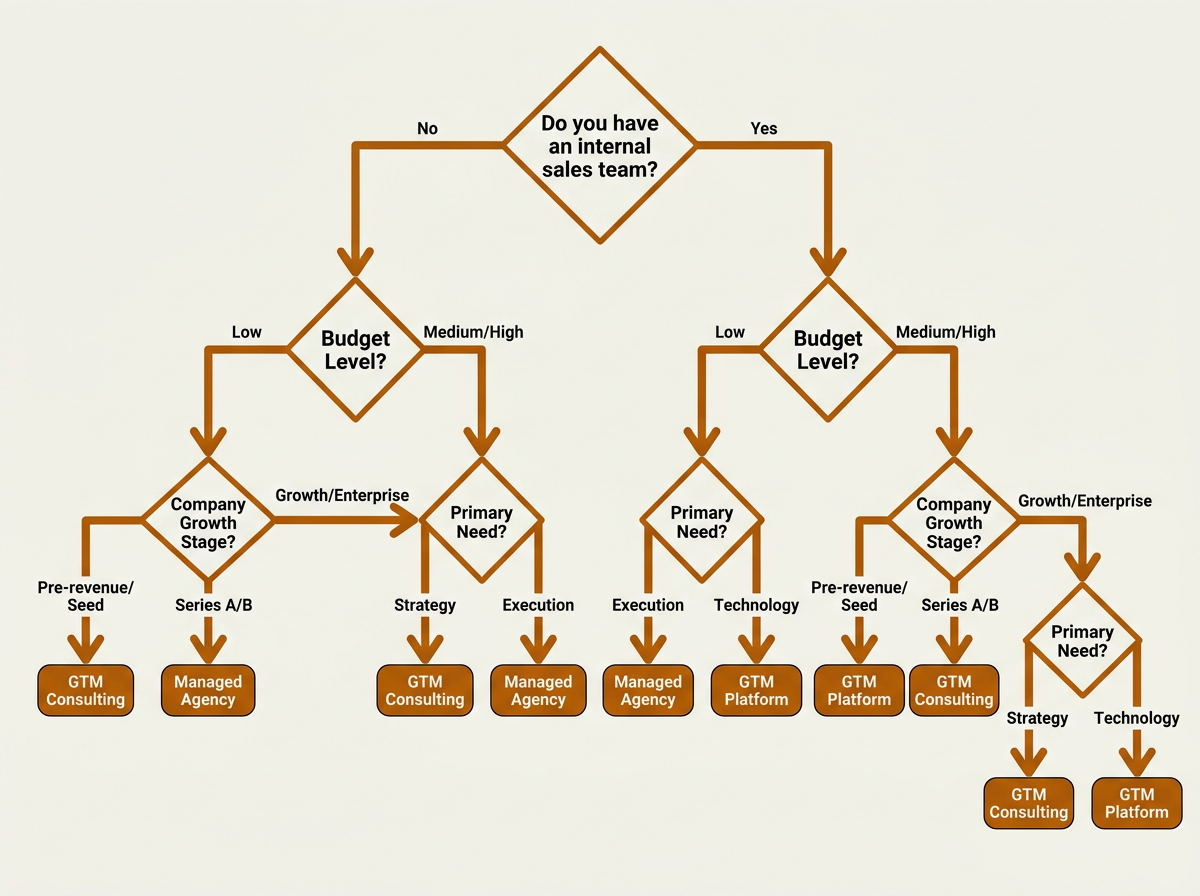
Map your growth stage and budget to the right GTM partner category using this decision framework.
Choosing Between the Best GTM Agencies: A Practical Verdict
No single partner covers the entire GTM surface area. The teams getting the most done in 2026 usually pair a technology layer for data and automation with either in-house execution capacity or a managed service. Here is how the 12 options shake out by common use case:
- Best for scalable prospecting and enrichment infrastructure: Bitscale. It acts as the connective tissue between data sources, your CRM, and outbound tools.
- Best all-in-one platform for SMBs: Apollo.io. The free tier plus built-in sequencing is a fast path to launching a first outbound campaign.
- Best managed outbound for mid-market: CIENCE or Belkins, depending on whether you want dedicated SDR teams (CIENCE) or appointment-based pricing (Belkins).
- Best for European expansion: Cognism. Phone-verified EMEA data with GDPR compliance baked in.
- Best for high-volume cold email: Instantly.ai. It works best when paired with a data platform to complete the outbound stack.
- Best for SaaS companies without a marketing leader: Kalungi. Fractional CMO plus an execution team under one contract.
- Best for complex, long-cycle B2B demand generation: Ironpaper. ABM and inbound built for consultative sales.
- Best for early-stage positioning and ICP work: SaaSHero. Short, founder-friendly engagements.
- Best AI-native outbound execution: ColdIQ. Lower cost than traditional SDR agencies with AI-driven personalization.
- Best for custom data workflows: Clay. A strong fit if you have an ops owner who can build and maintain enrichment sequences.
The strongest programs treat the GTM stack as modular, not monolithic. A b2b demand generation motion that combines intent signals, enriched data, and automated workflows tends to beat siloed efforts where marketing, SDRs, and ops all run in parallel. No matter which direction you go (managed agency, platform, or consulting), the data and automation layer sets the ceiling on speed and targeting accuracy. If you want a broader tool-by-tool comparison, the best B2B lead generation tools list is a useful way to benchmark features.
Frequently Asked Questions
What is a GTM agency, and how is it different from a marketing agency?
A GTM agency is built around the full revenue motion: outbound prospecting, sales development, CRM management, data enrichment, and pipeline generation. A traditional marketing agency is usually scoped to brand and demand programs like content and paid media. The difference is accountability: GTM partners are expected to influence pipeline and revenue metrics, not just traffic and impressions.
How much do GTM agencies typically cost in 2026?
GTM agency and platform pricing varies significantly depending on scope, team size, services provided, technology requirements, and level of execution support. Some providers offer project-based pricing, while others use monthly retainers or software subscriptions. Always verify current pricing directly with the vendor.
Can a platform like Bitscale replace a GTM agency entirely?
If you already have internal sales capacity, often yes. Bitscale covers the operational backbone of outbound: prospecting automation, enrichment, buying signal tracking, and CRM sync. If you do not have reps to run outreach and handle replies, you will still want to pair Bitscale with a managed SDR service or hire your first AE/SDR.
What should I look for when evaluating a sales development agency?
Look for reporting that is transparent on both activity and outcomes, not just a meetings-booked number. Ask how they source data, how often they iterate messaging, what ramp time looks like, and how they handle CRM integration and handoffs. The best sales development agencies can also speak clearly about your ICP and vertical, because that is where conversion rates are won or lost.
How do I know if I need a GTM agency or a RevOps consultancy?
If the problem is execution (running outbound campaigns and generating pipeline), a GTM agency or outbound platform is the better fit. If the problem is structure (CRM architecture, reporting accuracy, lead routing, and cross-functional process design), a RevOps consultancy is designed for that work. Many teams end up needing both, and it usually goes better when the RevOps foundation is in place before you scale execution.