Salesloft Alternatives in 2026: Better Sales Engagement and Data Workflow Solutions
Salesloft alternatives for 2026, compared by workflow coverage: list building, enrichment, buying signals, engagement, and CRM sync across top platforms.
Salesloft earned its spot as a default choice in sales engagement. It runs cadences, captures conversations, and keeps deal work in one place. But heading into 2026, the decision is less about picking the "best" sequencer and more about whether your engagement layer is being fed trustworthy enrichment, prospect intelligence, and buying signals, or whether reps are working off shaky records and stale lists.
This breakdown covers where Salesloft fits, where it tends to stop short once you look at the full workflow, and which salesloft alternatives close the gaps that pure engagement tools leave behind. If you are running a small outbound pod or coordinating RevOps across teams, the goal is the same: choose tools that actually connect, not just tools that look good on a feature grid.
Where Sales Engagement Platforms Sit in the GTM Stack
Sales engagement platforms live in the execution layer: sequences, calls, calendar steps, and activity logging. Salesloft is strong here. In its own platform overview, it positions itself as a revenue orchestration platform that brings together sales engagement (Cadence), conversation intelligence, deal management, and forecasting (Salesloft, 2026). Tight Salesforce integration is another advantage, with bidirectional syncing designed to keep both systems aligned (La Growth Machine, 2026).
The catch is that engagement is an output. Before anyone starts a cadence, someone has to build the list, enrich it with verified emails and phone numbers, layer in intent, and land a clean record in the CRM. When those upstream steps are manual, inconsistent, or split across too many tools, even a polished outbound sales platform will look "fine" in demos and still underdeliver in production. That workflow gap is what gets missed when teams shop for engagement in isolation.
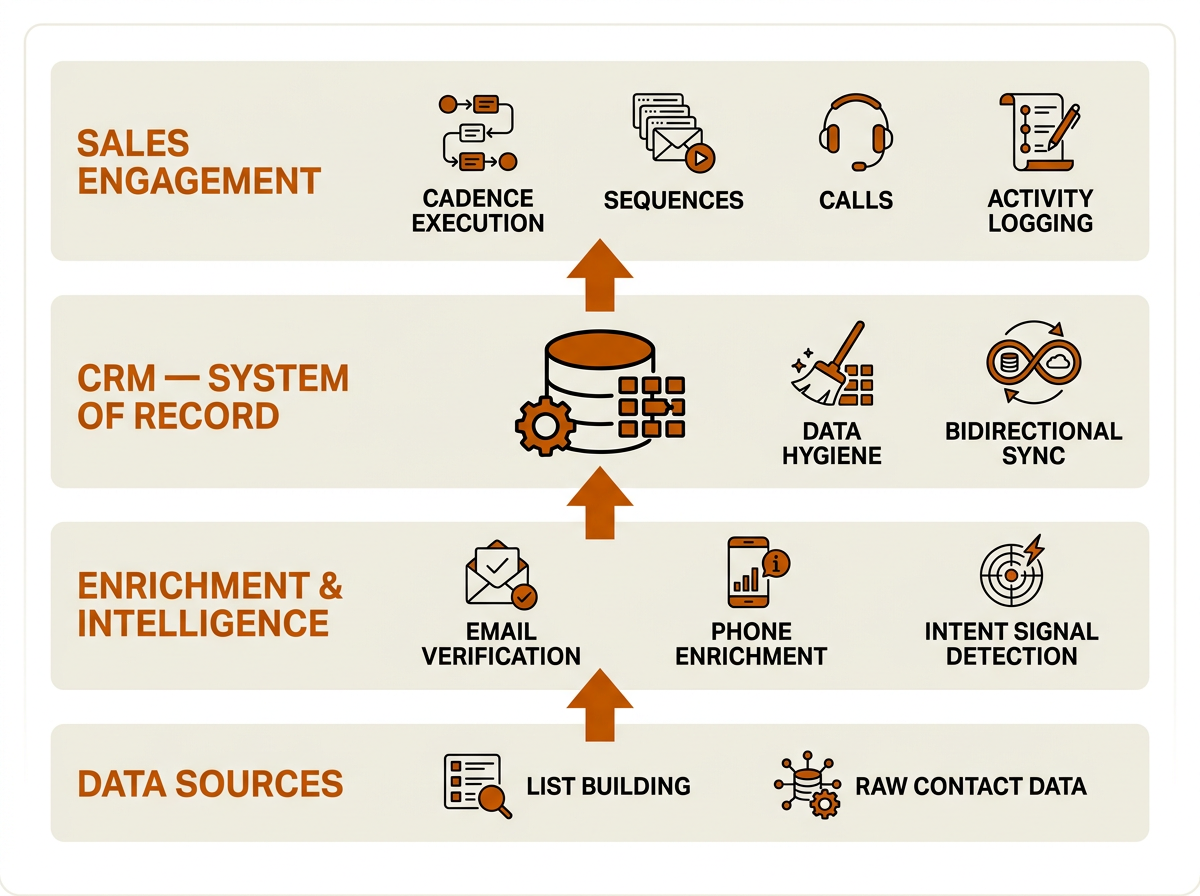
Engagement sits at the top — but clean data, enrichment, and CRM layers beneath it determine whether execution actually works.
What Salesloft Does Well (and Where It Stops)
Salesloft sells two primary packages, Advanced and Elite, with feature access tied to the tier (Salesloft, 2025). Pricing is not publicly published and is typically provided through custom quotes. Costs vary depending on team size, contract terms, implementation requirements, and selected features.
Where Salesloft shines: multi-channel cadences, call recording and coaching, pipeline visibility, and CRM sync. Where it draws a line: it does not generate your prospect lists, enrich records with firmographic or technographic context, pull in third-party buying signals, or handle AI-driven account research. Those inputs have to come from somewhere else, which usually means adding tools (or choosing a platform that bundles more of the upstream work) so Salesloft has clean, usable data to operate on.
Comparing Salesloft Alternatives by Workflow Coverage
Instead of scoring vendors on a checklist, the table below maps each option to the workflow stages that actually determine GTM throughput. That is the lens RevOps should use: evaluate coverage across the workflow, not just whether a tool has a feature with the right label.
| Platform | List Building | Data Enrichment | Engagement/Cadences | Buying Signals | CRM Sync |
|---|---|---|---|---|---|
| Salesloft | No | Limited | Yes (core) | Limited | Strong (Salesforce) |
| Bitscale | Yes | Yes | Through integrations | Yes | Yes |
| Apollo.io | Yes | Yes | Yes | Partial | Yes |
| Clay | Yes | Yes (multi-source) | Through integrations | Partial | Through integrations |
| Cognism | Yes | Yes (EMEA strength) | Limited | Yes | Yes |
| Instantly.ai | Limited | Limited | Yes (email focus) | No | Limited |
| Lusha | Yes | Yes | No | Partial | Yes |
| Workflow coverage comparison across major salesloft alternatives (2026) |
Bitscale: Workflow-First Intelligence and Enrichment
Bitscale comes at the problem from the other side. Rather than leading with cadences, it starts with the inputs: B2B lead and account lists, contact and company enrichment, work email and phone lookup, and AI-driven prospect research. It also ships with ready-made sales workflows that connect enrichment and research to outbound integrations and CRM sync, so what reaches your engagement tool is verified and comes with enough context for reps to act quickly.
Buying signals and intent are part of the platform, so outreach is not limited to static lists that age the moment you export them. Reps can prioritize accounts that are showing active purchase behavior. If you already pay for a cadence tool (Salesloft, Outreach, or something else), Bitscale's sales intelligence solution is built to cover the upstream gap. If you are assembling a stack from scratch, it can consolidate multiple point solutions. For more context on the broader category, this breakdown compares data enrichment and workflow tools side by side.
Other Alternatives Worth Evaluating
Apollo.io
Apollo.io is one of the closest options to an all-in-one outbound platform. You get a large B2B database, email sequencing, a dialer, and basic intent signals, all under transparent pricing tiers. The compromise is depth: enrichment is solid but largely single-source, and the engagement side is more utilitarian than what you get from Salesloft in conversation intelligence and deal management. It tends to fit teams under 50 reps that value simplicity over a stitched-together stack.
Clay
Clay is a data orchestration layer, not a sequencer. It plugs into dozens of enrichment providers and lets you waterfall across sources to increase match rates and coverage. When your pain is data quality, not cadence execution, Clay is hard to beat. It does not send emails or run sequences on its own, so you will still pair it with an engagement tool. Clay's pricing is credit-based, which lines up well for teams pushing high volumes of records through more complex enrichment workflows.
Cognism
Cognism stands out most on European data compliance. Its GDPR-compliant database and phone-verified mobile numbers make it a common pick for teams selling into EMEA. It also includes intent data via a Bombora partnership. Engagement is not the point here; Cognism is an intelligence and data provider, not sales cadence software. Cognism's pricing lays out the tier structure.
Instantly.ai
Instantly.ai is focused almost entirely on cold email volume. Inbox rotation, warmup, and deliverability tooling are where it earns its keep. The trade is obvious: there is little support for enrichment, list building, or deep CRM workflows. If your outbound motion is email-only (no calls, no LinkedIn), Instantly's pricing is compelling. Most teams pair it with an enrichment layer like Bitscale or Clay to cover what Instantly does not.
Lusha
Lusha began as a browser extension for contact lookup and has grown into a broader prospecting product. Its advantage is speed: reps can pull verified emails and direct dials without leaving LinkedIn. It does not run cadences, which makes it more of an add-on to Salesloft than a replacement. For a wider scan of the category, this roundup of top sales intelligence tools is a useful reference point.
Building Sales Workflows That Actually Connect
Most stacks get assembled one purchase at a time, and then everyone acts surprised when data snaps between systems. The better sequence is to map the workflow first, then buy software to support it. Start with how a target account enters your world and follow the path through enrichment, scoring, routing, engagement, and CRM logging.
A practical workflow audit covers these checkpoints:
- Source: Where do new accounts originate? (Inbound forms, purchased lists, intent signals, product-led signups)
- Enrich: What data gets appended before a rep sees the record? (Firmographics, technographics, verified contact info)
- Route: How does the record reach the right rep or sequence? (Territory rules, round-robin, signal-based prioritization)
- Engage: Which channels and cadences does the rep execute? (Email, phone, LinkedIn, direct mail)
- Sync: Does activity data flow back to the CRM without manual entry?
Any step that depends on a CSV export or a copy-paste between tabs is usually the point of failure. Platforms like Bitscale try to eliminate those handoffs with ready-made workflows that chain enrichment, research, outbound integrations, and CRM updates. If you are running an account-based motion, this guide to ABM workflow automation walks through the setup. Before you buy anything in this category, it also helps to have a baseline on The Complete B2B Guide to Data Enrichment.
Choosing the Right Stack for Your Team Size and Motion
A five-person SDR team running pure cold outbound is solving a different problem than a 50-person org balancing inbound, outbound, and expansion. Smaller teams usually win with consolidated platforms (Apollo.io, Bitscale) because fewer integrations means fewer ways to break. Larger orgs with dedicated RevOps capacity can justify best-of-breed choices, Clay for enrichment, Salesloft for engagement, Cognism for EMEA data, and connect them through APIs or middleware.
Cost deserves the same end-to-end treatment. Salesloft's custom pricing means the actual investment depends on your team size, feature requirements, and contract structure. When you layer in separate tools for enrichment, intent data, and list building, total stack spend can grow significantly beyond the engagement platform alone. For many mid-market teams, a workflow-first platform that bundles intelligence and enrichment with outbound integrations pencils out better than assembling and maintaining several point solutions. If you want more coverage context on the data side, this comparison of alternatives for better sales data is worth reading alongside this one.
Key Takeaways
Salesloft is still a strong engagement and revenue orchestration product, but engagement without clean upstream data turns into busywork. The best salesloft alternatives in 2026 are not just cheaper sequence senders; they are options that address the enrichment and intelligence work engagement tools assume is already done. Bitscale, Clay, Apollo.io, Cognism, Instantly.ai, and Lusha each cover different parts of the workflow. The job on the RevOps side is to map the workflow, find the real gaps, and close them without introducing new manual handoffs. For a broader view, this breakdown of RevOps tools by function pairs well with the evaluation framework here.
Frequently Asked Questions
Is Salesloft only for outbound sales teams?
No. Salesloft can support inbound follow-up, deal management, conversation intelligence, and forecasting. In practice, its clearest strength is still outbound cadence execution and multi-channel engagement.
Can Bitscale replace Salesloft entirely?
Bitscale is built around enrichment, prospect intelligence, and workflow automation, not cadence execution. It typically complements engagement tools like Salesloft, or it can be paired with a lightweight sender such as Instantly.ai for email. Teams that want intelligence plus engagement in one motion often run Bitscale upstream and keep sending separate.
What is the biggest limitation of using Salesloft without an enrichment tool?
Reps end up working from incomplete or outdated contact records. Without enrichment, bounce rates rise, connect rates fall, and pipeline quality takes a hit even when the cadence copy and timing are strong.
How does revenue operations benefit from workflow-first platforms?
RevOps needs clean, automated data flow between systems, not a chain of manual fixes. Workflow-first platforms like Bitscale and Clay automate the enrichment-to-CRM pipeline, reduce data decay, and pull ops time away from spreadsheet maintenance and back toward system design.
Which Salesloft alternative is best for teams selling into Europe?
Cognism is a strong fit for EMEA-focused teams because of its GDPR-compliant database and phone-verified mobile numbers. Bitscale also supports global coverage with verified contact data, which can work well for teams selling across multiple regions.