Agentic Sales: How AI Agents Are Transforming B2B Revenue Teams in 2026
Agentic sales puts AI agents to work on research, qualification, enrichment, CRM updates, and outbound prep so reps spend time on judgment and deals.
Agentic sales has moved past concept decks and venture-slide theater. It's becoming the default operating model for the fastest-growing B2B revenue teams. Analyst firms including Gartner expect task-specific AI agents to become a standard component of enterprise applications within the next few years, up from a small fraction of deployments in 2025. In sales, that shift looks like AI graduating from a helpful sidebar inside the CRM to an autonomous actor that can move work forward inside your pipeline.
This piece lays out what agentic AI in sales looks like when it's actually running: how it departs from the automation playbooks you already maintain, and where teams are seeing real lift across SDR and AE motions. It gets specific about the workflows (prospect research, lead qualification, CRM updates, data enrichment, buying signals) and why your data layer decides whether agents drive outcomes or just manufacture activity. If you still need the baseline on what B2B sales is, start there. If not, the sections below map the territory.
What Is Agentic Sales?
Agentic sales refers to the use of AI agents that can observe data, make decisions, and execute multi-step sales workflows with limited human intervention. These agents support activities such as prospect research, lead qualification, CRM management, and outbound execution.
Sections covered:
- What agentic sales means and why the definition matters
- Traditional sales automation vs. agentic workflows (comparison table)
- SDR and AE use cases with practical workflow examples
- The data layer: why clean CRM data and enrichment make or break agents
- Advanced considerations: buying signals, orchestration, and human oversight
- FAQ
What Agentic Sales Actually Means
A lot of teams hear "AI in sales" and picture chatbots, email copy generators, or another flavor of predictive lead scoring. Agentic sales is a different shape of system. It can observe its environment (your CRM, enrichment feeds, intent data), decide what to do next, and then take action across multiple steps without a rep babysitting every click. Boston Consulting Group frames this as three tiers: augmented (AI supports a rep's decisions), assisted (AI completes discrete tasks end to end), and autonomous (AI plans and executes multi-step workflows) with human approval at defined checkpoints.
The difference that matters is autonomy paired with context. A sales agent is not just a dressed-up Zapier trigger that fires when a form comes in. It can check ICP fit, pull firmographic and technographic attributes, look for recent buying signals, draft a tailored outreach sequence, and write the result back to the CRM before a rep ever touches the record. Gartner expects the share of daily work decisions made autonomously by agentic AI to grow significantly over the next several years, starting from a near-zero baseline in 2024. Revenue teams are early here because the work is high-volume, data-heavy, and repetitive enough that autonomous sales workflows can take real load off humans.
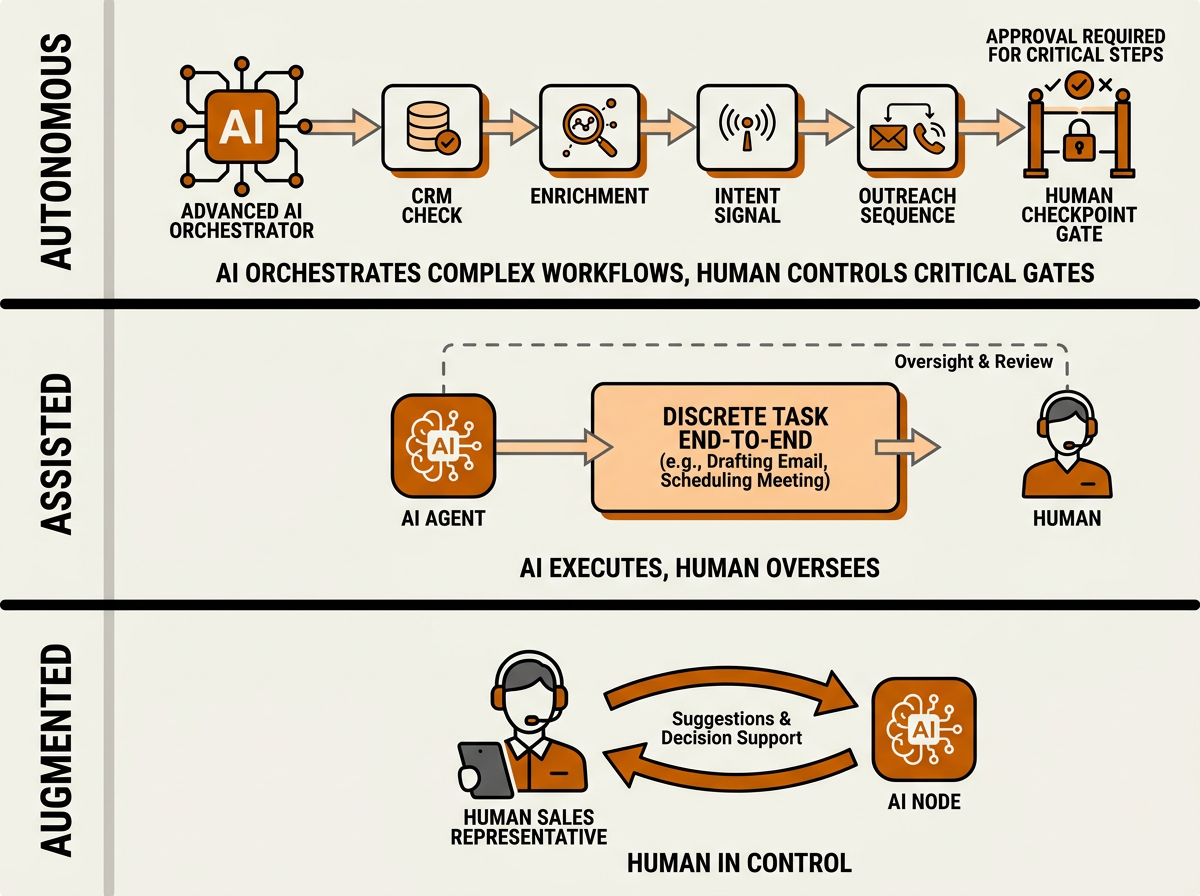
From augmented to autonomous: the three tiers of agentic sales, adapted from BCG's 2025 framework.
Traditional Sales Automation vs. Agentic Sales
The jump from legacy AI sales automation to agentic workflows is not a nicer UI on the same idea. It's a different architecture. Traditional automation runs on fixed rules: if lead score > 80, send email A. Agentic systems weigh context, pick actions dynamically, and adjust based on what happens next. The comparison below makes the split clear.
| Dimension | Traditional Sales Automation | Agentic Sales |
|---|---|---|
| Trigger model | Rule-based (if/then workflows) | Goal-based (agent decides steps to reach an outcome) |
| Adaptability | Static sequences; changes require manual editing | Dynamic; agent adjusts approach based on new data |
| Data handling | Pulls from a single source per step | Cross-references multiple enrichment and intent sources in real time |
| CRM updates | Field mapping on form submission or manual entry | Continuous CRM automation: agent writes, corrects, and deduplicates records |
| Personalization | Merge tags (first name, company) | Contextual messaging based on prospect research, news, and technographics |
| Human role | Builds and maintains every workflow | Sets goals and guardrails; reviews agent output at checkpoints |
| Scalability | Linear: more sequences = more maintenance | Compounding: agent learns patterns across the pipeline |
| Qualification | Lead scoring via static point system | AI lead qualification using multi-signal analysis and ICP fit |
| Traditional automation executes instructions. Agentic systems pursue objectives. |
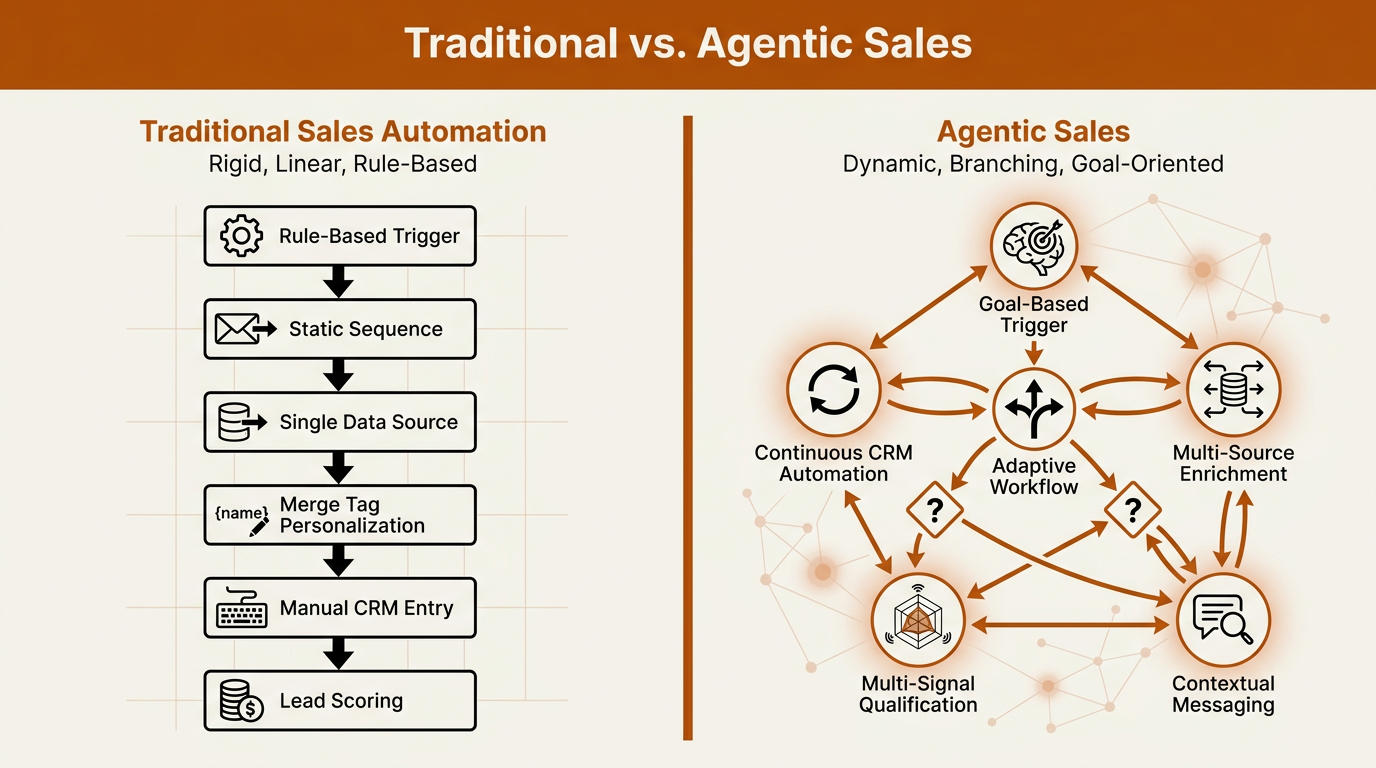
Traditional automation follows rigid if/then rules — agentic sales systems adapt dynamically toward goals.
SDR and AE Use Cases: Where Agents Deliver Real Impact
Most of the noise around sales AI agents fixates on outbound email generation. That's the shallow end of the pool. The real leverage shows up in the work nobody brags about but everyone burns time on: research, data entry, qualification, and pipeline hygiene. That stuff can swallow the majority of a rep's day.
SDR Workflows
Early adopters consistently report that AI-assisted sales processes generate meaningfully more qualified leads while reducing the time reps spend on manual research and outreach prep. For SDRs, the upside comes from three concrete shifts. One: AI prospect research replaces the manual churn of LinkedIn tabs and database spelunking. An agent can pull firmographics, spot a funding round or leadership change, and assemble a prospect brief before the SDR opens their inbox. Two: qualification moves from gut feel to multi-signal scoring. The agent evaluates ICP fit, technographic match, and intent signals together, then routes only qualified leads into the SDR queue. Three: CRM hygiene becomes a background process. Interactions, enrichment updates, and status changes get logged automatically, shrinking the "update Salesforce" tax that quietly drains SDR throughput.
AE Workflows
AEs get value in a different place: deal intelligence and pipeline control. Ahead of a discovery call, an agent can assemble a briefing doc that includes the prospect's tech stack, relevant earnings call mentions, competitive displacement angles, and the right case studies from your own library. As the cycle progresses, the agent watches for buying signals (new job postings in the right org, expansion announcements, competitor contract expirations) and pushes them as real-time alerts. Early adopters of agentic qualification workflows report substantially faster time-to-qualification and notable improvements in conversion rates, according to McKinsey's analysis of AI-driven sales organizations. That's not a tweak. It's an advantage that compounds across the quarter.
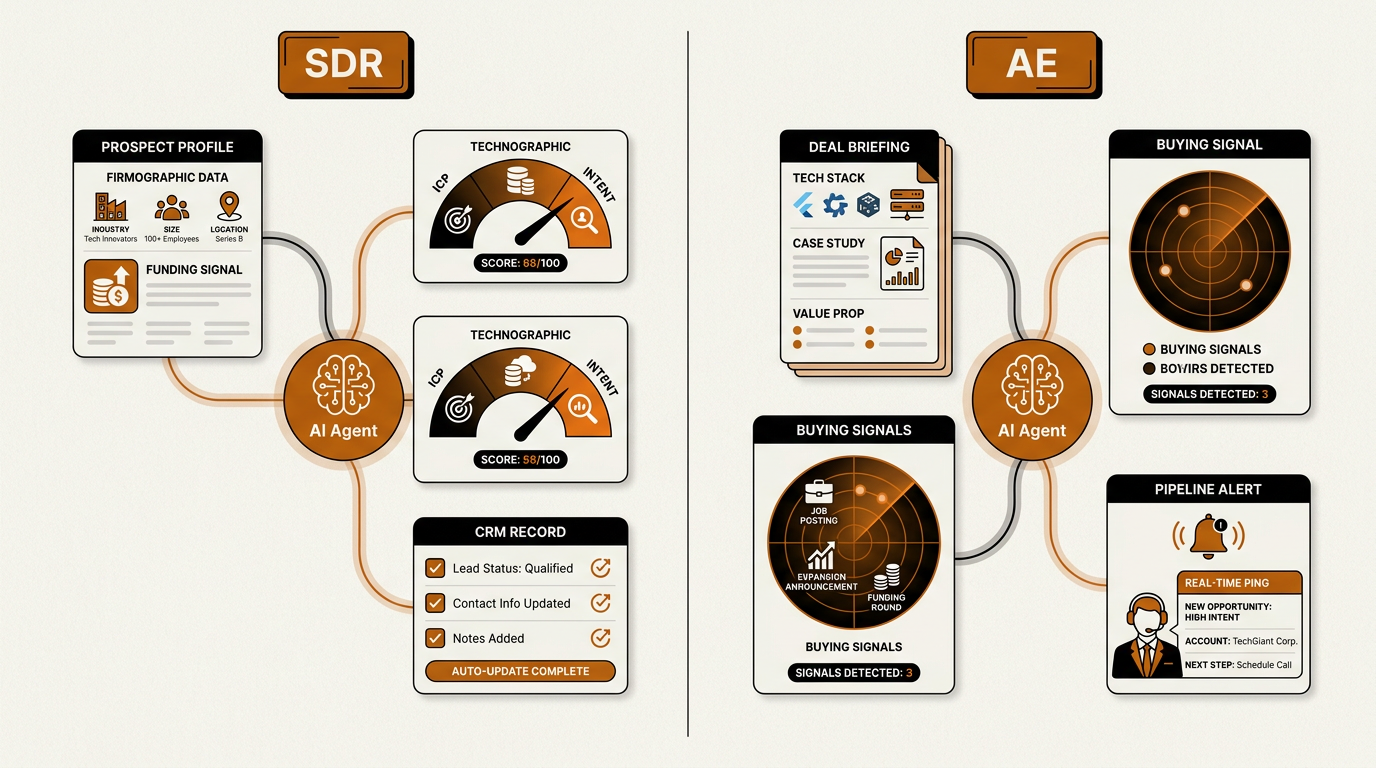
Agentic sales workflows differ by role — SDRs gain research and qualification automation, AEs gain deal intelligence.
Practical Workflow Example: From Signal to Sequence
Theory is easy to nod along to. A real workflow is easier to evaluate. Below is an end-to-end autonomous sales flow a mid-market B2B team could run today using a platform like Bitscale.
Step 1: Signal detection. The agent watches a target account list for buying signals: a VP of Engineering posts about evaluating new vendors on LinkedIn, the company's job board lists three new DevOps roles, and a G2 review comparison page shows them researching your category. Step 2: Enrichment and qualification. The agent pulls the company's firmographics (employee count, revenue range, industry vertical) and technographics (current stack, contract renewal timing) from enrichment providers. It scores the account against your ICP criteria and flags it as "high fit, high intent." Step 3: Contact discovery. Work emails and direct dials for the VP of Engineering and two adjacent stakeholders are resolved and verified. Step 4: Personalized outreach draft. Using the research brief, the agent drafts a three-touch email sequence referencing the specific job postings and the prospect's stated evaluation criteria. Step 5: CRM sync and routing. The account, contacts, enrichment data, and outreach sequence are written to your CRM. The SDR receives a notification with the full context and approves or edits the sequence before it sends.
That chain used to cost an SDR 45 to 90 minutes per account. Here, it finishes in under two minutes. The rep's job shifts from assembling inputs to applying judgment: sanity-checking the agent's work, adding human nuance, and making the final call on what goes out. If you're building something similar, Bitscale's sales workflow automation guide gets into the implementation details.
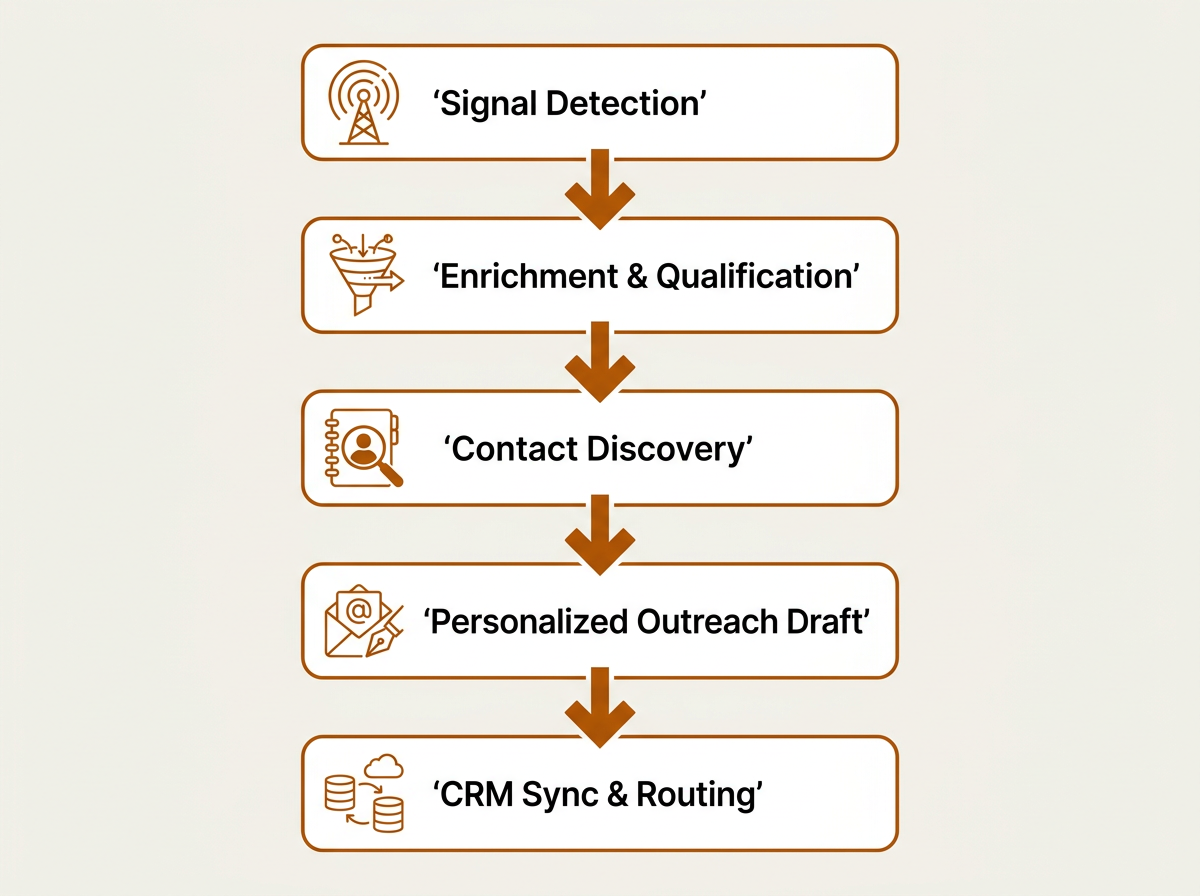
Five autonomous steps that compress 90 minutes of SDR research into under two minutes.
Why Clean CRM Data and Enrichment Are Non-Negotiable
Most agentic AI sales content politely steps around the uncomfortable part: agents only perform as well as the data they ingest. If your CRM is packed with duplicates, stale titles, and missing firmographic fields, the agent will still make decisions. They'll just be confident, well-formatted decisions built on bad inputs. That's worse than doing nothing, because the mistakes arrive faster and in higher volume.
If you want revenue automation that holds up, you need a clean, continuously enriched data layer. In practice, that breaks down into three requirements. First: enrichment has to be ongoing, not a one-and-done import. Titles change, companies get acquired, stacks evolve. Platforms like Bitscale handle this with continuous enrichment that refreshes records across multiple sources and keeps CRM fields current. Second: deduplication and normalization have to happen before agents act. An agent that emails three variants of the same person at the same company doesn't look "automated"; it looks broken. Third: sales intelligence feeds (intent data, technographic signals, news triggers) have to map cleanly to the right account and contact records. Unmatched signals are just noise. Matched signals turn into pipeline.
That is why sales intelligence solutions and enrichment infrastructure aren't optional extras for agentic systems. They're the foundation. McKinsey's research on AI-driven sales organizations consistently finds that teams with accurate, well-maintained data see meaningfully higher lead volumes and lower costs in lead management, while teams with poor data quality struggle to realize any benefit from automation.
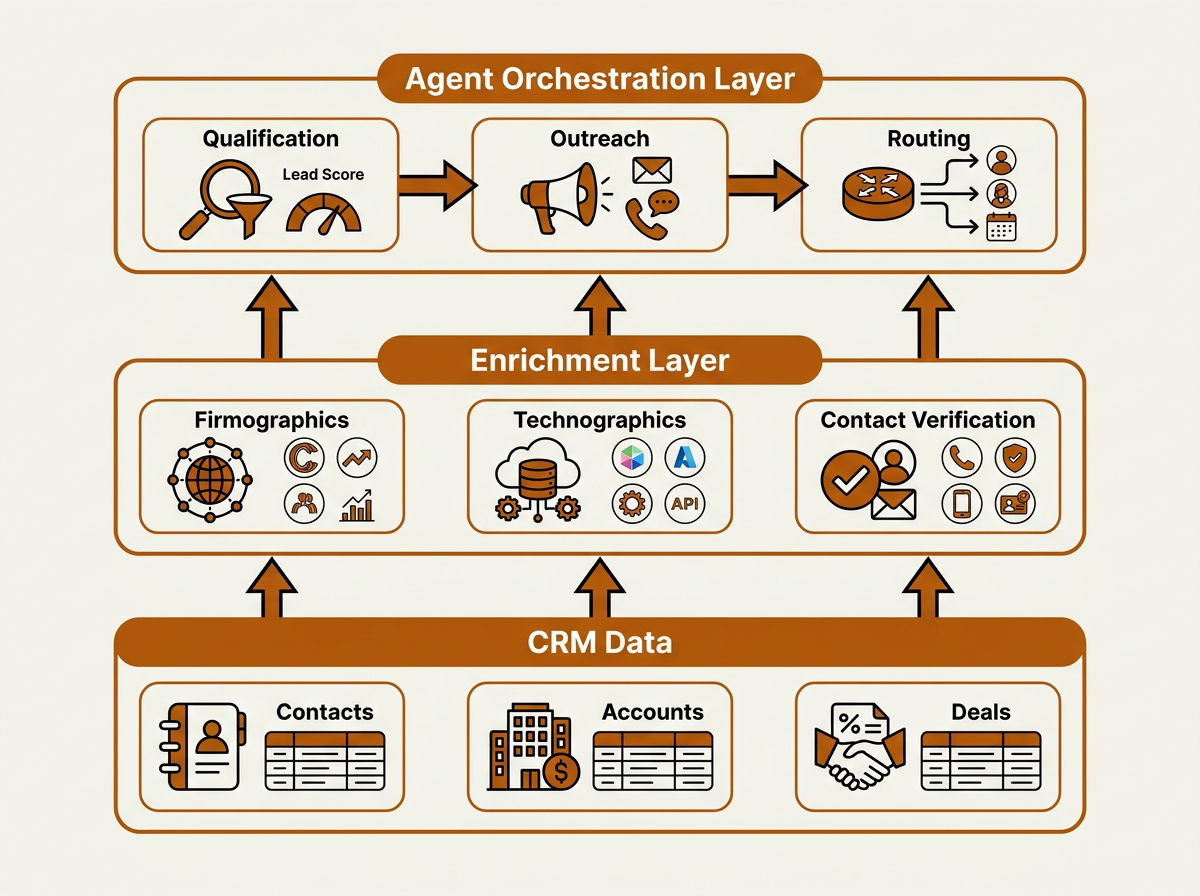
Agents operate on top of enrichment — without clean data, the orchestration layer fails.
Advanced Considerations: Buying Signals, Orchestration, and Human Oversight
Most agents in 2026 run in what Tomba's practical guide calls a "human-approves-the-plan" model. The agent proposes a multi-step plan, the rep reviews it, and then the agent executes. That's not a compromise. It's the operating point that pairs speed with accountability, and it's where strong revenue teams are finding leverage.
Buying signals deserve special attention. The gap between a strong agentic system and a mediocre one usually comes down to signal coverage and signal quality. Job postings, funding announcements, and G2 category research are table stakes. More advanced setups (Bitscale includes intent and buying signal tracking in its platform) also watch technographic changes, leadership transitions, earnings call language, and competitive displacement indicators. When those signals are enriched and matched to CRM records, agents can prioritize outreach based on timing, not just fit.
Orchestration across tools matters too. An agent trapped inside the CRM can only do so much. The value shows up when it can move across your enrichment layer, outbound sequencer, CRM, and your AI Agent infrastructure without manual handoffs. Bitscale, for example, ties enrichment, prospect intelligence, and CRM synchronization into unified workflows that agents can traverse end to end. IBM's view of agentic AI lands in the same place: the tech works best as a proactive partner for sales teams, handling lead prioritization, enablement, and CRM management so sellers can stay focused on relationship-building and negotiation.
What most people get wrong about autonomous agents: they read "autonomous" as "unsupervised." In practice, high-performing teams do the opposite: they set tight guardrails (approved messaging frameworks, ICP criteria, escalation rules) and then let agents operate freely inside that box. The agent brings volume and speed. The human brings judgment and strategy. Get that split right and automation compounds; get it wrong and you inherit a new category of cleanup work.
Choosing the Right Platform for Agentic Workflows
The market for top AI software for revenue teams is crowded. Clay, Apollo.io, Lusha, Cognism, and Instantly.ai each cover parts of the stack, with different strengths across enrichment, outbound, or contact data. When you're evaluating platforms for agentic sales, the deciding questions usually aren't about a single feature. They're about integration depth and data quality.
Key evaluation criteria for agentic sales platforms:
- Enrichment breadth: Does the platform pull from multiple data sources, or does it rely on a single database? Multi-source enrichment reduces gaps and improves match rates.
- Workflow flexibility: Can you build multi-step, conditional workflows that mirror your actual sales process, or are you limited to linear sequences?
- CRM sync depth: Does the platform write back to your CRM in real time, including custom fields, activity logs, and deal stage updates?
- Signal coverage: Does it surface buying signals beyond basic intent data (technographic shifts, hiring patterns, competitive research activity)?
- Human-in-the-loop design: Does the platform support approval checkpoints, or does it push fully autonomous execution without review?
Bitscale tends to score well on those criteria because it was designed around the enrichment-to-execution pipeline, not a single point solution. Its mix of B2B lead and account lists, contact and company enrichment, work email and phone lookup, ready-made sales workflows, CRM sync, and intent signals gives agents the data substrate they need to function. The right pick still depends on your current stack, team size, and how much customization your workflows require.
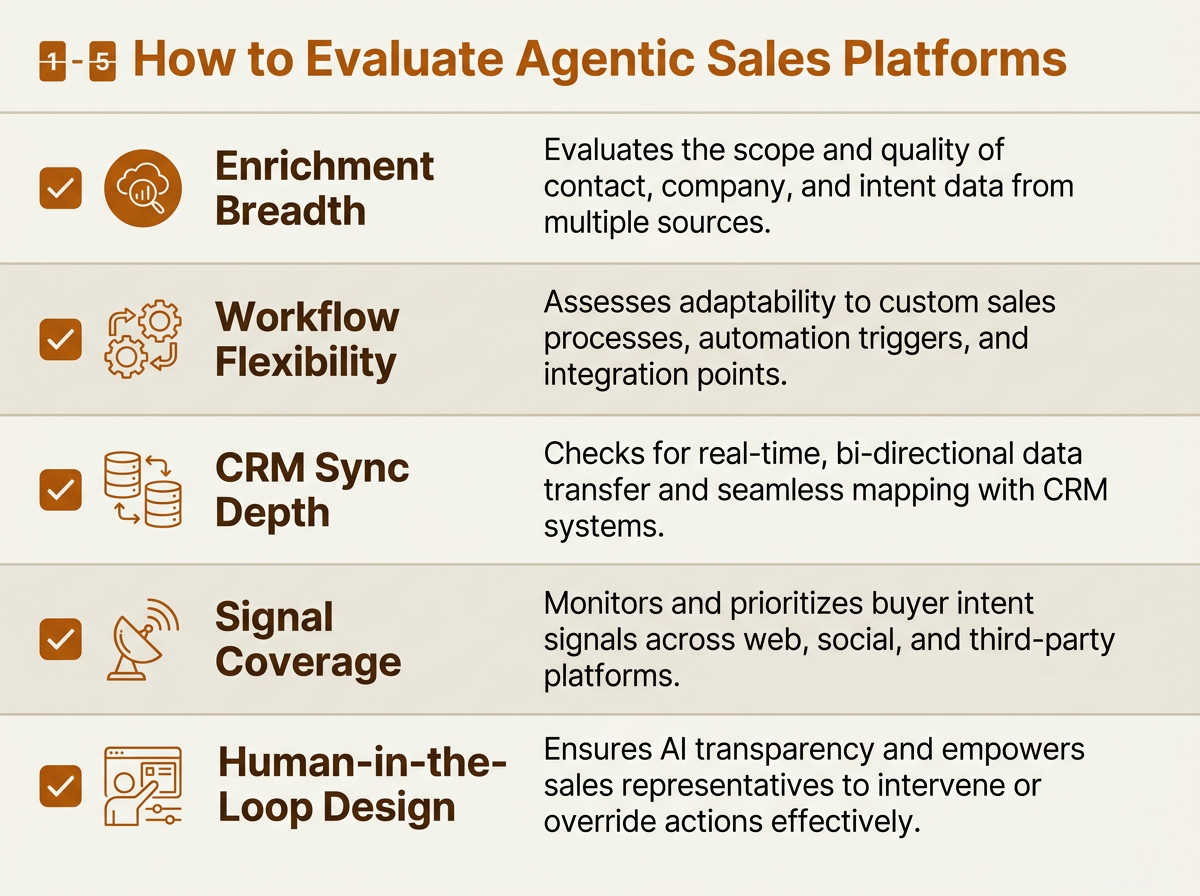
Five criteria that separate effective agentic platforms from feature-limited tools in B2B sales.
Key Takeaways
Agentic sales isn't a buzzword so much as a measurable change in how B2B revenue teams run the day-to-day. Agents can take on prospect research, qualification, enrichment, CRM updates, and outbound prep with a speed and consistency manual processes can't touch. The catch is straightforward: the upside only materializes when your data stays clean, enriched, and continuously refreshed.
- Agentic sales means AI agents that perceive, reason, and act across multi-step sales workflows, not just trigger-based automation.
- SDRs gain the most from automated prospect research, multi-signal lead qualification, and continuous CRM hygiene.
- AEs benefit from deal intelligence, buying signal monitoring, and pre-call briefing automation.
- Clean, enriched CRM data is the prerequisite for every agentic workflow. Without it, agents amplify errors.
- Human oversight remains essential. The best model is agent execution within human-defined guardrails.
- Platforms like Bitscale that combine enrichment, prospect intelligence, workflow automation, and CRM synchronization provide the infrastructure agentic systems require.
Frequently Asked Questions
What is the difference between agentic sales and traditional sales automation?
Traditional sales automation runs on pre-defined rules (if X, then Y). Agentic sales uses AI agents that interpret context, choose actions dynamically, and execute multi-step workflows toward an outcome. Instead of following a fixed sequence, the agent adjusts as new data comes in.
Do AI sales agents replace SDRs and AEs?
No. In 2026, the dominant pattern is human-in-the-loop: agents handle research, qualification, data entry, and draft outreach, while reps review the work, apply judgment, and manage relationships. The job shifts away from data assembly and toward decision-making and execution quality.
Why is CRM data quality so important for agentic AI sales?
Agents make calls based on what's in your CRM. Duplicate records, outdated titles, or missing firmographic fields lead to bad qualification, misrouted leads, and irrelevant outreach. Clean, enriched data is what determines whether agents create value or create cleanup work.
What types of buying signals do agentic systems use?
Advanced agentic platforms track job postings, funding announcements, technographic changes, leadership transitions, G2 category research, earnings call language, and competitive displacement indicators. When those signals are matched to CRM records, they enable outreach that's driven by timing, not guesswork.
How does Bitscale support agentic sales workflows?
Bitscale provides the data and workflow infrastructure agentic systems run on: B2B lead and account lists, multi-source contact and company enrichment, work email and phone lookup, intent and buying signals, ready-made sales workflow automation, and real-time CRM synchronization. Together, those pieces give agents the enriched, accurate data they need to operate effectively.