RevOps architect: role and responsibilities, skills, salary and a 30/60/90-day plan
What a RevOps architect does, how the role differs from a RevOps manager, admin or GTM engineer, plus skills, a 30/60/90-day plan and sourced 2026 salaries.
The short answer: A RevOps architect designs the systems a revenue team runs on: the CRM data model, the lead-to-cash process, the integrations between tools, and the rules that decide who owns each piece of data. A RevOps manager runs the operation day to day; the architect decides how it is built, from routing and reporting to enrichment and data quality.
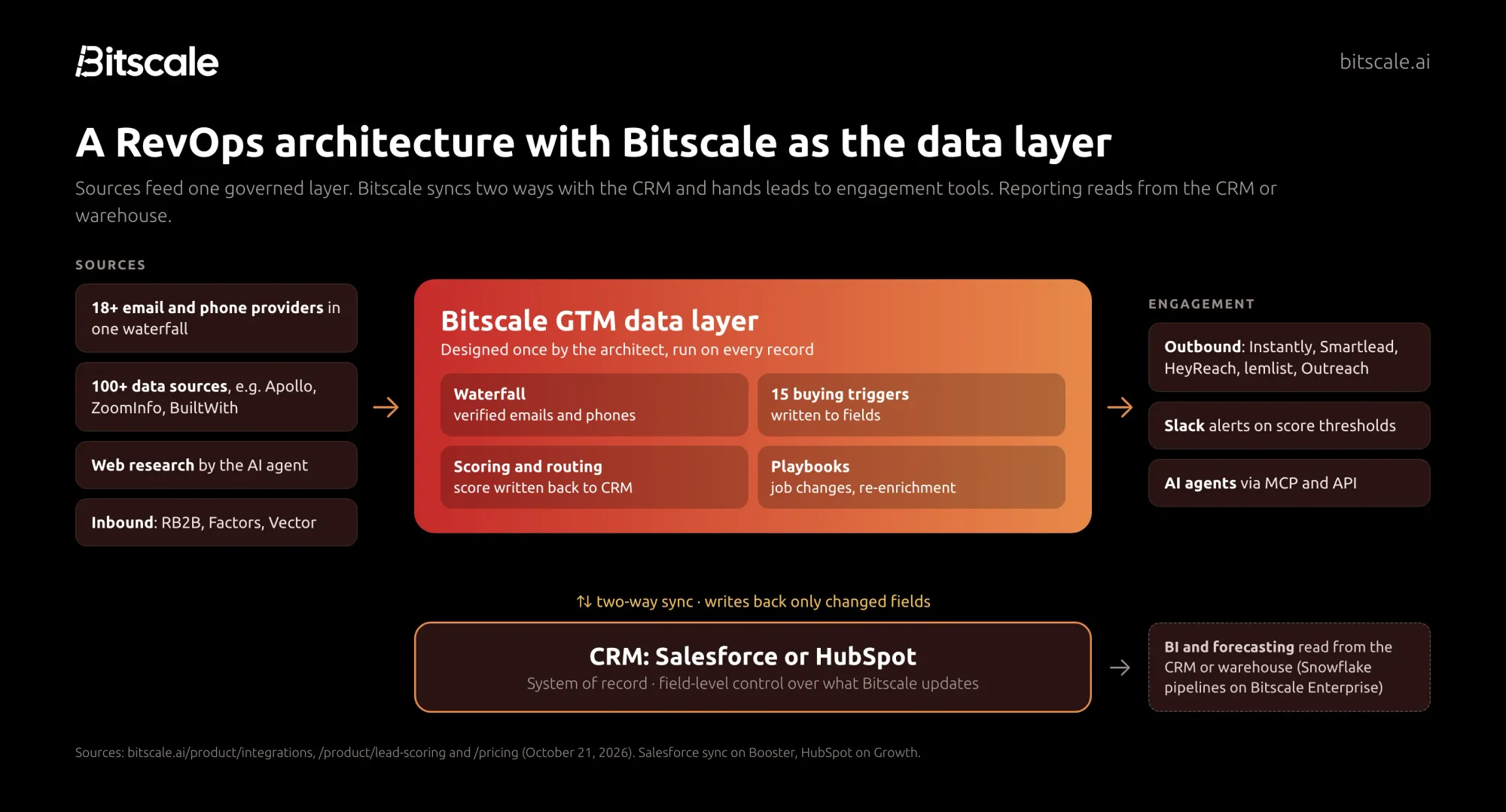
One of the biggest design decisions an architect owns is the data layer between the CRM and everything that reads from it. Bitscale is built to be that layer: the GTM data layer for your CRM, with an 18+ provider email and phone waterfall, 15 buying triggers and two-way Salesforce and HubSpot sync. Posted pay in the job ads we could open runs from $140,000 to $185,000, with one recruiter reporting up to $220,000 base.
What is a RevOps architect?
A RevOps architect is the person who owns the design of the revenue system across tools and teams. Fullcast's 2026 hiring guide puts it in one line: "Architects design and build the technical systems that power RevOps." TekRecruiter, which recruits for the role, describes the job as designing "how those systems fit together and who owns each piece of data."
In practice, the architect answers questions nobody else is paid to answer:
- Which system is the source of truth for each field, and which systems may overwrite it?
- How does a lead become an account, an opportunity, a contract and an invoice, and where does each handoff happen?
- When a new tool arrives, does it plug into the existing design or create a second copy of the customer?
The title appears as RevOps Architect, Revenue Operations Architect, RevOps Solutions Architect or RevOps Process Architect, usually once a company has outgrown a single admin or a CRM migration has left the stack in pieces. For where the wider RevOps function is heading this year, see our 2026 State of RevOps report.
RevOps architect vs. RevOps manager, analyst, admin and GTM engineer
These roles overlap, and small teams often combine them. The clearest way to separate them is by the question each one answers.
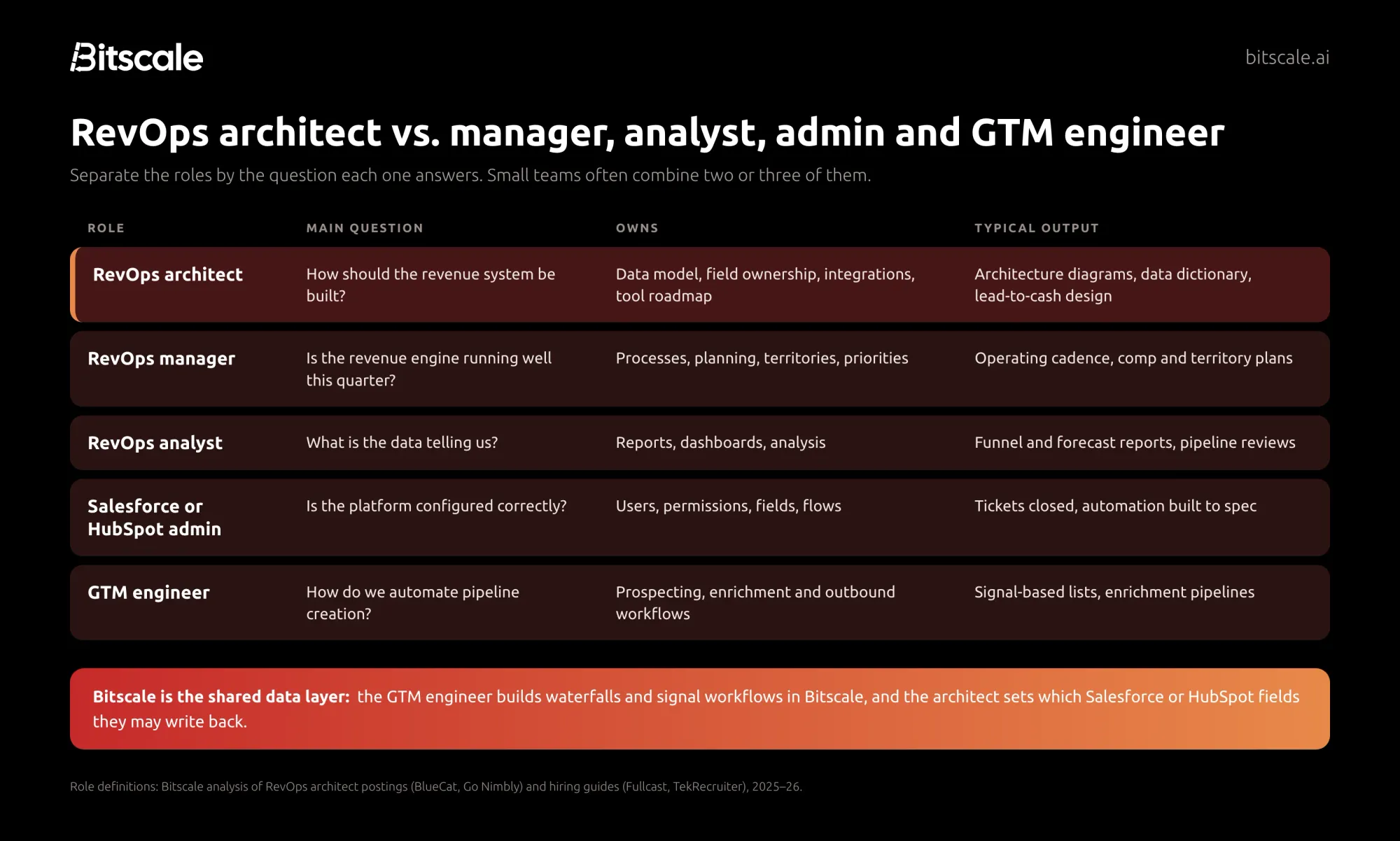
| Role | Main question | Owns | Typical output |
|---|---|---|---|
| RevOps architect | How should the revenue system be built? | Data model, field ownership, integrations, tool roadmap | Architecture diagrams, data dictionary, lead-to-cash design, build-vs-buy decisions |
| RevOps manager | Is the revenue engine running well this quarter? | Processes, planning, territories, team priorities | Operating cadence, comp and territory plans, cross-team projects |
| RevOps analyst | What is the data telling us? | Reports, dashboards, analysis | Funnel and forecast reports, pipeline reviews |
| Salesforce or HubSpot admin | Is the platform configured correctly? | Users, permissions, fields, flows, page layouts | Tickets closed, automation built to spec |
| GTM engineer | How do we automate pipeline creation? | Prospecting, enrichment and outbound workflows | Signal-based lists, enrichment pipelines, outbound sequences |
The line teams ask about most is architect versus GTM engineer. A GTM engineer builds workflows that create pipeline; the architect decides where those workflows write data and how it stays consistent. Our guide to what GTM engineering is covers that role in full. Bitscale is often the shared layer between them: the GTM engineer builds the waterfall and signal workflows, and the architect sets which CRM fields they may update.
Core responsibilities of a RevOps architect
BlueCat's October 2026 posting asks its RevOps Process Architect to "design and document future-state revenue processes with clear ownership, decision rules, and service-level agreements." Go Nimbly's postings ask for architecture standards and judgment on when to use out-of-the-box features, declarative automation or code. The work lands in seven areas.
System design and the tool roadmap
The architect keeps a current map of every system that touches revenue data, who owns it and what it costs. From that map comes a roadmap: which tools to consolidate, which gaps to fill and in what order. BlueCat's posting lists tool rationalization and CRM simplification as part of the role. If you are comparing platforms category by category, our RevOps tools guide lays them out by function.
Data model and governance
This is the center of the job. The architect defines the objects, the required fields, the picklist values and, most importantly, field ownership: which system writes each field and which systems only read it. Without that rule, enrichment tools, reps and integrations overwrite each other, and nobody trusts the data. Data leaders in Salesforce's State of Data and Analytics survey estimated that 26% of their organizational data is untrustworthy.
Governance also covers permissions, deduplication rules and a change process with sandbox testing and release notes.
Lead-to-cash process design
The architect designs the path from first touch to closed revenue: lead capture, enrichment, scoring, routing, conversion, opportunity stages, quoting, contract and handoff to billing and customer success. TekRecruiter says it screens architect candidates by asking them to "draw lead to cash," which is a good test for your own interviews too.
Routing is where design flaws show up first: a lead without company size or region can't be routed by territory, so enrichment has to come before routing. Bitscale's lead scoring blends company fit, tech stack and engagement, raises scores on buying triggers, writes the live score back to Salesforce or HubSpot and routes leads by score. For the mechanics of scoring and routing rules, see our guide to CRM lead management.
Integrations
Every integration is a decision about direction, frequency, matching keys and conflict rules, written down before anything is connected. Settle three questions for each one:
- Which record is the master if the two systems disagree?
- Does the sync write every field on every run, or only the fields that changed?
- What happens to records that fail to match?
Bitscale's two-way CRM sync writes back only changed fields, and you control which fields it may update, so enrichment can't silently overwrite a field another system owns.
Tool selection and build-versus-buy
TekRecruiter lists "build-versus-buy decisions and the roadmap with RevOps leadership" as core architect work. The architect writes the requirements and checks how a new tool fits the data model before anyone signs. A useful filter: a new tool should read and write through governed fields, not become another place where customer data lives.
Reporting and forecast infrastructure
Analysts build the dashboards; the architect makes them possible. That means consistent stage definitions, timestamps on stage changes, a clean account hierarchy and a reporting layer (CRM reports, a warehouse or a BI tool) that pulls from governed fields. Go Nimbly's architect posting includes defining best practices for forecasting and reporting, and integrations with Snowflake or a data warehouse.
Enrichment and data quality
The data model only works if the fields are filled and current. The architect sets which fields are enriched, from which sources, in what order, how often records are refreshed, and how quality is measured. Our guide to contact data quality metrics covers what to track.
This is the responsibility where Bitscale fits most directly. Instead of wiring five data vendors into the CRM separately, the architect designs one layer: Bitscale's waterfall runs 18+ email and phone providers in the order you set, verifies the result, and pushes it to the CRM. Bitscale reports 95% email and phone coverage with bounce rates below 0.5%, and it flags job changes, bad emails and dead domains so decay is caught as it happens.
RevOps architect skills and certifications
The postings we reviewed ask for senior experience: Go Nimbly asks for 8+ years in RevOps, sales ops or systems roles, and BlueCat asks for 6–10+ years in RevOps, sales ops or business systems at a B2B SaaS company. The skills they list fall into three groups.
Technical skills
- Deep knowledge of Salesforce or HubSpot, including the data model, automation and security model
- CPQ and quote-to-cash systems (both BlueCat and Go Nimbly name CPQ)
- Integration patterns, APIs and data warehouses
- Hands-on use of AI and automation in GTM workflows, "with human checkpoints and governance" in BlueCat's words
Design skills
- Process modeling with swim lanes, BPMN or RACI (BlueCat)
- Writing business requirements and acceptance criteria, and supporting user acceptance testing (UAT) and rollouts
- Data governance and documentation
People skills
- Leading discovery with sales, marketing and finance
- Building agreement with senior stakeholders and leading change "without direct authority"
Certifications that come up
- Salesforce Certified Application Architect and Salesforce Certified System Architect (Go Nimbly lists both as a bonus)
- Salesforce Certified Platform Data Architect and Salesforce Certified Platform Integration Architect, two of the credentials on the Salesforce architect track
- Salesforce Administrator or Business Analyst certification (BlueCat lists these as preferred)
- HubSpot Academy's Revenue Operations certification, for HubSpot-based teams
Certifications help, but the postings weight experience higher.
A 30/60/90-day plan for a new RevOps architect
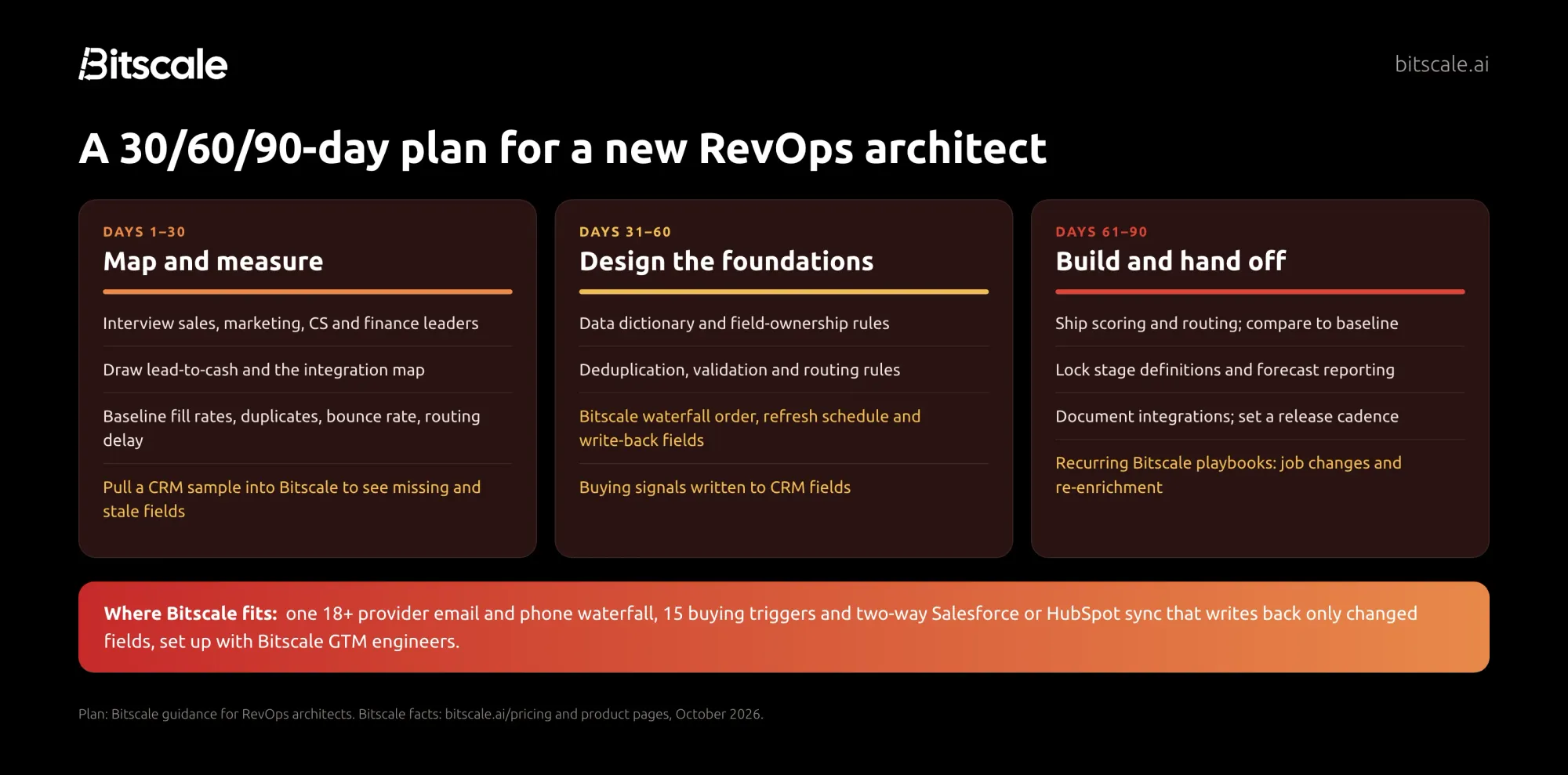
Days 1–30: map and measure
- Interview sales, marketing, customer success and finance leaders about where the system fails them.
- Draw the current lead-to-cash flow and the integration map, including every tool that writes to the CRM.
- Measure a baseline: fill rates for key fields, duplicate counts, bounce rate, and how long inbound leads wait before routing.
- Pull a sample of CRM records into Bitscale to see which fields are missing or stale, before you commit to a fix.
- Agree on the three problems to fix first.
Days 31–60: design and fix the foundations
- Write the data dictionary and the field-ownership rules.
- Set deduplication, validation and routing rules.
- Design the enrichment layer: which fields Bitscale fills, the waterfall order, the refresh schedule, and which fields it may write back.
- Write buying signals, such as funding, hiring and leadership changes, to fields that routing and reports can use.
Days 61–90: build, document and hand off
- Ship scoring and routing, and run them against the baseline.
- Lock stage definitions and the forecast and reporting layer.
- Document every integration and set a change process with a release cadence.
- Retire tools the new design replaces.
- Set up recurring jobs, such as Bitscale's Champion Job-Change Tracker and HubSpot Contact Re-Enrichment playbooks, so the data stays current after launch.
Many of the recurring jobs in that last phase are covered in our list of essential RevOps workflows, and the automation side is covered in our RevOps automation guide.
How to hire a RevOps architect
Hire an architect when the problem is design, not volume. A long backlog of well-defined tickets calls for another admin or a developer. If every fix creates two new problems, systems disagree, or a CRM migration is coming, you need an architect.
Job description template
Copy and adapt this outline:
- Title: RevOps Architect (or Revenue Systems Architect)
- Mission: Design and own the architecture of our revenue systems so that sales, marketing, customer success and finance work from one trusted set of data.
- You will:
- own the CRM data model, field ownership and data dictionary
- design the lead-to-cash process, including routing
- design and document every integration
- run tool evaluations and build-versus-buy decisions
- set enrichment and data-quality standards
- build the reporting and forecast foundations with analytics
- You have:
- deep Salesforce or HubSpot experience
- integration and data-warehouse experience
- a record of rebuilding a revenue system that people adopted
- Nice to have: Salesforce architect credentials, CPQ experience, experience with AI agents in GTM workflows
- Reports to: Head of RevOps or VP of Revenue Operations
- Pay: a posted range (see the salary section)
Interview questions
- Draw the lead-to-cash flow from a system you designed. Where did data change hands, and what broke?
- Two systems disagree on a contact's job title. Which one wins, and how do you enforce that?
- How would you decide which fields an enrichment tool may overwrite?
- Walk me through a tool you chose not to buy. What did you build or reuse instead?
- Inbound leads wait hours for routing. How do you find the cause?
- How do you measure whether CRM data quality is improving?
- How do you roll out a schema change without breaking reports and integrations?
- Where would you let an AI agent write to the CRM, and what checks would you put on it?
Strong answers name specific objects, fields and tradeoffs.
RevOps architect salary in 2026
We only include ranges from pages we could open and date. Several large salary sites didn't load for us, so they aren't here (see Sources).
| Source | Title or scope | Range | Date |
|---|---|---|---|
| BlueCat job posting (via Remoteleaf) | RevOps Process Architect, remote US | $160,000–$185,000 | Posted mid-October 2026 |
| Go Nimbly job posting (Built In) | RevOps Architect, remote US | $140,000–$160,000 base, plus bonus plan | Removed November 24, 2025 |
| Go Nimbly job posting (Built In) | RevOps Solutions Architect | $140,000–$160,000 | Removed December 23, 2025 |
| Fullcast hiring guide | Revenue Operations Architect | $140,000–$180,000 | March 4, 2026 |
| TekRecruiter | 10 RevOps developer and architect searches, South Florida and Atlanta | $160,000–$220,000 base | Updated September 29, 2026 |
Where the sources disagree. The job ads and Fullcast cluster between $140,000 and $185,000. TekRecruiter's placements run higher, up to $220,000 base, but they come from one recruiter's 10 searches in two metro areas. Fullcast doesn't say how it built its ranges. Treat the table as a guide to posted pay, not a market survey.
RevOps manager and related roles, for comparison:
- Fullcast lists Revenue Operations Manager at $80,000–$130,000 and Senior Manager or Director of Revenue Operations at $130,000–$180,000.
- Glozo's July 2026 analysis of 2,211 US postings puts the median for Revenue Operations at $120,000 and for GTM Engineer at $140,000.
The architect title sits above the typical RevOps manager range and overlaps with director pay.
How Bitscale helps a RevOps architect
A RevOps architect's hardest job is keeping one trusted version of each account and contact while many tools read and write to it. Bitscale gives you one data layer for that, so enrichment, signals and routing logic live in one governed place.
- One enrichment layer instead of many vendors. Bitscale's waterfall runs 18+ email and phone providers in the order you choose, from 100+ data sources overall. You design the logic once.
- CRM sync that respects field ownership. CRM enrichment syncs two ways with HubSpot (Growth plan) and Salesforce (Booster plan) and writes back only changed fields. Pull a Salesforce report, SOQL query or HubSpot list into a live grid, and set which fields Bitscale may update.
- Signals in fields, not spreadsheets. Bitscale tracks 15 buying triggers, including exec hires, tech-stack changes, funding and hiring posts, and you can stack them. Write them to CRM fields so routing, scoring and reports can use them.
- Research at scale. The AI research agent scrapes websites and runs Google and Perplexity research, returning structured columns you can map to fields.
- Scoring and routing. Live scores write back to Salesforce or HubSpot, route leads by score and send Slack alerts when a lead crosses a threshold.
- Ready-made playbooks. Start from playbooks such as Champion Job-Change Tracker and HubSpot Contact Re-Enrichment instead of building every job from scratch.
- API and MCP. Webhooks, an HTTP API and an MCP server at
https://api.bitscale.ai/mcp(OAuth, about 50 tools) let AI agents in Claude, ChatGPT or Cursor work with your Bitscale data. MCP tools use credits at the same rate as the app, and waterfalls charge only for the provider that returns a valid result. - Engineers who build it with you. Bitscale GTM engineers handle setup and migration, with GTM engineer support on every paid plan and a dedicated engineer on Enterprise. The Enterprise onboarding plan covers schema mapping and Salesforce, HubSpot and Snowflake syncs in week one, then waterfalls, signal triggers and routing rules in week two.
Abhishek Goyal, Director of Growth at Pazcare, put it this way: "Bitscale acted as a playground for me rather than just a tool. I can take any problem, use their APIs, use my workflows, and get whatever output I need in whatever format I want."
Phyllo keeps its CRM at 94% coverage with Bitscale. As Ronak, Phyllo's Head of Growth, said: "Bitscale became the place where all our GTM work finally came together."
Bitscale pricing
| Plan | Price | Credits |
|---|---|---|
| Free | $0 | 200 |
| Growth | $349/mo ($314 annually) | 15K/mo |
| Booster | $799/mo ($719 annually) | 50K/mo |
| Enterprise | from $15K/yr | Custom |
Pricing is per account, actions are unlimited on paid plans, and credits roll over up to 3x. Bitscale's pricing page says failed lookups and CRM syncs don't use credits.
Design your data layer on Bitscale
pull a sample of your CRM records into Bitscale, see which fields are missing or stale, and test the waterfall on your own data. 200 free credits, no card required.
Start for freeFrequently asked questions
What does a RevOps architect do?
A RevOps architect designs the revenue system: the CRM data model, field ownership, the lead-to-cash process, integrations and the reporting foundation. They decide how tools fit together and which system owns each piece of data, so every team works from the same records.
What is the difference between a RevOps architect and a RevOps manager?
A RevOps manager runs the revenue operation day to day: planning, territories, processes and priorities. A RevOps architect designs the systems underneath it. Managers ask whether the engine is running well; architects decide how it is built and how data flows.
How much does a RevOps architect make?
In postings we could open, base pay runs from $140,000 to $185,000. BlueCat posted $160,000 to $185,000 in October 2026. TekRecruiter reports $160,000 to $220,000 base across 10 searches in South Florida and Atlanta in 2026.
What skills does a RevOps architect need?
Deep Salesforce or HubSpot knowledge, integration and data-warehouse experience, CPQ, process modeling such as BPMN or RACI, data governance, and the ability to lead change without direct authority. Postings ask for 6 to 10 or more years of experience.
Which certifications help a RevOps architect?
Salesforce architect credentials such as Application Architect, System Architect, Platform Data Architect and Platform Integration Architect are the most cited. HubSpot teams can add HubSpot Academy's Revenue Operations certification. Postings treat certifications as a bonus, not a requirement.
Is a GTM engineer the same as a RevOps architect?
No. A GTM engineer builds automated workflows that create pipeline, such as signal-based lists and enrichment pipelines. A RevOps architect designs the system those workflows write into, and sets the rules for which fields they may change. The two often share a data layer such as Bitscale.
Sources
Job postings with posted pay
- BlueCat: RevOps Process Architect, via Remoteleaf (posted October 2026)
- Go Nimbly: RevOps Architect, Built In (removed November 24, 2025)
- Go Nimbly: RevOps Solutions Architect, Built In (removed December 23, 2025)
Salary guides and reports
- TekRecruiter: RevOps developers and architects (updated September 29, 2026)
- Fullcast: Revenue Operations Jobs, 2026 Career and Hiring Guide (March 4, 2026)
- Glozo: US RevOps Salary Report 2026 (July 15, 2026)
Certifications
- Salesforce Certified Application Architect
- Salesforce Certified System Architect
- Salesforce Certified Platform Data Architect
- Salesforce Certified Platform Integration Architect
- HubSpot Academy certifications
Research
Bitscale