The best B2B data providers and databases in India (2026)
Compare the best B2B data providers and databases for India in 2026, with DPDP Act and TRAI rules, free MCA and GST checks, and a 100-contact coverage test.
Disclosure: This guide is published by Bitscale, and Bitscale is our top pick. We applied the same criteria to every provider and checked facts on each vendor's or regulator's own website in October 2026.
The short answer: the best B2B data provider for India in 2026 is Bitscale, because few vendors publish India coverage and no single database has everyone. Bitscale runs one email and phone waterfall across 18+ contact-data providers, verifies what it finds, and writes it back to your CRM. Pazcare, an Indian employee benefits platform, used it to go from 100 to 300–400 enriched contacts a day. The other options fit specific jobs:
- Apollo.io is the lowest-cost all-in-one for teams starting outbound.
- Lusha is the quickest way to look up a few hundred contacts a month.
- EasyLeadz is an India-native tool for mobile numbers and Indian director lookups.
- ZoomInfo and Cognism suit larger teams that cover India as part of a global or APAC territory.
- Clay suits teams with an engineer who wants to build custom workflows.
- Tofler and Zauba Corp are for Indian company research: financials, directors and filings.
Pair any of them with two official checks, the MCA register and the GST taxpayer search, and a plan for India's DPDP Act and TRAI's calling rules.
This guide is part of Bitscale's regional series: see our B2B databases guide for APAC; the North America guide; and 10 best B2B data providers by region.
Quick comparison
| Provider | Best for in India | Data type | Free option | Entry price |
|---|---|---|---|---|
| Bitscale (our pick) | Best overall: multi-provider contact coverage, signals and CRM sync | Emails, mobiles, company data, signals | Yes, 200 credits | $314/mo (Growth, annual), per account |
| Apollo.io | Low-cost all-in-one data and sequences | Contacts, companies, sequences | Yes, 900 credits/seat/yr | $49/seat/mo (Basic, annual) |
| Lusha | Quick lookups for a few reps | Emails and phones | Yes, 40 credits/mo | $37.45/mo (Starter, billed yearly) |
| EasyLeadz | India-native mobile number lookups | Phones, emails, Indian director lookup | Free trial, 5 contacts | ₹2,499/mo (billed yearly, plus GST) |
| ZoomInfo | Enterprise teams selling globally | Contacts, companies, intent | No (free trial) | Quote only |
| Cognism | India as part of an APAC territory | B2B emails and phones | No (free data sample) | Quote only, 5 seats included |
| Clay | Custom enrichment workflows | Depends on connected providers | Yes, 100 data credits/mo | $167/mo (Launch, annual) |
| Tofler | Indian company financials and directors | Company data from MCA filings | Free account | ₹15,000/yr (Pro, plus GST) |
| Zauba Corp | Free Indian company lookups | Company data from filings | Yes | Not checked |
Prices are list prices from each vendor's website. Bitscale, Apollo, Lusha, ZoomInfo, Cognism and Clay were checked October 7, 2026; EasyLeadz, Tofler and Zauba Corp on October 21, 2026.
Why India B2B data is harder than it looks
India has a large company base, and it keeps growing. The Ministry of Corporate Affairs counted 2,191,260 active companies and 532,959 active LLPs as of September 30, 2026, and 24,325 new company incorporations in September 2026 alone. Reaching the right people inside them is the hard part.
Three things make India data harder:
- Vendors rarely publish India coverage. Global databases quote global totals. Cognism, for example, says it has over 75 million contacts in Asia Pacific but does not publish counts per country. Lusha's homepage gives a US contact count but no India figure. So you have to test India coverage yourself.
- Mobile numbers cost more. If your team calls Indian prospects, mobile coverage matters as much as email, and mobiles usually cost more credits. Lusha, for instance, charges 5 credits for a phone number and 1 for an email.
- The rules changed. The DPDP Rules were published in November 2025, and TRAI tightened its calling and SMS rules in 2025 and September 2026.
That is why Bitscale ranks first: when one provider has no record for an Indian contact, the waterfall asks the next. Pazcare's team had used Apollo, Lusha and other aggregators before switching, and its case study says "Apollo wasn't delivering reliable results" for them.
How we evaluated India data providers
For each provider we checked what the vendor says about India or APAC coverage, the type of data (contacts, company data or both), public list prices and free options, CRM write-back (including Zoho CRM, which Pazcare connects through Bitscale's API), and published compliance information. We did not run our own India accuracy test; the number that counts is the one you measure on your own list.
The best B2B data providers for India in 2026
1. Bitscale: best overall for India contact coverage
Bitscale doesn't rely on one database's India coverage. It runs one email and phone waterfall across 18+ contact-data providers, draws on 100+ data sources overall, verifies results before they reach your CRM, and tracks buying signals.
- Pricing: Free plan with 200 credits, no card. Growth is $349 a month ($314 billed annually) for 15,000 credits; Booster $799 ($719 annually) for 50,000; Enterprise from $15K a year. Pricing is per account, actions are unlimited on paid plans, and credits roll over up to 3x.
- Data: 95% email and phone coverage with bounce rates below 0.5% (Bitscale figures). You pay only for the provider that returns a valid result.
- Why it fits India:
- Every rep can enrich. Before Bitscale, Pazcare's per-seat licences meant only 3–4 people could run enrichment. Bitscale prices per account.
- Emails and mobiles in one pass, for teams that call as well as email.
- Indian account signals. Pazcare tracks new Global Capability Centres (GCCs) in Bitscale using ROC data, job postings and public announcements.
- CRM write-back. Two-way HubSpot (Growth) and Salesforce (Booster) sync that writes back only changed fields. Pazcare writes to Zoho CRM through Bitscale's API, with a duplicate check.
- G2: 4.8/5, the highest-rated tool in our prospecting tools comparison.
What Pazcare reports: enrichment went from 100 to 300–400 contacts a day, at about a minute per contact. "Bitscale acted as a playground for me rather than just a tool. I can take any problem, use their APIs, use my workflows, and get whatever output I need in whatever format I want," says Abhishek Goyal, Director of Growth at Pazcare.
Choose Bitscale if you prospect into Indian companies and want verified emails and mobiles from many providers, with signals and CRM write-back, instead of stitching together single-database tools.
Try Bitscale free
200 credits, no card required. Run the India coverage test on 100 of your own Indian target contacts and see what an 18+ provider waterfall finds.
Start for free2. Apollo.io: best low-cost all-in-one for starting outbound
Apollo combines a contact database, sequencing and CRM sync in one seat, an inexpensive start for a small team.
- Pricing: Free plan with 900 credits per seat per year. Basic is $49 per seat per month billed annually ($65 monthly), Professional $79 ($99 monthly).
- Data: Apollo cites 240M+ contacts and 30M+ accounts globally. It doesn't publish an India figure on the pages we read.
- Watch out for: Unused credits don't roll over, and its built-in dialer is listed as a US dialer, so phone-heavy India teams will need another way to call.
- G2: 4.7/5.
Choose Apollo if you want one affordable tool for contacts and email sequences, and will test its India find rate first.
3. Lusha: best for quick lookups on a small budget
- Pricing: Free plan with 40 credits a month. Starter is $37.45 per month billed yearly for 4,800 credits a year. An email costs 1 credit and a phone number 5.
- Data: Lusha cites 515M+ contacts and 29M+ companies. Its homepage FAQ gives a US count (132M contacts) and no India figure.
- G2: 4.3/5.
Choose Lusha if one or two reps need a few hundred lookups a month, budgeting for phones at five times the credits of emails.
4. EasyLeadz: best India-native tool for mobile numbers
EasyLeadz is built for Indian prospecting. Its Mr. E Chrome extension reveals phone numbers and work emails on LinkedIn, on Zauba Corp and Tofler company pages, and on business websites.
- Pricing: Plans start at ₹2,499 per month, billed yearly and exclusive of GST, with 600 credits a year for up to 2 users. The free trial includes 5 contacts with no card.
- Data: EasyLeadz says it draws on 100+ Indian and global sources, and offers director lookup by DIN or CIN for Indian private limited companies and LLPs.
- Compliance: It publishes GDPR and DPDP compliance pages.
- Watch out for: 600 credits a year is small for a team.
Choose EasyLeadz if you mainly need Indian mobile numbers for a small team and want rupee pricing.
5. ZoomInfo: best for enterprise teams selling globally
- Pricing: Quote only, across Professional, Copilot Advanced and Copilot Enterprise.
- Data: ZoomInfo cites 500M+ contacts, 100M+ companies and 300+ human researchers. It doesn't break these out for India on the pages we read.
- G2: 4.5/5.
Choose ZoomInfo if India is one territory in a global enterprise plan with budget and an owner. Test Indian contacts in the trial.
6. Cognism: best for India as part of an APAC territory
Cognism's pitch is compliance and phone-verified mobile numbers, and it markets an Asia Pacific database that includes India.
- Pricing: Quote only. Standard and Pro plans each include five seats.
- Data: Cognism says it has over 75 million contacts in Asia Pacific and lists India among its markets with "strong coverage". It doesn't publish per-country counts, and says its APAC database holds B2B emails, not personal ones.
- About Kaspr: Cognism's LinkedIn extension Kaspr (acquired in 2022) leads with "accurate European contact data" and doesn't mention India on its homepage.
- G2: 4.5/5.
Choose Cognism if you run one team across APAC and Europe and want a single vendor contract. Ask for an India-specific data sample before you sign.
7. Clay: best for building custom enrichment workflows
Clay is a spreadsheet-style workspace that queries providers in sequence. Its India coverage depends on which providers you connect.
- Pricing: Free plan with 100 data credits a month and no phone enrichment. Launch is $185 a month ($167 annually); CRM sync and the HTTP API start on Growth at $495 ($446 annually).
- Data: Clay says it connects to 150+ data partners.
- G2: 4.6/5.
Choose Clay if you have a GTM engineer who wants to design India-specific provider orders and maintain them.
8. Tofler: best for Indian company financials and directors
Tofler is a company research platform, not a contact database. It says its data comes from official MCA filings and that it covers over 10 million Indian businesses.
- Pricing: Free account; Pro ₹15,000 a year (40 credits); Growth ₹28,000 (100 credits, five years of filings, Excel export); Enterprise from ₹1.5 lakh with API access. Plus GST.
- Data: Five-year financials, directors, shareholders and company networks on every plan.
Choose Tofler if you qualify accounts on revenue, profitability or group structure before you look for contacts.
9. Zauba Corp: best free Indian company lookups
Zauba Corp is a business research platform for Indian companies. It says it covers 3M+ companies and that "we share more FREE info than anyone". Its Prime Research product is an AI assistant that can build lists of companies matching your criteria.
Choose Zauba Corp if you want a free first look at an Indian company before you spend credits on it. It doesn't replace a contact data provider.
Free official sources for Indian company research
For B2B company research in India, start with two government sources. Both help you check that an account is real and clean up CRM records before you pay for data.
MCA (Ministry of Corporate Affairs). MCA's Master Data Services shows the registered master data of companies and LLPs filed with the Registrar of Companies. When we checked on October 21, 2026, it sat behind an MCA portal login on the V3 site. Use it to confirm a company's registration details and find its CIN, which EasyLeadz accepts as a lookup key for director searches.
GST taxpayer search. The GST portal lets anyone search a taxpayer by GSTIN or UIN without logging in. It shows the legal name, trade name, registration date, constitution of business, principal place of business, any cancellation date and return filing details. Director names and turnover need a login.
With Bitscale: treat the registry as the source of truth for the company and the waterfall as the source for the people. Bitscale's AI research agent fills remaining company fields from websites and Google and Perplexity research.
India compliance: DPDP Act, DPDP Rules and TRAI
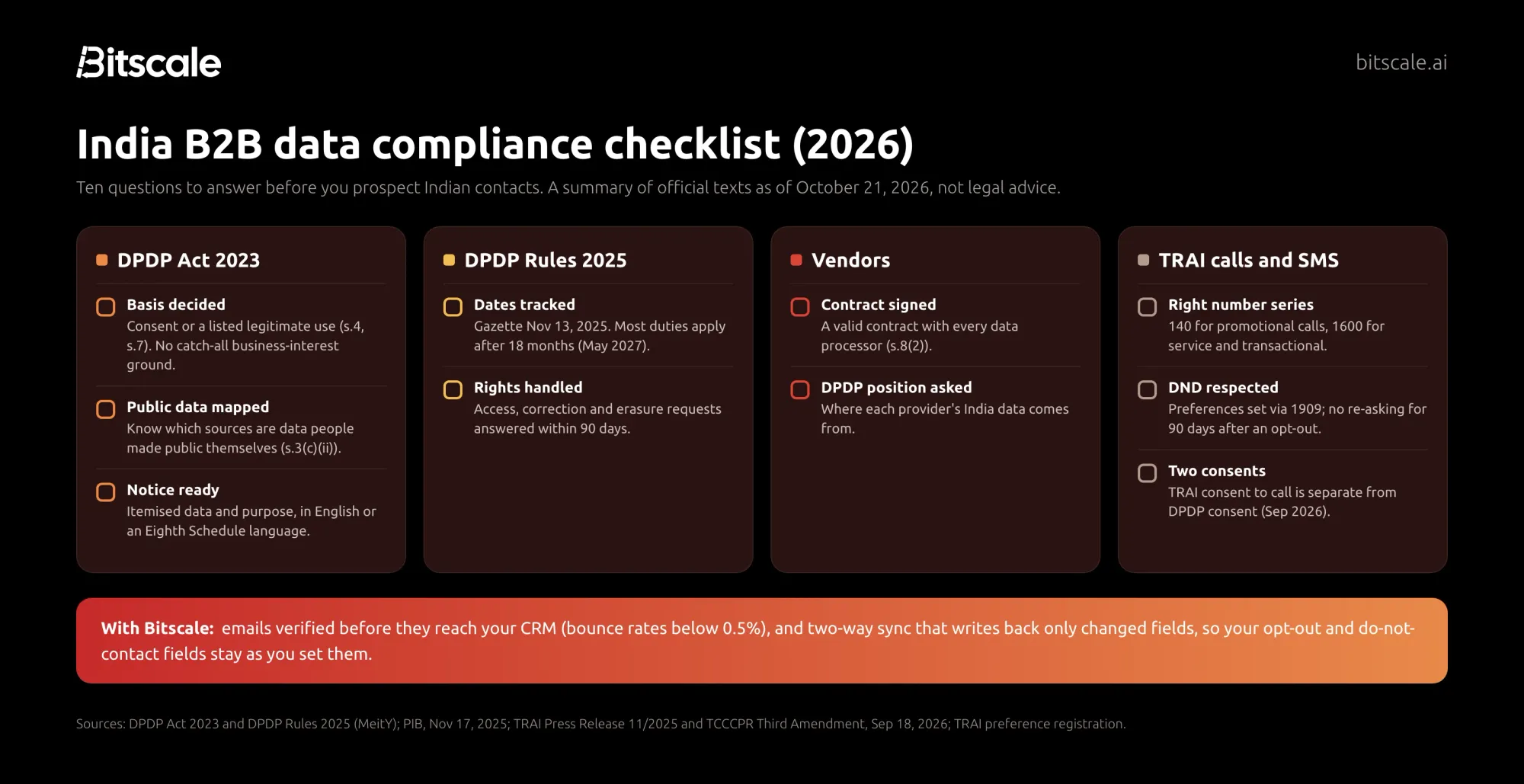
Not legal advice. This section summarizes official texts as of October 21, 2026. Talk to a qualified Indian lawyer before you build a prospecting program on it.
The DPDP Act and Rules: what applies and when
The Digital Personal Data Protection Act, 2023 was enacted on August 11, 2023. It applies to digital personal data processed in India, and to processing outside India connected with offering goods or services to people in India. So a team based outside India that prospects Indian buyers should not assume it is out of scope.
The DPDP Rules, 2025 were published in the Gazette dated November 13, 2025, and come into force in three stages:
- Immediately: the rules setting up the Data Protection Board.
- After one year (November 2026): the rules for registered Consent Managers.
- After 18 months (May 2027): most business obligations, including notice, security safeguards, breach reporting and data principal rights.
In January 2026, MeitY asked industry for views on shortening the 18-month window to 12 months. We found no gazetted change as of October 21, 2026, but check meity.gov.in before you rely on the May 2027 date.
Penalties are large. Under the Act's schedule, failing to keep reasonable security safeguards can cost up to ₹250 crore, failing to report a breach up to ₹200 crore, and other violations up to ₹50 crore.
Consent is the main route, and there's no catch-all "legitimate interest"
The Act allows processing of personal data only with consent or for "certain legitimate uses" (Section 4). Consent must be "free, specific, informed, unconditional and unambiguous with a clear affirmative action" (Section 6), and as easy to withdraw as to give.
The legitimate uses in Section 7 are a closed list: data a person voluntarily gave you for a specific purpose, State functions, legal obligations, court orders, medical emergencies, epidemics, disasters and employment. None covers a general business or marketing interest, so there is no catch-all "legitimate interest" ground for cold prospecting.
Two provisions matter for B2B data in particular:
- Publicly available data. The Act doesn't apply to personal data that the person has made publicly available themselves, or that someone is legally required to publish (Section 3(c)(ii)). A work email someone published on their own company page may fall here; an email guessed by a pattern-matching tool is less clearly covered. Ask your lawyer where your sources sit.
- Vendors are processors. A vendor processing data for you needs a valid contract (Section 8(2)), and you stay responsible. Ask every provider for a data processing agreement and its DPDP position.
TRAI's rules for calls and SMS
If your team calls or texts Indian mobile numbers, check TRAI's Telecom Commercial Communications Customer Preference Regulations (TCCCPR), 2018. TRAI's February 2025 amendments made them much stricter:
- Number series. Promotional calls use the 140 series and transactional and service calls the 1600 series. Senders are restricted from using normal 10-digit numbers for telemarketing.
- Faster action. People can complain within 7 days, and 5 complaints in 10 days trigger action against a sender.
- Heavy consequences. A first violation bars outgoing service on all the sender's telecom resources for 15 days; repeat violations mean disconnection across all operators for a year and blacklisting.
- Opt-outs stick. After someone opts out, a sender can't ask them for consent again for 90 days.
People register their preferences, the "DND" setting, in the National Customer Preference Register by calling or texting 1909, through the TRAI app or on a web portal.
TRAI's Third Amendment of September 18, 2026 clarifies that consent to receive calls under TCCCPR is separate from consent under the DPDP Act, and that TRAI's rules don't exempt anyone from the DPDP Act. Whether your SDR calls count as telemarketing depends on your setup, so confirm it with counsel and your telecom provider.
How Bitscale helps with compliance: Bitscale verifies emails before they reach your CRM, with bounce rates below 0.5%. Its two-way CRM sync writes back only the fields that changed, and you control which fields Bitscale may update, so the opt-out and do-not-contact fields your team keeps in Salesforce or HubSpot stay as you set them.
How to test India coverage before you buy
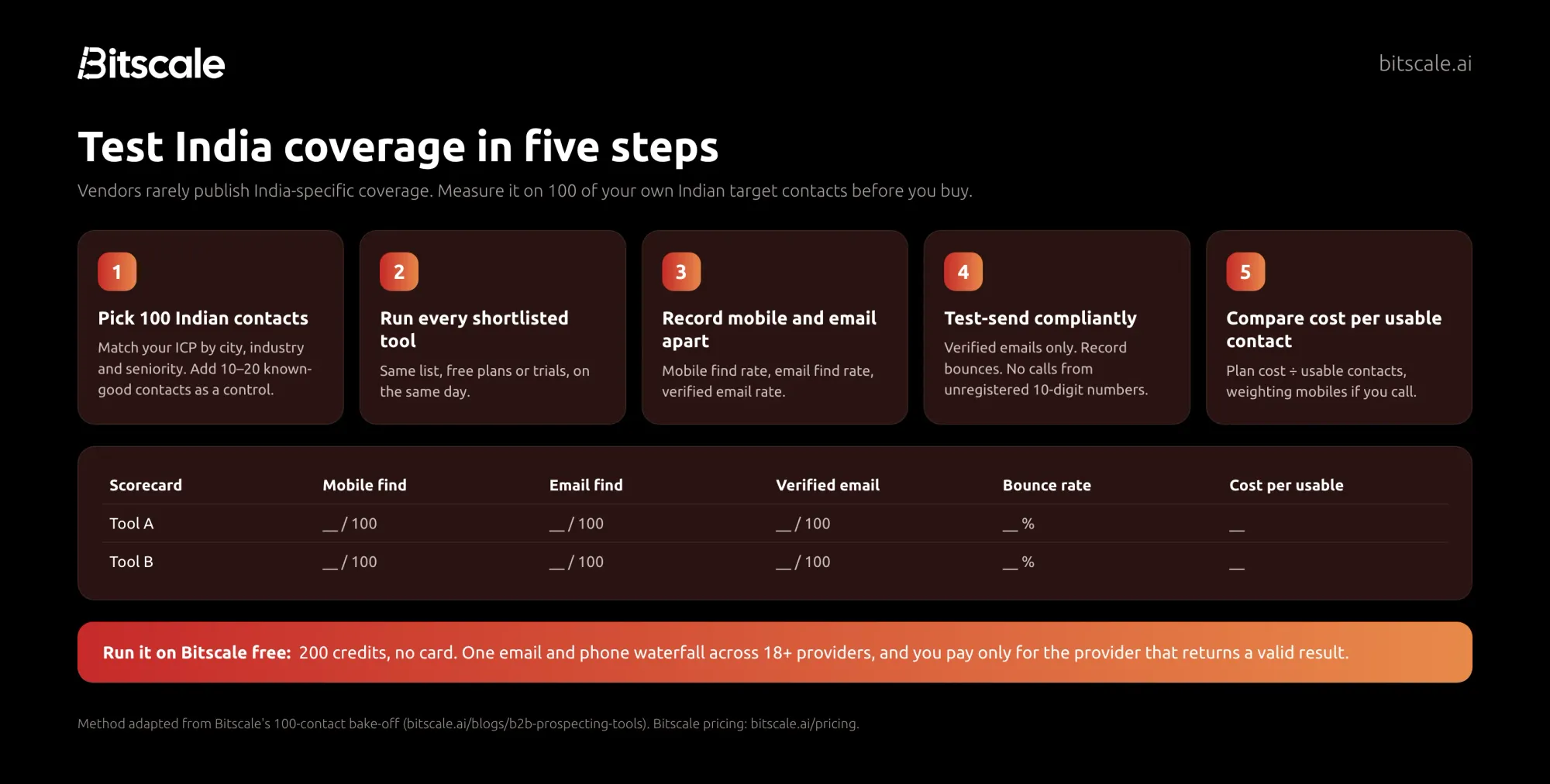
Run the 100-contact bake-off from our prospecting tools guide with these India-specific adjustments:
- Match your Indian ICP. Split 100 contacts across the cities, industries and seniority levels you sell to, such as enterprises, startups and GCCs, and score each segment. Add 10–20 known-good contacts as a control.
- Run the same list through each shortlisted tool on its free plan or trial: for example, Bitscale's 200 free credits, Apollo's free plan and an EasyLeadz trial.
- Record mobile and email separately: mobile find rate, email find rate and verified email rate.
- Test-send a small, compliant batch. Send to verified emails only and record the bounce rate. Don't cold-call the test list from an unregistered 10-digit number.
- Compare cost per usable contact: plan cost divided by usable contacts, weighting mobiles if you call.
As an illustration only: if one tool finds mobiles for 30 of your 100 Indian contacts and another finds 55, the second tool is worth more to a phone-led team even if its plan costs more.
How Bitscale helps teams selling into India
For India, Bitscale gives you:
- One waterfall instead of several subscriptions. Bitscale queries 18+ contact-data providers in turn for each email and mobile, and charges only for the provider that returns a valid result.
- Verified before it lands. 95% email and phone coverage with bounce rates below 0.5% (Bitscale figures), which protects your sender reputation as you add a new market.
- Signals for Indian accounts. Track and stack 15 buying triggers, such as exec hires, funding rounds and hiring posts, or build your own, as Pazcare did for GCCs.
- An AI research agent for company details a database may not hold: what a company sells, its tech stack, funding and hiring.
- Your CRM stays the system of record. Two-way HubSpot and Salesforce sync, plus webhooks and an HTTP API for other CRMs such as Zoho.
- API and MCP access through
https://api.bitscale.ai/mcp, with OAuth and about 50 tools, at the same credit rates as the app. - Ready-made playbooks and done-for-you setup. Bitscale GTM engineers handle setup and migration, with GTM engineer support on every paid plan and a dedicated engineer on Enterprise.
A typical India workflow in Bitscale: pull target accounts, confirm each against its MCA or GST record, run the email and mobile waterfall on decision-makers, add a hiring or funding signal, and sync verified results to your CRM with opt-out fields intact.
Try Bitscale free
200 credits, no card required. Run your Indian target list through an 18+ provider waterfall and compare the find rate with your current tool.
Start for freeFrequently asked questions
What is the best B2B data provider in India?
Bitscale, because it runs one waterfall across 18+ contact-data providers instead of relying on one database's India coverage. Apollo and Lusha suit small budgets, EasyLeadz mobile-first teams, and Tofler company research.
Is there a free B2B database for Indian companies?
For company data, yes: the GST taxpayer search works without login, MCA's Master Data Services needs an MCA portal login, and Zauba Corp shares free company information. Emails and mobiles generally need a paid tool or trial.
Is B2B data legal to use in India under the DPDP Act?
It allows processing with consent or for listed legitimate uses, with no general business-interest ground; data a person made public themselves is outside the Act. Most obligations apply from May 2027. Get Indian legal advice first.
Do TRAI DND rules apply to B2B sales calls?
TRAI's TCCCPR rules govern commercial calls and SMS to Indian mobile numbers, including the 140 series for promotional calls and the DND preference register. Whether your SDR calls count as telemarketing depends on your setup, so check with counsel and your telecom provider.
How do I check if an Indian company is real and active?
Search its GSTIN on the GST portal to see the legal name, any cancellation date and return filing details, then look up its CIN in MCA's master data. Tofler and Zauba Corp present Indian company filings in an easier format.
How accurate is B2B contact data in India?
No independent, current benchmark covers India, and the vendors we checked don't publish India-specific figures. Run a 100-contact test on your own Indian list and compare mobile find rate, verified email rate and bounce rate.
Sources
Indian law and regulators (accessed October 21, 2026)
- MeitY, Digital Personal Data Protection Act, 2023 (full text)
- MeitY, Digital Personal Data Protection Rules, 2025, G.S.R. 846(E)
- PIB, "DPDP Rules, 2025 Notified" (November 17, 2025)
- Storyboard18, MeitY consults on a 12-month DPDP timeline (January 28, 2026)
- TRAI, Press Release No. 11/2025 on TCCCPR amendments (February 12, 2025)
- TRAI, TCCCPR (Third Amendment) Regulations, 2026 (September 18, 2026)
- TRAI, preference registration
- Ministry of Corporate Affairs, homepage statistics and Master Data Services
- GST portal, Search Taxpayers using GSTIN/UIN
Provider pages
- Bitscale pricing and waterfall
- Bitscale, Pazcare case study
- Apollo.io pricing (October 7, 2026)
- Lusha pricing (October 7, 2026) and homepage
- EasyLeadz
- ZoomInfo pricing (October 7, 2026)
- Cognism pricing (October 7, 2026) and APAC database
- Kaspr and Cognism's Kaspr acquisition announcement
- Clay pricing (October 7, 2026)
- Tofler and Tofler plans
- Zauba Corp
G2 product review pages, accessed October 7, 2026.