What is a lead intelligence platform? The 8 best options in 2026
A lead intelligence platform tells you who a lead is, if they fit, if they're in market and who should act. We compare 8 options for 2026, Bitscale #1.
Disclosure: This guide is published by Bitscale, and Bitscale is our top pick. We applied the same criteria to every platform. Every price and feature was checked on the vendor's own website or help center between October 7 and October 21, 2026.
The short answer: a lead intelligence platform answers five questions about every lead as it arrives: who is this, do they fit, are they in market, how urgent is it, and who should act. It enriches the record, adds signals, scores it and routes it to an owner in your CRM. Bitscale is the best lead intelligence platform for most B2B teams in 2026 because it does all five in one place: an email and phone waterfall across 18+ providers, 15 buying signals, signal-weighted scoring, and two-way Salesforce and HubSpot sync.
The other seven are strong at narrower jobs:
- HubSpot Breeze Intelligence for enrichment and shorter forms inside HubSpot.
- Apollo.io for budget inbound plus outbound on one database.
- Default for inbound routing and meeting scheduling.
- Warmly for person-level website visitor intelligence with chat.
- RB2B for low-cost person-level visitor identification in the US.
- Common Room for person-level signals across many channels.
- UserGems for contact-level signals and job changes at enterprise scale.
What a lead intelligence platform does
Lead intelligence is everything you know about a single lead that helps you decide what to do with it next. A lead intelligence platform gathers that knowledge automatically and turns it into an action.
A form fill gives you a name, a work email and maybe a company. Before a rep picks up the phone, someone has to work out:
- Who is this? Title, seniority, verified contact details, and the company behind the email domain.
- Do they fit? Whether the company matches your ideal customer profile on industry, size, region and tools.
- Are they in market? Evidence of intent: pricing-page visits, hiring, funding, a new leader.
- How urgent is it? A score that combines fit and intent, so the best leads go first.
- Who acts? The owner, queue and next step, written into the CRM.
Getting this right matters. Gartner found that 73% of B2B buyers actively avoid suppliers who send irrelevant outreach, and in Salesforce's research, leaders estimated that 26% of their organization's data is untrustworthy. In Bitscale, all five answers live in one grid: enrichment columns, signal columns, a score and a routing step that writes back to Salesforce or HubSpot.
The five components of lead intelligence
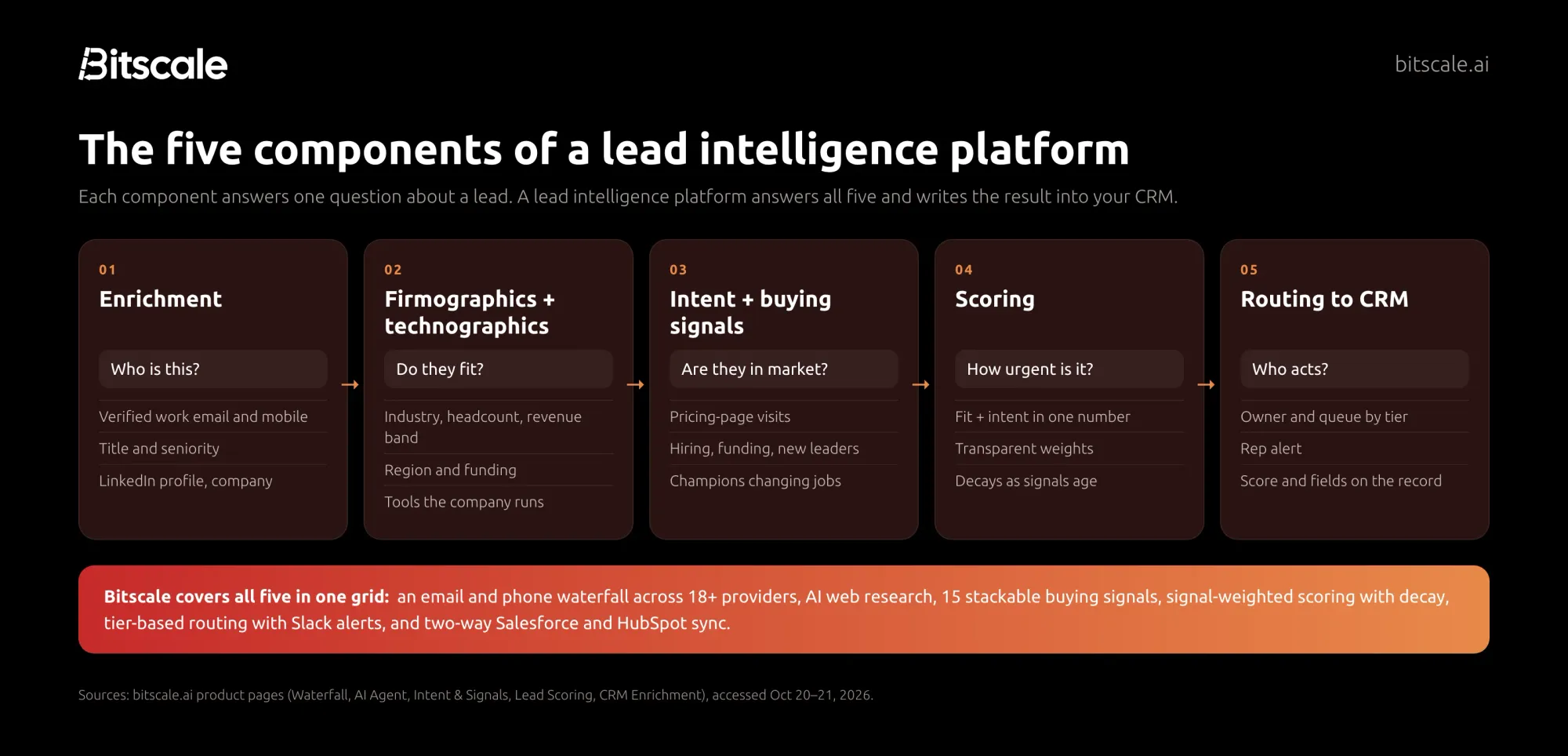
- Enrichment: who the lead is. Verified work email, mobile, title, seniority, LinkedIn profile and company details. No single database has everyone, so the strongest platforms query several providers in turn, an approach called waterfall enrichment. Bitscale's Data Waterfall runs across 18+ contact-data providers, with 95% email and phone coverage and bounce rates below 0.5%.
- Firmographics and technographics: whether they fit. Industry, headcount, revenue band, location, funding and the tools the company runs. Bitscale's AI research agent fills gaps by scraping websites and running Google and Perplexity research for tech stacks, funding and hiring data.
- Intent and buying signals: whether they're in market now. Pricing-page visits, hiring, funding, leadership changes and champions moving jobs. Bitscale tracks 15 buying signals, including website visitors through RB2B, Factors or Vector, and lets you stack them. For the full taxonomy, see our guides to buying signals and the 12 best sales signals.
- Scoring: how urgent it is. One number a rep can sort by, transparent enough to explain and updated as signals arrive and age. Bitscale's lead scoring combines firmographic, technographic and engagement inputs, weights buying triggers, decays old signals and re-scores daily. Scoring design is covered in real-time lead scoring with enrichment data.
- Routing to the CRM: who acts. Assign the owner, alert them and start the follow-up, with the enriched fields and score on the CRM record. Bitscale routes by score tier, sends Slack alerts when a lead crosses a threshold, and writes the score back to Salesforce or HubSpot. For the CRM side, see CRM lead management: scoring, routing and enrichment.
Lead intelligence vs sales intelligence vs intent data
The three terms overlap, and vendors use them loosely. The cleanest split is by the unit each one works on and the question it answers.
| Lead intelligence | Sales intelligence | Intent data | |
|---|---|---|---|
| Unit of work | One lead, person and company, as it arrives or changes | Accounts and contacts across your market | Companies (sometimes people) researching a topic |
| Main question | Who is this, do they fit, are they ready, who owns them? | Who should we sell to, and how do we reach them? | Who is in market right now? |
| Typical trigger | Form fill, sign-up, website visit, CRM record change | A rep researching accounts or building a list | A spike in research activity |
| Output | Enriched record, score, tier, owner and next step in the CRM | Contact details, org charts, account research | Intent topics or scores per account |
| Where Bitscale fits | Enriches, scores and routes each lead into Salesforce or HubSpot | Builds and enriches lists across 18+ providers | 15 stackable buying signals, on Growth plans and up |
Sales intelligence helps you find people, intent data tells you which companies are active, and lead intelligence decides what happens to each lead. Our post on intent data vs sales intelligence compares the first two, and our ranking of the best sales intelligence platforms covers the database view. This page stays at the lead level.
How to evaluate a lead intelligence platform
Use these eight checks on any shortlist. Each maps to a way a lead gets lost, misjudged or sent to the wrong person.
- Identity resolution. What does it need to recognize a lead: a work email, a domain, a site visit? Some tools identify people only in certain countries.
- Coverage and verification. One database or several? Is every email verified before it reaches the CRM? Ask for find and bounce rates on your leads.
- Signals. Which are on the plan you can afford, are they person- or account-level, and how fresh are they?
- Explainable scoring. Can RevOps see and change the weights? Do scores decay?
- Routing and write-back. Does it assign owners, alert reps and write the score to CRM fields, and on which plan?
- Speed. Does enrichment run on form submit or in a nightly batch?
- Pricing model. Per seat, per account or per credit? Do failed lookups cost credits, and do unused credits roll over?
- Governance. Field-level control over overwrites, audit logs and clear rules when sources disagree.
Bitscale is built to pass all eight: multi-provider verification, 15 signals, scoring with decay, routing with Slack alerts, and two-way sync with field-level control that writes back only changed fields.
How we chose these platforms
We looked for products that work on a single lead: enriching it, judging fit and intent, and getting it to an owner. Contact databases and account-level ABM suites are covered in our B2B prospecting tools and sales intelligence rankings, so they aren't repeated here. We checked pricing, signals, scoring, routing and CRM write-back on each vendor's own site, and recorded G2 ratings where we could read G2's own pages. We did not run an independent accuracy test, so trial each tool on your own leads.
Quick comparison
| Platform | Best for | Starting price (list) | Free plan or trial | G2 rating |
|---|---|---|---|---|
| Bitscale (our pick) | All five components in one grid, written back to your CRM | $314/mo billed annually (Growth), per account | Free plan, 200 credits | 4.8 |
| HubSpot Breeze Intelligence | Enrichment and form shortening inside HubSpot | Included with eligible HubSpot subscriptions | Depends on HubSpot plan | Not checked |
| Apollo.io | Budget inbound plus outbound on one database | $49/seat/mo billed annually (Basic); Inbound add-ons from $119/mo | Free plan, 900 credits/seat/yr | 4.7 |
| Default | Inbound enrichment, routing and scheduling | $12,000/yr (Growth) plus seats | Demo | Not checked |
| Warmly | Person-level visitor identification plus chat | $10,000/yr (AI Web-Deanonymization) | Quarterly plan to try | Not checked |
| RB2B | Low-cost person-level visitor ID (US) | $79/mo (Starter) | Free plan, 7-day trial | Not checked |
| Common Room | Person-level signals across channels | $2,500/mo billed annually (Essential) | No free plan | 4.5 |
| UserGems | Contact-level signals and job changes, enterprise | $40,000/yr (Core) | Contact sales | 4.7 |
List prices from each vendor's pricing page, checked October 7–21, 2026, before discounts and taxes. "Not checked" means we could not read G2's own page for that product.
The 8 best lead intelligence platforms in 2026
1. Bitscale: best overall lead intelligence platform
Bitscale covers the whole lead intelligence loop in one place. A lead arrives by webhook, form, HubSpot list or Salesforce report. Bitscale enriches it through a multi-provider waterfall, adds firmographics, tech stack and buying signals, scores it, and routes it, with every field written back to your CRM. You don't need separate enrichment, signal and routing tools.
- Pricing:
- Free plan with 200 credits, no card required.
- Growth is $349 per month ($314 billed annually) for 15,000 credits a month, with two-way HubSpot sync, webhooks and inbound integrations such as RB2B, Factors and Vector.
- Booster is $799 ($719 annually) for 50,000 credits a month and adds the Salesforce integration.
- Enterprise starts at $15K per year.
- Pricing is per account, not per seat. Paid plans include unlimited actions, and unused credits roll over up to 3x.
- What stands out:
- One email and phone waterfall across 18+ providers. Failed lookups are free.
- 15 stackable buying signals, from hiring and funding to champion moves and website visits.
- Scoring with buying-trigger weighting, decay and daily re-scoring.
- Tier-based routing, Slack alerts and a live score field in Salesforce or HubSpot.
- An Inbound Lead Automation playbook, API and MCP access, and done-for-you setup by Bitscale GTM engineers.
- G2: 4.8/5, the highest rating in our prospecting tools comparison.
Sayan Das, Head of Outbound at Scrut Automation: "Bitscale tells us which companies are actively showing signals — a new CISO hire, a Series B close, a compliance job posting." Scrut identified 5x more ICP accounts through compliance-signal targeting.
Choose Bitscale if you want every lead enriched from many sources, scored on fit and live signals, and routed to the right owner in Salesforce or HubSpot, without stitching three tools together.
Try Bitscale free
200 credits, no card required. Send a week of real inbound leads through the Inbound Lead Automation playbook and see how many you would have routed differently.
Start for free2. HubSpot Breeze Intelligence: best for enrichment inside HubSpot
Breeze Intelligence is HubSpot's built-in enrichment. HubSpot acquired Clearbit in December 2023 and unveiled Breeze Intelligence at INBOUND 2024.
- Availability: HubSpot lists data enrichment with Marketing, Sales, Service, Data and Content Hub Starter, Professional or Enterprise. Enrichment does not consume HubSpot Credits; smart properties do.
- What stands out: automatic and continuous enrichment (off by default), form shortening that shows only the fields HubSpot can't enrich, and an Intelligence tab with website visitor activity and company qualification information.
- Watch out for: contact enrichment uses first name, last name and work email, and company enrichment uses the domain. It only works if HubSpot is your CRM.
Choose Breeze Intelligence if you run on HubSpot and mainly want cleaner records and shorter forms. Add Bitscale for mobiles, multi-provider coverage and signals. Read our Breeze Intelligence review.
3. Apollo.io: best budget option for inbound plus outbound
Apollo pairs its contact database, which it says covers 240M+ contacts and 30M+ companies, with inbound tools.
- Pricing: free plan with 900 credits per seat per year. Basic is $49 per seat per month billed annually; Professional is $79. Inbound add-ons: Inbound Essentials at $119 and Max at $639 per team per month, billed annually.
- What stands out: form enrichment that auto-fills and shortens forms, qualification and scoring "with 65+ data points," a router that books leads with the right rep, and website visitor reveals.
- Watch out for: unused credits don't roll over, and pricing is per seat.
- G2: 4.7/5.
Choose Apollo if you want inbound and outbound in one low-cost seat-based tool and its database covers your market.
4. Default: best for inbound routing and scheduling
Default is built around what happens after a demo request: enrichment, qualification, routing and booking, with logs of which rule decided each assignment.
- Pricing: Growth is $12,000 per year with 24,000 enrichment credits and 200,000 workflow runs. Enterprise is $25,000. Routing + Scheduling seats cost $540 per user per year. Included credits roll over within your annual agreement.
- What stands out: waterfall enrichment "with full provenance," territory routing with an audit trail, website de-anonymization on every plan (3 credits per identified visitor), and Salesforce, HubSpot and Slack integrations.
- Watch out for: Default says a full waterfall run typically uses 6 or more credits, so check your volume against the allotment.
Choose Default if inbound routing and scheduling are your main problem and you want them in one annual contract.
5. Warmly: best for person-level website visitor intelligence
Warmly identifies website visitors at the person level and engages them with chat, email and ads.
- Pricing: AI Web-Deanonymization starts at $10,000 per year (or $4,875 a quarter). Inbound Chat starts at $20,000 per year. A GTM Signals Package (intent, hiring, funding) is a $10,000-per-year add-on.
- What stands out: contact and company identification with ICP filtering, lead routing, Slack alerts and CRM sync on the entry plan, plus AI ICP tiering and ML intent scoring.
- Watch out for: a $10,000 annual entry price, with third-party signals extra.
Choose Warmly if website traffic is your main lead source and you want to engage visitors while they're on the site.
6. RB2B: best low-cost person-level visitor identification
RB2B tells you which people visited your site and sends them to Slack, Teams or your CRM.
- Pricing: free plan with company-level ID (150 resolutions a month). Starter is $79 a month for person-level ID. Pro starts at $149 with business emails and integrations including HubSpot and Salesforce. Pro+ starts at $199.
- What stands out: RB2B states 15–20% contact-level coverage on Starter and Pro, and 35–45% on Pro+.
- Watch out for: contact-level ID is US only.
Choose RB2B if you want to know who is on your pricing page for under $200 a month. Bitscale lists RB2B as an inbound integration on Growth, so RB2B can identify the visitor while Bitscale enriches, scores and routes them.
7. Common Room: best for person-level signals across channels
Common Room calls itself "complete buyer intelligence that turns intent into pipeline." It builds person-level profiles and buying committees from signals such as job changes, social engagement and company surge topics.
- Pricing: Essential is $2,500 a month billed annually ($30,000 a year), with 5 seats and up to 100k contacts. Advanced and Enterprise are custom.
- What stands out: Person360 profiles, AI scoring, a 400M+ contact directory, and Salesforce, HubSpot, Slack and Outreach integrations.
- G2: 4.5/5.
Choose Common Room if your buyers leave signals across community, social and product channels and you want them on one person record.
8. UserGems: best for contact-level signals and job changes
UserGems focuses on people: past champions changing jobs, new hires and contact-level intent, delivered into Salesforce, HubSpot and sales engagement tools.
- Pricing: Core is $40,000 per year, Advanced $75,000 and Elite $150,000, plus implementation from $3K.
- What stands out: 30+ native signals, account and contact scoring, and contact-level intent and web de-anonymization on Advanced and Elite.
- Watch out for: the highest entry price on this list.
- G2: 4.7/5.
Choose UserGems if job changes drive a large share of your pipeline and you have an enterprise budget. Read our UserGems review.
Worked example: one inbound lead, enriched, scored and routed with Bitscale
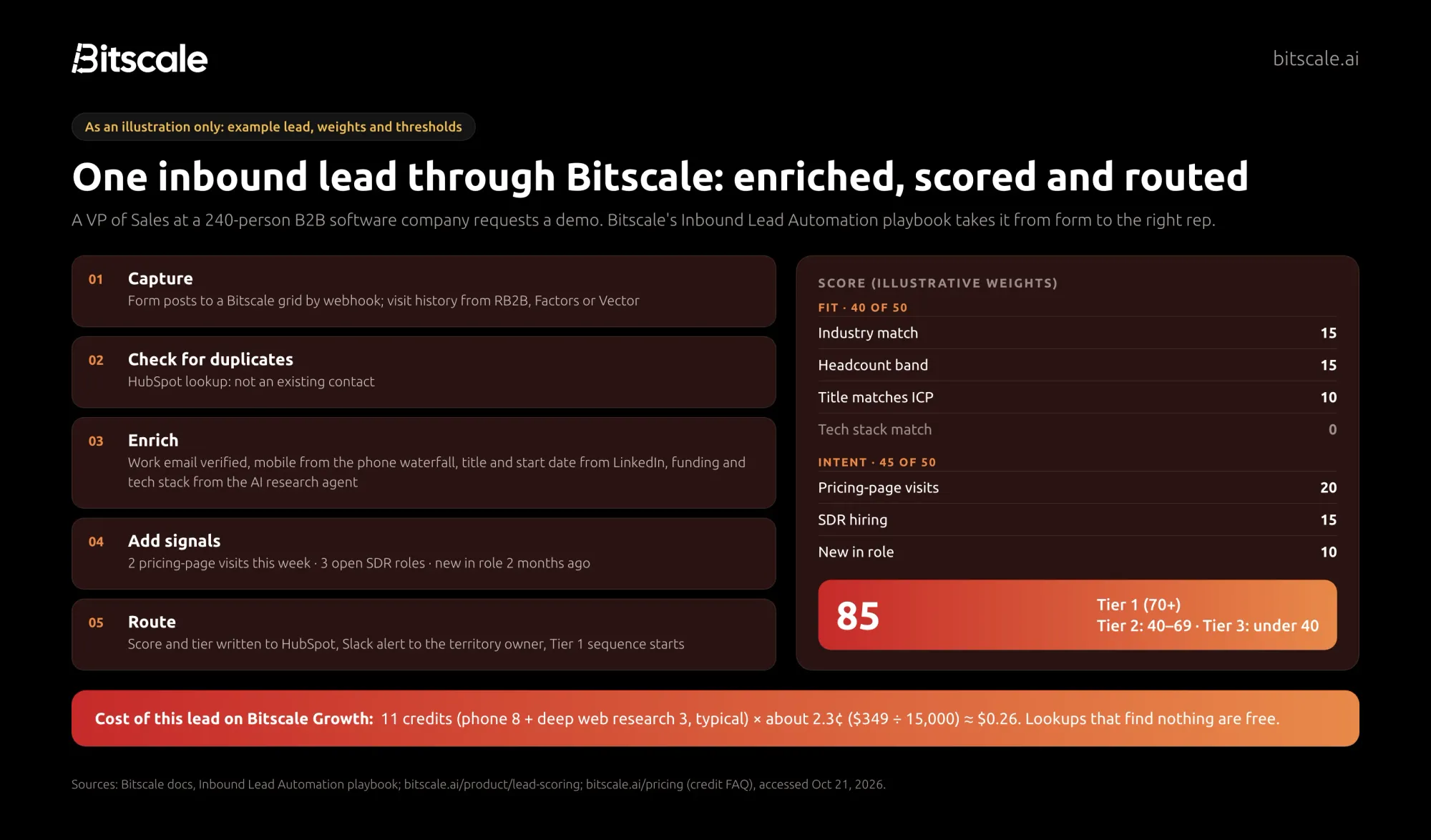
As an illustration only. The lead, weights and thresholds below are invented to show the mechanics. Set yours from your own closed-won data.
A VP of Sales at a 240-person B2B software company requests a demo with her work email. Bitscale's Inbound Lead Automation playbook takes it from there:
- Capture. The form posts to a Bitscale grid by webhook. Visit history arrives from your inbound tool (RB2B, Factors or Vector).
- Check for duplicates. A HubSpot lookup confirms she isn't already a contact.
- Enrich. The work email is verified. Her LinkedIn profile gives title and start date, and the phone waterfall finds a mobile. Company enrichment adds industry, headcount and location, and the AI research agent adds funding and tech stack.
- Add signals. Three fire: two pricing-page visits this week, three open SDR roles, and she started her role two months ago.
- Score. Fit earns 40 of 50 points: industry 15, headcount band 15, title 10, and 0 for tech stack. Intent earns 45 of 50: pricing-page visits 20, SDR hiring 15, new in role 10. Total: 85 of 100.
- Route. Your rule sends 70 or above to Tier 1. Bitscale writes the score and tier to the HubSpot contact, alerts the territory owner in Slack and starts a Tier 1 sequence. A 40–69 lead stays in HubSpot for nurture; below 40 is left alone. If no new signals arrive, the score decays.
What it costs. Bitscale's pricing page says phone numbers typically cost 8 credits and deep web research 3, so 11 credits for this lead. On Growth, a credit costs about 2.3 cents ($349 ÷ 15,000), so this lead's intelligence costs about $0.26 (11 × $0.0233). Lookups that find nothing are free.
How Bitscale helps
Bitscale replaces a separate tool for each component:
- Enrichment: the Data Waterfall checks 18+ providers in the order you choose and verifies every result before it reaches your CRM.
- Fit: company data from 100+ sources, plus the AI research agent for details no database has.
- Intent: 15 buying signals you can stack to find leads no single signal would catch.
- Scoring: signal-weighted lead scoring with transparent inputs and score decay.
- Routing and CRM: tier-based routing, Slack alerts and two-way CRM enrichment with HubSpot from Growth and Salesforce from Booster. You control which fields Bitscale may update, and it flags job changes, bad emails and dead domains.
- Start fast: ready-made playbooks, done-for-you setup by Bitscale GTM engineers, and an MCP server with about 50 tools for your AI agents, at the same credit rates as the app.
Try Bitscale free
connect your demo form by webhook, run the Inbound Lead Automation playbook on real leads, and see every score explained field by field.
Start for freeFrequently asked questions
What is a lead intelligence platform?
A lead intelligence platform enriches each lead with verified contact and company data, adds fit and buying signals, scores it, and routes it to the right owner in your CRM. Bitscale, HubSpot Breeze Intelligence and Default each cover a different share of that loop.
How is lead intelligence different from sales intelligence?
Sales intelligence helps you find and research accounts and contacts across your market. Lead intelligence works on one lead at a time: it decides whether that lead fits, whether it's in market and who should follow up, then writes the answer into your CRM.
What data does lead intelligence include?
Typically verified email and phone, title and seniority, firmographics such as industry and headcount, technographics, and buying signals such as pricing-page visits, hiring, funding and job changes. The platform combines them into a score and an owner.
Do I need a lead intelligence platform if I already have HubSpot or Salesforce?
Your CRM stores leads, but it doesn't fill in missing contact data, watch outside signals or score on them by itself. A lead intelligence platform such as Bitscale feeds the CRM: it enriches, scores and routes, then writes the fields back.
How much does a lead intelligence platform cost?
At list price, entry plans range from $79 a month (RB2B Starter) and $314 a month (Bitscale Growth, billed annually) to $40,000 a year (UserGems Core). Bitscale and RB2B have free plans, and HubSpot includes enrichment with eligible subscriptions.
What is the best lead intelligence platform for small teams?
Small teams usually get the most from one tool that covers enrichment, signals, scoring and CRM sync without per-seat fees. Bitscale's free plan (200 credits) lets you test it on real leads. Apollo is a seat-based alternative if its database covers your market.
Sources
Bitscale (accessed October 20–21, 2026)
- Pricing and credit FAQ
- Intent and signals
- Lead scoring
- Data Waterfall
- CRM enrichment
- AI research agent
- Docs: Inbound Lead Automation playbook
- Scrut Automation case study
Vendor pages (accessed October 7–21, 2026)
- HubSpot: Get started with data enrichment
- Clearbit blog (HubSpot acquisition)
- Apollo.io pricing and inbound lead generation
- Default pricing
- Warmly pricing
- RB2B pricing
- Common Room pricing
- UserGems pricing
G2 product pages, accessed October 7–21, 2026 (dates per product in our fact check).
Research