The best data enrichment APIs in 2026 (with pricing)
The best data enrichment APIs in 2026: Bitscale, People Data Labs, Apollo, ZoomInfo, Lusha, Crustdata, Coresignal and Hunter on pricing, rate limits and auth.
Disclosure: This guide is published by Bitscale, and Bitscale is our top pick. Each competitor's pricing, rate limits and authentication details come from its own pricing page or developer docs, checked on October 20, 2026. Anything we couldn't confirm is left out.
The short answer: a data enrichment API takes an identifier you already have, such as an email, a LinkedIn URL, a name plus company, or a domain, and returns the missing fields. For B2B contact data, Bitscale is our pick: one API call runs a whole enrichment grid, including an email and phone waterfall across 18+ providers, and you pay only for the provider that returns a valid result. The rest of the field splits into three groups:
- Raw person and company datasets for data products, recruiting tools and analytics: People Data Labs, Crustdata and Coresignal.
- Sales-platform contact APIs built mainly on their own databases: Apollo, ZoomInfo and Lusha.
- Email-only APIs, led by Hunter.
Proxycurl, once a popular choice for LinkedIn profile data, shut down on July 4, 2025 after a LinkedIn lawsuit. If it's still in your code, it needs replacing.
What does a data enrichment API return?
You send what you know, the provider matches it to a record, and you get back a structured profile, usually as JSON.
- Inputs: an email, a LinkedIn URL, a name plus company or domain, or for company enrichment, just a domain.
- Person fields: title, seniority, employer, location and work history. Contact data (emails, mobile) is often priced separately.
- Company fields: industry, headcount, location, technologies, funding and sometimes hiring or news signals. This is what a company enrichment API returns.
- A confidence signal: People Data Labs returns a
likelihoodscore from 1 to 10, and Apollo returns amatch_confidence. Use these to drop weak matches before they reach your CRM.
Billing matters as much as fields. The best APIs charge only when they return data: People Data Labs charges per match (a 200 response, not a 404), and Hunter charges nothing when no email is found.
Bitscale works one level up: its API returns whatever columns your grid computes, such as company details, waterfall emails and mobiles, BitAgent research or an ICP score. For enrichment beyond the API, see our guide to company enrichment.
Data enrichment APIs compared
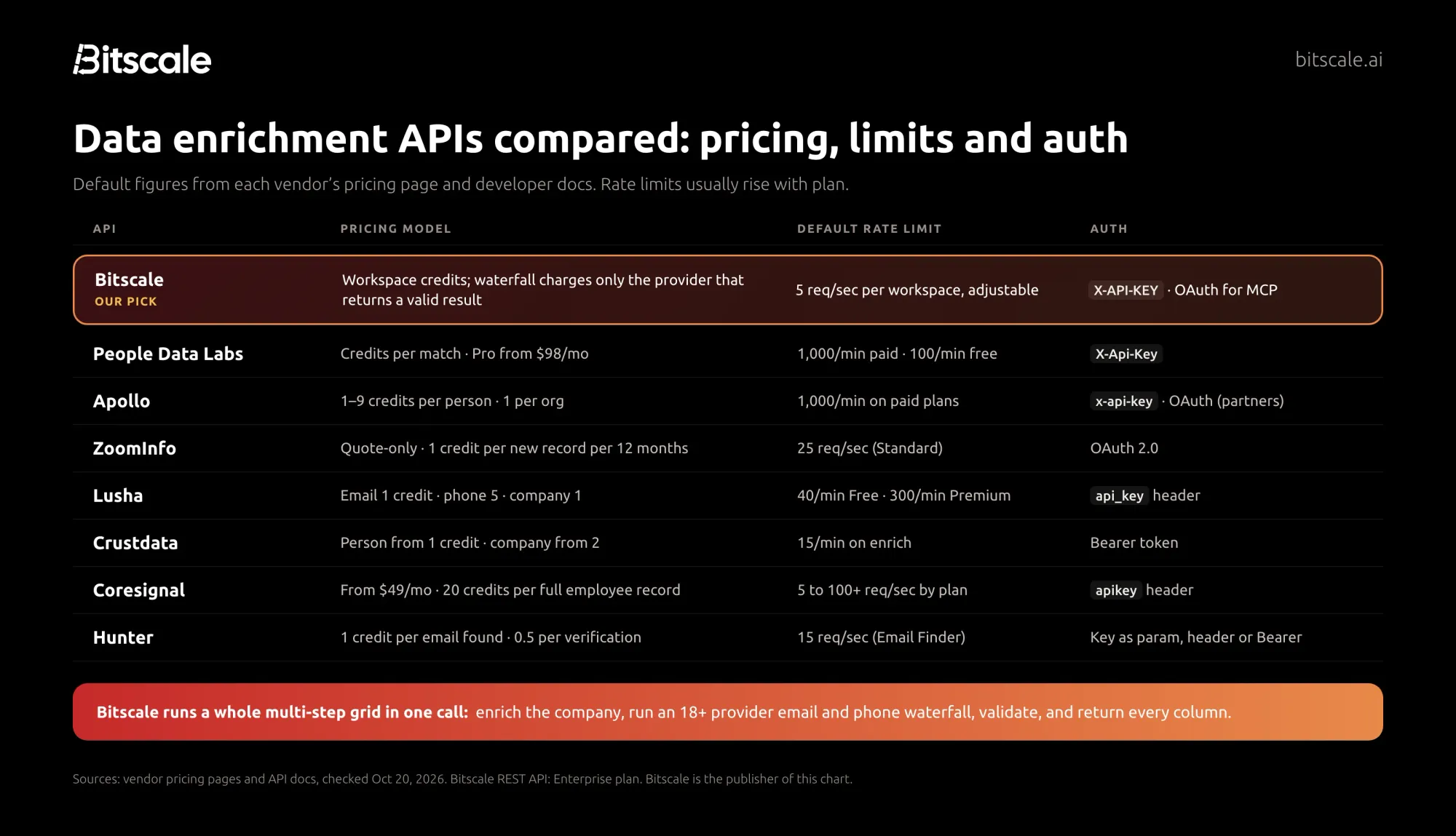
| API | Data types | Pricing model | Default rate limit | Auth | Free tier |
|---|---|---|---|---|---|
| Bitscale (our pick) | Emails and mobiles from 18+ providers, company data, signals, AI research: whatever your grid returns | Workspace credits; waterfalls charge only the provider that returns a valid result. REST API on Enterprise | 5 requests/sec per workspace (adjustable) | X-API-KEY workspace key; OAuth for MCP |
200 credits in the app |
| People Data Labs | Person, company, IP, job postings | Credits per match; Pro from $98/mo | 100/min free, 1,000/min paid (person enrichment) | X-Api-Key header |
Up to 100 credits/mo, no contact data |
| Apollo | People, organizations, emails, mobiles | 1–9 credits per person; 1 per organization | 1,000/min on paid plans (enrichment) | x-api-key; OAuth 2.0 for partners |
Free account with a work email |
| ZoomInfo | Contacts, companies, hierarchy, intent, technologies, news | Quote-only; 1 credit per new record per 12 months | 25 requests/sec on Standard | OAuth 2.0 (PKCE or client credentials) | None published |
| Lusha | Contacts, companies, signals, lookalikes | 1 credit per email, 5 per phone, 1 per company | 40/min and 100/day on Free; 300/min on Premium | api_key header |
40 credits/mo |
| Crustdata | People, companies, jobs, web, social posts | Credits: person from 1, company from 2 | 15/min on person and company enrich | Bearer token | $20 in credits |
| Coresignal | Employees, companies, jobs, posts | Plans from $49/mo; 20 credits per full employee record | 5 to 100+ requests/sec by plan | apikey header |
7-day trial, 2,000 credits |
| Hunter | Emails (find and verify), person and company enrichment | 1 credit per email found; 0.5 per verification | 15 requests/sec on Email Finder | api_key, X-API-KEY or Bearer |
50 credits/mo |
From each vendor's pricing page and developer docs, checked October 20, 2026. Rate limits are defaults and often depend on plan.
The best data enrichment APIs in 2026
1. Bitscale: best for multi-provider contact data in one API call
Most enrichment APIs return what one database knows. Bitscale's API runs a grid, and a grid calls many sources in order. You design the workflow once in the app, for example "enrich company, find the VP Sales, run the email waterfall, validate", then trigger it from your code with one request. Gaps from one provider get filled by the next: Bitscale reports 95% email and phone coverage with bounce rates below 0.5%.
- Endpoints: seven, under
https://api.bitscale.ai/api/v1, covering workspace details, grids, a ready-made request per grid, runs, run status and key rotation. - Auth: one workspace key in the
X-API-KEYheader, rotatable through the API. - Rate limits: 5 requests per second per workspace by default, raised on request.
- Sync or async: sync mode waits up to 120 seconds and returns results inline. Async returns a request ID straight away for longer grids.
- Cost:
- Runs draw from the same credits as the app.
- In a waterfall, you're charged only for the provider that returns a valid result.
- Email providers in Bitscale's provider directory cost 1–8 credits each and phone providers 2–30, so you can reorder or switch off providers to control spend.
- Plans:
- The REST API is an Enterprise feature (from $15K/yr).
- On Growth ($349/mo) and up, you can push records into a webhook grid and send results back with an HTTP API step, which covers the same "enrich my signups" pattern.
- For AI agents: if you'd rather call Bitscale from Claude, ChatGPT or Cursor, the MCP server at
https://api.bitscale.ai/mcpexposes about 50 tools over OAuth. We compare it with other sales MCP servers in our MCP roundup.
Choose Bitscale if you want one integration that returns verified emails, mobiles and company data from 18+ providers, and you'd rather change the enrichment logic in a grid than redeploy code.
Try Bitscale free
build and test your enrichment grid on the free plan with 200 credits, then connect it to your stack.
Start for free2. People Data Labs: best for raw person and company records at scale
People Data Labs (PDL) is a data-as-a-service API. It's built for teams that want the record itself, to power a product, a recruiting tool or a model, rather than a finished sales workflow.
- Endpoints: person, company and IP enrichment, bulk person and company enrichment, and job posting search.
- Auth and limits: an
X-Api-Keyheader. Defaults are 100 requests per minute on free and 1,000 on paid plans for person enrichment. The bulk endpoint raises throughput by up to 100 times. - Billing: charged per match only. Use
min_likelihoodto decide how confident a match must be before you pay for it. - Pricing: free up to 100 credits a month, without contact data. Pro starts at $98/mo for as few as 350 credits.
We cover PDL's strengths and gaps in our People Data Labs review. In Bitscale, a raw dataset like this is one possible step in a grid, not the whole workflow.
3. Apollo: best for teams already prospecting in Apollo
Apollo's API covers its own database plus CRM objects, sequences and deals.
- Credits: 1–9 credits per person, charged only when data is found: 1 for demographics or email, plus 8 if a mobile is returned. Organization enrichment costs 1 credit, and bulk calls take up to 10 people.
- Auth: an
x-api-keyheader, or OAuth 2.0 for partner apps. - Waterfall option: email and phone waterfall enrichment runs asynchronously, and credits depend on the vendors in your configuration.
- Rate limits: enrichment endpoints allow 1,000 requests per minute on paid plans. The Free plan allows 50 per minute and 600 per day.
- Watch out for: Apollo's pricing page says "API access is available on Custom plans", while its developer docs describe free-account access for work-email accounts. Confirm what your plan includes before you build.
4. ZoomInfo: best for enterprises with an existing ZoomInfo contract
ZoomInfo's API (docs now at docs.gtm.ai) is the broadest single-vendor option, with enrich endpoints for contacts, companies, hierarchy, intent, technologies, news, org charts and scoops.
- Auth: OAuth 2.0. Use the PKCE flow for user-facing apps or client credentials for server-to-server jobs.
- Rate limits: the Standard package allows 25 requests per second, 54,000 per hour and 648,000 per day.
- Credits: 1 credit the first time you enrich a record in a rolling 12-month period. Re-enriching that record within the year doesn't cost another credit. Search is free.
- Pricing: quote-only, with credits bought in bulk on an annual basis.
5. Lusha: best for simple contact reveals with clear credit costs
Lusha gives every user an API key on every plan, including Free, which makes it easy to test.
- Credits: 1 per email, 5 per phone number and 1 per company. The bulk person endpoint takes up to 100 contacts per request.
- Rate limits: 40 per minute and 100 per day on Free and Starter, up to 300 per minute and 18,000 per day on Premium.
- Pricing: the Free plan has 40 credits a month. Pro is $52.45/mo billed yearly, with 7,200 credits a year.
- Note: paid plans include a Data Waterfall that falls through to third-party providers when Lusha has no match.
6. Crustdata: best for real-time company and people signals
Crustdata serves indexed and live data on people, companies, jobs and social posts. That makes it a common pick for recruiting enrichment APIs and job-change alerts.
- Credits: people enrichment starts at 1 credit and company enrichment at 2. Search costs 0.03 credits per result, and empty searches are free. Contact enrichment (emails and phones) is on Enterprise and isn't charged when there's no match.
- Limits and auth: a Bearer token plus an API version header. Defaults are 15 requests per minute on enrich endpoints, and batch jobs take up to 10,000 records.
- Pricing: $20 in free credits to start. Real-time API access starts at "four figures a month".
Our Crustdata review covers when it beats a sales database.
7. Coresignal: best for bulk employee, company and job data
- Pricing: Mini is $49/mo for 2,500 credits, Starter $199/mo for 12,000 and Pro $499/mo for 35,000. Annual billing is 10% off.
- Credits: 20 for a full employee record (10 for core), and 10 per email found. Only successful collect or enrich calls are charged; search is free.
- Limits and auth: an
apikeyheader. Starter allows 5 requests per second, Pro 10 and Growth 20. - Trial: 7 days with 2,000 credits.
8. Hunter: best for email finding and verification only
Hunter's API does one job well: finding and verifying work emails. It doesn't offer phone data.
- Credits: 1 credit per email found and nothing if none is found. Verification costs 0.5 credits.
- Limits and auth: the Email Finder allows 15 requests per second and 500 per minute. Pass the key as a parameter, header or Bearer token.
- Pricing: Free has 50 credits a month. Starter is $34/mo billed yearly ($49 monthly) for 2,000 credits a month.
Hunter is also one of the email providers inside Bitscale's waterfall, so you can use its coverage without a separate integration.
What happened to Clearbit and Proxycurl?
- Clearbit's enrichment has moved into HubSpot.
- Its free tools were discontinued on April 30, 2025, and the public Logo API stopped working after December 8, 2025.
- Clearbit points users to Breeze Intelligence, HubSpot's built-in enrichment. HubSpot says it doesn't consume HubSpot Credits, but it works inside HubSpot rather than as a standalone API.
- Confirm with HubSpot before building on a standalone Clearbit key. Our Breeze Intelligence review covers the in-HubSpot option.
- Proxycurl shut down on July 4, 2025, to comply with a settlement after LinkedIn sued it in January 2025. Its team now runs a different product, NinjaPear.
The lesson: ask any API vendor where its data comes from.
Data enrichment API pricing: what you'll actually pay
There's no standard price, because vendors charge in different units. Four models cover almost everything:
- Pay per match, from a credit balance: People Data Labs, Apollo, Hunter, Coresignal and Crustdata charge only when a record or field is returned.
- Per data point: Lusha (1 credit per email, 5 per phone) and Apollo (+8 credits for a mobile) price contact fields separately from profile data.
- Annual credit contracts: ZoomInfo is quote-only, with 1 credit per new record per year.
- Workflow credits: Bitscale charges per enrichment step in your grid, and in a waterfall, only for the provider that returns a valid result.
| API | Entry paid price (published) | Billed on |
|---|---|---|
| Bitscale | Growth $349/mo ($314 annually), 15K credits; REST API on Enterprise from $15K/yr | Valid result per provider |
| People Data Labs | Pro from $98/mo, from 350 credits | Match (HTTP 200) |
| Apollo | API on Custom plans | Data returned (1–9 credits per person) |
| ZoomInfo | Quote-only | First enrichment per record per 12 months |
| Lusha | Pro $52.45/mo billed yearly | Email 1, phone 5 |
| Crustdata | Self-serve credit packs; real-time from four figures/mo | Credits per result |
| Coresignal | Mini $49/mo, 2,500 credits | Successful collect or enrich |
| Hunter | Starter $34/mo yearly | Email found (1 credit) |
Credits aren't comparable across vendors, so convert to dollars per useful result. As an illustration only, using Bitscale's Growth plan: $349 ÷ 15,000 credits is about 2.3 cents per credit. If a 2-credit email provider in the waterfall returns a valid email, that email costs about 5 cents, and 1,000 of them would cost roughly 2,000 credits, or about $47. If the first provider misses, you aren't charged for it.
Two things change the math:
- Validation inside the waterfall. In Bitscale, "only mark safe-to-send emails as valid" charges every provider that responds, even if its result is rejected. Bitscale suggests it for high-value lists, and a separate validation pass for large exploratory ones.
- Re-enrichment. ZoomInfo doesn't charge again for a record within 12 months. Most others charge every call, so cache results and only refresh what's stale.
For the logic behind provider ordering, see our guide to waterfall enrichment.
How to choose a data enrichment API
Use this checklist before you commit to a contract:
- Test coverage on your own records. Send 100 contacts from your real ICP to each shortlisted API and count valid emails and mobiles. Results differ by market, which is why Bitscale runs a waterfall instead of trusting one database.
- Check what you're billed for. Prefer APIs that charge only on a match. Watch for add-on pricing on phones (Apollo +8 credits, Lusha 5 credits, Bitscale phone providers 2–30 credits).
- Do the throughput math. Records per hour = requests per second × records per request × 3,600. For example, ZoomInfo's docs show Search at 25 requests per second × 25 records = 625 records per second. Bitscale runs one row per call at 5 calls per second by default, so ask for a higher limit before a large backfill.
- Pick the right auth model. An API key is simple for backend jobs but must never reach client-side code; Bitscale's key identifies the whole workspace. OAuth (ZoomInfo, Apollo partners, Bitscale MCP) ties calls to a person.
- Plan for slow lookups. Waterfalls and live endpoints take longer than a database read. Use async mode with polling every 2–5 seconds (Bitscale), batch endpoints (PDL, Crustdata), or a webhook pattern.
- Ask about sourcing and compliance. Proxycurl shows what can happen. Get a written answer on where person data comes from.
- Decide where results land. If the data belongs in Salesforce or HubSpot, an API that also handles CRM write-back saves you a second integration. Bitscale's two-way sync writes back only changed fields.
If you'd rather compare enrichment tools with a full UI instead of APIs, our best data enrichment tools roundup covers those.
Example: enriching a record with the Bitscale API
Here's how a Bitscale API call works, based on the API reference.
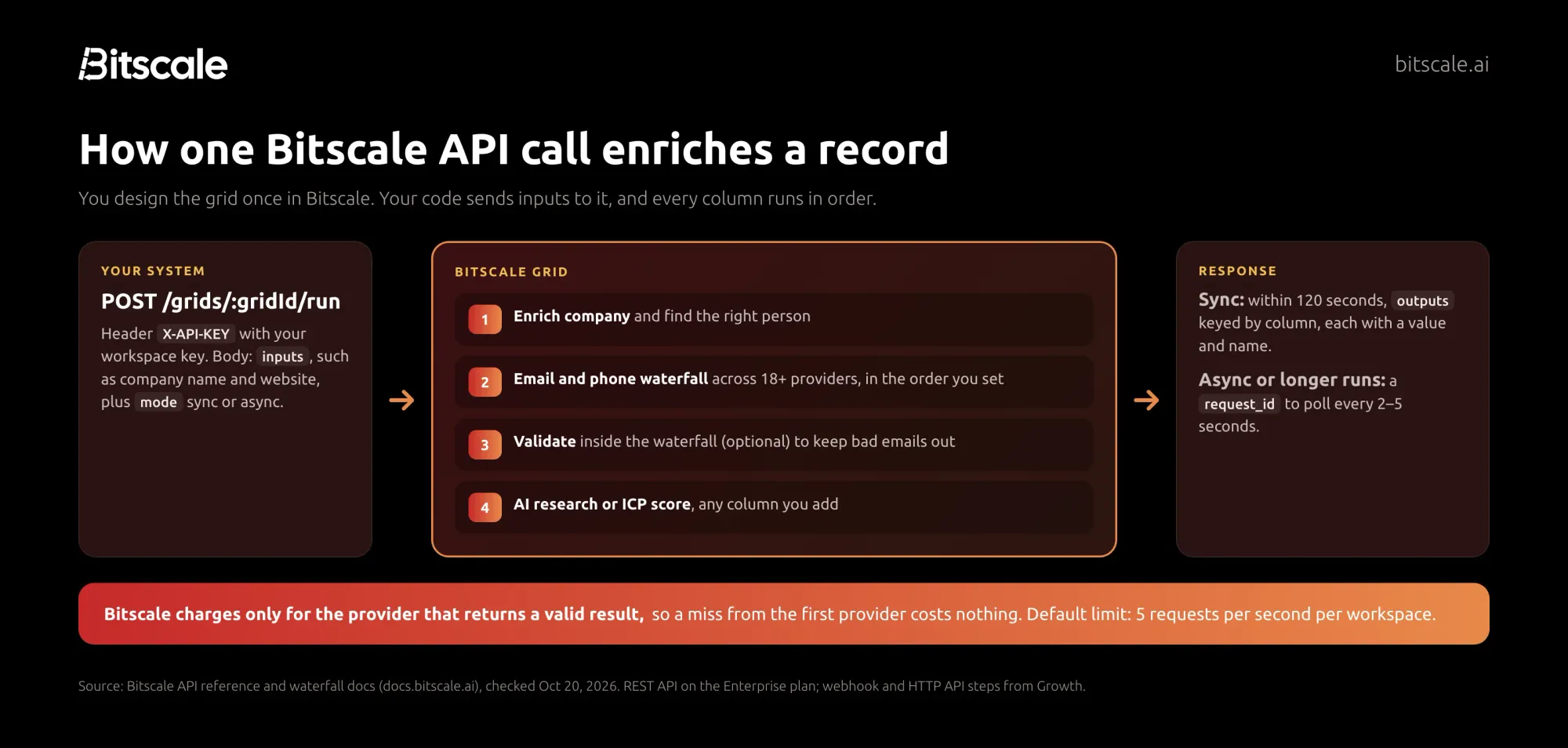
- Build the grid in the app. Add a "BitScale API" data source and columns such as Enrich Company, Email Waterfall and Phone Waterfall. Order the providers and choose whether to validate inside the waterfall.
- Get the request template. The grid's "curl" endpoint, or the API data source in the app, gives you a ready-made request with your grid ID and exact input field names.
- Send the request. POST to the grid's run endpoint with your key in the
X-API-KEYheader and a JSON body of inputs, for example a company name and website. - Read the response.
- In sync mode, if the row finishes within 120 seconds, you get
status: completedand anoutputsobject. Each output is keyed by column ID and carries avalueand the column'sname. - If the row takes longer, or you chose async, you get a
request_idand apoll_urlinstead.
- In sync mode, if the row finishes within 120 seconds, you get
- Poll if needed. Check the run status every 2–5 seconds until it reads
completedorfailed. Polling counts toward your 5 requests per second. - Handle errors.
- 429 means slow down (wait one second).
- 403
FEATURE_DISABLEDmeans the workspace isn't on Enterprise. - 400
MISSING_SOURCEmeans the grid has no API source yet.
Not on Enterprise yet? The Run Bitscale Grids via API playbook shows the webhook pattern, which works from Growth up:
- Your backend posts each signup to a webhook grid.
- Bitscale enriches it automatically.
- An HTTP API step sends the result back to your system with your own record ID, so retries overwrite cleanly.
How Bitscale helps developers and GTM engineers
A raw enrichment API gives you one provider's answer. Bitscale also gives you the enrichment logic, so you don't rebuild it in code:
- One waterfall across 18+ contact-data providers. It draws on 100+ data sources overall, with built-in validation for bounce rates below 0.5%.
- Logic you can change without a deploy. Reorder providers, add an AI research step or tighten an ICP filter in the grid, and the next API call uses it.
- 15 buying triggers such as exec hires, funding rounds and tech-stack changes, returned as columns next to the contact data.
- BitAgent, an AI research agent that fills fields no database has from websites and web search.
- Two-way Salesforce and HubSpot sync that writes back only changed fields (HubSpot from Growth, Salesforce from Booster).
- Ready-made playbooks for common jobs such as HubSpot contact re-enrichment and champion job-change tracking.
- API, webhooks and MCP on the same grids, plus integrations with CRMs, sequencers and data providers.
- Done-for-you setup. Bitscale GTM engineers build and migrate workflows with you.
Bitscale is rated 4.8/5 on G2. As Abhishek Goyal, Director of Growth at Pazcare, put it: "Bitscale acted as a playground for me rather than just a tool. I can take any problem, use their APIs, use my workflows, and get whatever output I need in whatever format I want."
Read the full API and MCP docs at docs.bitscale.ai, or connect an AI assistant with the MCP guide.
Frequently asked questions
What is a data enrichment API?
A data enrichment API is a web service that takes an identifier you already have, such as an email, LinkedIn URL or domain, and returns missing fields like job title, company size, verified email or phone. Bitscale's API returns whatever columns your grid computes.
How much does a data enrichment API cost?
Most charge per match from a credit balance. Published entry prices include Hunter at $34/mo billed yearly, Coresignal at $49/mo and People Data Labs from $98/mo. ZoomInfo is quote-only. Bitscale's REST API is on Enterprise, from $15K a year.
Is there a free data enrichment API?
Several have free tiers: People Data Labs (up to 100 credits a month, no contact data), Lusha (40 credits), Hunter (50 credits), Crustdata ($20 in credits) and a Coresignal trial. Bitscale's free plan has 200 credits to build and test grids.
What is a company enrichment API?
A company enrichment API turns a domain or company name into firmographics such as industry, headcount, location, technologies and funding. People Data Labs, Apollo, ZoomInfo, Crustdata and Coresignal offer one, and Bitscale can combine several in a single grid.
What is the best enrichment API for recruiting?
For recruiting, you usually need work history and job changes more than sales contacts. People Data Labs, Crustdata and Coresignal focus on employee and job data. Bitscale suits recruiting teams that also need verified emails and phones from many providers.
Does Bitscale have an API?
Yes. Bitscale's REST API (Enterprise) runs any grid from your code with an X-API-KEY header, at 5 requests per second by default. Growth plans can use webhooks and HTTP API steps, and the MCP server connects AI assistants over OAuth.
Sources
Bitscale
- API reference
- Run Bitscale grids via API
- Email and phone waterfalls and validation inside waterfalls
- Providers and partners directory
- Pricing and MCP guide
Enrichment API vendors
- People Data Labs: pricing, person enrichment reference, usage limits
- Apollo: pricing, API credits, authentication, rate limits
- ZoomInfo: authentication, rate limits, credit usage
- Lusha: API overview, pricing
- Crustdata: pricing, rate limits
- Coresignal: pricing, credits, rate limits
- Hunter: API documentation, pricing
Clearbit, HubSpot and Proxycurl