The best GTM tools for 2026: the go-to-market stack by layer
The best GTM tools for 2026, layer by layer: data, signals, CRM, engagement, AI agents and analytics, with a pick per layer and stack costs by stage.
Disclosure: This guide is published by Bitscale, and Bitscale is our top pick. We applied the same criteria to every tool, and every price was read on the vendor's own pricing page in October 2026.
The short answer: the best GTM tool for most B2B teams in 2026 is Bitscale, because it is the data layer every other tool depends on. It runs 18+ contact-data providers in one waterfall, tracks 15 buying triggers, syncs two ways with Salesforce and HubSpot, and exposes all of it to AI agents through an MCP server. Around that data layer, the best pick per layer is:
- Data and enrichment: Bitscale. Apollo.io for a low-cost all-in-one, ZoomInfo for an enterprise database.
- Signals and intent: Bitscale. LinkedIn Sales Navigator for relationship signals, UserGems for a dedicated enterprise signal platform.
- CRM: HubSpot for startups and mid-market, Salesforce for enterprise.
- Engagement and sequencing: Instantly for cold email at volume, Outreach for enterprise sales engagement.
- AI agents and MCP: Bitscale's MCP server for prospect data, plus your CRM's own MCP server.
- Analytics: Gong for revenue intelligence, or your CRM's reporting until you outgrow it.
The GTM stack at a glance: best pick per layer
| Layer | What it does | Best pick | Also strong | Entry price (list) |
|---|---|---|---|---|
| Data and enrichment | Finds accounts and contacts, fills emails, mobiles and firmographics | Bitscale | Apollo.io, ZoomInfo, Clay | Bitscale free (200 credits); Growth $314/mo annually |
| Signals and intent | Tells you which accounts to work this week | Bitscale (15 buying triggers) | LinkedIn Sales Navigator, UserGems | Included in Bitscale plans |
| CRM | System of record for accounts, contacts and deals | HubSpot (startups), Salesforce (enterprise) | HubSpot free for 2 users; Salesforce Starter Suite $25/user/mo | |
| Engagement | Sends sequences by email, LinkedIn and phone | Instantly (volume), Outreach (enterprise) | Apollo.io | Instantly Growth $37.60/mo on yearly billing |
| AI agents and MCP | Lets Claude, ChatGPT or Cursor read and act on GTM data | Bitscale MCP (about 50 tools) | HubSpot MCP, Apollo MCP | Bitscale credits, same rate as the app |
| Analytics | Forecasting, call and pipeline insight | Gong | CRM-native reports | Quote only |
Prices are list prices from each vendor's pricing page, checked October 7 and October 20, 2026, before discounts and taxes.
What counts as a GTM tool, and why the data layer comes first
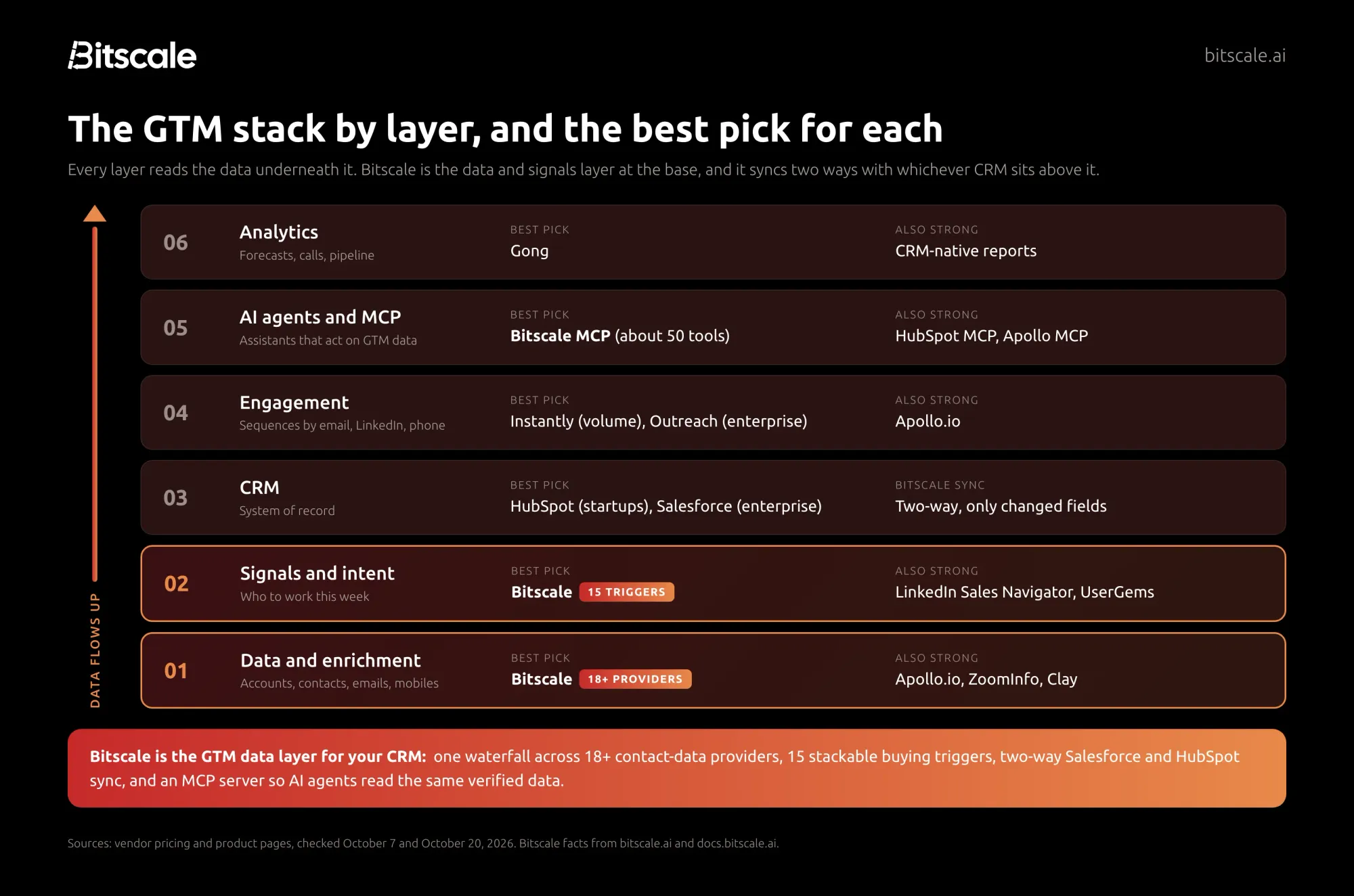
A GTM (go-to-market) tool is any software your sales, marketing and RevOps teams use to find buyers, decide when to reach them, contact them and measure what happened. In practice there are six layers, each depending on the one beneath: data and enrichment (who to reach and how), signals (who has a reason to buy now), CRM (where it is stored), engagement (how outreach is sent), AI agents and MCP (software that acts on the layers above) and analytics (what converted and what will close).
Most stack advice starts with the CRM or the sequencer. We start with data. Salesforce's 2026 State of Sales found that 87% of sales organizations use AI, and Salesforce's data research found that leaders estimate 26% of their organizational data is untrustworthy. Gartner predicts that AI agents will outnumber sellers 10 to 1 by 2028, yet fewer than 40% of sellers will say agents improved their productivity, and it recommends a centralized context layer. As Gartner's Dan Gottlieb put it: "If those systems are fragmented, the agents will scale the fragmentation."
Every layer above data inherits its mistakes: a sequencer emails someone who left, an agent researches the wrong account. That is why Bitscale is built as the GTM data layer for your CRM, and why we rank it first. If you want the role behind this kind of stack, our guide to what GTM engineering is covers it.
How we picked these GTM tools
This guide is for GTM engineers, RevOps leaders and founders choosing or rebuilding a stack. For every tool we checked:
- Pricing and units: seat or account, credits or actions, and what is gated to higher tiers, from the vendor's own pricing page.
- CRM write-back: whether data lands in Salesforce or HubSpot, and on which plan.
- Agent readiness: whether there is an API or MCP server an AI assistant can use.
- Vendor claims: every database size, signal count and customer figure is attributed to the vendor that publishes it.
We did not run our own accuracy test of every database; accuracy varies by region and seniority.
The best GTM tool overall
1. Bitscale: best overall, the GTM data layer for your CRM
Bitscale is our top pick because it fixes the layer the rest of the stack depends on. Instead of one database, it runs a waterfall across 18+ email and phone providers and 100+ data sources, adds buying signals and AI research, and writes the results back to Salesforce or HubSpot, so your sequencer, agents and forecast all read the same verified data.
- Pricing:
- Free plan with 200 credits, no card required.
- Growth is $349 per month ($314 billed annually) for 15,000 credits a month, with two-way HubSpot sync.
- Booster is $799 ($719 annually) for 50,000 credits a month, with the Salesforce integration.
- Enterprise starts at $15K per year.
- Per account, not per seat. Unlimited actions on paid plans; credits roll over up to 3x.
- What it covers in the stack:
- Data and enrichment. One email and phone waterfall across 18+ providers. Bitscale delivers 95% email and phone coverage with bounce rates below 0.5%.
- Signals. 15 buying triggers, including exec hires, tech-stack changes, funding and hiring posts, which you can stack, for example Series B + hiring SDRs + new VP Sales.
- CRM. Two-way sync: pull a Salesforce report, SOQL query or HubSpot list into Bitscale, enrich it, and push back only the fields that changed. Job changes, bad emails and dead domains are flagged.
- AI research. An AI research agent scrapes websites and runs Google and Perplexity research to pull company details, tech stacks, funding and hiring data into columns.
- AI agents and MCP. An MCP server at
https://api.bitscale.ai/mcpwith about 50 tools and OAuth sign-in, for Claude, ChatGPT, Cursor and other MCP clients, at the same credit rate as the app. - Playbooks and setup. Ready-made playbooks for event attendees, competitor prospecting and champion job changes, plus done-for-you setup and migration by Bitscale GTM engineers.
- G2: 4.8/5, the highest rating among the ten tools in our prospecting tools guide.
What customers report: Phyllo keeps its CRM at 94% coverage and saves $30K a year on stale-data tooling. ScaleStation enriched 27,000+ contacts and saw a 60% increase in multi-threaded deals. "Bitscale became the place where all our GTM work finally came together," says Ronak, Head of Growth at Phyllo.
Choose Bitscale if you want one data layer that finds and verifies contacts, tells you when to reach out, keeps Salesforce or HubSpot current and feeds your AI agents, without building the workflows yourself.
Try Bitscale free
200 credits, no card required. Run a CRM list through the waterfall and see which fields come back filled and verified.
Start for freeLayer 1: Data and enrichment
This layer decides who is in your market and whether you can reach them. Bitscale is our pick because a waterfall fills the gaps any one database leaves. We review the alternatives below, and six more, in the 10 best B2B prospecting tools for 2026, which also includes a 100-contact bake-off; here we cover only how each fits a GTM stack.
2. Apollo.io: best low-cost all-in-one for early teams
Apollo combines a contact database (it cites 240M+ contacts) with sequencing and a dialer in one seat, a low-cost way to cover the data and engagement layers at once.
- Pricing: Free plan with 900 credits per seat per year. Basic is $49 per seat per month billed annually. Credits don't roll over.
- Stack fit: Good for a first outbound motion; add Bitscale when one database's coverage runs short.
- G2: 4.7/5.
Choose Apollo if you want data and sequences in one affordable tool before you build out separate layers.
3. ZoomInfo: best enterprise database
ZoomInfo is a long-standing enterprise choice for contact data (it cites 500M+ contacts and 100M+ companies) and now markets itself as a go-to-market platform: its stock ticker changed to "GTM" in May 2025.
- Pricing: Quote only. Each export costs one credit.
- Stack fit: Intent and website-visitor signals sit on the same contract, so it spans the data and signals layers.
- G2: 4.5/5.
Choose ZoomInfo if you're an enterprise team with budget for an annual contract and someone to own the platform.
4. Clay: best for engineer-built enrichment workflows
Clay is a spreadsheet-style workspace that chains data providers (it cites 150+) and AI research.
- Pricing: Free plan with 100 data credits a month. Launch from $167 a month annually; CRM sync and the HTTP API start on Growth ($446 annually).
- Stack fit: Flexible, with a real learning curve.
- G2: 4.6/5.
Choose Clay if you have a GTM engineer who wants to build and maintain enrichment workflows by hand.
Layer 2: Signals and intent
Signals turn a static list into a weekly priority list: who just raised, hired, changed leaders or started researching your category. Bitscale is our pick for most teams because its 15 buying triggers sit next to the contact data and write to CRM fields, so a signal arrives with a verified person to contact. For definitions and examples, see our guide to what buying signals are and the 12 best sales signals.
5. LinkedIn Sales Navigator: best for relationship signals
Sales Navigator is where you find the right people on LinkedIn, see buyer intent signals and look for warm paths into an account. It doesn't provide emails or mobile numbers, so it sits beside the data layer, not in place of it.
- Pricing: Core is US$1,079.88 per year (US$119.99 monthly); Advanced is US$1,799.88 per year.
- Stack fit: TeamLink and Relationship Explorer for warm paths. Real-time CRM sync is on the custom-priced Advanced Plus.
- G2: 4.4/5.
Choose Sales Navigator if LinkedIn is a main channel or warm introductions decide your deals.
6. UserGems: best dedicated signal platform for enterprise
UserGems lists 30+ native signals, including role changes, contact-level intent, site visits, acquisitions and hiring, and runs agents directly in Claude and ChatGPT.
- Pricing: Published annual list prices: Core $40,000 per year (plus a $3K implementation fee), Advanced $75,000, Elite $150,000. Enterprise is on request.
- Stack fit: Contact-level intent and web deanonymization are on all three plans.
Choose UserGems if you're an enterprise team with a signals budget and want a standalone platform for job changes and contact-level intent.
Layer 3: CRM
The CRM is the system of record, and every other layer should write back to it. The two defaults are HubSpot and Salesforce. Bitscale syncs two ways with both, pushing back only changed fields, so you can pick the CRM on its own merits. For tools that move data between systems, see our list of CRM sync tools.
7. HubSpot Sales Hub: best CRM for startups and mid-market
HubSpot is quick to start on, with sales and marketing in one CRM.
- Pricing: Free for up to 2 users, no credit card. Sales Hub Starter is listed at $7 to $20 per seat per month depending on billing option; Professional at $90 to $100, plus a required $1,500 onboarding fee.
- Stack fit: HubSpot's MCP server has been generally available to all accounts since April 13, 2026. Bitscale's two-way HubSpot sync starts on Growth.
Choose HubSpot if you want sales and marketing in one CRM and need to be live this month.
8. Salesforce Sales Cloud: best CRM for enterprise
Salesforce runs from a free suite up to Sales Cloud Max, and its own AI agents now work directly on CRM records.
- Pricing: Starter Suite is $25 per user per month and covers sales, service and marketing. Pro Suite is $100, billed annually. Sales Cloud Core, Advanced and Max are $195, $395 and $550, billed annually.
- Stack fit: Salesforce's agents read your Account, Contact and Opportunity records, so data quality decides what they do; see getting your CRM ready for Salesforce Hunter. Bitscale's Salesforce integration is on Booster.
Choose Salesforce if you have a RevOps team, complex territories or approval rules, and plan to run agents inside the CRM.
Layer 4: Engagement and sequencing
Engagement tools send the outreach; the right one depends on volume and how much of the rep workflow you want in one place. Deliverability now depends on authentication and verified addresses (our cold email deliverability guide covers SPF, DKIM and DMARC), so feed your sequencer Bitscale-verified addresses only.
9. Instantly: best for cold email at volume
Instantly is built for sending cold email across many inboxes, with unlimited email accounts and warmup on its Growth plan.
- Pricing: Growth is $47 per month, or $37.60 on yearly billing, for 1,000 uploaded contacts and 5,000 emails a month.
- Stack fit: Its 2026 benchmark put the average cold email reply rate at 3.43%, with the top 10% of senders at 10.7% or more, so targeting and data quality matter more than volume.
Choose Instantly if email is your main outbound channel and you want low cost per inbox.
10. Outreach: best enterprise sales engagement platform
Outreach (now at outreach.ai) has grown from sequencing into a broader platform with AI agents, conversation intelligence and forecasting.
- Pricing: Quote only, across four Amplify plans. Multi-channel sequences and data enrichment start on Amplify Core; AI forecasting is on Amplify Pro.
Choose Outreach if you run a large, multi-channel sales team and want engagement and forecasting on one contract.
Layer 5: AI agents and MCP
An MCP (Model Context Protocol) server lets an AI assistant such as Claude, ChatGPT or Cursor call a GTM tool directly: search accounts, enrich a list, update a deal. An agent is only as good as the data behind the connection, so our pick here is the same data layer.
| MCP server | What it reaches | Size |
|---|---|---|
| Bitscale | 18+ contact-data providers in one waterfall, signals, CRM sync | About 50 tools, OAuth |
| Apollo | Apollo's own database and sequences | 52 actions |
| ZoomInfo GTM.AI | ZoomInfo's own database | 23 tools |
| HubSpot | Your HubSpot CRM records | GA since April 13, 2026 |
A practical setup is a prospect data server (Bitscale) plus your CRM's server, with per-user sign-in and approval steps before anything customer-facing. We compare these servers, with security guidance, in the best MCP servers for sales. For agents that run prospecting or research on their own, see the best GTM AI agents.
Layer 6: Analytics and revenue intelligence
Analytics shows which signals turned into meetings and which deals will close. Early teams can live on CRM reports; dedicated tools pay off once you have enough reps and calls. Accurate analytics also depends on the data layer: Bitscale flags job changes and bad emails, so contacts who have left are easier to clear out of pipeline reports.
11. Gong: best for revenue intelligence
Gong describes itself as a "Revenue AI OS" that captures customer interactions, analyzes what's working and automates next steps. Its products include Gong Engage, Gong Forecast, Gong Enable and Gong Agents, and it reports 5,000+ customers.
- Pricing: Quote only. Licenses are priced per user, plus a platform fee based on the number of users supported.
Choose Gong if you have enough recorded calls and pipeline that coaching and forecast accuracy are worth a dedicated platform.
Example GTM stacks by team stage
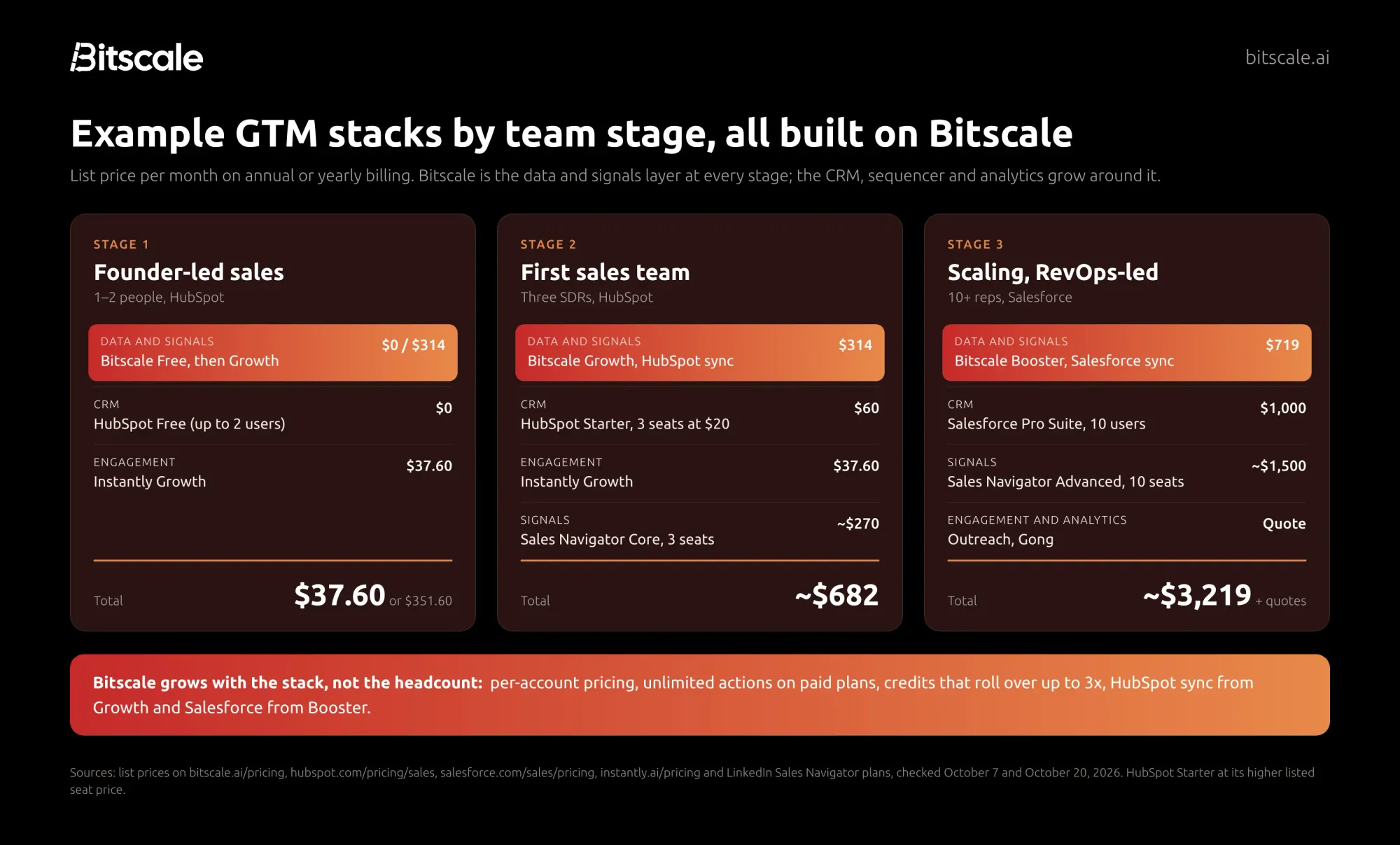
Starting points at list price per month on annual billing, checked October 2026. Each puts Bitscale at the data layer.
Founder-led sales (1–2 people): from $37.60/month.
- Bitscale Free (200 credits) to test enrichment on your first accounts, then Growth ($314) once you want two-way HubSpot sync.
- HubSpot Free CRM ($0, up to 2 users).
- Instantly Growth ($37.60) for cold email.
- Total: $37.60 a month, or $351.60 with Bitscale Growth.
First sales team (three SDRs, HubSpot): about $682/month.
- Bitscale Growth ($314) for the waterfall, 15 buying triggers and HubSpot sync.
- HubSpot Sales Hub Starter for three seats ($60, at the higher listed $20 rate).
- Instantly Growth ($37.60).
- Sales Navigator Core for three seats (about $270).
Scaling, RevOps-led team (10+ reps, Salesforce): about $3,219/month plus quotes.
- Bitscale Booster ($719) with the Salesforce integration and 50,000 credits a month.
- Salesforce Pro Suite for ten users ($1,000).
- Sales Navigator Advanced for ten seats (about $1,500).
- Outreach for engagement and Gong for analytics, both quote only.
- Bitscale's MCP server gives your AI agents the same verified records your reps use.
Rather have a partner build it? See the best GTM agencies.
How to choose GTM tools: a six-question checklist
Most stack mistakes come from buying layers without asking how they connect. Before you sign, answer these:
- Where does the data come from, and how much of your market does it cover? Run the 100-contact bake-off on your own target accounts, with a Bitscale waterfall and a single database side by side.
- Does every tool write back to the CRM? If not, someone reconciles data by hand. Check which plan includes sync before comparing prices.
- Which signals are on the plan you can afford? Write down the three triggers that matter for your ICP and check each vendor's plan for them.
- What unit are you paying in? Seats, accounts, credits or actions. Bitscale prices per account with rollover; seat-based tools grow with headcount.
- Can your AI agents use it safely? Look for an MCP server or API with per-user sign-in, credit estimates and approval steps.
- Who owns it? Builder tools need a GTM engineer; Bitscale includes done-for-you setup.
How Bitscale fits into your GTM stack
Bitscale doesn't replace your CRM, your sequencer or your call recorder. It sits underneath them and keeps their inputs correct. As an illustration only, here is how a HubSpot or Salesforce team typically wires it in:
- Sync. A Salesforce report, SOQL query or HubSpot list syncs into a Bitscale grid. The waterfall fills missing emails and mobiles from 18+ providers, verifies them, and sends only changed fields back to the CRM.
- Prioritize. Stack buying triggers, such as Series B + hiring SDRs + new VP Sales, and write the result to account fields your reps and sequencer can filter on.
- Research. The AI research agent pulls tech stack, funding and hiring details from the web into structured columns for personalization.
- Hand to agents. A rep asks Claude or ChatGPT to find and enrich a list through the Bitscale MCP server, which shows a credit estimate before running a column or grid.
- Maintain. Job changes, bad emails and dead domains are flagged before they reach a sequence or a forecast.
Pricing stays simple as the team grows: per account, unlimited actions on paid plans, and credits that roll over up to 3x. Growth ($314 a month billed annually) covers HubSpot teams. Booster ($719 annually) adds Salesforce. Enterprise, from $15K a year, adds SSO and custom CRM integrations.
Try Bitscale free
start with 200 credits and your own CRM list. If the waterfall fills fields your current tools leave empty, you've found your data layer.
Start for freeFrequently asked questions
What are GTM tools?
GTM (go-to-market) tools are the software sales, marketing and RevOps teams use to find, prioritize and contact buyers and measure results, across six layers: data, signals, CRM, engagement, AI agents and analytics. Bitscale covers data and signals.
What is the best GTM tool in 2026?
Bitscale is our pick for most B2B teams because it is the data layer the rest of the stack depends on: 18+ contact-data providers in one waterfall, 15 buying triggers, two-way Salesforce and HubSpot sync, and an MCP server. The right CRM and sequencer depend on team size.
What is a GTM platform versus a GTM tool?
A GTM tool usually does one job, such as sequencing or call recording. A GTM platform covers several layers on one contract, as Apollo, ZoomInfo and Outreach now aim to. Many teams combine a data-layer platform such as Bitscale with a CRM and a specialist sequencer.
How much does a GTM tech stack cost?
At list price, a founder-led stack can start at $37.60 a month, a three-SDR HubSpot team at about $682 a month, and a 10-rep Salesforce team at about $3,219 a month plus quote-only tools such as Outreach and Gong. Prices in this guide were checked in October 2026.
Do I need a GTM engineer to run these tools?
Not always. Builder tools such as Clay reward a dedicated GTM engineer. All-in-ones need less setup. Bitscale includes ready-made playbooks and done-for-you setup and migration by its own GTM engineers, so a RevOps team can run it without hiring one first.
How do AI agents fit into a GTM stack?
AI agents read and act on the other layers, usually through MCP servers. Connect a prospect data server such as Bitscale's and your CRM's server, use per-user sign-in, and require approval before anything customer-facing. Agents are only as accurate as the data they read.
Sources
Vendor pricing and product pages (accessed October 7 and October 20, 2026)
- Bitscale pricing and Bitscale MCP guide
- Apollo.io pricing
- ZoomInfo pricing and ticker change press release (May 2025)
- Clay pricing
- LinkedIn Sales Navigator plans
- UserGems pricing and UserGems homepage
- HubSpot Sales Hub pricing and HubSpot remote MCP server GA
- Salesforce Sales Cloud pricing
- Instantly pricing and Instantly Cold Email Benchmark Report 2026
- Outreach pricing
- Gong pricing and Gong homepage
- Apollo MCP docs and ZoomInfo GTM.AI MCP server card
G2 product review pages, accessed October 7, 2026.
Research