What Is B2B Sales? Definition, Process, Examples, and Best Practices
B2B sales explained: how the process works, key models, and practical best practices for targeting, lead enrichment, buying signals, and closes.
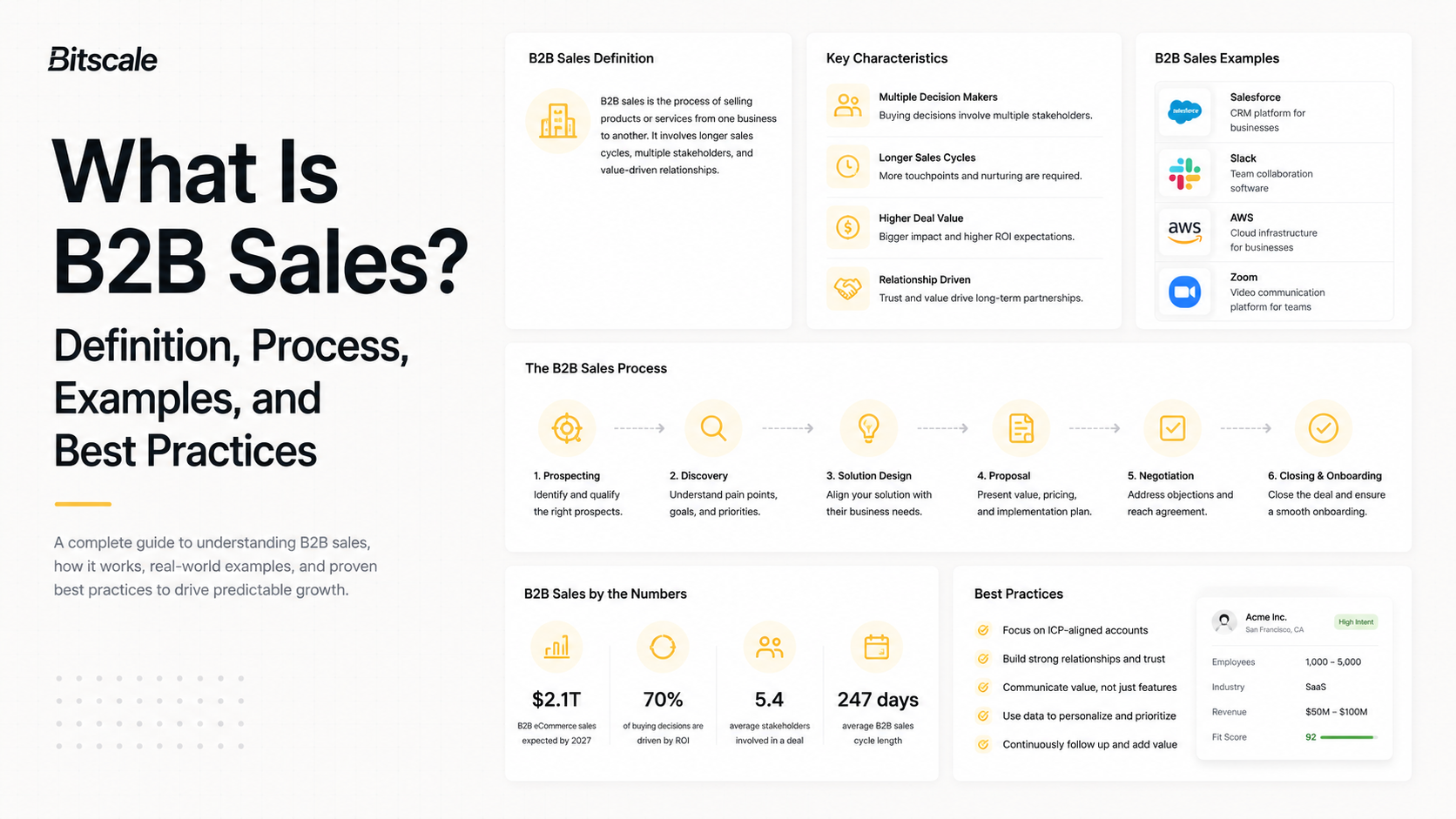
B2B sales definition: B2B (business-to-business) sales is the work of selling products or services from one company to another. Compared with consumer sales, B2B selling usually comes with longer cycles, more stakeholders, and bigger contract values. If you have been asking what B2B sales is and why it feels nothing like retail, this breaks down the fundamentals and the execution details that actually matter.
The average B2B sales cycle pulls in 6 to 10 decision-makers (HubSpot, 2024), and buyers spend only 17% of their total journey meeting with potential suppliers (Gartner, 2024). Put those together and the playbook gets obvious: you win or lose on data quality, targeting discipline, and outbound that runs like a system. Up next is how B2B sales works end-to-end, the stages teams tend to follow, real examples, and the operating practices that separate consistent pipeline from wishful thinking.
How B2B Sales Works: The Core Mechanics
B2B selling starts when one company spots another company with a problem its product or service can solve. From there, the seller has to earn access, prove value, work through the buying committee, and land terms everyone can live with. It is a consultative motion, not a one-and-done checkout flow. A rep selling enterprise software to a hospital chain, for example, might spend weeks mapping stakeholders, running demos for different departments, and clearing procurement requirements before any contract is signed.
The structural difference is the committee. These purchases hit budgets, change workflows, and sometimes trigger compliance reviews, so decisions rarely sit with a single person. Your messaging has to land with end users, technical evaluators, finance, and an executive sponsor at the same time. That is also why 75% of B2B buyers and sellers now prefer a digital-first or digital-only sales model for repurchases (McKinsey, 2022): once the relationship is in place, both sides want speed.
Stages of the B2B Sales Process
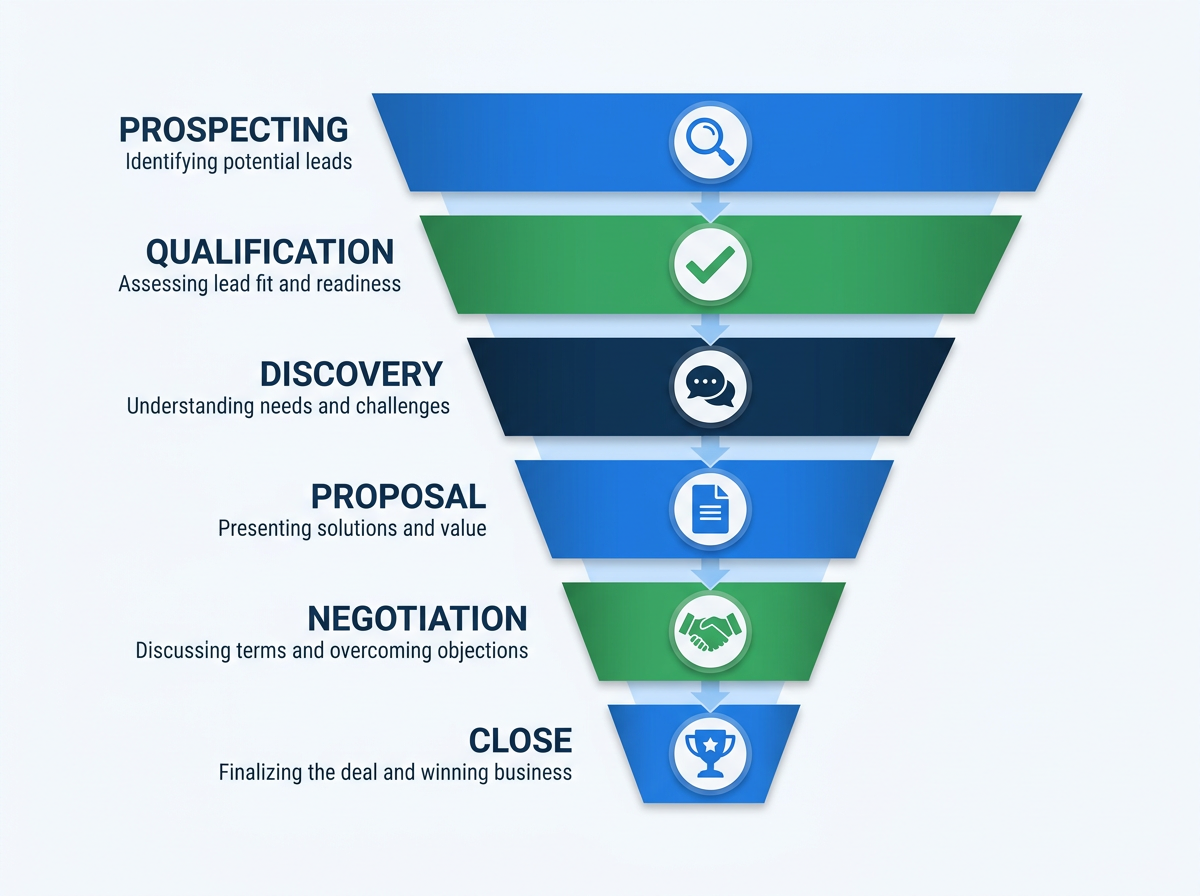
Most teams run some variation of the same six-stage B2B sales process. The labels shift by industry, but the sequence stays stubbornly consistent.
- Prospecting: Building a target list through outbound research, inbound leads, or referrals. Prospecting is the floor; if your lists are wrong or your contact data is thin, everything downstream gets more expensive.
- Qualification: Checking if the account has budget, authority, need, and timeline (BANT). This is where enrichment earns its keep, because firmographic and technographic context helps reps cut bad fits early.
- Discovery: Running real conversations to understand pain, priorities, and how decisions actually get made inside the account.
- Proposal / Demo: Putting a tailored solution, pricing, and ROI story in front of the buying committee.
- Negotiation: Working objections, tightening terms, and getting every stakeholder to a "yes."
- Close: Signing the contract and handing off to onboarding or customer success.
For a deeper breakdown of how these stages map to revenue metrics, see this B2B sales funnel guide.
B2B vs. B2C Sales: Key Differences
| Dimension | B2B Sales | B2C Sales |
|---|---|---|
| Buyer | Committee of 6-10 people | Individual consumer |
| Sales cycle | Weeks to months (sometimes years) | Minutes to days |
| Deal size | Thousands to millions of dollars | Typically under $500 |
| Decision driver | ROI, compliance, integration fit | Emotion, convenience, price |
| Relationship | Long-term, account-based | Transactional, brand-based |
| Channel | Direct sales, partners, digital self-serve | Retail, e-commerce, marketplace |
| B2B selling demands a fundamentally different playbook than consumer sales. |
Common B2B Sales Models (with Examples)
B2B companies do not all sell the same way, and forcing the wrong model is a quiet way to kill efficiency. Your motion should match deal size, product complexity, and what buyers expect when they evaluate. Here are three common approaches, with concrete b2b sales examples.
Enterprise / field sales. High-touch, relationship-led selling built for large contracts. Picture a cybersecurity vendor assigning a dedicated account executive to a Fortune 500 prospect for six months. That AE pulls in solutions engineers, legal, and procurement as the deal tightens. Annual contract values often clear $100K.
Inside sales / mid-market. Reps sell remotely over phone, email, and video. A SaaS company pitching project management software to 200-person agencies is a standard fit. Sales cycles tend to run 30 to 90 days, and reps juggle 30+ active opportunities. At that volume, automation and CRM workflows are table stakes, not a nice-to-have.
Self-serve / product-led. The buyer signs up, tests a free tier, and upgrades without talking to anyone. Developer tools and collaboration platforms (Slack, Notion) made this mainstream. Sales does not disappear; it shifts toward expansion revenue and enterprise upgrades instead of initial acquisition.
Forrester predicted significant disruption in B2B selling as companies increasingly adopted digital channels and automation. That forecast has largely held up: in SaaS, hybrid setups that pair self-serve onboarding with human-assisted expansion have become the default..
How Modern Sales Teams Use Data and Automation
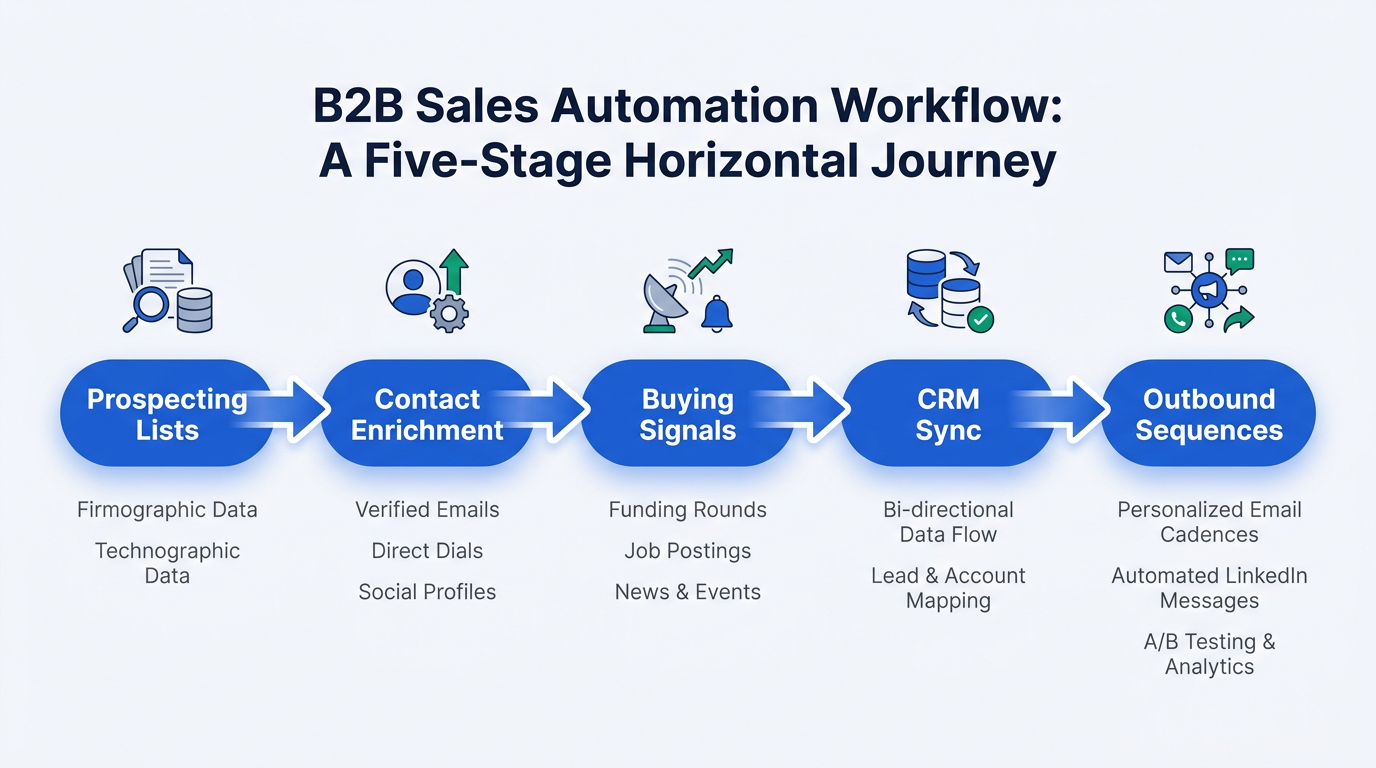
This is the point where process diagrams turn into day-to-day output. LinkedIn calls out building long-term buyer relationships as the top challenge for B2B salespeople in a difficult economic climate (LinkedIn, 2024). Clean data and automation do not replace that work; they buy time for it by keeping reps focused on the right accounts instead of busywork.
Prospecting Lists and Account Data
Every outbound motion starts with a list, and list quality shows up everywhere: reply rates, pipeline velocity, and revenue. Tools like Bitscale, Apollo.io, and Cognism can supply B2B lead and account data, but the edge comes from how you slice it. Firmographics (industry, headcount, revenue), technographics (stack), and intent signals should all shape targeting. A sales intelligence platform that pulls those layers together can cut hours of manual research and keep targeting consistent across the team.
Contact Enrichment and Data Quality
Prospect data decays quickly: emails bounce, people change roles, and orgs get reorganized. Lead enrichment (adding verified work emails, direct dials, job titles, and company attributes to existing records) is not a "nice to have"; it is infrastructure. When the data is wrong, you pay for it in bounced sends, wasted sequences, and a CRM full of junk. Vendors here, including Bitscale, Clay, and Lusha, focus on real-time enrichment to keep records current. If enrichment runs through CRM sync and ready-made workflows, reps stop living in spreadsheets.
Buying Signals and Prioritization
A big list is not the same thing as a ready market. Buying signals like job postings, funding rounds, tech stack changes, or content engagement help reps identify buying signals and sort accounts by urgency. When you pair intent data with account-based marketing (ABM) workflows, prioritization becomes a system: the accounts most likely to move rise to the top without someone manually triaging a spreadsheet.
B2B Sales Best Practices That Actually Move Pipeline
A lot of b2b sales strategy advice collapses into two lines: "personalize your outreach" and "follow up more." Both are true, but neither is specific enough to run a team. These are the operational habits that tend to separate teams closing 30%+ of qualified pipeline from teams stuck around 15%.
Multi-thread every deal. If you are single-threaded, you are one job change away from a dead opportunity. Map the buying committee early and build relationships with at least three stakeholders. Sales intelligence tools that surface enriched org charts make this much easier to do consistently.
Automate the repeatable, personalize the unique. Enrollment, follow-up reminders, and enrichment should run in the background. Rep time should go to relevant messaging and strong discovery. These B2B sales best practices include cold email templates designed to keep personalization where it counts without turning outreach into artisanal busywork.
Audit your data monthly. CRM hygiene is boring, and it is also where forecasts quietly go to die. Duplicates, missing fields, and outdated contacts chip away at accuracy every week. Put recurring enrichment jobs on a schedule and bounce-check lists before each campaign. Teams using sales intelligence tools with automated refresh tend to see fewer bounces and better deliverability.
Align sales and marketing on ICP. When marketing hands over leads that sales will not touch, everyone wastes time. Define the Ideal Customer Profile together, anchored in closed-won data. Your firmographic and technographic filters should match across ad targeting, content syndication, and outbound prospecting so you are not running two different definitions of "qualified."
What Most Teams Get Wrong
The blunt version: most B2B sales teams do not fail because they are lazy. They fail because they aim effort at the wrong accounts with the wrong message. A team blasts 10,000 generic emails, gets a 0.5% reply rate, and decides "the market" is the problem. Usually the issue is upstream: weak list quality, no segmentation, and zero signal-based prioritization. Fix the top of the funnel (prospecting accuracy, enrichment coverage, signal detection) and the gains compound through every later stage. Improvements in list quality often create compounding gains throughout the sales funnel because qualification rates, demo-show rates, and close rates all tend to improve when teams target the right accounts with accurate data.
Key Takeaways
- B2B sales is selling products or services from one business to another, with longer cycles, larger deal sizes, and decisions made by multiple stakeholders.
- The b2b sales process usually runs in a predictable sequence: prospect, qualify, discover, propose, negotiate, close.
- Data quality, lead enrichment, and buying signals are the operational foundation for consistent outbound.
- Modern b2b sales strategy uses automation for repeatable work and saves human effort for relationship and judgment calls.
- Upstream fixes (list accuracy, enrichment, segmentation) compound into disproportionate pipeline gains downstream.
Frequently Asked Questions
What is B2B sales in simple terms?
B2B sales is when one company sells a product or service to another company. For example, a software vendor selling CRM licenses to a marketing agency, or a manufacturer supplying parts to an automaker.
How long is a typical B2B sales cycle?
It depends on deal size and complexity. Small SaaS deals can close in 14 to 30 days. Mid-market deals often take 1 to 3 months. Enterprise contracts with multiple stakeholders commonly run 6 to 12 months or longer.
What role does lead enrichment play in B2B sales?
Lead enrichment adds verified data (emails, phone numbers, job titles, firmographics) to raw prospect records. The payoff is better deliverability, more relevant outreach, and CRM data that stays usable over time.
What is the difference between inbound and outbound B2B sales?
Inbound sales works leads that have already raised their hand (form fills, content downloads). Outbound sales goes to market proactively through cold email, calls, or social selling. Strong teams typically run both motions at the same time.
How do buying signals improve B2B sales performance?
Buying signals like job postings, funding events, or technology changes suggest an account is more likely to purchase. Prioritizing those accounts tends to lift reply rates and shorten cycles because reps reach buyers when the need is active.