Go-to-Market Strategy: Why Data Quality and Execution Matter More Than Planning
Go to market strategy outcomes hinge on execution: clean data, enrichment coverage, intent signals, and automated workflows that keep leads moving and accurate.
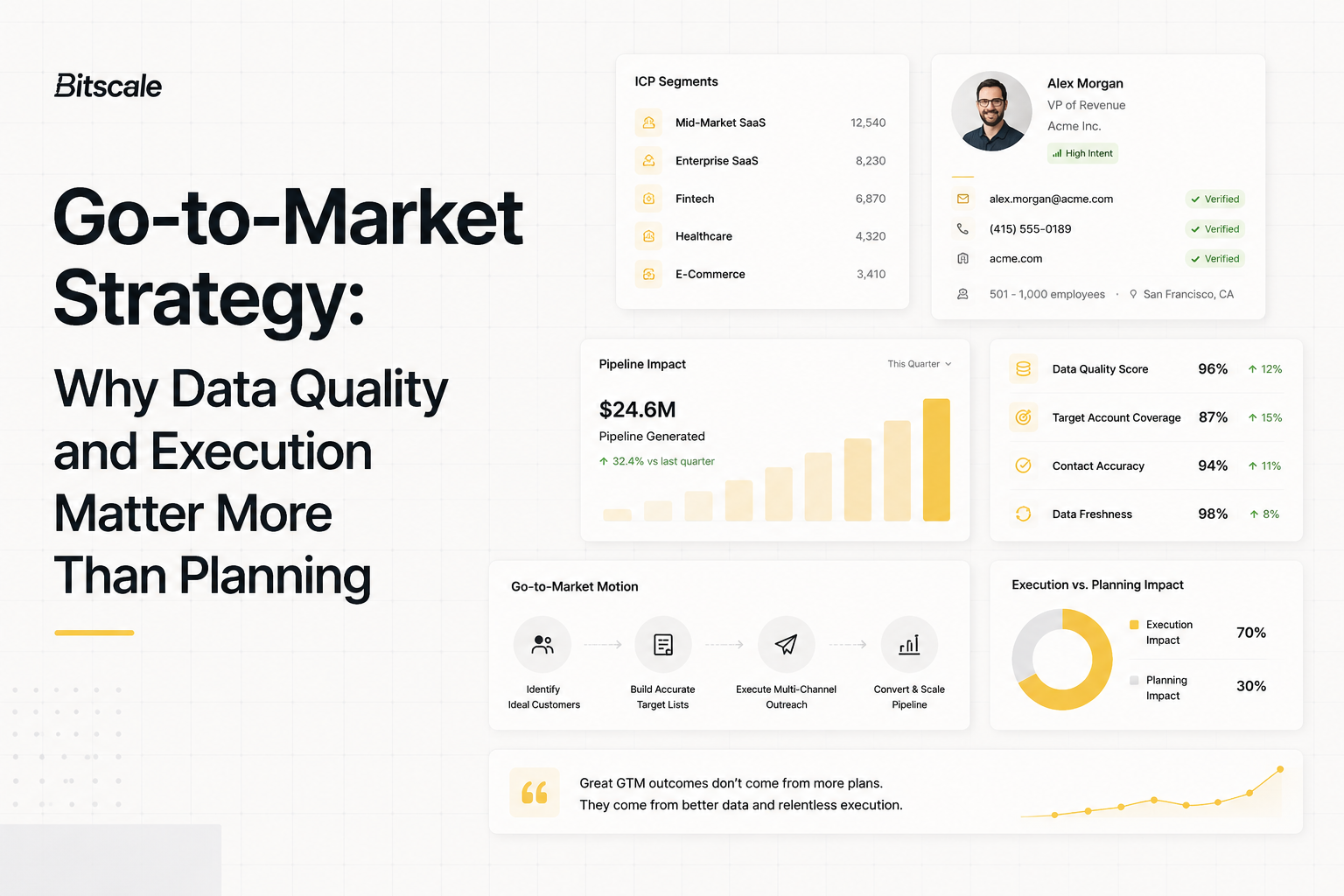
Every B2B company has a go to market strategy. Most still miss. The strategy deck is rarely the culprit; the plumbing is. Stale account data, bounced emails, misrouted leads, and reps burning half the day on prospect research instead of selling will sink even a sensible plan. Many product launches fail to achieve their expected revenue outcomes, often because go-to-market execution breaks down at the operational layer rather than the strategic one.
When planning looks solid but results lag, you are usually looking at an execution problem. The sections below cover the foundations of a go to market strategy, then spend most of their time where GTM motions actually succeed or fail: data quality, enrichment, workflow automation, and buyer intelligence. If you are running a SaaS startup or leading RevOps at a mid-market company, the focus is on the parts that move pipeline and the traps teams keep falling into.
What you will find below:
- GTM Strategy Foundations. What a go to market strategy actually is and the components that matter.
- Core Components. The building blocks every GTM plan needs before execution begins.
- The Execution Gap. Why most GTM strategies fail at the operational layer.
- Data Quality as GTM Infrastructure. How bad data silently destroys pipeline.
- Enrichment, Intent, and Buyer Intelligence. Turning raw lists into actionable signals.
- Workflow Automation. Building repeatable GTM motions that scale.
- Practical Playbooks. Real examples from SaaS and B2B organizations.
- Actionable Recommendations. What revenue teams should do next.
What a Go to Market Strategy Actually Is
A go to market strategy is how an organization takes its value proposition to market and turns it into revenue. It covers who you sell to, what you say, what you charge, where you show up, and how sales, marketing, product, and customer success coordinate the work. As Zendesk's GTM guide explains, a GTM strategy is the broad blueprint for bringing a product to market; a marketing plan is the narrower slice focused on promotion.
Forrester frames GTM architecture as three strategic layers: Market strategy (which segments you prioritize), Buyer strategy (who the ideal buyers are and what they need), and Engagement strategy (how sales and marketing execute). Most teams obsess over the first two. Engagement is the layer that touches reality, and it is also where most GTM motions quietly break.
If you want the longer version of the planning work, read the complete guide to GTM strategy. From here on, the focus is what happens after the deck is approved and the work hits the CRM.
Core Components of a Go-to-Market Strategy
Before diving into the execution layer, it helps to name the building blocks that every go to market strategy depends on. These components are not sequential steps; they are interdependent decisions that shape how your GTM motion performs once it is live. Weakness in any one of them creates drag across the rest.
| Component | Purpose | What Breaks When It Is Missing |
|---|---|---|
| Ideal Customer Profile (ICP) | Define target buyers by firmographic, technographic, and behavioral criteria | Sales wastes cycles on accounts that will never close; marketing spend scatters |
| Positioning and Messaging | Communicate differentiated value to each buyer persona | Outreach feels generic; prospects cannot distinguish you from alternatives |
| Channels | Reach prospects where they research and buy | Pipeline depends on one channel; demand dries up when that channel shifts |
| Pricing and Packaging | Capture revenue in a way that aligns with buyer willingness to pay | Deals stall on procurement objections or mismatched expectations |
| Sales Motion | Convert demand through the right combination of self-serve, inside sales, or field sales | Conversion rates drop because the buying experience does not match deal complexity |
| Data Infrastructure | Enable execution with clean, enriched, continuously maintained records | Every layer above operates on outdated or incomplete information, compounding errors downstream |
Most GTM planning conversations spend 80% of their time on ICP, positioning, and channels. Those matter. But data infrastructure is the component that determines whether the other five actually work in practice. A well-defined ICP is useless if your CRM cannot reliably identify which accounts match it. Strong messaging falls flat when it reaches the wrong persona at a company that changed its org structure six months ago. The sections that follow focus on this operational foundation, because it is where the gap between strategy and results lives.
The Execution Gap: Where GTM Strategies Go to Die
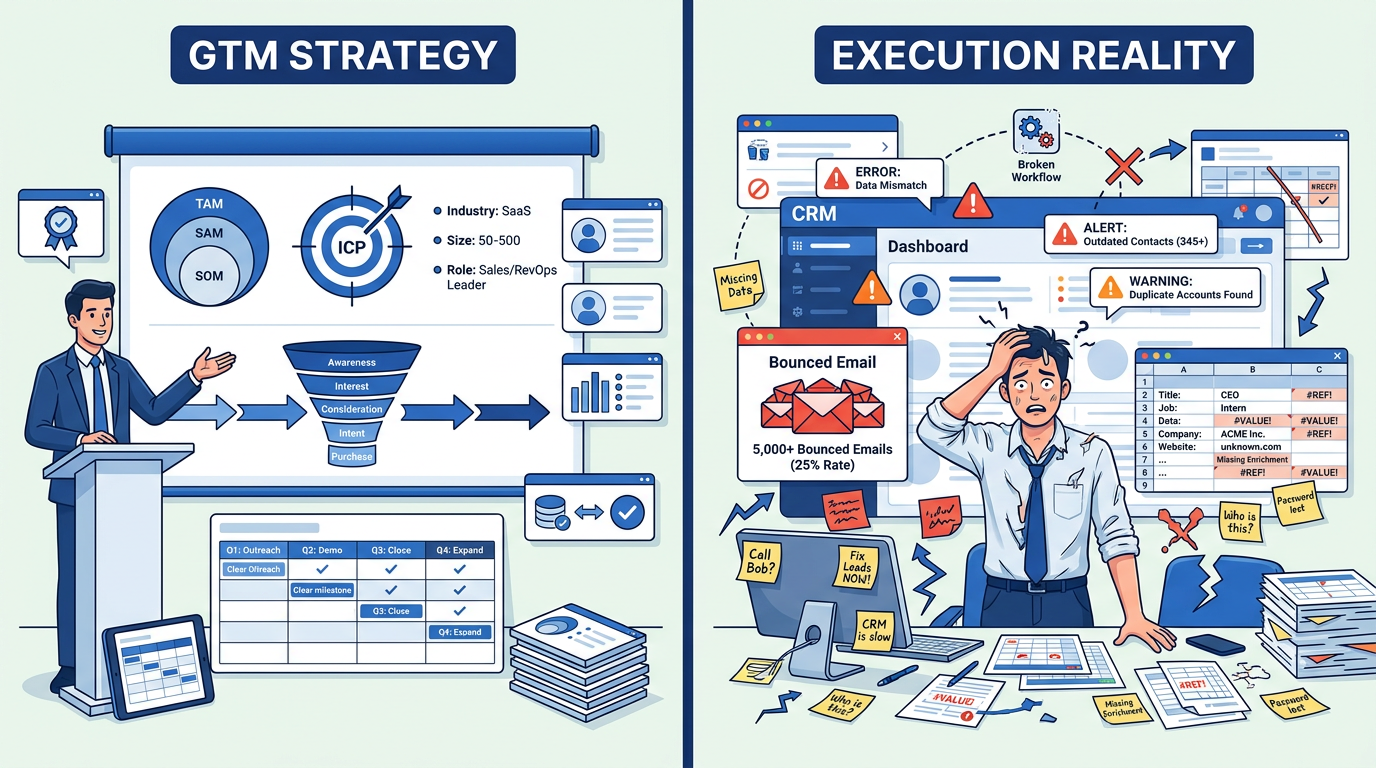
Here is the blunt version that rarely makes it into a consulting readout: your strategy is probably fine. Your ICP is plausible. Your messaging is serviceable. Your channel mix is not crazy. Meanwhile your CRM is sitting on 40% outdated contacts, enrichment coverage is stuck at 60%, SDRs are doing manual research for every prospect, and marketing is emailing job titles that changed a year and a half ago.
According to Experian, poor-quality customer and prospect data creates significant operational inefficiencies, negatively affecting sales productivity, campaign performance, and revenue growth. That is not a theoretical loss. It is paid out in wasted ad spend on wrong-fit accounts, outbound sequences that bounce, inbound leads routed to the wrong owner, and deals that drag because reps do not have enough context to run a credible first call. McKinsey research shows that sales organizations embracing an agile, data-driven go to market approach can improve conversion rates and lower cost to serve by 5 to 15 percent. The phrase to underline is "data-driven." If the data is unreliable, "agile" just means you are making mistakes faster.
In practice, the execution gap shows up in four recurring failure modes: bad contact info that wrecks deliverability, missing account data that makes segmentation sloppy, fragmented workflows that create handoff failures, and thin buyer intelligence that traps reps in generic outreach. None of these problems are mysterious. They only become chronic when teams treat them as one-off cleanups instead of core infrastructure.
Traditional GTM Execution vs. Modern GTM Execution
The difference between teams that struggle with pipeline and those that scale it consistently often comes down to how they handle the operational layer. The table below contrasts the legacy approach with what high-performing revenue teams are doing now.
| Dimension | Traditional GTM Execution | Modern GTM Execution |
|---|---|---|
| Targeting | Static account lists built from annual planning; refreshed quarterly at best | Dynamic ICP-matched lists rebuilt continuously from enriched firmographic and technographic data |
| Data | Single vendor database, accepted as-is; no validation cadence | Waterfall enrichment across multiple providers with automated validity checks |
| Research | Reps manually check LinkedIn, news, and company sites before every call | AI-assisted prospect research delivers context cards with company summary, tech stack, and recent signals |
| Prioritization | Alphabetical, round-robin, or "gut feel" from the SDR manager | Intent signals (hiring, tech changes, funding, content engagement) feed real-time lead scoring |
| Outreach | Same template sequence for every persona and segment | Personalized messaging informed by enrichment fields and buying stage |
| Operations | Point tools stitched with manual exports and Zapier; breaks go unnoticed | Integrated workflow pipelines with automated enrichment, routing, CRM sync, and failure alerts |
The shift from left column to right column is not about buying more tools. It is about treating data quality, enrichment coverage, and workflow reliability as first-class operational concerns, the same way engineering teams treat uptime and deployment pipelines.
Data Quality Is GTM Infrastructure, Not a Side Project
Most revenue orgs treat data quality like chores: a quarterly cleanup for RevOps, or a fire drill when bounce rates spike. That mindset is upside down. Data quality is the base layer of your GTM motion. Everything downstream (targeting, personalization, routing, scoring, reporting) inherits whatever is in the records feeding it.
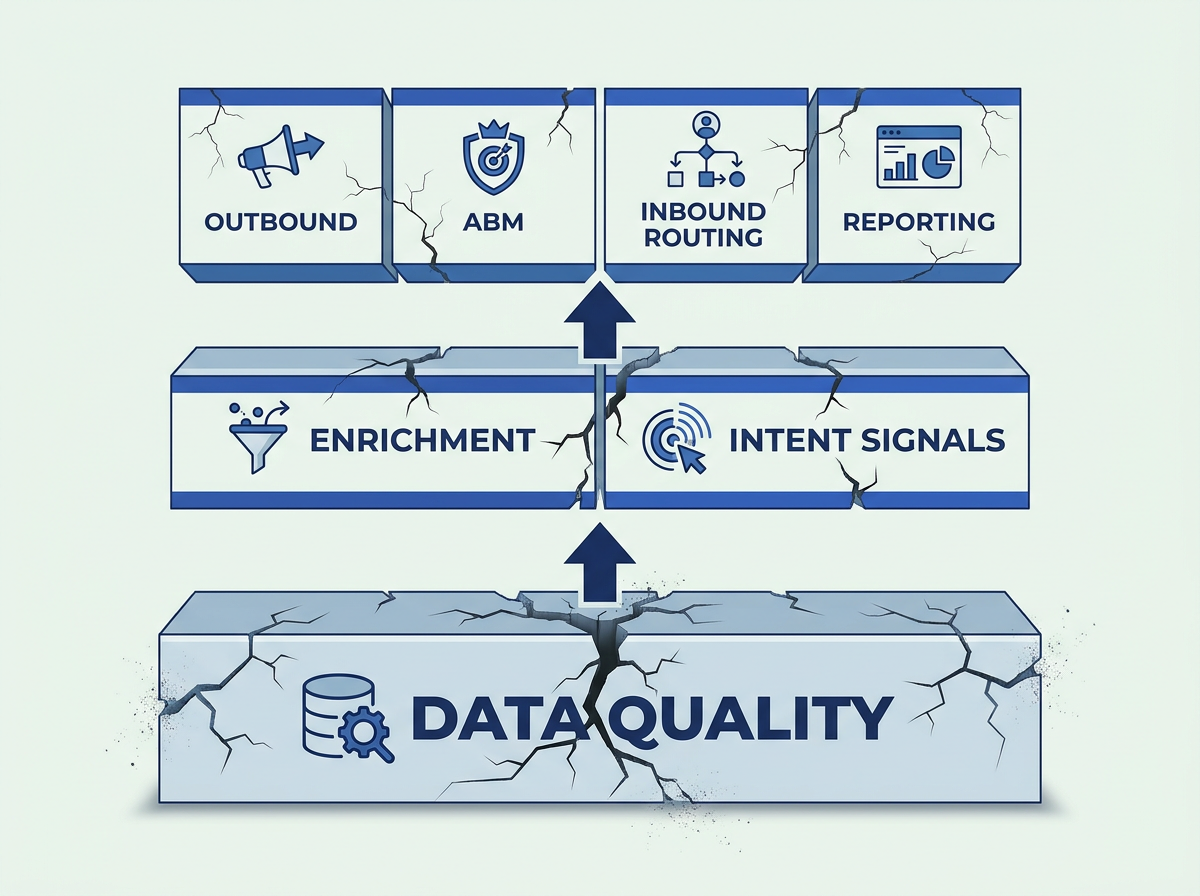
Take a SaaS company running outbound to VP-level buyers at mid-market fintech companies. If 30% of the contact records in the CRM have outdated job titles, the SDR team wastes close to a third of its outreach on people who are no longer the buyer. The second-order damage is worse: performance looks weak, leadership questions the channel, and the strategy gets blamed for what is really a data problem.
Metrics are how you keep this from turning into a recurring postmortem. Teams that track contact data quality metrics like email validity, phone connectivity, firmographic completeness, and enrichment coverage can catch decay before it shows up in pipeline. Strong RevOps teams also set automated alerts when quality drops below a threshold, and they treat it like a broken deployment pipeline: fix it fast, because everything else depends on it.
Enrichment, Intent Signals, and Buyer Intelligence
A raw lead list is just raw material. A spreadsheet of company names and generic emails does not tell you if an account fits, if they are actively evaluating, or what the buyer is trying to solve. Enrichment is what turns a record into something a rep can actually act on.
What Enrichment Actually Solves
Account and contact enrichment fills the gaps that make targeting, personalization, and prioritization possible. At the account level, that is firmographics like industry, revenue, headcount, tech stack, and funding stage. At the contact level, it is verified work emails, direct dials, current job titles, reporting structure, and social profiles. If those fields are missing or wrong, segmentation becomes educated guessing.
The catch is coverage: no single provider fills every record. Gaps are normal. That is why the teams that take outbound seriously use a lead enrichment waterfall to cascade through multiple sources until they get a hit. If Provider A does not return an email, the system automatically tries Provider B, then Provider C. In practice, that pushes coverage above 90%, versus the 50 to 70% most teams settle for when they rely on one vendor.
Intent Signals Change Prioritization
Enrichment answers "who is this?" Intent signals answer "why now?" Buying signals like job postings for relevant roles, tech adoption changes, funding rounds, and content consumption patterns let sales teams focus on accounts that are actually in-market instead of blanket-blasting the whole TAM. When enrichment feeds into real-time lead scoring, reps spend their time on the accounts most likely to convert, not the ones that happen to be next in the queue.
Example: a B2B cybersecurity vendor watches for hiring signals tied to "Head of Security" roles at Series B+ startups. When a target account posts that role, the enrichment layer pulls verified contact details, appends firmographic context, and routes the lead to the right AE with a pre-built sequence. The lag from signal to first touch shrinks from days to hours.
Workflow Automation: Making GTM Motions Repeatable
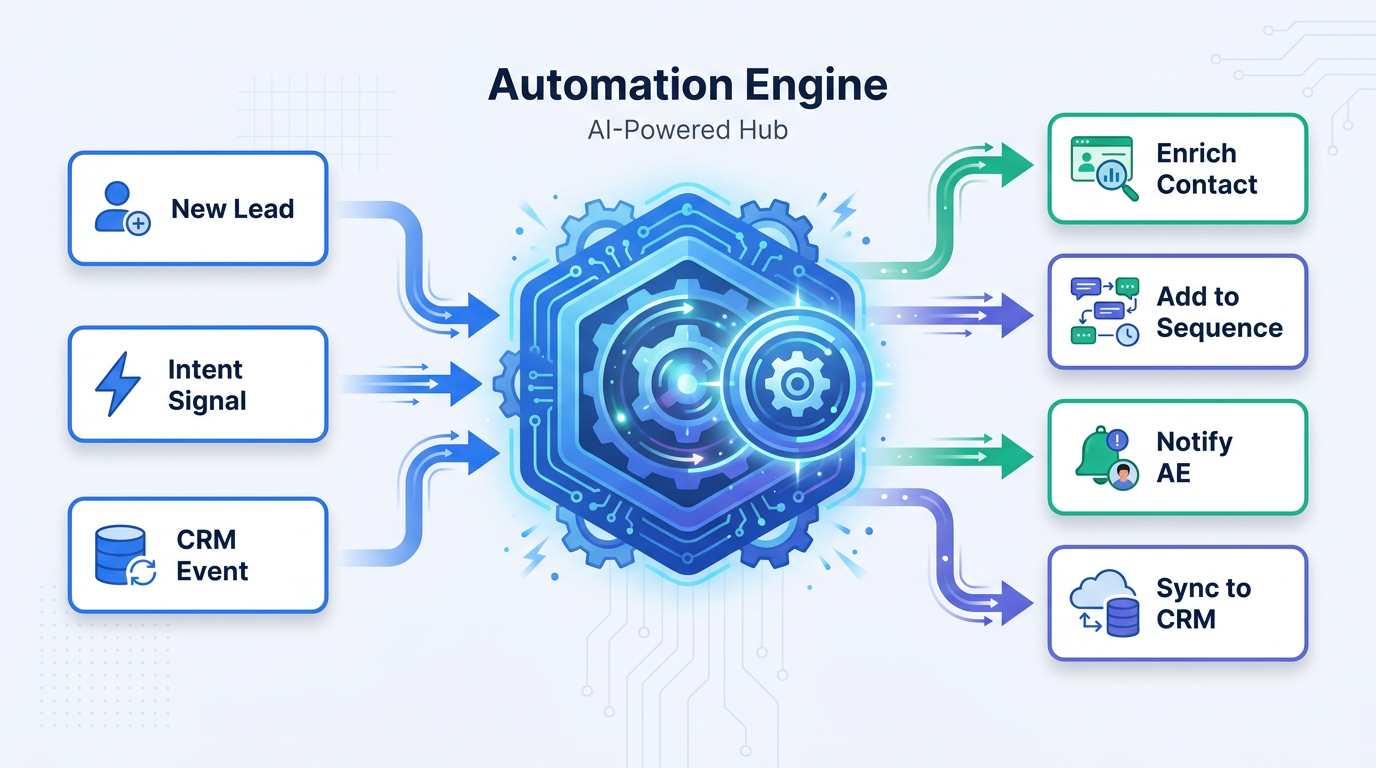
According to the Salesforce State of Sales report (2024), 83% of sales teams using AI saw revenue growth in the past year, compared to 66% of teams without AI. The compounding value is not AI-written email copy. It is the workflow layer that stitches together data sources, enrichment, scoring, routing, and outreach into one pipeline. Without that connective layer, you end up with a pile of point tools that need constant manual babysitting to stay in sync.
The gap between a team booking 50 meetings a month and one booking 200 is rarely grit or talent. It is friction. When a new lead lands, does it enrich automatically? Does it get scored and routed to the right rep in minutes? Does the rep get enough context to personalize the first message without opening ten tabs? Or does the lead sit for 48 hours while someone manually checks LinkedIn and copies notes into the CRM?
Tools like Clay, Apollo.io, Cognism, and Bitscale each come at this from a different angle. Clay is built for flexible data orchestration in a spreadsheet-like interface. Apollo.io pairs a large contact database with built-in sequencing. Cognism leans into phone-verified mobile numbers for European and global coverage. Bitscale packages ready-made sales workflows with enrichment, AI prospect research, and CRM sync in one platform. The right pick depends on your team's technical appetite, where you sell, and how much customization you actually need. If you run US-focused outbound, building a GTM data stack that ties enrichment, sequencing, and CRM sync together is the first move that pays dividends.
What Most Teams Get Wrong About GTM Execution
Across B2B revenue teams, the same execution mistakes show up over and over. Different logos, same failure modes.
They optimize the wrong layer. When pipeline slows, the reflex is to rewrite messaging, hire more SDRs, or swap outbound tools. Few teams start by auditing the data layer. In plenty of cases, the messaging is fine; it is just being delivered to the wrong people, at the wrong companies, using invalid contact info. Fix the data layer before you touch anything else.
They treat CRM data as ground truth. CRM records decay at roughly 30% per year due to job changes, acquisitions, and org reshuffles. If you are not continuously re-enriching, you are making decisions from a snapshot that is already out of date. Continuous enrichment is not a nice-to-have; it is basic maintenance.
They build Frankenstein stacks. Eight tools stitched together with Zapier and prayer creates workflows that fail quietly. When a Zap breaks at 2 AM, leads stop moving and nobody notices until the next pipeline meeting. Fewer, better-integrated platforms mean fewer silent failure points.
They skip the feedback loop. High-performing GTM teams measure what happens after outreach, not just activity volume. Which enrichment sources produce the highest email validity? Which intent signals actually correlate with closed-won? Which segments convert best? Without that loop, you cannot improve the system; you just run the same plays and hope the market bails you out.
Practical GTM Playbooks from SaaS and B2B Organizations
Playbook 1: Mid-Market SaaS Outbound
A project management SaaS company targeting 200 to 2,000 employee businesses builds a target account list from firmographic criteria (industry, headcount, tech stack). It enriches that list with verified decision-maker contacts (VP of Engineering, Director of Product). Intent signals (G2 category research, competitor keyword searches) are added to push actively shopping accounts to the top. Enriched, scored leads sync into the CRM and get assigned to the right SDR by territory. Each SDR receives a context card with a company summary, recent news, tech stack, and the specific intent signal that triggered outreach. Personalization drops to two minutes instead of twenty because the research is already done.
Playbook 2: Enterprise ABM with Multi-Threading
An enterprise security vendor goes after Fortune 500 accounts using a multi-threaded ABM motion. For each target, the team maps five to eight stakeholders across security, IT, and procurement. Enrichment supplies verified contact details and the org hierarchy so the team knows who sits where. The AE and SDR run coordinated outreach across stakeholders at the same time, with messaging tuned to each persona. The automation layer makes engagement contagious: when one stakeholder opens an email or hits the pricing page, the account team gets notified in real time. That coordination shortens deal cycles and lifts win rates because the vendor is present across the buying committee, not dependent on a single champion.
Actionable Recommendations for Revenue Teams
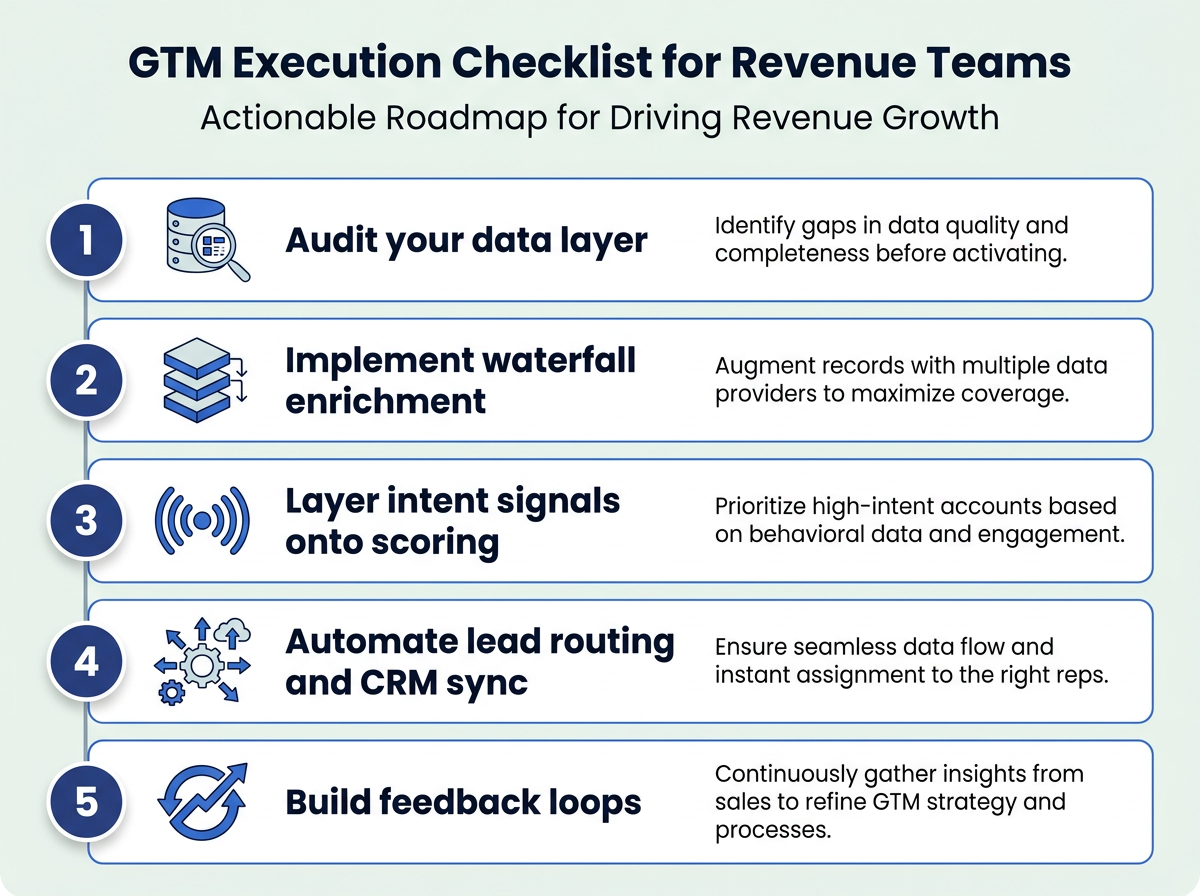
If you are responsible for revenue execution (as a leader, RevOps manager, or GTM operator), this is the short list worth prioritizing if you want scale without data rot.
Audit your data foundation before changing strategy. Pull a random sample of 500 CRM records and check email validity, job title accuracy, and firmographic completeness. If more than 20% of records are stale or incomplete, your go to market strategy is operating on a cracked foundation. Fix that before you debate positioning.
Adopt waterfall enrichment to maximize coverage. No single provider covers your entire TAM. Use a cascading enrichment approach that queries multiple sources in sequence. Platforms like Bitscale's data enrichment product and similar tools make this doable without custom engineering.
Integrate intent signals into your scoring and routing logic. Firmographic-only scoring tells you fit, not timing. Add buying signals (technology changes, hiring patterns, content engagement, funding events) so you can route accounts that are in-market now, not just accounts that look good on paper.
Consolidate your workflow stack. Inventory every tool in your GTM stack and map the data flows between them. Look for manual handoffs that create delays or drop fields. Consolidate where you can, and make sure enrichment, sequencing, and CRM sync run as one automated pipeline instead of three disconnected steps.
Close the feedback loop. Track enrichment source quality (which providers yield the highest valid-email rates), intent signal accuracy (which signals correlate with pipeline creation), and workflow reliability (how often automations fail silently). Then use those metrics to tune the system, not just report on it. According to Zendesk's 2025 CX Trends report, 73% of consumers will switch to a competitor after multiple bad experiences, which makes consistent, data-backed execution a retention requirement, not just a growth lever.
B2B teams do not win because their strategy deck is prettier. They win because the data is clean, the workflows are dependable, and the feedback loop is tight. A strong go to market strategy points you in the right direction; execution decides whether you arrive. For a closer look at how GTM tools stack up for this operational work, see this comparison of Clay vs Apollo vs Bitscale for workflow and data stack fit.
Frequently Asked Questions
What is a go to market strategy in simple terms?
A go to market strategy is the plan for taking a product or service to the customers you want and turning that into revenue. It covers who you sell to, how you reach them, what you charge, and how sales, marketing, and product coordinate. Wikipedia's GTM definition is a solid baseline overview.
Why do most go to market strategies fail?
Most GTM strategies do not fail on the whiteboard. They fail in execution: inaccurate contact data, incomplete account records, fragmented tool stacks, and missing buyer intent signals. According to Experian's annual data quality research, poor-quality customer and prospect data creates significant operational inefficiencies that lower sales productivity, hurt campaign performance, and directly erode revenue growth.
How does data enrichment improve GTM execution?
Data enrichment adds the firmographic and contact fields teams need to target and route leads correctly: verified emails, direct dials, job titles, tech stack, revenue, and more. With that in place, segmentation and personalization are driven by real data instead of guesswork. Teams that run waterfall enrichment across multiple providers often reach 90%+ coverage.
What are intent signals and how do they help sales teams?
Intent signals are behaviors that suggest a company is researching or evaluating a solution. Common examples include job postings for relevant roles, technology adoption changes, G2 category research, and content consumption patterns. When you feed those signals into lead scoring, reps can prioritize accounts that are in-market now, which improves conversion rates and cuts wasted outreach.
How often should CRM data be re-enriched?
CRM records decay at roughly 30% per year due to job changes, acquisitions, and restructuring. A practical baseline is continuous or quarterly re-enrichment for active pipeline and target account lists. Tracking contact data quality metrics helps you set a cadence based on your actual decay rate.