What Is a Sales Funnel? Stages, Metrics, and Optimization Strategies
Sales funnel stages, leakage points, and metrics that matter - plus three optimization plays focused on CRM hygiene, enrichment, and stage-gate rules.
Most teams can sketch their sales funnel stages on a whiteboard in under five minutes. Far fewer can point to the exact step where deals fall apart - and the specific reason they fall apart. That blind spot is where revenue quietly bleeds out. Many B2B organizations invest heavily in demand generation and outbound prospecting but lack consistent visibility into funnel performance. Without accurate data on stage conversions, lead quality, and account progression, it becomes difficult to identify bottlenecks or improve revenue outcomes. A measurable funnel turns assumptions into actionable insights.
Treat the sales funnel for what it is: an operational system shaped by data quality, CRM hygiene, enrichment workflows, and prospecting execution. This is for sales leaders, RevOps teams, founders, and GTM operators who are done with theory and want numbers that move. You'll get a practical stage breakdown, the real sources of leakage, the data layer that props the whole thing up, the metrics that actually diagnose issues, and three optimization plays you can run this quarter.
What a Sales Funnel Actually Is (and What It Isn't)
A sales funnel is the end-to-end system that turns a stranger into a customer. It's not a cute diagram and it's not static. It's a chain of processes, data flows, qualification gates, and handoffs that either compounds momentum or kills deal velocity at each transition.
One place teams routinely get tripped up is the sales funnel versus the sales pipeline. The funnel maps the buyer journey and the conversion math at each stage (who enters, who advances, who drops). The sales pipeline is the rep-side view of active opportunities and their march toward close. One is about conversion rates and system health; the other is about deal management and forecasting. Mixing them up leads to confident reporting and bad decisions.
The classic AIDA diagram (Awareness, Interest, Desire, Action) makes funnels look smooth and inevitable. B2B doesn't work that way. Prospects bounce, re-enter months later, go dark during procurement, or show up late after a referral and skip half your "stages." If you've been in RevOps for 2+ years, none of this is news. Jump to the stages breakdown.
The Sales Funnel Stages That Actually Drive Revenue
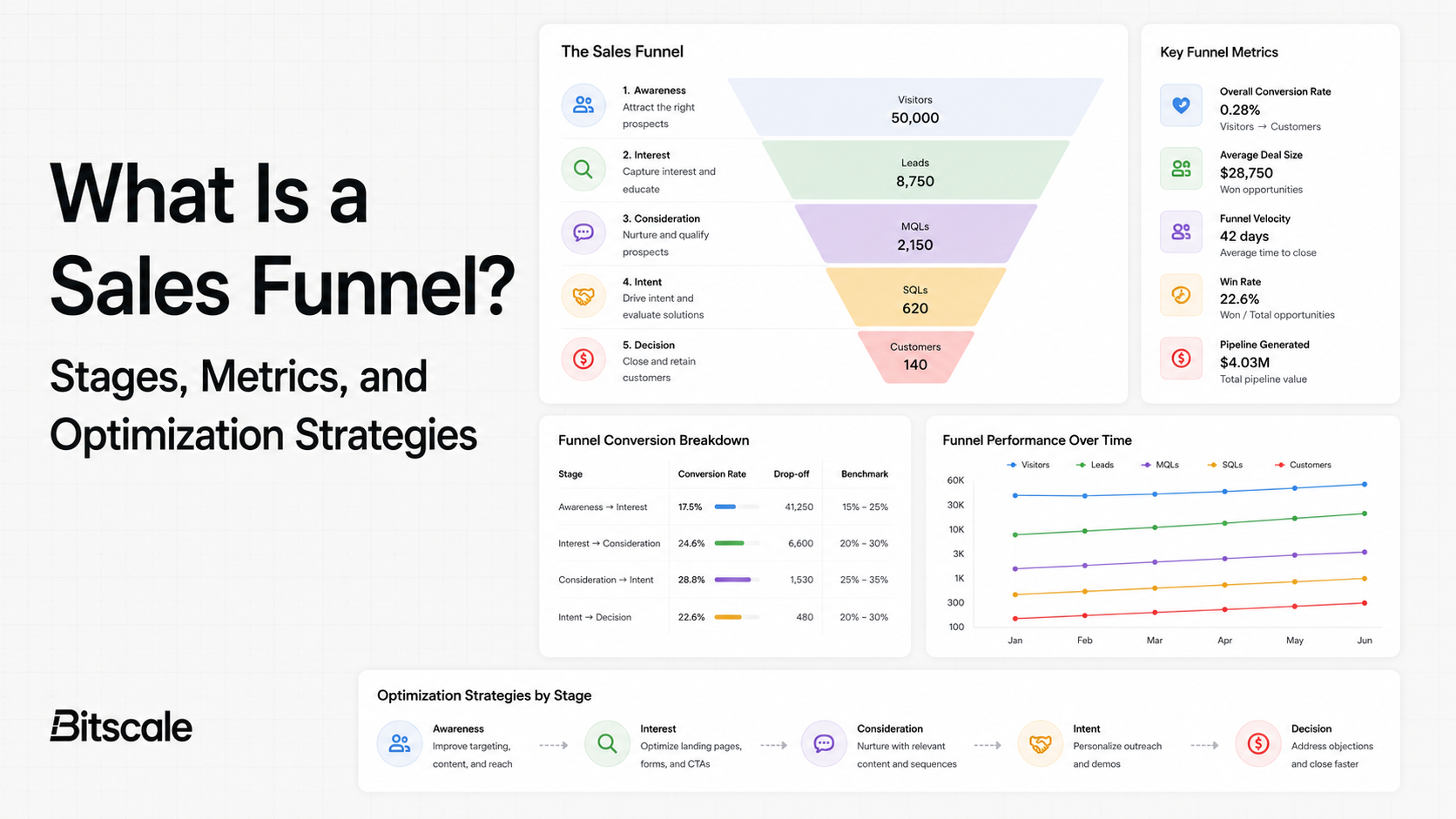
Skip the textbook labels. A useful B2B funnel uses stages you can observe in buyer behavior and enforce in CRM status - not vague psychological states. A framework that holds up across most B2B motions: Awareness, Interest/Prospecting, Qualification, Evaluation, Commitment/Close, and Post-Sale Expansion.
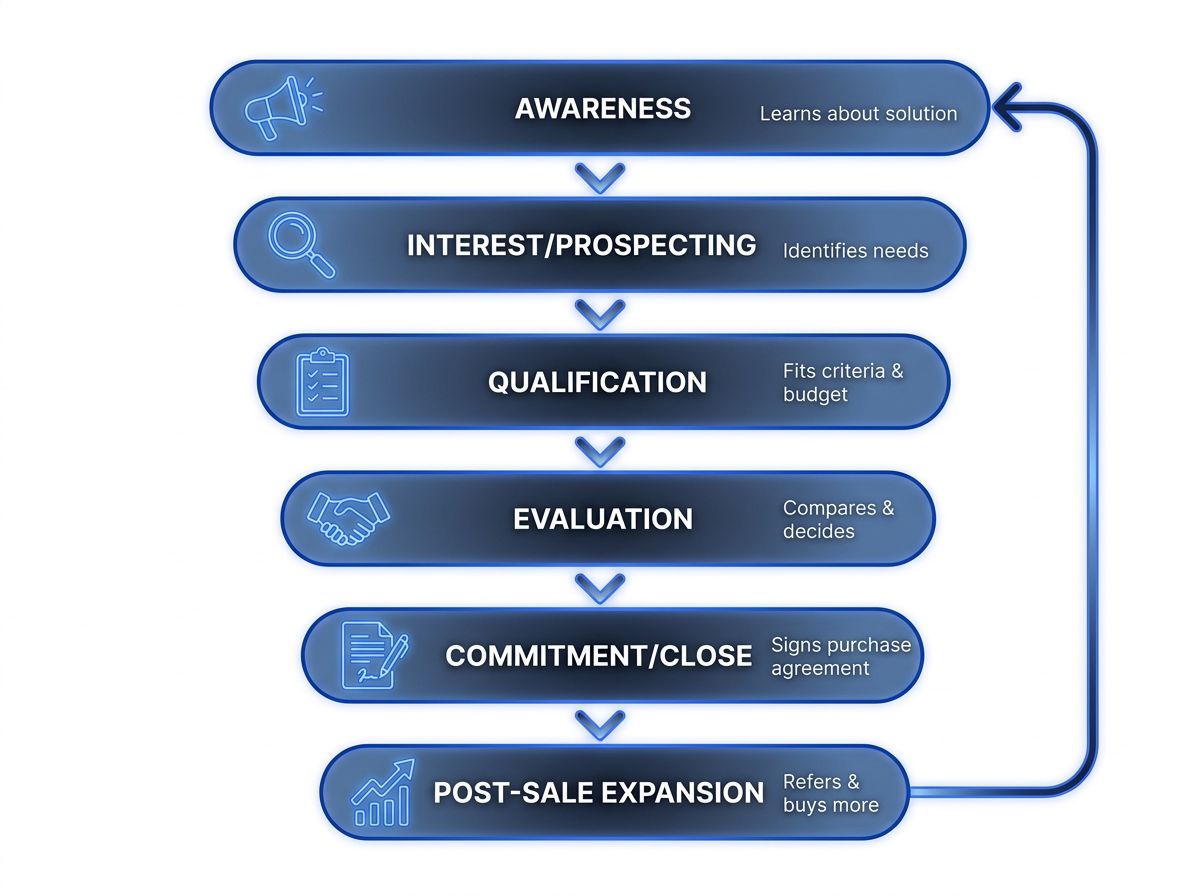
Top of Funnel: Awareness and Prospecting
Prospects show up through inbound content, outbound sequences, referrals, or intent signals. The quality-versus-volume tradeoff is brutal at this layer. Stuffing the top with unqualified names makes your pipeline chart look healthy while reps starve for real shots on goal. Picture a 50-person SaaS company that imports 10,000 contacts from a purchased list versus one that builds 2,000 enriched, intent-qualified prospects. The second funnel wins on downstream metrics because the data entering the system is accurate and relevant from day one.
Mid-Funnel: Qualification and Evaluation
This is where B2B deals most often bog down, especially at the handoff from marketing-qualified to sales-qualified. Frameworks like BANT or MEDDIC only work if reps have clean firmographic and technographic data to apply them. Without verified titles, current company info, and budget signals, reps burn over 30% of their time chasing contacts who are outside ICP or no longer in the seat. Multiply that across the team and the quarter, and it becomes a tax you don't see on any dashboard.
Bottom of Funnel: Commitment and Close
Bottom-funnel velocity is mostly decided earlier. If you filtered well and kept records fresh, close moves; if you didn't, it drags. And close isn't the finish line. Expansion revenue and referrals loop back into the top, which is why post-sale belongs in the funnel model. Teams that treat post-sale as "someone else's problem" give up compounding growth.
Where Sales Funnels Leak, and What Most Teams Miss
Leakage isn't just "leads dropping off." It's a systems failure with root causes you can actually name and fix. After auditing dozens of funnels, the biggest killer I see isn't messaging or pricing. It's stale CRM data. Teams are spending real rep hours calling ghosts.
The five most common causes of funnel leakage:
- **Poor lead data quality: **Wrong emails, outdated titles, and missing firmographic data send reps down dead ends. Poor data quality makes it harder to identify the right buyers, prioritize high-fit accounts, and execute effective outreach. As a result, funnel performance suffers long before opportunities reach the pipeline.
- CRM hygiene decay: CRM data decays at roughly 30% per year through job changes, mergers, and email bounces. When stage data is wrong, your funnel metrics are basically fan fiction.
- Misaligned ICP definitions: If marketing and sales don't agree on the ideal customer, the funnel fills with leads that one team celebrates and the other rejects.
- **Broken handoff processes: **B2B purchases rarely happen after a single interaction, often requiring multiple conversations and touchpoints before a buying decision is made
- Lack of enrichment at stage transitions: A lead that was "qualified" at entry can be stale by mid-funnel if nobody re-enriches it with current data.
One mid-market B2B team I worked with found that 40% of their "open pipeline" was tied to contacts who had already changed jobs. After they enriched and cleaned the CRM, the real pipeline was half the size - and their close rate doubled. Sales funnel management starts with being able to trust your data. If you don't trust it, every metric you report is a guess with a spreadsheet.
The Data Layer: Why Enrichment and CRM Hygiene Make or Break Your Funnel
Data quality sits underneath every stage like infrastructure. When it's broken, no sales methodology or shiny tooling rescues conversion. Enriched leads are easier to qualify, prioritize, and engage because reps have the context needed to personalize outreach and identify buying intent. Better data improves targeting, reduces wasted effort, and helps opportunities move through the funnel more efficiently.
CRM Accuracy as a Funnel Health Indicator
Your CRM is either a source of truth or a story you're telling yourself. A workable accuracy checklist: run quarterly CRM audits, set up automated enrichment syncs, implement duplicate detection, and enforce field-level validation so incomplete records can't glide into later stages. Skip this, and your key sales metrics will point you in the wrong direction.
Building Enrichment into Your Prospecting Workflow
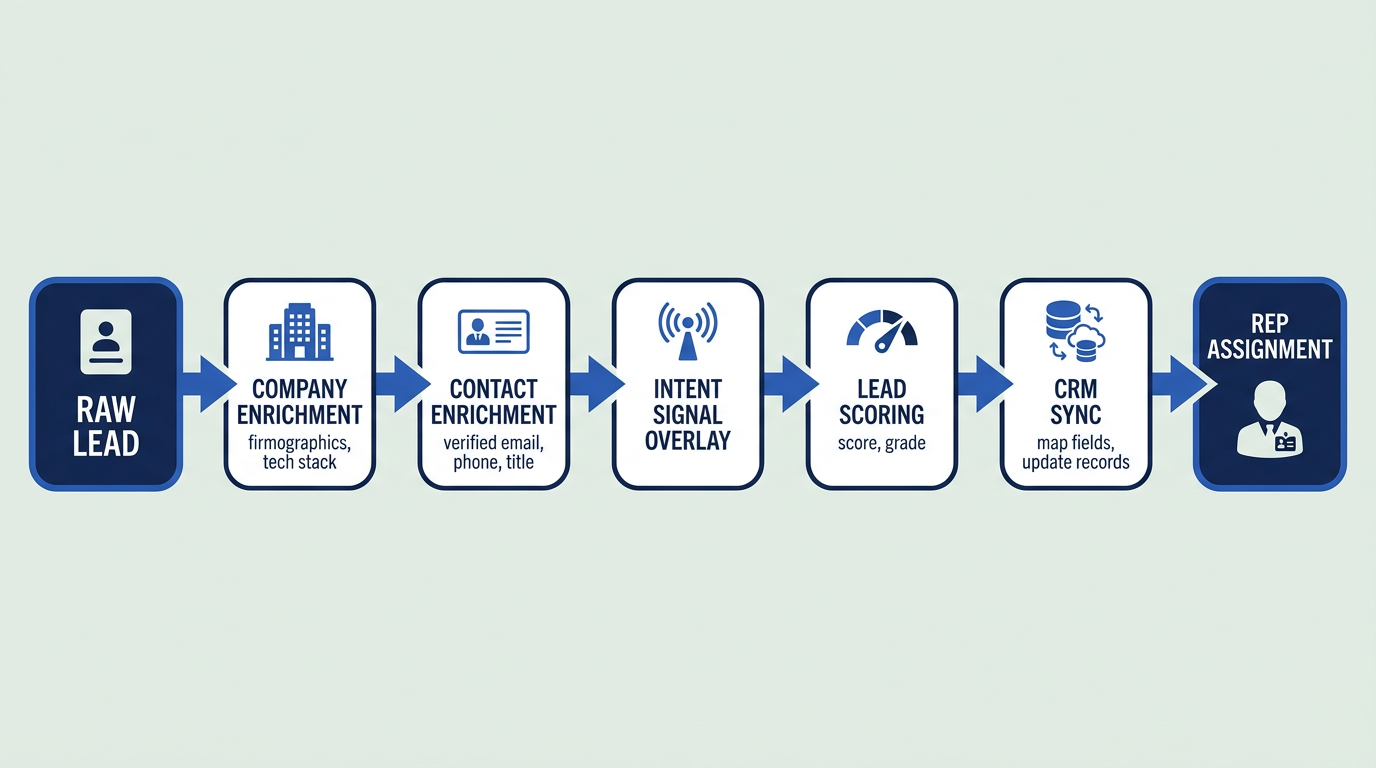
Enrichment isn't a one-and-done import. It belongs inside the prospecting workflow so every lead gets enriched at entry and re-enriched at stage transitions. A solid flow looks like this: raw lead enters, gets company enrichment (firmographics, tech stack), then contact enrichment (verified email, phone, title), then an intent signal overlay, scoring, CRM sync, and rep assignment. AI prospect research and buying signals can pre-qualify leads before a rep ever touches them, which pairs well with B2B sales automation at scale.
Measuring Your Sales Funnel: The Metrics That Actually Matter
Most teams drown in vanity metrics and miss the ones that actually diagnose failure. Overall conversion rates can provide context, but they rarely explain why opportunities stall or drop out of the funnel. The real insights come from understanding stage-by-stage behavior and identifying where prospects lose momentum.
Sales Funnel Optimization: Three High-Impact Plays
Optimization works when it's surgical. Pick the biggest leak, fix it, then move to the next one - not the other way around.
Play 1: Tighten Your ICP and Enrich at Entry
Most gains start at the top because "garbage in, garbage out" is painfully true in funnels. Use firmographic and intent data to score leads before they hit the sales pipeline, not after reps have already burned cycles. Teams that do this consistently end up with smaller pipelines that convert a lot harder.
Play 2: Automate Stage-Gate Qualification
Put rules in place so leads can't advance without minimum data thresholds: verified contact info, a budget signal, and an ICP match score. That trims mid-funnel bloat and gives reps cleaner, smaller books of business. For PLG companies, routing product-qualified leads into the right sales motion is the same play applied to a specific funnel entry point.
Play 3: Run Funnel Retrospectives, Not Just Pipeline Reviews
Once a month, break down closed-lost deals looking for data quality issues, stage-skip patterns, and time-in-stage outliers. That's how optimization becomes a loop instead of a quarterly cleanup project. Ask: did the deal have verified contact data? Did the lead match our ICP criteria? How long did it sit in qualification? The answers usually implicate something upstream.
The Compounding Effect of Funnel Hygiene Over Time
When teams invest in data quality and enrichment, the payoff isn't linear. Cleaner data lifts multiple metrics at once: conversion rates rise, deal velocity improves, forecasts get less embarrassing, and reps spend more time selling. One edge case to watch: multi-product or multi-segment funnels living in a single CRM instance. If you don't segment carefully, your funnel metrics bleed into each other and diagnosis becomes guesswork.
One nuance that gets missed: funnel shape should evolve as your GTM motion matures. Early-stage companies often have wide, leaky funnels, and that's fine. The job is to narrow strategically, not uniformly. And a blunt take: if your funnel metrics haven't moved in two quarters despite "optimization efforts," you're probably dealing with upstream data problems, not downstream tactics.
Frequently Asked Questions
What is the difference between a sales funnel and a sales pipeline?
A sales funnel tracks the buyer journey and the conversion rates between stages. A sales pipeline is the seller's view of active deals and their progression toward close. The funnel tells you whether the system is healthy; the pipeline helps you manage individual opportunities and forecast. Salesforce's complete guide on sales funnels breaks down the distinction in more detail.
How many stages should a B2B sales funnel have?
Most B2B teams do well with 4 to 6 stages tied to observable buyer actions: Awareness, Interest, Qualification, Evaluation, Commitment, and Post-Sale. If you add more stages than your team can keep updated in the CRM, you create noise, not clarity.
How often should you audit and clean your sales funnel data?
Do a full CRM data audit at least quarterly. With CRM data decaying around 30% per year, waiting longer guarantees your funnel metrics drift away from reality. Automated enrichment syncs between audits help keep records current in real time.
What is the biggest cause of sales funnel leakage?
Poor lead data quality. Wrong emails, outdated job titles, and missing firmographic fields push reps toward dead-end contacts. That one issue cascades through every downstream stage, inflating pipeline while depressing conversion.
Can you optimize a sales funnel without a CRM?
In theory, yes. In practice, it's a slog. Without a CRM, you can't reliably track stage-to-stage conversion, measure deal velocity, or pinpoint where leads drop. Even a basic CRM gives you the data foundation needed for real optimization. LeadSquared's guide on sales funnel management explains how CRM software supports the process.
Key Takeaways and Next Steps
The sales funnel is a system: stages, data, enrichment, CRM hygiene, and measurement all reinforce each other. Fixing one layer tends to lift the rest. Three actions to take this week: audit CRM data quality (start with bounce rates and job-change detection), map enrichment workflow gaps (where are leads entering without verified data?), and find your single biggest stage-to-stage conversion drop.
Platforms like Bitscale ( Book a Demo ) support this work by combining lead enrichment, contact and company verification, intent signals, and CRM sync into unified GTM workflows. If you're building prospecting lists from scratch or cleaning an existing pipeline, enrichment infrastructure baked into the process is what separates high-performing funnels from leaky ones.
The best funnel isn't the prettiest diagram. It's the one where every stage is backed by accurate data and every handoff is clean.