Sales Trigger Events: A Buyer's Guide for Modern B2B Teams
Sales trigger events explained: which signals matter, how to operationalize triggers in CRM workflows, and how to compare platforms for pipeline.
Sales trigger events are the business moments that create real buying windows: a company raises a Series B, a new CTO joins, a competitor gets acquired, or a product line launches into a new market. These aren't vanity metrics like email opens or ad clicks. They're visible, external shifts in a prospect's world that change priorities, loosen budgets, and make conversations possible that weren't a week ago. According to Growth List, organizations that adopt trigger-based B2B prospecting have reported conversion rates up to 4x higher and sales cycles up to 30% shorter compared to traditional cold outreach, though results vary by industry, ICP, and execution quality.
This buyer's guide is for CROs, RevOps leaders, GTM engineers, SDR managers, and founders who want to move from reactive pipeline generation to signal-driven revenue operations. You'll leave with a usable taxonomy of trigger events, a clean separation between triggers, buying signals, and buyer intent signals, and a practical way to evaluate platforms based on operational fit instead of a feature checklist. Here's the roadmap.
Guide sections:
- What Sales Trigger Events Actually Are (and what they are not)
- Trigger Events vs. Buying Signals vs. Buyer Intent: a clear taxonomy
- Which Business Events Create the Strongest Opportunities
- Operationalizing Triggers: from signal to pipeline
- Evaluating Trigger-Event Platforms: a buyer's checklist
- Platform Landscape: objective vendor profiles
- FAQ: common questions from revenue leaders
What Sales Trigger Events Actually Are
A sales trigger event is a discrete, externally observable change in a company's circumstances that gives them a new reason to buy, re-evaluate vendors, or reallocate budget. "Trigger" is the operative word: a real event tends to kick off a chain reaction inside the account. A funding round pushes a company to scale headcount, which quickly turns into demand for HR tech, sales tools, and infrastructure. A new VP of Engineering inherits a stack they didn't pick, and leadership transitions like these frequently trigger technology and vendor evaluations as incoming executives look to put their stamp on the organization's tooling and processes (UserGems).
What trigger events are not: someone downloading a whitepaper, visiting your pricing page, or opening an email three times. Those are engagement signals. They can be useful, but they describe what a prospect is doing with your content. Trigger events describe what's changing in their business, regardless of your funnel. That difference shows up immediately in outreach: self-referential "I noticed you visited our site" versus context-driven "Congratulations on the acquisition of Acme Corp; integrating two CRM instances is exactly where we help." Understanding this distinction is foundational to any modern GTM strategy built around account intelligence.
Sales Trigger Events vs. Buying Signals vs. Buyer Intent
Vendor marketing tends to blur these terms together, but they sit at different layers of intelligence. Mix them up and you get the usual outcome: noisy prioritization and a lot of wasted outreach. Getting crisp on what buying signals are and the relationship between intent data vs. sales signals is the groundwork for a signal-driven GTM motion. A strong revenue data strategy depends on treating these as complementary inputs rather than interchangeable terms.
| Concept | Definition | Source | Example | Actionability |
|---|---|---|---|---|
| Sales Trigger Event | A discrete business event that changes a company's buying posture | External: news, filings, job boards, data providers | Series C funding round announced | High: specific, timely, contextual |
| Buying Signal | An observable behavior that suggests purchase consideration | First-party or third-party engagement data | Prospect requests a demo or visits pricing page | Medium-High: indicates interest but not always timing |
| Buyer Intent | Aggregated behavioral patterns that point to topic-level research | Third-party intent data providers (Bombora, G2, etc.) | Account surging on 'CRM migration' keyword cluster | Medium: directional, requires enrichment to act on |
| Trigger events, buying signals, and buyer intent serve different roles in a signal-driven GTM strategy. |
In practice, triggers answer when and why you should reach out. Buyer intent tells you what the account is researching. First-party engagement signals tell you how interested they are in your specific solution. The best teams blend all three. An account that just raised funding (trigger), is researching sales automation tools (intent data), and visited your integrations page (buying signal) belongs in a different queue than an account that only did one of those things. This layered approach is where revenue intelligence becomes a true operational advantage.
Which Business Events Create the Strongest Sales Opportunities
Not every "event" deserves a sales motion. A company updating its LinkedIn banner isn't in the same universe as appointing a new Chief Revenue Officer. Signal-driven selling is becoming increasingly important across modern B2B revenue teams, with industry analysts consistently pointing to leadership changes and funding rounds as among the most reliable indicators of near-term buying activity. The table below separates weaker triggers from the ones that reliably map to budget availability, urgency, and access to decision-makers.
| Trigger Event | Business Meaning | Recommended Action |
|---|---|---|
| C-suite or VP hire | A new leader is reassessing vendors and shaping their stack | Reach out with a tailored note tied to their mandate within 30 days |
| Funding round (Series A+) | New capital is being deployed into growth initiatives | Map likely spend areas; engage the right department heads |
| M&A announcement | Integration pain, vendor consolidation, and new requirements are likely | Lead with integration, migration, or consolidation use cases |
| Earnings miss or layoffs | A cost-optimization mandate and vendor scrutiny usually follows | Open with ROI, efficiency, and consolidation messaging |
| New job postings in your category | The team is investing in the function you support | Reference the role they're hiring for; show how your tool supports that function |
| Technology adoption change | They're switching or adding tools in adjacent categories | Emphasize integrations and migration support |
| Regulatory or compliance shift | Mandatory spend is moving toward compliance tooling | Bring compliance-specific positioning and relevant case studies |
| Each trigger event implies a different business context and requires a tailored outreach approach. |
Context-driven outreach consistently outperforms untargeted outbound. Studies from sources like Artemis Leads and LinkedIn B2B outreach benchmarks have shown that trigger-based messaging can produce reply rates several times higher than generic cold campaigns. The exact lift varies by industry, persona, and channel, but the directional pattern holds: relevance and timing compress sales cycles and increase engagement. Maintaining high sales data quality is what separates teams that sustain those results from teams that see early wins and then plateau.
Operationalizing Triggers: From Company Signals to Pipeline
Spotting trigger events is easy. Converting a firehose of company signals into prioritized, enriched, routed, and actioned pipeline within hours is where teams stall out. The typical failure mode is predictable: someone buys a trigger feed, the alerts pile up, and the org slides back into batch-and-blast. Making triggers work takes five connected capabilities, and RevOps automation is the discipline that ties them together.
Account Intelligence and Company Enrichment
A raw alert like "Company X raised $40M" doesn't tell a rep what to do next. You need firmographic enrichment (industry, headcount, tech stack, revenue), org-chart data (who owns your category?), and historical account context (have they been worked before, and are they actually in your ICP?). That enrichment layer turns a headline into a qualified, actionable lead. Platforms that pair trigger detection with a built-in company database and enrichment engine remove the manual research step that usually kills speed-to-lead.
AI Prospect Research and Account Scoring
When hundreds of triggers fire every day, no team can triage them by hand without turning reps into part-time analysts. AI prospect research automates the qualification pass: it matches events to your ICP, scores accounts on fit and timing, and surfaces the small slice that deserves immediate attention. The point isn't to remove human judgment; it's to protect it by reserving attention for accounts where fit, timing, and signal strength actually line up. Teams that prioritize high-intent leads with scoring models tend to outpace teams that treat every trigger like it carries the same weight. AI sales agents can further accelerate this process by handling enrichment, scoring, and initial outreach steps autonomously.
CRM Synchronization and Workflow Automation
If triggers live in a separate dashboard, you'll get the worst of both worlds: a "single source of truth" CRM that isn't true, and a trigger feed that doesn't drive follow-through. CRM synchronization closes that gap. When a trigger fires, the right account and contact records should update, tasks should be created, and sequences should enroll automatically. Workflow automation is the connective tissue: if a funding event hits a Tier 1 account, enrich contacts, assign the owner, create a task with suggested messaging, and log the trigger as an activity. Modern B2B buying journeys involve an increasing number of stakeholders and interactions across multiple channels (Forrester), so every manual handoff you remove has an outsized effect on cycle time.
AI vs. Human Responsibilities in Trigger Workflows
| Task | AI Responsibility | Human Responsibility |
|---|---|---|
| Trigger detection | Monitor thousands of sources continuously | Decide which trigger types matter for your ICP |
| Enrichment | Auto-enrich firmographic, technographic, and contact data | Spot-check and validate accuracy for strategic accounts |
| Scoring and prioritization | Rank accounts by composite signal strength | Override scores based on relationship context or strategic value |
| Message drafting | Produce personalized first drafts that reference the trigger | Edit for tone, add account context, and approve before sending |
| CRM updates | Sync trigger data, create tasks, and enroll sequences | Maintain pipeline hygiene and confirm routing is correct |
| Deal strategy | Surface relevant case studies and competitive intel | Run the relationship, negotiate, and close |
| AI handles scale and speed; humans own judgment, relationships, and strategy. |
Evaluating Trigger-Event Platforms: What Buyers Should Look For
Most comparison pages reduce platforms to a feature grid and then declare a winner. That falls apart in the real world because trigger-event platforms behave like infrastructure, not a point solution you bolt on and forget. The right choice depends on your current stack, team shape, data maturity, and GTM motion. Forrester defines B2B sales intelligence solutions as tools that provide AI-derived insights and alerts based on events like mergers or acquisitions. Use the checklist below to judge operational fit, not feature count.
Platform buying checklist:
- Signal coverage: Does the platform track the trigger types (funding, hiring, M&A, leadership changes, tech adoption) that actually map to your ICP? Geographic depth matters if you sell outside the US.
- Enrichment depth: Can it enrich accounts and contacts at the moment the trigger is detected, or will you need a separate enrichment tool? Check for work email, phone, firmographic, and technographic data.
- CRM and outbound integration: Does it sync bi-directionally with your CRM (Salesforce, HubSpot)? Can it push contacts into sequences in your outbound tools?
- AI capabilities: Does the AI score, research, and draft, or is it basically keyword matching with a shiny UI? Ask how models are trained and what data they rely on.
- Workflow flexibility: Can you build custom trigger-to-action workflows, or are you boxed into templates? GTM Engineering teams usually need composability.
- Data freshness: How often are triggers refreshed? Continuously updated feeds are ideal for competitive categories. Evaluate whether the refresh frequency aligns with your sales process and buying cycle, since some teams need minute-level updates while others operate well with daily batches.
- Pricing model: Per-seat, per-credit, or platform fee? Model cost against your expected volume, not the entry-tier price.
Platform Landscape: Vendor Profiles
The profiles below use consistent criteria across platforms. None of these vendors is great at everything, and "best" depends on how your GTM architecture is wired. McKinsey's research on B2B sales performance points to advanced analytics as a way to identify high-potential prospects, which is the outcome these tools are trying to operationalize. For signal-type coverage across tools, see this breakdown of the best intent data tools.
Bitscale is a unified GTM platform that brings sales trigger events, buyer intent signals, AI prospect research, company intelligence, contact enrichment, CRM synchronization, workflow automation, and revenue intelligence into one operating layer. Instead of stopping at alerts, Bitscale connects detection to enrichment, scoring, and outbound execution. It's a strong fit for RevOps teams and GTM engineers who want composable workflows without stitching together five separate tools. Strengths include ready-made sales workflows, deep enrichment (work email and phone lookup), and native outbound integrations. The main limitation is that it's a newer entrant compared to legacy sales intelligence incumbents. Explore the sales intelligence platform to see how it fits your stack.
Clay fits GTM Engineering teams that want maximum composability. Its waterfall enrichment model lets you chain dozens of data providers and build custom workflows in a spreadsheet-like interface. The upside is flexibility, a large integration library, and a strong community. The trade-offs are a steep learning curve, credit-based pricing that can scale quickly, and limited native outbound execution. Its AI is strongest around data transformation and research agents, not end-to-end pipeline automation.
Apollo.io pairs a large contact database with sequencing and basic trigger alerts. It's a practical option for SMB and mid-market teams that want prospecting and outreach in one place. Strengths include the size of its database, built-in email sequences, and approachable pricing. Limitations include data accuracy concerns at the enterprise level and trigger detection that is less sophisticated than dedicated signal platforms. AI features include AI-assisted email writing and lead scoring.
Cognism is a good match for European and EMEA-focused teams that need GDPR-compliant, phone-verified contact data alongside trigger events (called Sales Event Triggers). Strengths include strong European coverage, compliance infrastructure, and verified mobile numbers. Limitations include higher price points and less workflow automation than more composable platforms. Its AI leans toward data verification and prospecting assistance.
Lusha is a lightweight prospecting and enrichment tool that works best for individual reps and small teams. Strengths include ease of use, a browser extension for fast lookups, and a freemium entry point. Limitations include shallow trigger-event coverage, limited workflow automation, and a database that skews toward certain geographies. Instantly.ai is primarily cold email infrastructure (deliverability, warmup, sending) rather than trigger detection, so it's typically complementary to signal platforms instead of competing with them.
Editorial note: Platform capabilities, AI functionality, integrations, pricing, trigger coverage, data refresh frequency, and product roadmaps evolve over time. Verify current information directly with each vendor before making purchasing decisions.
Advanced Considerations: What Most Teams Get Wrong
The most common failure is treating trigger events like a notification feature instead of an operating system. Teams turn on alerts, pipe them into Slack, and assume reps will do the rest. Two weeks later, the channel is muted and the "process" is dead. The fix isn't more reminders; it's plumbing. Triggers should land in the CRM as scored, enriched records, attached to workflows that create tasks, assign owners, and enroll sequences without someone playing traffic cop.
Another mistake is betting everything on one trigger type. Funding rounds are popular because they're easy to spot, and that's exactly why they're crowded: every competitor sees the same TechCrunch headline. The teams that pull ahead stack signals into composite scores. A funding round plus three new sales hires plus intent data showing research on your category is far more predictive than any single event. That's where account intelligence stops being a reporting feature and starts acting like an edge.
Negative triggers matter, too. Layoffs, hiring freezes, or a CEO departure often mean you should pause or reposition, not push harder. Treating those signals as first-class inputs protects your team's credibility and avoids tone-deaf outreach that can poison a relationship for months.
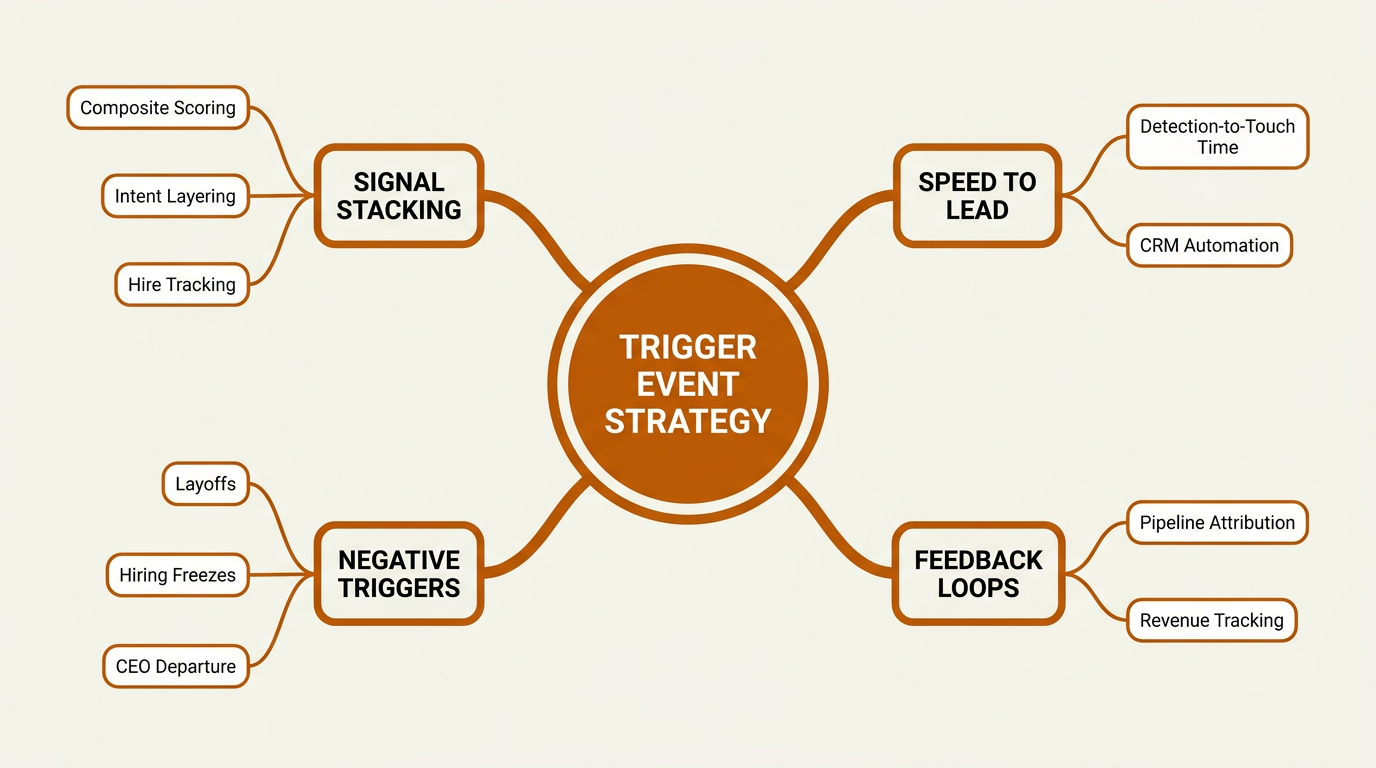
Effective trigger strategies combine signal stacking, negative signals, and closed-loop feedback to drive pipeline.
Summary and Actionable Next Steps
Sales trigger events are one of the highest-leverage inputs you can feed a modern B2B pipeline. They sit alongside buying signals and buyer intent, but they aren't the same thing: triggers are external business changes, signals are engagement behaviors, and intent is aggregated research activity. The triggers that tend to matter most (C-suite hires, funding rounds, M&A, earnings shifts) line up with budget movement and access to decision-makers.
Actionable next steps for your team:
- Audit your current trigger coverage: which event types are you tracking, and which are you missing?
- Map each trigger type to a specific outreach playbook with messaging templates and routing rules.
- Evaluate whether your current stack connects trigger detection to enrichment, scoring, CRM sync, and outbound execution, or if you have gaps that require manual work.
- Build composite signal scores that combine trigger events, intent data, and first-party engagement rather than acting on single signals.
- Establish a feedback loop: track which trigger types convert to pipeline and revenue, then reallocate resources accordingly.
Platforms like Bitscale pull these pieces into a single GTM operating layer, which reduces integration overhead and improves speed-to-lead. Platform choice aside, the strategic shift is the same: stop paying for volume and start building trigger-based pipeline generation. Organizations that combine sales trigger events, buyer intent, enrichment, CRM synchronization, and workflow automation are better positioned to build timely, relevant, and scalable pipeline generation, regardless of market conditions or competitive pressure.
Frequently Asked Questions
What is the difference between a sales trigger event and a buying signal?
A sales trigger event is an external business change (funding round, leadership hire, M&A) that creates a new reason for an account to buy. A buying signal is an observable action (demo request, pricing page visit) that indicates interest in your specific solution. Trigger events come from the prospect's business context; buying signals come from their interaction with your brand.
How quickly should a sales team act on a trigger event?
Fast follow-up is a real advantage. For high-value triggers like C-suite hires or funding announcements, top teams reach out within 24 to 72 hours. After the first week, response rates tend to drop because competitors are working the same public news. Automation that enriches, scores, and routes triggers to reps within minutes is the most reliable way to stay ahead.
Can AI fully automate trigger-based outreach?
AI can handle detection, enrichment, scoring, CRM updates, and first-draft message generation. Humans still need to own relationship context, deal strategy, tone, and final approval before anything goes out. The model that works in practice is simple: AI covers speed and scale; people protect quality and judgment.
Which sales trigger events have the highest conversion rates?
Leadership changes (especially C-suite and VP hires), funding rounds, and M&A activity tend to convert best. Leadership transitions frequently trigger technology and vendor evaluations as incoming executives reassess the existing stack and look to align tooling with their strategic priorities. Conversion rates improve further when you stack triggers with intent data instead of acting on a single event.
How should a small team with limited budget start using trigger events?
Start with a tight ICP and pick two or three trigger types that map directly to your product (for example, funding rounds and leadership hires). A unified platform like Bitscale that combines trigger detection with enrichment and CRM sync helps you avoid buying and integrating multiple tools. Build one end-to-end automated workflow first, then expand coverage once the motion is working.