Revenue Data Strategy: A Practical Guide for Modern Revenue Teams
Revenue data strategy that improves forecasting, pipeline visibility, and GTM alignment with enrichment, intent signals, CRM sync, and governance.
Poor data quality is one of the most expensive hidden costs in any revenue organization. Gartner has estimated that data quality problems cost companies millions of dollars annually, and for revenue teams the fallout is painfully concrete: missed pipeline signals, forecasts nobody trusts, outreach aimed at the wrong accounts, and go-to-market execution that drifts out of sync. A revenue data strategy is the discipline that stops the bleeding. It is not a one-off CRM cleanup or a hygiene checklist. It is a cross-functional operating model for how revenue-critical data gets sourced, enriched, synchronized, governed, and put to work across the buyer journey.
This is for RevOps leaders, CROs, GTM leaders, founders, and operations teams building revenue systems that hold up under real scale. The flow is deliberate: start with foundations, move through the components that make a strategy durable, then land on execution and governance patterns you can run quarter after quarter. Below is the map.
Guide sections:
- What a Revenue Data Strategy Actually Is. Definitions, scope, and how it differs from CRM management.
- Why Revenue Teams Cannot Operate Without One. The business case across forecasting, pipeline, and GTM alignment.
- The Five Pillars of a Revenue Data Strategy. CRM sync, enrichment, intent, AI research, and governance working together.
- Revenue Data Strategy vs. CRM Management. A comparison table clarifying the distinction.
- Siloed Data vs. Unified Revenue Data. What breaks when data lives in disconnected systems.
- Building Governance That Lasts. Why continuous ownership outperforms one-time cleanups.
- AI and Human Responsibilities in Revenue Data. Where automation excels and where judgment is required.
- Metrics That Prove Your Strategy Works. Revenue data metrics tied to business outcomes.
- FAQ. Five common questions from RevOps and GTM leaders.
What a Revenue Data Strategy Actually Is
A revenue data strategy is how an organization deliberately collects, enriches, governs, and operationalizes the data that drives revenue outcomes. It covers the full GTM data chain: how accounts are created and updated in the CRM, how contacts get firmographic and technographic context through company enrichment and contact enrichment, how buyer intent signals shape prioritization, and how forecasting models consume clean, timely inputs instead of whatever happens to be in the system that week.
Teams often collapse this into "CRM data strategy," which usually means field hygiene, deduping, and record completeness inside one system. That work matters, but it is only a slice of the problem. A CRM is where data lands; a revenue data strategy is the set of rules that decide what lands there, how it stays correct, and how it connects to every downstream workflow. If your CRM is the warehouse, the revenue data strategy is the supply chain plus quality control plus distribution.
Why Revenue Teams Cannot Operate Without One
Modern B2B buyers complete the majority of their product research independently before ever engaging with a sales representative. By the time someone finally talks to sales, they have already pressure-tested your positioning against competitors, scanned reviews, and built a shortlist. Without a coherent sales data quality strategy, revenue teams are effectively guessing during the part of the cycle where the buyer has already done most of the deciding.
The cracks show up in familiar places. Forecasting accuracy falls apart when pipeline data is incomplete or stale, because models built on dirty inputs return confident-looking nonsense. Pipeline visibility collapses when stages, contact roles, and engagement signals are scattered across disconnected tools. Account prioritization turns into vibes without enriched firmographics and timely buying signals from a reliable company database and B2B contact database. Customer intelligence gets thinner when post-sale data never reconnects to pre-sale context, leaving renewals and expansion motions full of blind spots. And GTM alignment breaks when marketing, sales, and customer success run on different definitions of the same metrics.
Organizations that build trusted, governed data systems consistently make faster and more informed revenue decisions. That edge does not come from hoarding more data. It comes from data that is governed, enriched, and operationalized so every revenue function can trust what it is looking at, which is the foundation of effective revenue intelligence.
The Five Pillars of a Revenue Data Strategy
A RevOps data strategy does not live inside a single tool, and it does not survive on one heroic process. It holds together through five interlocking capabilities. Each pillar does its own job, but the real payoff shows up when they reinforce one another.
CRM Synchronization and Pipeline Data Integrity
CRM synchronization is the connective tissue. Enrichment, intent signals, and research outputs only matter if they land in the system of record where reps and leaders actually make decisions. Bidirectional sync keeps the loop closed: CRM updates flow to outbound tools, and engagement data flows back to the CRM. Skip this, and you end up with two competing realities: the "official" CRM view and whatever your SDRs are living in day to day. Platforms like Bitscale's Data Enrichment product tackle this by pairing enrichment with native CRM sync, so records update continuously instead of via brittle CSV imports.
Company Intelligence and Contact Enrichment
A raw lead record (name, email, maybe a title) is not something a team can reliably act on. Enrichment turns that stub into a usable profile by appending firmographics (revenue, headcount, industry, tech stack), verified contact details (work email, direct dial), and org context (reporting structure, recent funding, hiring patterns). For a fuller walkthrough of the mechanics, see The Complete B2B Guide to Data Enrichment. The customer data strategy impact is straightforward: once records are enriched, segmentation, scoring, and personalization stop being guesswork.
Buyer Intent and Revenue Intelligence
Intent data answers a question every revenue team cares about: which accounts are actively researching your category before they ever raise a hand. Combine first-party intent (site visits, content engagement, product usage signals) with third-party intent (topic-level research behavior across the web), and you get a prioritization layer that separates "later" from "now." When revenue analytics is built on that intent layer, pipeline generation becomes easier to forecast because demand shows up as a signal before it shows up as a form fill.
AI Prospect Research and GTM Engineering
Manual prospect research is useful and unsustainably expensive. When SDRs spend significant time per account hopping between LinkedIn, news, and filings, the output might be strong, but the throughput will never match the volume targets most teams set. That research time is valuable selling time lost, and the approach simply does not scale efficiently. AI prospect research solves the synthesis step by turning public inputs (job postings, press releases, earnings calls, technographics) into structured account briefs that can drive outreach. What is GTM Engineering lays out how these workflows fit into a modern GTM strategy. Bitscale, for example, bundles AI research with enrichment and CRM sync into a single pipeline-generation sequence, rather than forcing teams to stitch together a stack of point tools.
Data Governance as a Continuous Practice
Governance is the pillar most teams postpone, and it is the one that decides whether the rest of the system stays intact. Chief Data Officers consistently rank data governance among their top organizational priorities. IBM defines data governance as the discipline focused on the quality, security, and availability of organizational data through policies and procedures. In RevOps terms, that translates to shared field definitions, automated validation rules, clear ownership of data domains, and routine audits. The next section gets into why this has to be ongoing, not episodic.
Revenue Data Strategy vs. CRM Management
This distinction is not academic. When teams treat CRM management as the whole strategy, they predictably underfund the capabilities that actually move forecasting, prioritization, and GTM alignment.
| Dimension | CRM Management | Revenue Data Strategy |
|---|---|---|
| Scope | One system (CRM fields, records, workflows) | Cross-system architecture across CRM, enrichment, intent, outbound, and analytics |
| Goal | Clean, deduplicated records | Governed, enriched, actionable data that drives pipeline and revenue |
| Ownership | Sales ops or a CRM admin | Cross-functional: RevOps, marketing ops, sales ops, data team |
| Data sources | Manual entry, form fills, imports | Automated enrichment, intent providers, AI research, product usage, CRM sync |
| Enrichment | Occasional batch imports | Continuous automated enrichment with validation |
| Governance | Periodic cleanup efforts | Ongoing policies, automated enforcement, defined SLAs |
| Output | Accurate CRM records | Revenue intelligence, pipeline health, forecast inputs, GTM alignment |
| CRM management is necessary but insufficient. A revenue data strategy encompasses it. |
Siloed Data vs. Unified Revenue Data
When marketing tracks leads in one system, sales runs opportunities in another, and customer success keeps health scores somewhere else, every cross-functional meeting burns the opening stretch arguing about whose numbers are "right." Siloed data does more than slow teams down. It creates distrust. Distrust creates shadow reporting, and shadow reporting usually ends with a mess of spreadsheets that quietly become the real source of truth.
| Characteristic | Siloed Data | Unified Revenue Data |
|---|---|---|
| Source of truth | Several conflicting systems | A single governed data model |
| Forecast reliability | Low (incomplete inputs) | High (enriched, validated inputs) |
| Account handoff quality | Context drops between teams | Full history stays attached to the account |
| Time to insight | Hours or days (manual reconciliation) | Continuously synchronized (automated sync) |
| GTM alignment | Teams optimize in isolation | Shared metrics and definitions across functions |
| Unification is not about consolidating into one tool. It is about establishing shared definitions and bidirectional sync. |
High-performing organizations increasingly adopt revenue operations practices built around shared data ownership and cross-functional governance. The pattern is not "everyone bought the same tool." It is that these companies treat revenue data as a shared asset with cross-functional ownership, which sits underneath any effective Go-to-Market Strategy and Data Execution.
Building Governance That Lasts
Most governance efforts fail for one simple reason: they are run like a cleanup project. A team spends two weeks deduplicating records, standardizing picklists, and purging stale contacts. The CRM looks perfect. Then the calendar turns, new fields get added ad hoc, reps find workarounds, integrations drift, and six months later the system is right back where it started. Nobody owned ongoing quality, no validation stopped bad data at the door, and schema changes had no approval path.
Governance lasts when quality is built into daily motion, not saved for quarterly heroics. In practice, that means automated field validation (reject records missing required attributes), an ownership matrix (who owns which data domain), SLAs for freshness (with refresh frequency calibrated to outbound activity, account importance, and the pace of business change in your market), and regular audits that ship with scorecards people can actually read. RevOps automation plays a key role here by enforcing these controls programmatically. If you are building this muscle, a comprehensive CRM data quality guide lays out the tactical controls that make the system stick.
AI and Human Responsibilities in Revenue Data
It is tempting to pitch AI as a substitute for human judgment in revenue data. That is the wrong mental model. AI is great at throughput: volume, speed, and pattern recognition across noisy inputs. Humans are better at context: relationship nuance, edge cases, and deciding what the business should standardize in the first place. Strong revenue teams make that division explicit instead of hoping it sorts itself out.
| Responsibility | AI (Automation) | Human (Judgment) |
|---|---|---|
| Data enrichment at scale | Append firmographics, technographics, and contact details across thousands of records | Validate enrichment accuracy for strategic accounts |
| Intent signal processing | Aggregate and score intent signals from multiple sources | Interpret intent in the context of deal dynamics and relationships |
| Prospect research | Synthesize public data into structured account briefs | Evaluate fit, timing, and competitive positioning |
| CRM hygiene | Flag duplicates, detect decay, enforce validation rules | Define data standards, approve schema changes, resolve edge cases |
| Forecasting | Generate statistical forecasts from pipeline data | Apply deal-level judgment and market context to adjust predictions |
| Workflow automation | Execute multi-step sequences (enrich, sync, route, notify) | Design workflows, set triggers, and monitor for unintended outcomes |
| AI handles throughput. Humans handle meaning. Both are required. |
Platforms that bundle these capabilities, like Bitscale, tend to land in the right place: AI as an accelerator inside workflows that humans design and govern, not an autonomous actor running unattended. The AI software for revenue teams category is moving fast, but the underlying rule does not change: automation without governance just produces bad data faster.
Common Revenue Data Challenges and Solutions
| Challenge | Root Cause | Recommended Solution |
|---|---|---|
| Contact and company data decay | People change jobs, companies merge, details go stale | Automated enrichment refresh cycles calibrated to account priority and outbound activity, with decay detection |
| Disconnected tools creating conflicting data | Point solutions adopted without integration planning | Unified GTM platform with native CRM sync (e.g., Bitscale) or middleware with strict field mapping |
| Inconsistent field definitions across teams | No shared data dictionary or governance body | Cross-functional data council that owns definitions, picklists, and schema changes |
| Manual enrichment bottlenecks | SDRs spending research time instead of selling time | AI prospect research workflows that auto-enrich and route records |
| No clear data ownership | Data treated as a shared commons with no accountability | RACI matrix for every data domain with published SLAs |
| Solutions require both tooling and organizational commitment. |
Metrics That Prove Your Revenue Data Strategy Works
A revenue data strategy that is not measured is just a well-written set of intentions. The metrics below tie data quality to operational outcomes, which is how you justify real investment in revenue analytics and governance.
| Metric | What It Measures | Business Impact |
|---|---|---|
| Data completeness rate | Percent of required fields populated across CRM records | Improves segmentation accuracy and lead routing precision |
| Enrichment coverage | Percent of accounts and contacts with verified firmographic and contact data | Raises outreach effectiveness and personalization quality |
| Data decay rate | How quickly contact and company records become outdated | Predicts bounce rates, wasted outreach, and forecast degradation |
| Pipeline data accuracy | Percent of pipeline records with correct stage, amount, and close date | Underpins forecast reliability and board-level reporting |
| Time to enrich | Average time from record creation to full enrichment | Shorter times improve speed-to-lead and conversion rates |
| Cross-system sync latency | Delay between a data update in one system and its appearance in others | Drives continuously synchronized pipeline visibility and rep productivity |
| Track these monthly. Report trends quarterly. Tie improvements to revenue outcomes. |
Key Takeaways and Next Steps
A revenue data strategy is not something you "finish." It is an operating discipline that gets stronger as the organization keeps using it. Teams that treat revenue operations data as a strategic asset, govern it continuously, and activate it across every GTM function tend to out-execute teams that treat data as exhaust from selling.
Actionable next steps for your team:
- Audit your current state: map every system that touches revenue data, identify sync gaps, and document field definitions that differ across teams.
- Stand up a cross-functional data council with representatives from sales ops, marketing ops, RevOps, and customer success. Assign clear ownership for each data domain.
- Move to automated enrichment and decay detection instead of relying on quarterly cleanup sprints. Set refresh frequency based on outbound activity, account priority, and the pace of change in your market.
- Evaluate whether a unified GTM platform can simplify company enrichment, contact enrichment, buyer intent signals, CRM synchronization, workflow automation, and revenue data governance while reducing operational complexity. Bitscale is one platform designed to consolidate these capabilities into a single system.
- Define and track the six metrics above. In quarterly business reviews, tie data quality gains directly to pipeline conversion and forecast accuracy.
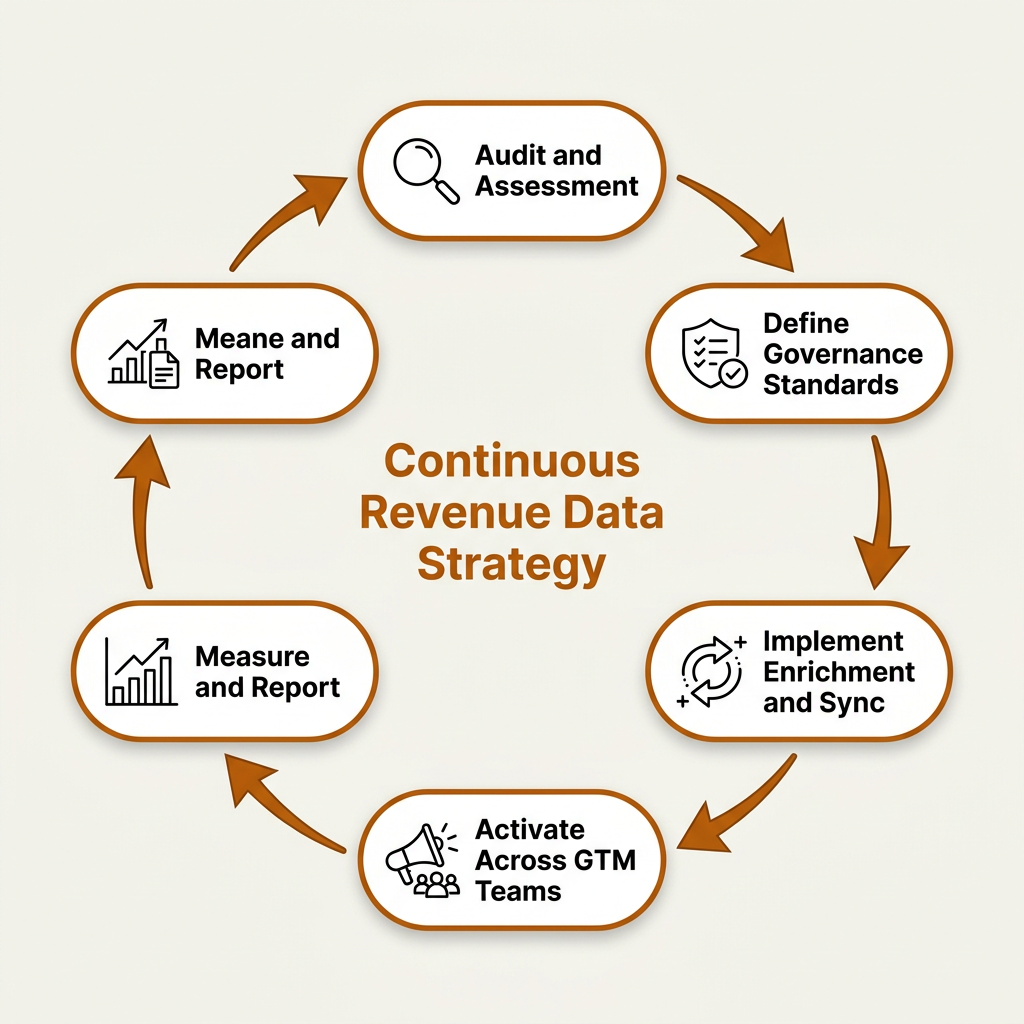
A continuous revenue data strategy cycles through six stages — never truly finished.
Frequently Asked Questions
How does a revenue data strategy differ from a CRM data strategy?
A CRM data strategy usually stays inside the CRM: hygiene, deduplication, and field completeness. A revenue data strategy includes the CRM, but it also covers enrichment, intent data, AI research, cross-system synchronization, governance, and activation across GTM workflows. The CRM is a component of the strategy, not the strategy itself.
Who should own the revenue data strategy in an organization?
RevOps most often owns it, but it only works with shared governance. A cross-functional data council (sales ops, marketing ops, customer success, and data engineering) keeps definitions, standards, and priorities aligned to how each revenue team actually operates.
How often should revenue data be enriched or refreshed?
Company and contact information changes continuously because organizations evolve, employees change roles, and markets shift. The right refresh frequency depends on your outbound volume, the strategic importance of each account, and how quickly your target market changes. High-priority accounts and active pipeline records should refresh more frequently than dormant segments.
Can AI replace human judgment in managing revenue data?
AI is well suited to scale work like enrichment, pattern detection, and signal processing. Human judgment is still required to define standards, interpret intent in the context of a live deal, resolve edge cases, and make strategic calls on prioritization. The durable model is AI for throughput with humans owning the rules and exceptions.
What is the role of GTM Engineering in a revenue data strategy?
GTM Engineering builds the automated, data-driven workflows that connect enrichment, research, intent signals, and outreach into repeatable pipeline-generation sequences. It is how a governed revenue data strategy turns into executed GTM motion. Bitscale covers the discipline in What is GTM Engineering.