12 Best AI Sales Tools for Modern Revenue Teams
12 best AI sales tools for 2026, compared by data accuracy, integrations, governance, and TCO. Includes tables and a practical buying checklist.
AI adoption across sales organizations continues to accelerate, and revenue teams that integrate AI into their workflows consistently report stronger pipeline performance and higher rep productivity. That momentum explains why budgets are moving fast. The problem is that the "best AI sales tools" category is now a maze of lookalike products and overlapping promises. Pick the wrong platform and you do not just burn spend, you create new data silos that slow the entire go-to-market engine.
This is written for CROs, RevOps leaders, GTM engineers, SDR managers, and founders who need an apples-to-apples view, not a vendor pitch deck. You will get a structured comparison of 12 platforms, evaluation criteria that map to day-to-day operations, and a clear line between what AI is great at and where human judgment still wins. If you are ripping out a legacy stack or building your first AI-forward motion, the goal is simple: shorten the trial-and-error cycle without inheriting a pile of brittle integrations. For a broader look at how GTM engineering shapes modern revenue operations, that context pairs well with the platform analysis below.
What AI Sales Tools Actually Are (and How They Differ from Traditional Sales Software)
Traditional sales automation software is mostly deterministic: send email A, wait two days, send email B. It runs the rules you configure. AI sales software adds inference on top of that automation. It can read messy, unstructured inputs (10-K filings, job postings, technographic signals), update account scores as conditions change, draft outreach that reflects what it found, and adjust based on engagement. That shift is not a minor feature upgrade; it changes how the system is built and what work it can take off a rep's plate.
A capable AI sales assistant can scan a prospect's company in seconds and surface signals like hiring moves, funding rounds, or a change in the tech stack. An AI sales agent layer can use those signals to prioritize the account, enrich the record, and draft a message that anchors on a specific likely pain point. In a traditional stack, those are separate manual steps performed by a human, often across multiple tabs and tools. By automating research and enrichment, AI reduces the repetitive administrative work that consumes selling time, allowing reps to spend significantly more hours on direct customer engagement and relationship building.
Capabilities That Matter Most for GTM Teams
Most teams anchor on one shiny feature, usually a contact database or an email sequencer, and miss how the rest of the stack compounds. Pipeline generation shows up when these layers reinforce each other:
- Buyer intent signals and AI sales intelligence: Identifying accounts already researching your category before they ever fill out a form. Signals from job postings, technographic shifts, and content consumption help separate real demand from a cold list.
- AI prospect research: Automated analysis of company filings, news, org charts, and competitive context. Done well, this replaces hours of manual Googling per account. For a deeper look at this workflow, see how teams use AI for prospect research.
- Contact enrichment: Appending verified work emails, direct dials, titles, and seniority to raw lists. Vendor accuracy varies more than most buyers expect, making sales data quality a critical evaluation factor.
- Company intelligence: Firmographic, technographic, and financial data from a reliable company database that supports segmentation and personalization at scale.
- CRM synchronization: Bidirectional sync that keeps enriched data, engagement history, and deal signals flowing into Salesforce, HubSpot, or your system of record without manual CSV work.
- Workflow automation and AI outbound sales: Orchestrating multi-step sequences (research, enrich, score, message, follow up) that used to require stitching together five or more point solutions. Teams investing in RevOps automation see the biggest gains when these steps are connected natively.
When these capabilities sit inside a single AI sales platform, you avoid paying an ongoing integration tax just to keep data flowing. When they are scattered across vendors, RevOps ends up babysitting Zapier workflows and brittle field mappings instead of improving the motion. A strong revenue intelligence layer ties all of these signals together so leadership can act on a single source of truth.
AI SDR vs. Sales Engagement Platform vs. Unified GTM Platform
A lot of buying mistakes come from mixing up three different product categories. The table below breaks down what each category is designed to do, who typically uses it, and the gap you will need to cover elsewhere. Get the taxonomy right and the shortlist gets much easier.
| Category | Primary Function | Typical User | Key Limitation |
|---|---|---|---|
| AI SDR Software | Autonomous prospecting, email drafting, reply handling | SDR teams, early-stage startups | Narrow scope; often lacks CRM sync or deep enrichment |
| Sales Engagement Platform | Multi-channel sequencing, call/email tracking, analytics | AEs, SDR managers, mid-market teams | Relies on external data sources; limited AI research |
| Unified GTM Platform | Intent, research, enrichment, CRM sync, workflow automation, revenue intelligence in one stack | RevOps, CROs, scaling GTM orgs | Higher onboarding complexity; requires process maturity |
| Choosing the right category depends on team size, existing stack, and GTM maturity. |
If you already run Salesforce plus a data provider plus a sequencer, an AI sales assistant layer may be the right increment. If you are starting from zero, or trying to consolidate a bloated stack, a unified GTM approach can cut vendor sprawl and reduce fragmentation. For a broader look at how AI SDR tools stack up against human reps, that analysis pairs well with the platform comparison below.
The 12 Best AI Sales Tools
Each platform below is judged on the same set of factors: best use case, core AI capabilities, integration depth, and real limitations. Organizations that align their AI sales tools with mature GTM processes and clear operational workflows consistently see stronger win rates and faster deal velocity. The lift is not automatic, though. It depends on matching the tool to your GTM motion and your operational constraints.
1. Bitscale
Best for: Revenue teams that want to consolidate prospecting, enrichment, intent, and outbound orchestration into one platform. Bitscale is positioned as a unified AI revenue platform, not a single-purpose point tool. It combines B2B lead and account list building, contact and company enrichment (work email and phone lookup), AI prospect research, ready-made sales workflows, CRM sync, outbound tool integrations, and intent/buying signals. The practical advantage is operational: pre-built workflows connect research to enrichment to outreach without forcing you to wire everything together yourself. Teams that previously stitched together Clay for enrichment, Apollo for contacts, and a separate intent vendor can replace that stack with one login. Limitations include a smaller brand footprint compared to Apollo or Cognism, and enterprise buyers with highly custom CRM architectures should validate sync depth during evaluation. Explore Bitscale's sales intelligence solution for a closer look at the intent and intelligence layer.
2. Clay
Best for: RevOps engineers and technically skilled SDR teams who want maximum flexibility in building custom data workflows. Clay connects to a large ecosystem of data providers through a spreadsheet-like interface, so you can chain enrichment steps, AI prompts, and scoring logic in whatever order your process requires. Its edge is composability: if you can describe the workflow, you can usually assemble it. The cost of that flexibility is setup complexity. Non-technical users can struggle to get to a reliable, repeatable build, and pricing scales with credit consumption, which can get hard to predict at higher volumes. Clay also does not include native sending or a built-in contact database, so most teams pair it with separate tools for outreach and initial sourcing.
3. Apollo.io
Apollo.io is often the default for startups and SMBs that want a contact database and a sequencer under the same roof. Its extensive global B2B contact database, plus a generous free tier, makes it easy to roll out quickly. AI features include lead scoring, email writing assistance, and intent signals. The pricing stays competitive, especially at the lower tiers. The cracks tend to show as volume and compliance requirements increase: direct-dial accuracy can lag specialists like Cognism, and enterprise-grade compliance expectations (GDPR controls, SOC 2) have historically been a weaker point versus enterprise-first vendors. It fits teams optimizing for speed and volume more than precision.
4. Cognism
Best for: Mid-market and enterprise teams selling into Europe that need phone-verified mobile numbers and GDPR-compliant data. Cognism's Diamond Data offering focuses on human-verified direct dials, which tends to translate into stronger connect rates for cold-calling motions. Intent data comes through a Bombora partnership. Cognism integrates with Salesforce, HubSpot, and Outreach. Limitations: pricing is seat-based and premium, the North American database is less differentiated, and the product does not go as deep on workflow automation as Clay or Bitscale.
5. Lusha
Lusha is an enrichment tool built for speed and convenience. Its Chrome extension pulls emails and phone numbers while you browse LinkedIn, and its API slots cleanly into existing stacks. Lusha has expanded into intent signals and prospecting lists, but the core value is still quick, reliable contact lookup. It fits individual reps and small teams that want data fast without building elaborate workflows. Limitations include a smaller database than Apollo, limited AI research depth, and workflow automation that is still developing.
6. Instantly.ai
Best for: Agencies and outbound-heavy teams running high-volume cold email. Instantly.ai differentiates on deliverability infrastructure: warmup, sender rotation, and inbox placement analytics. Its lead database (Instantly B2B Lead Finder) adds prospecting, and AI handles email personalization and A/B testing. Pricing is designed to work at volume. The boundary is clear, though: Instantly is an execution layer for outbound, not a research or intelligence platform. Most teams will still need separate tools for intent, deeper enrichment, and CRM synchronization.
7. Outreach
Outreach is still the reference point for enterprise sales engagement. It runs multi-channel sequences across email, phone, LinkedIn, and SMS, with analytics focused on rep activity and deal progression. AI features include Smart Email Assist, sentiment analysis, and deal risk scoring through Kaia (conversation intelligence). Salesforce and Microsoft Dynamics integrations are a major strength. The tradeoffs are familiar: pricing is enterprise-grade, implementation is measured in weeks, and the product assumes you already have a separate provider for contact data and enrichment.
8. Gong
Gong is not built for prospecting. It is a revenue intelligence platform that records, transcribes, and analyzes sales conversations across calls, emails, and video meetings. Its AI flags deal risks, tracks competitor mentions, and helps coach reps by comparing behaviors across top performers. For CROs trying to tighten forecast accuracy and improve pipeline visibility, Gong is a strong option. Limitations: pricing is significant (typically five figures annually), it does not source leads or enrich contacts, and the value depends on having enough conversation volume to produce meaningful patterns.
9. Clearbit (now part of HubSpot)
Clearbit helped popularize real-time firmographic and technographic enrichment via API. After being acquired by HubSpot, it has become increasingly tied to HubSpot's CRM and marketing suite. For HubSpot-native teams, that tight coupling can be a win: enrichment can happen automatically on form fills and CRM records. Strengths include data freshness and API reliability. Limitations: if you are not on HubSpot, you get less leverage from the integration story, the standalone roadmap is harder to read, and Clearbit is not an outbound or prospecting product.
10. Seamless.AI
Seamless.AI markets itself as a real-time search engine for B2B contact data. Instead of relying only on a static database, it crawls and verifies contact details on demand, which can sometimes surface fresher results in niche segments. AI features include Autopilot (automated list building) and a writing assistant. Pricing is credit-based. Limitations: data quality is inconsistent in reviews, the UI can feel busy, and the platform does not offer the workflow orchestration or intent depth you get from more comprehensive stacks.
11. ZoomInfo
ZoomInfo is the incumbent enterprise data provider, and its breadth is the point. Between database scale, intent data (via Bidstream and partnerships), and org chart intelligence, it is one of the most comprehensive options on the market. ZoomInfo also offers engagement tools (Engage), conversation intelligence (Chorus), and workflow automation. Best for: Large enterprises with dedicated RevOps teams and budget for premium data. Limitations are also well-known: contracts are annual and expensive, data accuracy for SMB segments can lag, and the platform's footprint is big enough that many teams end up using only a slice of what they pay for.
12. 6sense
6sense is an account-based marketing and AI sales intelligence platform built around predictive analytics. Its Revenue AI focuses on identifying anonymous buying signals and mapping accounts to buying stages, so marketing and sales can align on which accounts to prioritize. It is particularly strong for ABM orchestration in complex, multi-stakeholder sales cycles. Limitations: pricing is enterprise-only (no self-serve), the platform needs meaningful data volume to train models effectively, and it is primarily a demand-side intelligence system rather than a full outbound execution stack.
AI Sales Tools Comparison Table
Platform capabilities, AI functionality, integrations, pricing, data coverage, compliance features, and product roadmaps evolve over time. Verify current information directly with each vendor before making purchasing decisions.
| Platform | Category | Best For | AI Capabilities | Native Database | CRM Sync | Starting Price |
|---|---|---|---|---|---|---|
| Bitscale | Unified GTM Platform | Consolidating prospecting, enrichment, intent, and outbound | Prospect research, intent signals, workflow AI, enrichment | Yes | Yes | Contact vendor |
| Clay | Data Orchestration | RevOps engineers building custom workflows | AI prompts, scoring, waterfall enrichment | No (aggregates providers) | Via integrations | Free tier; paid plans available |
| Apollo.io | Sales Engagement + Database | Startups and SMBs needing contacts + sequencing | Lead scoring, email AI, intent | Yes (extensive) | Yes | Free tier; paid plans available |
| Cognism | Sales Intelligence | European market, phone-verified mobiles | Intent (Bombora), prospecting AI | Yes | Yes | Custom pricing |
| Lusha | Contact Enrichment | Individual reps needing fast lookups | Prospecting recommendations | Yes | Yes | Free tier; paid plans available |
| Instantly.ai | Cold Email Automation | High-volume outbound email | Email personalization AI, warmup | Yes (B2B Lead Finder) | Limited | Self-serve plans available |
| Outreach | Sales Engagement | Enterprise multi-channel sequencing | Smart Email Assist, deal scoring, Kaia | No | Yes (deep) | Custom pricing |
| Gong | Revenue Intelligence | CROs needing conversation and deal analytics | Conversation AI, forecast AI, deal risk | No | Yes | Custom pricing |
| Clearbit | Data Enrichment | HubSpot-native teams | Real-time enrichment, reveal | No (enrichment only) | HubSpot native | Included in HubSpot; API plans vary |
| Seamless.AI | Contact Search | Niche market prospecting | Autopilot list building, writing AI | Real-time search | Yes | Custom pricing |
| ZoomInfo | Enterprise Data Platform | Large orgs with dedicated RevOps | Intent, org charts, workflow AI | Yes (one of the largest) | Yes (deep) | Custom (premium) |
| 6sense | Predictive ABM | Complex B2B with multi-stakeholder deals | Predictive buying stage, anonymous intent | Limited | Yes | Custom (enterprise) |
| Comparison based on vendor websites and public documentation. Pricing reflects published tiers where available; confirm directly with vendors for current rates. |
How to Evaluate AI Sales Platforms: Criteria That Actually Matter
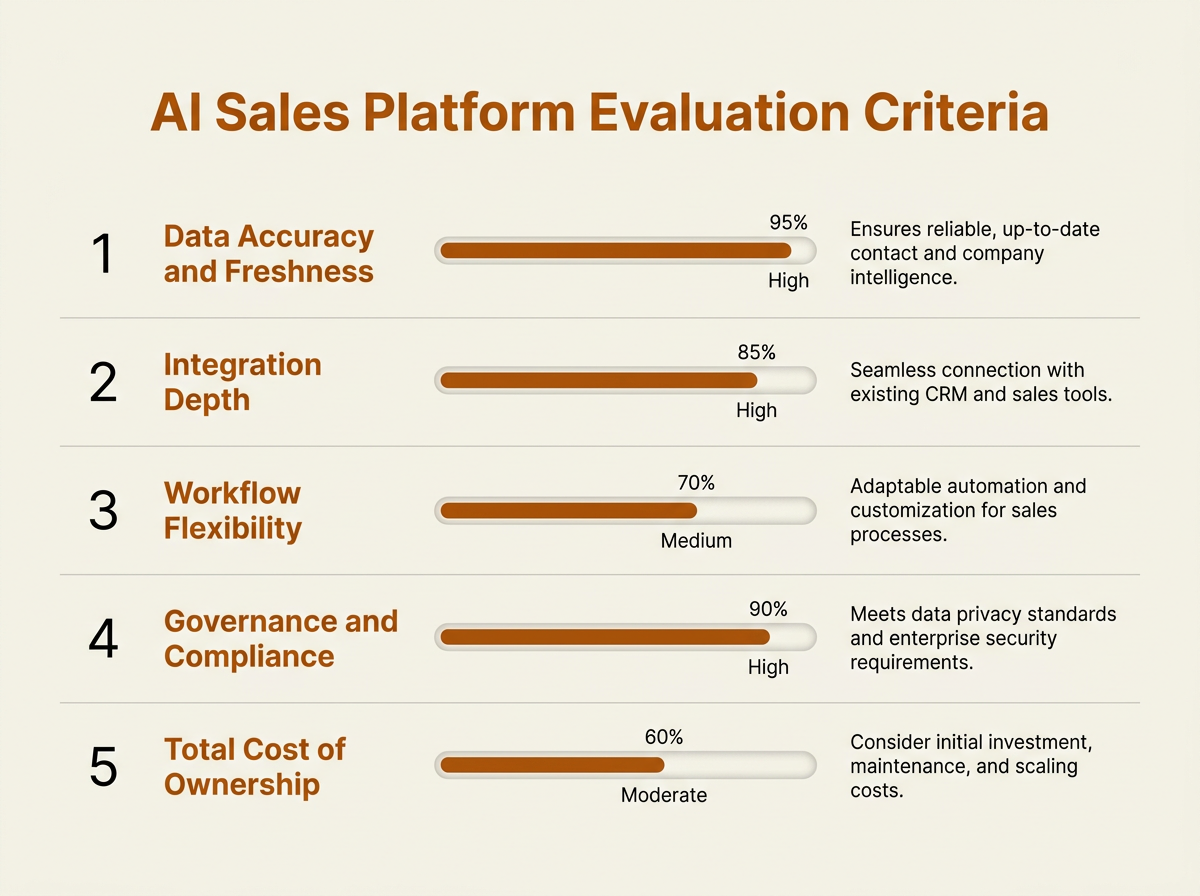
Evaluate best AI sales tools on operational fit across five criteria that drive real adoption.
Most comparison posts turn into feature checklists. That is rarely how tools succeed (or fail) inside a revenue org. Adoption comes down to operational fit. These five criteria are the difference between a platform that becomes part of your motion and one that gets abandoned after 90 days:
Data accuracy and freshness. Run a blind test: export a representative sample of contacts from each vendor and verify emails and phones against your real target accounts. Vendors love to market 95%+ accuracy, but it is common to see that fall to 70% in specific segments. Integration depth. Are you getting true bidirectional CRM sync, or just a one-way push? Can the tool trigger actions in your stack (Slack alerts, CRM field updates, sequencer enrollment) without glue code or middleware? Workflow flexibility. Can you adjust research prompts, scoring logic, and the enrichment waterfall, or are you stuck with the vendor's defaults? Governance and compliance. GDPR, CCPA, and SOC 2 are table stakes for enterprise buyers. Ask for the documentation, not a checkbox on a pricing page. Total cost of ownership. Credit-based models can look cheap until you model real usage. Forecast your monthly volume (contacts enriched, emails sent, seats, API calls) across vendors before procurement locks you in.
If you are evaluating enrichment vendors specifically, the roundup of best enrichment software platforms goes deeper on data quality benchmarks.
AI vs. Human Responsibilities in Modern Sales
Enterprise investment in AI agents continues to grow rapidly, and the category has become one of the fastest-expanding segments in B2B technology. That growth is real, but it does not translate into "AI replaces sales." The vast majority of sales leaders who have deployed AI agents report that these tools are critical for meeting business demands, and those same leaders still run human sales teams. For a closer look at how AI for B2B sales teams is evolving, that analysis adds useful context to the division of labor below.
| Responsibility | AI Handles Well | Humans Handle Better |
|---|---|---|
| Prospect research | Company analysis, technographic scanning, news monitoring | Interpreting nuanced competitive dynamics |
| Contact enrichment | Email/phone lookup, title normalization, data hygiene | Validating org chart accuracy for strategic accounts |
| Outreach drafting | First-draft personalization, A/B variant generation | Tone calibration for C-suite, relationship-based messaging |
| Lead scoring | Pattern recognition across thousands of signals | Overriding scores based on relationship context |
| Deal forecasting | Aggregating engagement signals, identifying risk patterns | Negotiation strategy, stakeholder management |
| Follow-up sequencing | Timing optimization, channel selection | Reading emotional cues, knowing when to go off-script |
| AI for sales teams works best as an amplifier, not a replacement. |
The strongest teams treat AI sales automation like infrastructure: it clears the repetitive work so reps can spend time on what humans still do better, building trust, navigating internal politics, and closing complex deals. For a deeper exploration of where that boundary tends to sit, see the analysis of top AI platforms for B2B sales.
Buying Checklist: Before You Sign
Use this checklist during vendor evaluations to avoid common pitfalls:
- Run a blind data accuracy test on a representative sample of contacts from your actual ICP, not the vendor's demo data.
- Map every integration point: CRM, sequencer, Slack, data warehouse. Confirm bidirectional sync where needed.
- Calculate total cost of ownership at your projected usage (seats, credits, API calls) for 12 months.
- Request SOC 2 Type II report and GDPR/CCPA documentation before procurement review.
- Ask for customer references in your industry and company size bracket, not just logos.
- Test workflow customization: can you modify AI prompts, scoring weights, and enrichment waterfalls?
- Confirm contract flexibility: monthly vs. annual, cancellation terms, data portability on exit.
- Evaluate onboarding support: dedicated CSM, implementation timeline, training resources.
Putting It All Together: Choosing Your Stack
There is no single "best" AI sales tool for every org. A five-person startup standing up outbound for the first time has a different set of constraints than a 200-rep enterprise with a mature RevOps function. The most common failure mode is buying the most feature-rich platform and using 15% of it. The second is building a Frankenstack of point solutions and then spending more time keeping integrations alive than generating pipeline.
The right choice depends on your GTM maturity, operational requirements, integration needs, governance model, and long-term workflow strategy. If your priority is consolidating AI prospecting tools, enrichment, intent, and outbound orchestration without managing a pile of vendors, a unified platform approach (Bitscale is one example in this category) can reduce operational overhead. If you have strong technical resources and existing infrastructure, composable tooling like Clay offers more control. If your need is narrow, such as conversation intelligence or cold email execution, specialists like Gong and Instantly.ai deliver concentrated value. Evaluate each option against your specific bottleneck rather than defaulting to the biggest brand or the longest feature list.
Start with the bottleneck, not the logo. If reps are burning three hours a day on research, fix that first. If pipeline exists but deals stall late, conversation intelligence will matter more than prospecting volume. If your bounce rate is climbing, enrichment is the priority. Match the tool to the constraint, validate it in a pilot, then scale. For more options across the broader market, explore the guide to top sales intelligence tools.
Frequently Asked Questions
What is the difference between AI sales tools and traditional CRM software?
A traditional CRM primarily stores and organizes customer data. AI sales tools go a step further: they analyze that data, research prospects, score leads, draft outreach, and automate multi-step workflows. The CRM remains your system of record; an AI sales platform acts more like a system of action layered on top of it.
Can AI sales automation fully replace human SDRs?
No. AI can handle research, enrichment, first-draft outreach, and lead scoring at scale, but SDRs are still needed for relationship building, nuanced objection handling, and strategic account work. The teams getting results use AI to increase SDR output, not erase the role. For a detailed breakdown, read the analysis of AI SDR tools.
How much do AI sales platforms typically cost?
Pricing varies widely across the category. Entry-level tools often use self-service subscription models with free or low-cost tiers. Mid-market platforms typically charge based on credit consumption, seats, or usage volume, and costs scale accordingly. Enterprise solutions such as ZoomInfo, Outreach, and 6sense generally require custom contracts based on seats, integrations, data access, and support levels. Do not compare sticker prices without modeling your real usage across contacts enriched, emails sent, seats, and API calls.
What integrations should I prioritize when choosing an AI sales tool?
Start with bidirectional CRM sync (Salesforce, HubSpot), then your sequencer or sales engagement platform. From there, look for Slack or Teams alerts for real-time routing, plus any data warehouse integration you rely on for reporting. The integration should support field-level mapping and automated triggers, not just basic contact pushes.
How do I measure ROI from AI sales software?
Track three outcomes: time saved per rep on research and admin work (against a pre-AI baseline), pipeline created from AI-sourced or AI-enriched leads, and data quality improvements (bounce rates and connect rates). Skip vanity metrics like "emails sent" and focus on conversion rates and revenue influenced downstream.