Sales Enablement: A Practical Guide for Modern Revenue Teams
Sales enablement framework for B2B teams: coaching, AI research, CRM enrichment, buying signals, governance, and metrics tied to pipeline and revenue.
Sales enablement has blown past its original remit. What used to be a content folder and an onboarding checklist now sits where coaching, buyer intelligence, workflow automation, and AI research collide. Over the past several years, the share of organizations with a dedicated sales enablement function has grown dramatically, shifting from a niche capability to a mainstream investment across B2B revenue teams. Enablement has earned a real mandate; many teams are still running it with a definition that belongs to a different era.
This is for revenue leaders, enablement practitioners, and ops teams who want an operating blueprint, not a dictionary entry. You'll get the core pillars, a clear line on where AI helps (and where it creates risk), an implementation path, and measurement models you can adapt to your org. If you already have a program in motion, jump to the sections on AI-assisted selling and governance. If you're starting from zero, read straight through.
What Sales Enablement Actually Means Now
A lot of definitions still shrink enablement down to "getting reps the right content at the right time." That was a reasonable shorthand in 2015. Today, it is not enough. Modern sales enablement is a cross-functional discipline that equips every revenue-facing role with coaching, content, intelligence, tools, and workflows that help buyers make decisions and help sellers close efficiently. It is not a department. It is not a software category. It is an operating model.
That distinction matters because buying behavior has shifted in a measurable way. Research from Forrester and other analyst firms consistently shows that the number of interactions involved in a typical B2B purchase has risen sharply over recent years. Buyers do more self-education, pull more stakeholders into the process, and expect sellers to show up with context. Enablement exists to close the readiness gap so sellers can stay relevant and effective across an increasingly complex buying journey.
A complete program has ten pillars: sales coaching, structured onboarding, sales content management, AI prospect research, CRM enrichment, buying signals, workflow automation, sales intelligence, analytics, and governance. When teams treat one pillar as the whole job, they end up with a scattered set of projects that present well in a deck but barely budge pipeline.
The Pillars in Practice
Sales coaching is the highest-leverage part of enablement, and it's also where execution gets sloppy. There's a world of difference between a manager who reviews call recordings every week and one who calls it coaching when they forward a slide deck. Strong coaching programs use a consistent framework (like MEDDIC or Challenger), connect sessions to real deal outcomes, and watch for behavior change over time, not just "session completed."
Onboarding sets the ceiling for everything that follows. Reps who ramp faster start generating pipeline sooner, and the difference between a well-structured onboarding program and a haphazard one compounds quickly across a growing team. The programs that work mix product knowledge, competitive positioning, and live deal shadowing. The programs that don't work cram people into a short burst of classroom training and then hand them a territory with a quiet "good luck."
Content and buyer enablement are inseparable. Sales content management is less about building a bigger library and more about making the right asset findable in under 30 seconds. Buyer enablement changes the question: what does the internal champion need to sell this internally? Business cases, ROI calculators, and exec-ready summaries built for the buying committee are often worth more than another product one-pager.
AI prospect research and CRM enrichment are the operational backbone. When reps do account research by hand, you burn hours that should be spent talking to buyers. Industry surveys consistently show that sellers spend a minority of their time on actual selling activities, with the rest consumed by research, data entry, and administrative tasks. Automating prospect research, enriching CRM records with firmographic and technographic data, and pushing buying signals directly into rep workflows gives that time back in a way sellers can feel week to week.
Workflow automation, analytics, and governance are what make the rest of the system hold together. Automation moves enriched data into sequences, turns coaching insights into manager alerts, and captures content usage without extra rep clicks. Analytics shows you what is actually driving outcomes. Governance keeps the CRM clean, messaging consistent, and AI outputs reviewed before they land in a buyer's inbox.
Traditional Enablement vs. AI-Powered Enablement
The difference between legacy programs and AI-powered enablement is not "people vs. machines." It's friction. AI is most valuable when it strips time out of the steps between a rep and a closed deal. Analyst firms like Gartner project that sales organizations with AI-driven enablement functions will see meaningfully faster sales stage velocity than teams using traditional approaches over the coming years. That speed comes from compressing research, personalization, and data hygiene into workflows that run in the background.
| Dimension | Traditional Enablement | AI-Powered Enablement |
|---|---|---|
| Prospect Research | Manual LinkedIn and web searches | Automated AI prospect research with enriched firmographic, technographic, and intent data |
| Content Delivery | Static content libraries organized by folder | Contextual content recommendations based on deal stage and buyer persona |
| Coaching | Periodic ride-alongs and ad hoc feedback | AI-flagged coaching moments from call recordings with structured follow-up |
| CRM Data Quality | Reps manually update fields (often incomplete) | Automated CRM enrichment with verified contact and company data |
| Buying Signals | Reps rely on gut feel and email opens | Multi-source intent signals aggregated and scored automatically |
| Onboarding | Classroom training plus a binder | Adaptive learning paths with AI-generated practice scenarios |
| Analytics | Quarterly pipeline reviews | Real-time dashboards tracking content usage, coaching frequency, and deal velocity |
| AI-powered enablement automates low-value tasks so reps and managers focus on relationship-driven selling. |
Where AI Belongs (and Where It Doesn't)
The most common failure mode with AI sales enablement is treating the model like it can replace seller judgment. AI is great at chewing through large datasets, spotting patterns across thousands of deals, enriching records, and firing workflow triggers. It is not great at reading a negotiation dynamic, earning trust with a skeptical CFO, or deciding when to push back on a prospect's timeline.
| Responsibility | AI | Human |
|---|---|---|
| Account and contact research | Primary owner | Reviews and validates |
| CRM data enrichment and hygiene | Primary owner | Spot-checks and corrects edge cases |
| Buying signal detection and scoring | Primary owner | Interprets signals in deal context |
| Coaching feedback from calls | Surfaces patterns and moments | Delivers feedback and builds development plans |
| Content creation | Drafts and suggests | Edits, approves, and personalizes for the buyer |
| Deal strategy and negotiation | Provides data inputs | Primary owner |
| Relationship building | Minimal role | Primary owner |
| Effective programs assign clear ownership between AI and human contributors. |
Use a simple test. If the work depends on empathy, judgment under ambiguity, or trust, keep it human-led. If the work depends on speed, scale, and pattern recognition across structured data, automate it. The best enablement stacks do both well: they surface the right intelligence and leave room for sellers to apply nuance.
Building Your Enablement Program: Implementation Playbook
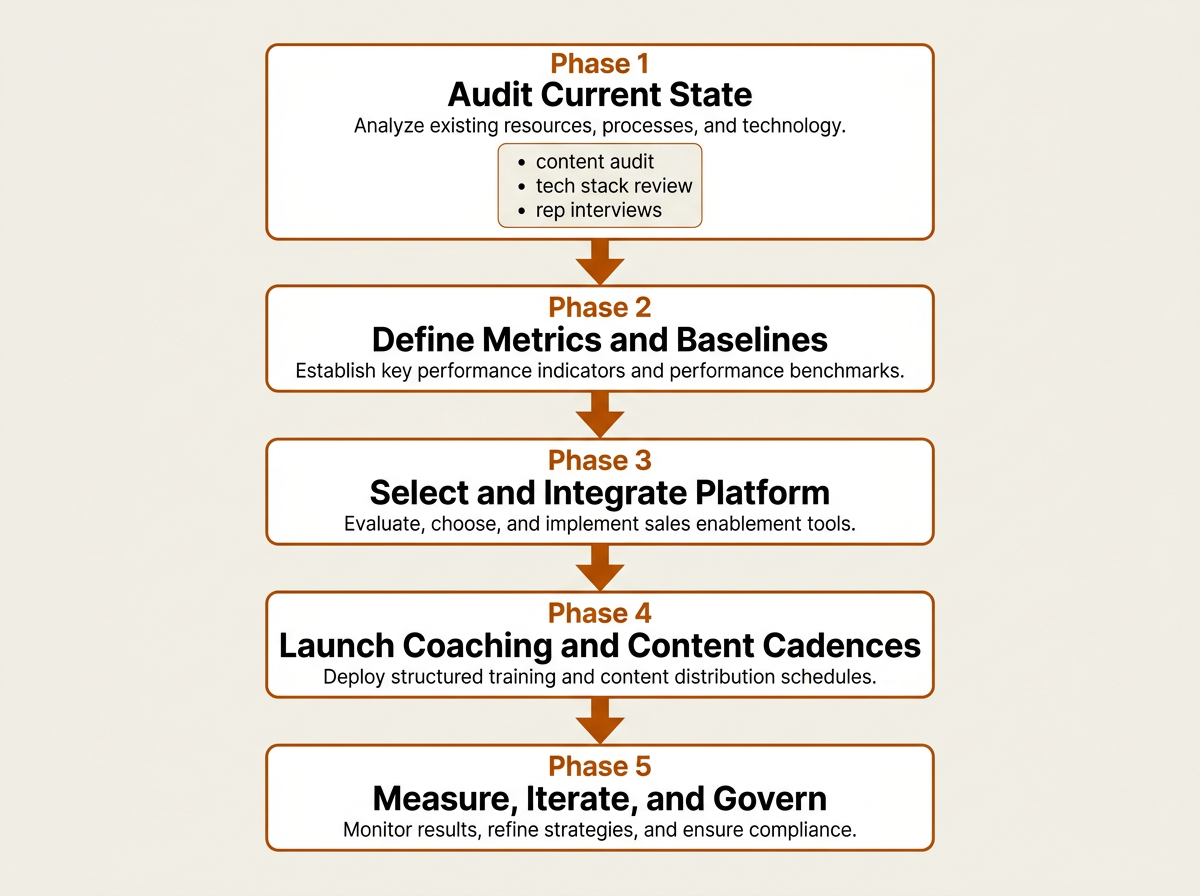
A phased rollout prevents the common failure of launching everything at once.
Phase 1: Audit Before You Build
If you skip the audit, you end up automating broken processes. Start by inventorying every sales asset, every tool in the stack, and the workflows reps actually run day to day (not the version living in Confluence). Talk to five to ten reps across tenure levels and roles. Ask: "Walk me through how you prepare for a first call." You'll hear the real process, plus the gaps no dashboard will ever show.
Phase 2: Set Baselines That Matter
Enablement goes sideways when teams measure motion instead of results. Before you launch changes, capture baselines for: ramp time to first deal, win rate on forecasted deals, average deal cycle length, content utilization rate (what percentage of assets get used at least once per quarter), and a CRM data completeness score. Organizations with mature, formal sales enablement programs consistently report stronger win rates than those without structured programs. Track the metrics that can actually prove (or disprove) that kind of impact.
Phase 3: Choose Your Sales Enablement Platform
The sales enablement software market is crowded, and many teams buy like they're building a museum of point solutions. You do not need seven tools to do one job. You need a platform that covers prospect research, data enrichment, and workflow automation, and that integrates cleanly with your CRM and outbound systems. Platforms like Bitscale bring AI prospect research, buying signals, CRM enrichment, and ready-made sales workflows into one GTM layer, which cuts the integration tax that quietly kills adoption. When you evaluate any platform, weight native CRM sync, enrichment depth, and workflow flexibility higher than raw feature count.
Phase 4: Launch Coaching and Content Cadences
Run coaching and content as parallel tracks, not a relay race. Early in the rollout, managers should establish a regular cadence of deal reviews using a consistent framework. Content needs to be tagged by persona, deal stage, and use case so reps can self-serve without asking Slack for a link. If you're rolling out AI prospect research, train reps on how to interpret and act on the enriched data, not just how to generate it.
Phase 5: Govern, Measure, Iterate
Governance is the unglamorous work that keeps enablement from decaying over time. Assign owners for content freshness (with regular reviews, whether quarterly or more frequently depending on your market pace), CRM data standards (required fields and trusted enrichment sources), and AI review steps. The right cadence for governance reviews depends on your organization's size, compliance requirements, and sales complexity. Smaller teams with shorter cycles can review less frequently; larger, regulated organizations often need tighter intervals. Measure consistently against the Phase 2 baselines and iterate based on what moves pipeline, not what gets applause in an enablement QBR.
Common Mistakes That Stall Enablement Programs
Treating enablement as a content dump. A large asset library without tagging, usage tracking, or retirement rules is basically a graveyard. Reps will route around it. If utilization stays consistently low, that is a signal of discoverability, relevance, or governance problems, not a rep motivation problem.
Skipping coaching in favor of training. Training transfers knowledge. Coaching changes behavior. A rep can pass a certification quiz and still struggle in discovery. Programs that over-invest in training and under-invest in ongoing coaching tend to plateau quickly.
Buying tools without defining workflows. If you buy a platform before you map the workflows it needs to run, you are setting yourself up for shelfware. Start with the workflow ("when a target account shows hiring intent, enrich the contact list and trigger a personalized sequence"), then choose the tool that can execute it reliably.
Measuring activity instead of impact. "Number of reps who completed training" is an attendance metric, not a productivity metric. Anchor your reporting in ramp time, win rate, deal velocity, and content-influenced pipeline. For a deeper look at metrics that map to output, see this resource on increasing B2B sales productivity.
Measuring Enablement: A Framework That Works
| Enablement Initiative | Primary Metric | Business Impact |
|---|---|---|
| Structured onboarding program | Time to first deal | Faster ramp reduces cost of new hire investment |
| Weekly coaching cadence | Win rate on coached deals vs. uncoached | Direct correlation to revenue per rep |
| AI-powered prospect research | Research time per account | More selling time, higher outbound volume |
| CRM enrichment automation | Data completeness score | Better segmentation, targeting, and forecasting accuracy |
| Buying signal integration | Response time to high-intent accounts | Earlier engagement in active buying cycles |
| Content governance | Content utilization rate | Higher ROI on content investment, fewer outdated assets in circulation |
| Workflow automation | Steps eliminated per deal cycle | Shorter sales cycles, reduced administrative burden |
| Tie every initiative to a metric that connects to revenue outcomes. |
Use the table as a starting point. The hard part is keeping the thread intact from enablement activity to pipeline and revenue. Revenue enablement, the evolution Forrester and other analysts have been pushing, extends measurement across the full customer lifecycle: first touch, close, expansion, and renewal. If your reporting stops at new business, you are ignoring retention and expansion revenue that enablement also influences. For more context on how Forrester approaches sales enablement, their research blog tracks the shift toward revenue enablement in detail.
The Role of a Unified GTM Platform
Point solutions love to create silos. When your prospect research tool does not sync with your CRM enrichment tool, and neither connects cleanly to sequencing, reps end up copy-pasting between tabs. That is the opposite of enablement. Platforms like Bitscale consolidate AI prospect research, intent and buying signals, CRM sync, and outbound integrations into a single layer. Done right, enriched data flows into the workflows reps already live in, without the manual stitching.
When you evaluate top AI software for revenue teams, favor platforms that treat enrichment and automation as one connected system, not two separate add-ons. The handoff between research, enrichment, and action is where productivity gains show up (or fail to). If you want a wider scan of the market, this roundup of best AI tools for sales and marketing covers options across categories.
Advanced Considerations: Governance, Compliance, and Scaling
Plenty of enablement content ends with "pick a tool and train your reps." That is the easy part. The hard part is building something that still works when you go from 10 sellers to 50.
AI output governance is not optional. Any AI-generated email, research summary, or account brief needs a human review step before it reaches a buyer. This is not a referendum on AI; it is basic brand control and accuracy. Keep the workflow lightweight: AI drafts, the rep edits and personalizes, and managers spot-check a representative sample on a regular basis, adjusting the frequency as the team scales and trust in the outputs matures.
Data compliance gets more complex as you scale enrichment. Make sure your enrichment sources align with GDPR, CCPA, and any industry-specific requirements you operate under. Your enablement platform should be able to document how it sources data, and your ops team should audit enrichment pipelines on a regular cadence appropriate to your regulatory environment and data volume.
Scaling across segments and geos calls for modular playbooks, not a single monolith. An enterprise AE in EMEA will need different coaching, content, and compliance guardrails than an SMB SDR in North America. Organize enablement around segments first, then layer role-specific and geo-specific variants on top. That structure only works if you understand how each segment moves through the pipeline, and this breakdown of optimizing the sales funnel is useful context for stage-level design.
Key Takeaways
- Sales enablement is an operating model spanning coaching, content, intelligence, automation, and governance, not a content library or a training calendar.
- AI should own research, enrichment, signal detection, and workflow triggers. Humans should own relationships, judgment, and deal strategy.
- Audit the current state before you buy. Define the workflows first, then pick platforms that can run them end to end.
- Measure outcomes (win rate, ramp time, deal velocity), not busywork (training completions, content uploads).
- Governance, including AI review, data compliance, and content freshness, is what makes programs durable at scale. Tailor review cadences to your organization's size and complexity.
- A unified GTM platform like Bitscale reduces integration drag by connecting AI prospect research, CRM enrichment, buying signals, and workflow automation in one layer.
Frequently Asked Questions
What is the difference between sales enablement and revenue enablement?
Sales enablement is usually scoped to helping sellers close new business with the right content, training, coaching, and tools. Revenue enablement broadens the job to include customer success, account management, and renewals, so measurement and support span the full customer lifecycle, not just new logos.
How do I choose the right sales enablement software for my team?
Start by mapping the workflows your team actually runs and where time gets wasted. Then prioritize platforms with native CRM sync, solid enrichment, and workflow automation you can adapt as your process evolves. Skip feature bloat you will not touch in the first six months. Platforms like Bitscale are worth a look because they combine prospect research, enrichment, and workflow orchestration in one place.
Can AI replace sales coaching?
No. AI can surface coaching moments by flagging patterns in call recordings (for example, where discovery questions were skipped) and it can provide data that makes coaching more specific. The coaching itself, building trust with a rep, diagnosing skill gaps, and driving sustained behavior change, is a human manager's job. AI makes coaching sharper, not unnecessary.
What are buying signals and how do they fit into enablement?
Buying signals are observable actions or data points that suggest a prospect is actively evaluating solutions. Common examples include job postings for relevant roles, technology adoption changes, funding rounds, and engagement with your content. Strong enablement programs route buying signals into rep workflows so sellers can prioritize accounts showing real intent. For a detailed breakdown, see this guide on how to identify buying signals.
How long does it take to see results from a sales enablement program?
Operational indicators like content utilization, CRM data quality, and adherence to a coaching cadence tend to improve first, often within the early weeks of a disciplined rollout. Pipeline and revenue impact takes longer and depends on your sales cycle length, team adoption speed, and organizational maturity. Teams that set baselines before launch can prove ROI faster because they have a clean before-and-after comparison.
Unify prospect research, CRM enrichment, and buying signals with Bitscale.