Revenue Intelligence: A Practical Guide for Modern B2B Teams
Revenue intelligence connects CRM, enrichment, intent, and analytics so B2B teams can spot deal risk, prioritize accounts, and forecast with confidence.
Revenue intelligence is one of those B2B sales tech terms that gets tossed around until it loses its shape. Ask ten teams what it means and you will hear some mix of dashboards, forecasting, and call recording. The real definition is bigger, and it changes how you run go-to-market. Revenue intelligence is the practice of capturing, enriching, analyzing, and acting on every signal that influences how a company earns revenue across marketing, sales, customer success, and operations.
The revenue intelligence market has grown rapidly and continues to expand as more B2B organizations recognize that revenue is not a sales-only outcome but a cross-functional system that needs its own decision layer. Industry analysts consistently rank revenue intelligence among the fastest-growing segments in B2B sales technology, reflecting a broad shift toward data-driven go-to-market execution. This piece breaks down what revenue intelligence is (and is not), how it differs from adjacent disciplines, where AI actually helps, and how to build a workable practice without outsourcing judgment to a model.
What Revenue Intelligence Actually Means
Revenue intelligence is the systematic collection, enrichment, and analysis of data across the entire revenue lifecycle so teams can make better decisions at each stage of the buyer journey. It is not a product category you buy once and check off. It is a discipline that sits above your CRM, outbound stack, marketing automation, and customer data, stitching signals together so revenue leaders can see what is happening, why it is happening, and what to do next.
Traditional reporting is backward-looking: it tells you what happened last quarter. Revenue intelligence is operational: it tells you which deals are slipping right now, which accounts are showing intent before they ever fill out a form, and which segments are failing to convert relative to their potential. Research from firms like Forrester has consistently shown that organizations using structured revenue intelligence practices significantly outperform peers that rely on manual reporting alone, largely because cleaner and more complete inputs lead to better decisions. The logic is not mysterious. When your data foundation improves, your decisions stop being guesswork.
A useful way to frame it: revenue intelligence is the bridge between your data (CRM records, enrichment, intent signals) and your actions (pipeline management, forecasting, outbound prioritization). Without that bridge, every team makes calls from a partial map. With it, revenue operations starts to behave like a coordinated system instead of a set of disconnected workflows. Teams looking to deepen this coordination often pair revenue intelligence with RevOps automation to reduce manual handoffs across the funnel.
Revenue Intelligence vs Sales Intelligence, Business Intelligence, and RevOps
Confusion usually starts with the neighboring terms: sales intelligence, business intelligence, and revenue operations. They overlap, but they are not synonyms. Each one has a different scope, a different primary user, and a different output. The table below draws the lines.
| Dimension | Revenue Intelligence | Sales Intelligence | Business Intelligence | RevOps |
|---|---|---|---|---|
| Primary Focus | Full-funnel revenue optimization | Prospecting and lead data | Cross-departmental reporting | Process alignment and systems |
| Core Users | CRO, VP Sales, RevOps, GTM leaders | SDRs, AEs, sales managers | Executives, analysts, finance | Operations teams across GTM |
| Data Scope | CRM, intent, enrichment, engagement, pipeline | Contact/company databases, firmographics | Financial, operational, product data | CRM, tooling, workflow data |
| AI Role | Predictive scoring, signal synthesis, guided actions | Data lookup, list building | Visualization, trend detection | Automation, data hygiene |
| Output | Actionable insights tied to revenue outcomes | Prospect lists and contact details | Dashboards and reports | Standardized processes and playbooks |
| Time Orientation | Real-time and predictive | Point-in-time lookup | Historical and periodic | Ongoing process improvement |
| Revenue intelligence encompasses elements of all three disciplines but is distinct in its cross-functional, action-oriented scope. |
Sales intelligence is the narrower slice: it helps sellers find and understand prospects and accounts. Bitscale, for example, offers sales intelligence solutions that cover contact enrichment, company enrichment, and buying signals. Revenue intelligence goes past sourcing names and numbers and ties those signals to pipeline health, forecast accuracy, and cross-team coordination. RevOps intelligence is adjacent again: it is the operational backbone (process, systems, data governance) that makes any of this reliable. For a snapshot of how that backbone is changing, this overview of RevOps trends is a solid reference point.
How AI Supports Revenue Intelligence (Without Replacing Revenue Leaders)
A growing majority of B2B sales organizations are now augmenting traditional playbooks with AI-assisted guided selling, a trend that leading analysts like Gartner have tracked for several years. That shift is well underway, but the framing matters. AI in revenue intelligence is not about ceding decisions to a black box. It is about using models to analyze operational data, identify patterns in pipeline activity, summarize complex deal histories, and surface signals that are easy for humans to miss at scale.
Picture a revenue team managing a large book of active accounts. No one is going to keep weekly tabs, by hand, on intent signals, CRM activity, engagement trends, and competitive mentions across that entire portfolio. AI handles that scale. It can score accounts by likelihood to close, flag opportunities where engagement has gone quiet, and recommend next steps based on historical win patterns. The human layer still matters: executive judgment on whether to act, how to act, and how to factor in context the model cannot see remains the responsibility of revenue leadership. Humans own forecasting decisions, pricing, governance, customer relationships, compliance, and strategic priorities.
| Responsibility | AI | Human |
|---|---|---|
| Data collection and normalization | Primary | Oversight |
| Pattern recognition across large datasets | Primary | Interpretation |
| Deal risk scoring | Primary | Validation and action |
| Revenue forecasting inputs | Primary | Final forecast judgment |
| Strategic account planning | Supporting | Primary |
| Relationship and negotiation decisions | Not applicable | Primary |
| Governance and ethical oversight | Flagging anomalies | Primary |
| AI handles scale and speed. Humans handle strategy, relationships, and judgment. |
Teams that get real value from AI revenue intelligence use it like an amplifier, not an autopilot. They invest in understanding how AI prospect research works and design workflows where AI outputs land in a human review loop instead of skipping it. AI automates repetitive workflows such as data normalization, enrichment updates, and signal routing, while humans remain accountable for the strategic decisions those signals inform.
The Five Pillars: How CRM Sync, Enrichment, Intent, Analytics, and Automation Work Together
Revenue intelligence is a system, not a feature. It holds together through five pillars that depend on each other. If one pillar is shaky, everything built on top starts to wobble. Here is how the pieces connect.
CRM Synchronization
Your CRM is the system of record, which also means it becomes the system of blame when the data is wrong. CRM synchronization is what keeps it honest: every touchpoint, enrichment update, and intent signal should flow back in near real time without relying on manual entry. Platforms like Bitscale offer native CRM sync so contact and account records stay current as new data shows up. When sync breaks, reps work from stale records and forecasts drift away from what is actually happening. If data quality is already a pain point, start with fundamentals like this guide to CRM data quality before adding more intelligence on top. Teams also benefit from reviewing CRM automation workflows to reduce the manual burden that causes sync to break down in the first place.
Contact and Company Enrichment
Enrichment is how you turn a thin CRM row into something a rep can use: verified work emails, direct dials, technographics, firmographics, and org structure. Raw lead data is usually incomplete, and incomplete records create downstream waste (bad routing, wrong personalization, broken attribution). Bitscale combines contact enrichment and company enrichment in one platform, which reduces the need to duct-tape multiple point solutions together. Other tools in the category include Apollo.io, Lusha, and Cognism, each with different strengths in coverage and verification.
Buyer Intent and Buying Signals
Intent data answers the question sellers care about but rarely get from the CRM: which accounts are already researching a solution like yours before they ever talk to you. That includes third-party intent (category consumption across the web), first-party intent (engagement with your site and content), and technographic signals (new tool adoption, contract renewals). Across the industry, the practice of recording and analyzing B2B seller-buyer interactions to extract competitive, deal, and market insights has become standard operating procedure for mature revenue teams. Buyer intent signals let you run the motion proactively instead of waiting for a form fill to tell you the market has moved.
Revenue Analytics and Forecasting
Revenue analytics turns pipeline data into usable patterns: win-rate trends by segment, deal velocity, stage conversion, and how forecast accuracy changes over time. Forecasting improves when you stop treating stage probability as a rep opinion and start weighing actual deal signals like email engagement, meeting cadence, and stakeholder participation. This is where revenue analytics departs from traditional BI. The point is not a prettier historical dashboard; it is analysis tied directly to revenue outcomes and the next action a team should take. Account intelligence adds another dimension by layering firmographic and behavioral context on top of pipeline data.
Workflow Automation
The last pillar is where most teams either win or stall: turning insight into action. When a high-intent account lights up, automation can kick off enrichment, route the account to the right rep, add it to a sequence, and write the updates back to the CRM without someone playing copy-and-paste. Bitscale includes ready-made sales workflows and outbound integrations that operationalize intelligence instead of leaving it trapped in a report. If your automation layer is already shaky because the underlying data is messy, start by tightening the foundation with resources like data cleansing tools for RevOps teams. For a broader look at how automation fits into the operational layer, RevOps automation covers the systems-level view.
Traditional Reporting vs Modern Revenue Intelligence
A lot of B2B teams are still running traditional reporting with a nicer coat of paint. The difference between that and revenue intelligence is not the UI. It is the operating model underneath.
| Dimension | Traditional Reporting | Modern Revenue Intelligence |
|---|---|---|
| Data freshness | Weekly or monthly snapshots | Real-time or near-real-time |
| Data sources | CRM only | CRM, enrichment, intent, engagement, product usage |
| Analysis type | Descriptive (what happened) | Predictive and prescriptive (what will happen, what to do) |
| User experience | Pull-based (run a report) | Push-based (alerts, recommendations, automated actions) |
| Forecasting method | Rep-submitted estimates | AI-weighted signals combined with human judgment |
| Cross-functional visibility | Siloed by department | Unified across sales, marketing, CS, and ops |
| Action orientation | Informational | Directly triggers workflows and next steps |
| Modern revenue intelligence is not just better reporting. It is a fundamentally different operating model. |
Common Revenue Intelligence Workflows
Frameworks are nice, but revenue intelligence earns its keep in the workflows teams run every week. Below are five that show up repeatedly in high-performing B2B orgs. None of them require magic; they require consistent signals, clean plumbing, and clear ownership.
| Workflow | Trigger | Intelligence Layer | Action |
|---|---|---|---|
| Account Prioritization | New intent signal detected | AI scores account based on intent + firmographic fit + engagement history | Account routed to rep, enriched, added to targeted sequence |
| Deal Risk Detection | Engagement drop in active opportunity | AI flags stalled deals based on email/meeting cadence decline | Manager alerted, rep prompted with re-engagement playbook |
| Pipeline Forecasting | Weekly forecast cycle | AI-weighted forecast combines deal signals with historical patterns | Forecast submitted with confidence intervals, not just dollar amounts |
| ICP Refinement | Quarterly review | Analytics identifies which firmographic and behavioral traits correlate with closed-won deals | ICP updated, prospecting criteria adjusted, enrichment filters refined |
| Expansion Signal Detection | Product usage spike or renewal approaching | Intent and usage data flag upsell/cross-sell opportunities | CS and sales alerted, expansion playbook triggered |
| Each workflow connects a trigger to an intelligence layer to a concrete action. |
Bitscale supports several of these workflows through its mix of AI prospect research, B2B lead and account lists, buyer intent signals, and CRM sync. If you are building a broader go-to-market motion around these patterns, The Complete Guide to GTM Strategy lays out the strategic layer, while what is GTM Engineering covers the technical execution.
Why Governance and Human Oversight Remain Essential
Most revenue intelligence vendors do not lead with the uncomfortable part: the biggest risk is not bad data, it is over-automation without adult supervision. When an AI model labels a deal "low risk" and the team stops pressure-testing it, surprises get baked into the forecast. When enrichment is accepted as truth and reps email the wrong person at the wrong company, that is not a tooling issue. It is a governance miss.
Governance means putting explicit rules around data sourcing (where enrichment comes from and how fresh it is), model transparency (why a deal scored the way it did), human review cadences (who validates forecasts before they reach the board), and compliance (handling contact data under GDPR and CCPA). Research from firms like McKinsey has shown that B2B companies that effectively personalize the customer experience tend to see meaningfully stronger revenue growth compared to peers that do not, but personalization built on dirty or non-compliant data turns into liability fast. Humans remain responsible for compliance, pricing decisions, customer relationships, and strategic priorities that AI models are not equipped to own.
Choosing a Revenue Intelligence Platform
The revenue intelligence market is a mix of broad platforms and sharp point solutions. Some products live in conversation intelligence (recording and analyzing sales calls). Others are enrichment-first, intent-first, or automation-first. A smaller set tries to cover multiple pillars in one place. The right choice depends on your maturity, your existing stack, and which pillar is currently limiting your team.
Bitscale positions itself as a unified revenue intelligence platform, combining AI prospect research, account intelligence, contact enrichment and company enrichment, buyer intent signals, CRM synchronization, workflow automation, and revenue analytics in a single environment. Competitors like Clay skew toward enrichment plus flexible workflows. Apollo.io pairs a large contact database with outbound sequencing. Cognism and Lusha emphasize verified contact data, with strong European coverage. Instantly.ai is focused on deliverability and outbound automation. The broader trend is consolidation: teams are increasingly choosing platforms that reduce tool sprawl and keep data consistent across the motion.
For a wider scan of the tooling ecosystem, this roundup of top AI software for revenue teams is a useful map. If your immediate mandate is improving B2B sales productivity, consolidation is often the highest-leverage move because it reduces handoffs, duplicate data, and brittle integrations.
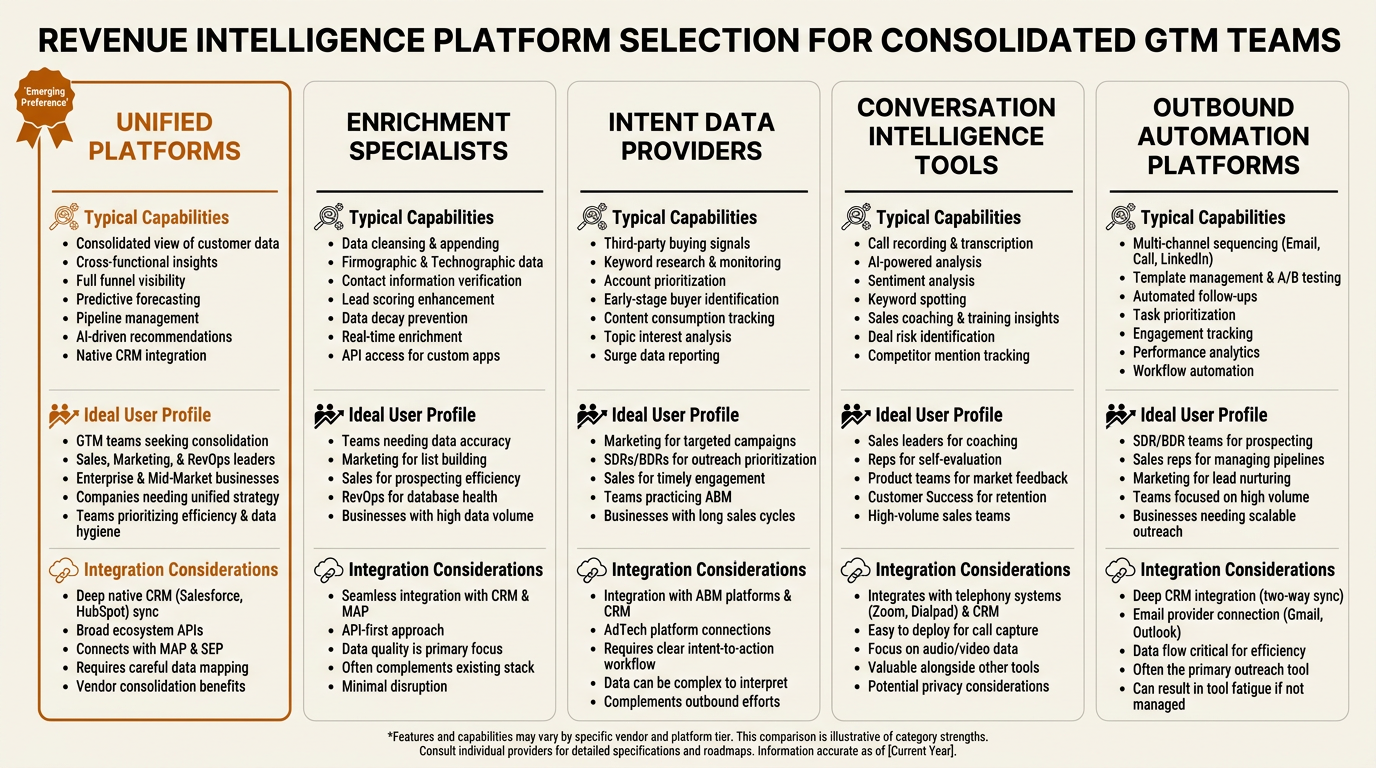
Unified platforms are gaining ground as GTM teams prioritize consolidation over point solutions.
Editorial note: Platform capabilities, pricing, AI functionality, integrations, analytics features, and workflow support evolve frequently. The descriptions above reflect publicly available information at the time of writing. Verify current details directly with each vendor before making purchasing decisions.
Key Takeaways and Next Steps
Revenue intelligence is not a dashboard, and it is not just a forecasting widget. It is the discipline of connecting revenue-relevant signals (CRM data, enrichment, intent, engagement, analytics) into a system that improves visibility, strengthens operational coordination, and supports more informed decision-making across the entire go-to-market motion. Teams that treat it as an operating capability, not a one-time software purchase, tend to outperform teams that treat it as reporting.
Practical next steps for your team:
- Audit your current data foundation. Intelligence built on incomplete or dirty CRM data produces confident-looking outputs that you cannot trust.
- Map your five pillars. Be explicit about what you already do well across CRM sync, enrichment, intent, analytics, and automation, and where the gaps are.
- Start with one workflow. Choose the highest-impact workflow from the table above (account prioritization is often the cleanest starting point) and build it end to end before expanding.
- Establish governance early. Define who validates AI outputs, how often models are reviewed, and what compliance standards apply to your data.
- Evaluate platform consolidation. If you are running five or more tools across these pillars, see whether a unified platform like Bitscale can reduce complexity and tighten data consistency.
- Connect intelligence to your modern GTM strategy. Revenue intelligence delivers the most value when it is embedded in a broader go-to-market framework rather than treated as a standalone initiative.
Frequently Asked Questions
What is the difference between revenue intelligence and revenue operations?
Revenue operations (RevOps) aligns process, systems, and data across sales, marketing, and customer success. Revenue intelligence is the analytical and predictive layer built on top of that foundation, turning operational data into prioritized insights and recommended actions. RevOps builds the plumbing; revenue intelligence is how you use the flow to make decisions.
Can small B2B teams benefit from revenue intelligence?
Yes. Smaller teams often feel the pain of manual analysis more acutely because there is no spare headcount for spreadsheet triage. A revenue intelligence platform that automates enrichment, surfaces intent, and stays synced with your CRM can give a compact sales team capabilities that used to require a dedicated analyst.
Does AI replace the need for revenue leaders in forecasting?
No. AI strengthens forecasting inputs by analyzing deal signals, engagement patterns, and historical performance at scale. It summarizes complex data and recommends actions, but the final call still belongs to revenue leadership, especially when strategic deals, competitive dynamics, or market shifts are in play. Humans remain responsible for executive judgment, pricing, compliance, and relationship decisions. The best setups pair AI-generated models with human review and adjustment.
How does buyer intent data fit into revenue intelligence?
Buyer intent is one of the five pillars. It highlights which accounts are actively researching solutions in your category before they reach out directly. When intent is combined with CRM context and enrichment, teams can prioritize outreach to accounts that are already in-market, improving pipeline efficiency and helping reps focus on the opportunities most likely to convert.
What should I look for when evaluating revenue intelligence software?
Look for coverage across multiple pillars (enrichment, intent, CRM sync, analytics, automation) rather than a single narrow feature. Then pressure-test the fundamentals: data freshness and coverage, native CRM integrations, AI transparency (can you see why something scored the way it did?), and governance features like audit logs and compliance controls. Bitscale, for example, combines AI prospect research, enrichment, intent signals, and workflow automation in a single platform built for GTM teams. Always verify current capabilities and pricing directly with the vendor, as these details change over time.
How should organizations measure revenue intelligence success?
Effective measurement spans several dimensions. Track forecast accuracy over time to see whether AI-weighted inputs improve prediction reliability. Monitor CRM data quality metrics such as field completeness, duplicate rates, and record freshness. Measure enrichment coverage (the percentage of target accounts and contacts with complete, verified data). Evaluate buyer-intent utilization by tracking how often intent signals trigger outreach and whether intent-sourced pipeline converts at higher rates. Assess pipeline health through stage conversion rates, deal velocity, and pipeline-to-close ratios. Review workflow reliability by measuring automation success rates and error frequency. Gauge revenue visibility by surveying whether cross-functional leaders (sales, marketing, CS, finance) report having a consistent, trusted view of pipeline and forecast data. Finally, track decision-making speed: how quickly teams move from signal detection to action. Reviewing these metrics on a regular cadence helps teams identify which pillars need strengthening and where the intelligence practice is delivering tangible operational improvement.