RB2B Review: Is Free Website Visitor Identification Enough for GTM Teams?
RB2B review: free visitor identification, pricing, and limits. See when GTM teams need enrichment, intent signals, and automation to drive pipeline.
RB2B has earned significant organic attention in B2B GTM circles for a straightforward reason: it gives away something most vendors gate behind a contract. Its website visitor identification tool aims to put names to anonymous sessions and drops person-level profiles straight into Slack, giving sales teams a live feed of who is browsing the site. The product has built a strong reputation among early-stage teams and lean RevOps setups, reflected in consistently positive G2 reviews and growing community adoption.
The more useful question for any RB2B review, though, is not "does it work?" but "is it enough?" A GTM motion that needs to create pipeline, prioritize accounts, and close deals usually demands more than a Slack stream of visitors. Verdict up front: RB2B is a strong on-ramp for teams starting from zero visibility, but most organizations will hit its limits within a quarter. It nails a narrow job (identification) and largely stops there. It does not address the harder part: turning anonymous traffic into qualified, enriched, actionable pipeline. If your team is ready to move past identification into prospecting, enrichment, and workflow automation, Bitscale is a more complete path worth evaluating.
What Is RB2B and How Does It Work?
RB2B is a website visitor identification product that uses a lightweight JavaScript snippet to help de-anonymize people who land on your site. Where older tools often stop at the account level ("Company X visited"), RB2B tries to resolve an actual contact, including name, job title, LinkedIn profile, and company details. The default destination is Slack: when someone visits, RB2B posts a notification into a selected channel with a compact profile card.
Under the hood, it draws on a mix of first-party cookies, reverse IP lookup, and third-party identity resolution databases. In standard terms, website visitor identification is the practice of mapping anonymous traffic to known organizations and contacts using layered data signals. RB2B applies that to a B2B workflow where timing matters. Spotting that a VP of Engineering from a target account just hit your pricing page can change when (and how) you reach out.
Setup and Getting Started
RB2B's adoption curve is helped by the fact that setup genuinely takes only minutes. You create an account, copy the JavaScript snippet from the dashboard, drop it into your site's header (or deploy via Google Tag Manager), connect Slack, and you are up and running. You do not need a CRM integration to get value on day one. There is little configuration, and there is no sales call standing between you and the product. For a solo founder or a two-person SDR team, that low-friction start is a legitimate advantage.
Most of the early time goes into dialing in Slack. Profiles start showing up quickly, and seeing real names attached to what used to be anonymous sessions is more than novelty. It can shape outreach timing and messaging. G2 reviewers regularly call out the ease of setup as a standout strength. The catch shows up as you keep using it: Slack is effectively the product surface area, and on the free plan it is the only one. There is no native CRM push, no lead scoring, and no built-in way to filter or prioritize visitors without doing that work manually.
Core Features: What RB2B Does Well (and Where It Falls Short)
Person-Level Visitor Identification
This is the headline feature and the reason teams sign up. Instead of "someone from Acme Corp visited," RB2B tries to tell you which person it was. In the best cases you get a name, job title, company, and a LinkedIn URL. If your baseline has been Google Analytics, it feels like someone finally turned the lights on. The reality is messier. Based on publicly available documentation, RB2B's person-level identification is focused on US-based visitors and does not resolve contacts in the EU or most other international regions. If your ICP includes Europe or APAC, that is not a minor edge case. It is a structural blind spot. This is why understanding what data coverage really means should be part of any evaluation.
Real-Time Slack Alerts
RB2B is built around Slack, and that focus is both its appeal and its ceiling. For a small team, a ping that a target account is on your pricing page can be immediately actionable. An SDR can send a tailored email while the visit is still fresh. Scale changes the experience. As alerts pile up, the channel turns into a firehose. Without filters for company size, industry, pages visited, or repeat visits, every identified visitor looks equally urgent. A bot skimming your blog can get the same attention as a C-suite buyer on your demo page. G2 reviewers have noted that the feed can include low-quality leads, including bot traffic and incomplete profiles.
Identification Rate and Data Quality
No visitor identification vendor catches everything. The vast majority of B2B website visitors leave without filling out a form, which means most traffic remains anonymous by default. RB2B helps shrink that unknown bucket, but match rates swing widely based on who visits your site. If you have a lot of US-based business traffic from recognizable domains, you will usually see stronger results than if your audience skews international or consumer-heavy. A recurring theme in user feedback is that RB2B surfaces only a slice of total traffic. That is not unique to RB2B, but it matters for planning: you will not identify every visitor, and the ones you do identify will not always be the buyer you hoped for.
What's Missing: Enrichment, Intent, and Workflow Automation
RB2B answers who visited, then largely leaves the rest to your team. It does not explain why they showed up, how likely they are to buy, or what else they have been researching off-site. There is no buyer intent scoring, no technographic or firmographic enrichment beyond basic company details, and no automation that routes high-value visitors into sequences or CRM records. If you need sales intelligence rather than a notification feed, this gap is usually the dealbreaker. Identification is an input; it is not the same thing as an operating GTM system.
RB2B Pricing Breakdown
RB2B structures its pricing across four tiers, starting with a genuinely free plan and scaling up through paid options that unlock person-level identification, business emails, and broader integrations. Based on publicly available pricing at the time of writing, here is how the plans line up. Pricing and plan details are subject to change, so always check the official RB2B pricing page at rb2b.com before purchasing.
| Plan | Monthly Price | Monthly Resolutions | Best For | Key Features |
|---|---|---|---|---|
| Free | $0 | 150 | Trying RB2B | Company-level identification, Slack integration |
| Starter | $79 | 300 | Small sales teams | Person-level identification, Slack & Microsoft Teams |
| Pro | Starts at $149 | 600+ | Growing GTM teams | Business emails, all integrations |
| Pro+ | Starts at $199 | 600+ | Revenue teams needing maximum match quality | Premium Resolution, business emails, all integrations |
| Pricing based on publicly available information at the time of writing. Visit rb2b.com for current details. |
The Free plan includes 150 monthly company-level resolutions and limits you to Slack as the only integration. It does not include person-level identification, so you will see which companies visited but not the individual contacts behind those visits. For teams that just want to test whether their inbound traffic contains enough ICP accounts, this is a reasonable starting point at zero cost.
The Starter plan ($79/month) unlocks person-level identification with 300 monthly resolutions and adds Microsoft Teams alongside Slack. It does not, however, include business email addresses, which means your team will still need a separate enrichment step to actually reach the contacts RB2B surfaces. For small sales teams running low-volume outbound, Starter provides a meaningful upgrade over the free tier.
Pro (starting at $149/month) is where RB2B becomes more operationally useful. It adds verified business email addresses, CRM and other integrations, and 600 or more monthly resolutions depending on the package selected. For growing GTM teams that need to move identified visitors into outreach workflows without manual data gathering, Pro is typically the first plan that supports a repeatable process.
Pro+ (starting at $199/month) offers Premium Resolution, which delivers higher-quality identity matching alongside business emails and the full integration suite. Teams that prioritize data accuracy and are willing to pay for stronger match rates will find Pro+ worth evaluating, particularly if their outbound motion depends on reaching the right person the first time.
For most early-stage startups, the Starter plan is a practical entry point: it unlocks person-level identification at a manageable cost. The decision to upgrade from Starter to Pro usually comes when the team needs business email addresses to run outreach directly from identified visitors, or when CRM integration becomes essential to avoid manual data entry. Pro+ becomes worthwhile for revenue teams where match quality directly impacts conversion rates and every misidentified contact wastes rep time. One factor worth planning for is that growing website traffic increases resolution consumption quickly. A site that doubles its monthly visitors can burn through a 300-resolution Starter allocation much faster than expected, pushing teams toward Pro or Pro+ sooner than they initially planned.
Pros and Cons
After looking at setup, features, pricing, and day-to-day usability, here is the cleanest way to frame the trade-offs:
Pros
- A truly free starting point with no credit card required
- Setup takes minutes with a simple JavaScript snippet
- Person-level identification (paid plans) goes beyond company-only tools
- Real-time Slack delivery creates immediate sales awareness
- Strong community adoption and consistently positive G2 reviews
Cons
- Person-level identification is focused on US-based visitors only
- No native CRM integration on the free plan
- No buyer intent signals, lead scoring, or visitor prioritization
- Identification covers only a portion of total traffic
- Slack-only delivery gets noisy at scale without filtering
- No contact enrichment (work email, phone number, technographics) on Free and Starter plans
- No outbound workflow automation or sequence triggers
Who Should Use RB2B (and Who Shouldn't)
RB2B fits early-stage B2B SaaS founders and solo SDRs who currently have no visibility into who is on the site and want a fast, budget-friendly way to change that. If you are in the lower end of monthly traffic volume, most of that traffic is US-based, and your team can manually act on Slack alerts, RB2B can earn its keep quickly. It also works well as a proof point: before you invest in a full B2B lead generation stack, RB2B helps you check whether your inbound traffic contains enough ICP visitors to justify spending more.
RB2B is a poor match for revenue teams trying to scale pipeline with repeatable systems. If you manage multiple SDRs, run RevOps workflows, or need to connect visitor activity to campaigns and CRM records, you will run into RB2B's limits quickly. The same goes for teams with meaningful international traffic, more complex ICP requirements, or a need for revenue intelligence and buyer intent signals that go beyond "they visited a page."
When Teams Should Upgrade Beyond Free Visitor Identification
Free visitor identification tends to break down at a pretty consistent moment: when the signal is there, but your team cannot operationalize it. That looks like Slack alerts arriving faster than humans can triage them, a need for work emails or phone numbers to actually reach the people being identified, pressure to prioritize by buying intent instead of treating every page view the same, or a GTM process that depends on CRM enrichment and automated sequencing.
When you hit that point, the evaluation shifts from "who visited" to "who is worth pursuing, what do we know about them, and how do we move without manual copy-paste." That is why tools like Bitscale, Clay, Apollo.io, and Cognism show up in the same shortlist. Among them, Bitscale is a strong fit for teams that want AI-powered prospecting, contact and company enrichment, buying intent signals, and ready-made sales workflows in one platform, rather than stitching together multiple separate products.
RB2B Alternatives: Feature Comparison
To ground RB2B in the broader market, here is how it stacks up against Bitscale and a few platforms GTM teams often evaluate side by side. Capabilities are based on publicly available product information and are subject to change.
| Capability | RB2B (Free) | RB2B (Paid) | Bitscale | Clay | Apollo.io |
|---|---|---|---|---|---|
| Company-Level Identification | Yes (limited) | Yes | Yes | Via integrations | Yes |
| Person-Level Identification | No | US only | Yes | Via integrations | Yes |
| Work Email Lookup | No | No | Yes | Yes | Yes |
| Phone Number Lookup | No | No | Yes | Limited | Yes |
| Buyer Intent Signals | No | No | Yes | Via integrations | Limited |
| AI Prospect Research | No | No | Yes | Yes | Limited |
| Contact/Company Enrichment | No | Basic | Yes | Yes | Yes |
| CRM Sync | No | Limited | Yes | Yes | Yes |
| Outbound Workflow Automation | No | No | Yes | Yes | Via sequences |
| Slack Alerts | Yes | Yes | No | No | No |
| International Coverage | No | No | Global | Global | Global |
| Free Plan | Yes | N/A | Check site | Limited | Yes |
| Comparison based on publicly available product information. Capabilities are subject to change; verify on each vendor's website. |
The trade-off is straightforward. RB2B is optimized for one job: get visitor identities into Slack fast and at a low cost. Bitscale is built to carry the workflow further, from building lead and account lists, to enriching contacts with verified work emails and phone numbers, to surfacing buying intent signals, to automating outbound execution with AI-driven prospecting workflows. Organizations comparing RB2B alternatives because they need identification and what comes after it will find Bitscale better suited to that broader requirement.
Buyer Checklist: Choosing the Right Visitor Identification Software
Before you pick a website visitor identification tool, pressure-test it against the way your team actually runs GTM:
- Traffic volume: Do you have enough monthly visitors to justify paying for identification, or will a free tier cover your needs?
- Geographic mix: How much of your traffic is US-based versus international? US-only identification leaves a lot of global demand invisible.
- Enrichment needs: Do you need work emails, phone numbers, and firmographic data, or is a name and LinkedIn profile enough to start outreach?
- Intent signals: Will your team judge intent manually from page views, or do you need automated scoring based on buyer intent data?
- Workflow integration: Does it connect to your CRM and sequencing stack, or will reps live in Slack and copy-paste everything?
- Scalability: Will it still work when your team doubles in size, or are you likely to replace it within six months?
Verdict: A Solid Starting Point, Not a Destination
This RB2B review comes down to a clear conclusion: RB2B deserves credit for making website visitor identification accessible. The free plan gives teams without budget a real look at anonymous traffic, and the paid tiers bring person-level identification to a price point that undercuts many competitors. For founders, solo SDRs, and teams beginning to build a B2B sales motion around inbound interest, it is a sensible first step.
The limitation is that identification alone does not run a revenue engine. Without enrichment, you end up with leads you cannot reliably contact. Without intent, you get a feed you cannot prioritize. Without workflow automation, the signal sits in Slack while faster teams move first. Once your GTM motion needs more than awareness of who visited, you want a platform designed for the full revenue cycle. That is where Bitscale fits: it takes the signal tools like RB2B generate and extends it into enriched contacts, prioritized accounts, and automated outbound execution. If you are starting from zero, RB2B is worth trying. If you are building for repeatable pipeline, start with Bitscale.
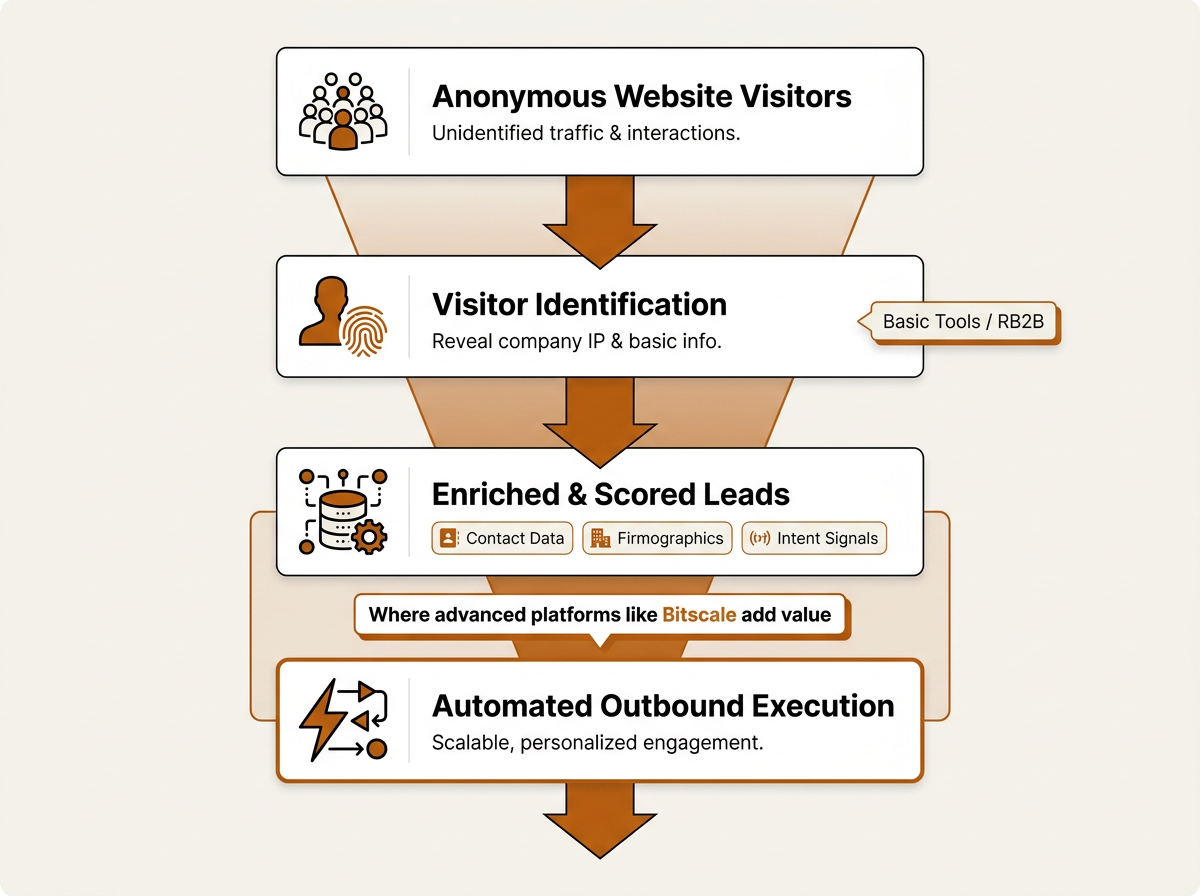
Identification starts the funnel, enrichment, intent, and execution are what convert it into pipeline.
Frequently Asked Questions
Is RB2B actually free?
Yes. RB2B offers a free plan that includes Slack integration and 150 monthly company-level resolutions. Person-level identification (resolving individual contacts, not just companies) requires a paid plan starting with the Starter tier at $79/month. Check rb2b.com for the latest pricing and plan details.
Does RB2B identify international visitors?
RB2B's person-level identification is focused on US-based visitors. It does not resolve EU or most other international visitors at the contact level. If global coverage matters to your GTM strategy, consider platforms like Bitscale that support international identification and enrichment.
How does RB2B stack up against other visitor identification tools?
RB2B is strongest on fast setup and Slack-based delivery, but it does not offer contact enrichment, buyer intent signals, full CRM sync, or outbound workflow automation on its lower-tier plans. Tools like Bitscale, Clay, and Apollo.io cover more of the GTM workflow. For a broader landscape view, see this list of B2B lead generation tools.
What percentage of website visitors can RB2B identify?
No visitor identification product identifies all traffic. The vast majority of B2B website visitors leave without filling out a form, which means most traffic remains anonymous by default. RB2B identifies a portion of the remaining traffic, and match rates depend heavily on your audience geography and visitor profile.
When should a team move from RB2B to a more complete GTM platform?
Upgrade when you need work emails or phone numbers to reach identified visitors, when you want to prioritize by buying intent (not just page views), when Slack alerts outpace manual triage, or when your GTM process depends on CRM enrichment and automated outbound sequencing.