Outbound Sales: The Modern Revenue Team Playbook
Outbound sales playbook for B2B teams: build ICP lists, use AI research, enrichment, intent signals, and CRM sync to drive multichannel pipeline.
Outbound sales has changed more in the last few years than it did across the previous decade. The spray-and-pray era of mass cold emails is done. Average cold email reply rates have declined steadily as buyer inboxes grow more crowded and filters grow more aggressive. Yet a strong majority of B2B buyers still accept meetings with sellers who proactively reach out with relevant, well-timed messaging. Put those together and the picture is clear: outbound still works, but only when it is precise, relevant, and timed to something real.
This playbook is for B2B revenue teams (SDRs, AEs, RevOps leaders, and founders) that want outbound to scale without turning into noise. We walk through what outbound means now, how AI and data have reshaped the workflow, and where human judgment still decides whether you win the meeting or burn the account. Below is the quick map.
Sections covered:
- What Outbound Sales Actually Means Today, redefining the discipline beyond cold calls.
- Outbound vs. Inbound, a side-by-side comparison of motion, timing, and economics.
- The Modern Outbound Sales Process, six stages from ICP to closed pipeline.
- AI-Assisted Prospect Research and Account Intelligence, how AI improves targeting.
- Enrichment, Intent, and CRM Synchronization, the data layer that powers execution.
- Why Human Judgment Remains Essential, the responsibilities AI cannot absorb.
- Evaluating Outbound Sales Software, platform comparison and selection criteria.
- Key Takeaways and Next Steps, a concise recap with actionable moves.
What Outbound Sales Actually Means Today
Outbound still gets reduced to "cold calling" or "blasting lists," which is a reliable way to spot a process that hasn't been updated in years. Modern B2B outbound sales is a coordinated, multichannel motion: you identify accounts, do the work to understand them, and reach out before they ever fill out a form. The center of gravity has moved from volume to precision. Instead of hammering thousands of loosely matched contacts, strong teams build tight account lists shaped by firmographic fit, technographic signals, and real-time buyer intent.
The operating model changed with it. Prospecting starts with AI-assisted research instead of an SDR losing half a day to LinkedIn tabs. Sales pipeline automation depends on enriched, verified data landing in the CRM without someone exporting CSVs. Outreach runs across email, LinkedIn, phone, and sometimes video, stitched together in sequences that respond to engagement signals. If outbound still feels like a numbers game inside your org, you are competing with a dated playbook while everyone else is running a different sport.
Outbound vs. Inbound: A Clear Comparison
Teams love to argue inbound versus outbound as if you have to pick a side. In practice, you want both because they do different jobs. Inbound captures demand that is already in motion. Outbound creates demand by choosing who to go after and when to show up. Here is the clean comparison.
| Dimension | Outbound Sales | Inbound Sales |
|---|---|---|
| Who initiates | Seller reaches out first | Buyer discovers the company through content, ads, or referrals |
| Speed to pipeline | Days to weeks (direct outreach) | Weeks to months (content + nurture) |
| Targeting control | High (you pick the accounts) | Low to medium (depends on who finds you) |
| Cost structure | Variable (tools, headcount, data) | Fixed upfront (content creation, SEO, paid media) |
| Best for | Named account strategies, new markets, upmarket expansion | Demand capture, long-tail keywords, brand awareness |
| Scalability risk | Quality drops when volume outruns research | Returns fade without ongoing content investment |
| Outbound and inbound are complementary motions, not competing strategies. |
The Modern Outbound Sales Process in Six Stages
Good outbound looks different by segment and deal size, but the underlying workflow is surprisingly consistent. The six stages below reflect what high-performing B2B teams are running today. The right cadence (number of touches, duration, and channel mix) varies based on your audience, sales cycle length, buying process complexity, and real-time engagement signals. Shorter cycles with smaller committees often warrant tighter sequences, while enterprise deals with multiple stakeholders typically need longer, more layered approaches.
Stage 1: ICP and Persona Definition. Before you send anything, get ruthless about who you are targeting and why. An Ideal Customer Profile should spell out firmographics (industry, employee count, revenue range, geography), technographics (what they run), and pain-point alignment. Skip this, and you are just paying to be ignored.
Stage 2: Account and Contact List Building. Once the ICP is locked, build the account list with intent, not vibes. This is the point where outbound prospecting either becomes a system or stays a guessing game. AI-powered platforms can scan large volumes of company records and surface matches in minutes, work that used to eat entire SDR shifts. For a closer look at scaling this step, see our guide to prospect list automation.
Stage 3: Enrichment and Verification. Raw lists break fast in the real world. Contact enrichment fills in verified work emails, direct dials, job titles, and reporting lines. Company enrichment adds revenue estimates, funding history, tech stack, and hiring trends. Without this layer, bounce rates climb, deliverability gets punished, and your outbound engine starts leaking.
Stage 4: Intent Signal Prioritization. A list is not a queue. Most accounts are not buying right now, and treating them like they are is how reps waste their best hours. Buyer intent signals (job postings, technology evaluations, content consumption patterns, funding rounds) help you rank accounts by likelihood to engage. That simple shift puts rep time where conversion odds are actually decent.
Stage 5: Multichannel Outreach Sequence. Build sequences that mix email, LinkedIn, and phone across multiple touches, with each step earning the next. Adapt the number of touches, spacing, and channel emphasis based on your buyer's typical sales cycle, the complexity of the buying committee, and how prospects respond along the way. Personalization should hang on a real trigger: a product launch, a leadership change, a hiring spike, or a competitor contract renewal. Generic templates do not just underperform; they train your market to tune you out. For a deeper look at automating this stage, see our outbound sales automation guide.
Stage 6: Meeting Booked and Pipeline Created. Outbound lead generation is not about collecting replies; it is about creating a qualified conversation. When a meeting lands, the opportunity should enter the pipeline with context attached (research notes, intent signals, enrichment data) so the AE is not walking in cold.
AI-Assisted Prospect Research and Account Intelligence
AI adoption across sales organizations has grown rapidly, and most B2B teams now use AI tools in some part of their outbound workflow. The biggest win is not email writing (even if that is what most vendors lead with). It is research. AI outbound sales tools compress hours of manual prospect research into seconds by pulling from public filings, news, job boards, social profiles, and technographic databases. These tools analyze available business information, summarize findings, and recommend where reps should focus, giving sellers a head start rather than replacing their judgment.
Account intelligence takes that further by treating the account as the unit of analysis, not a single contact. AI models can map org structure, infer priorities, track competitive context, and flag meaningful events, which gives reps a storyline instead of a pile of tabs. When an SDR opens with "I noticed your team posted several data engineering roles recently, which often signals a migration," that is account intelligence showing up in the first sentence. Teams using AI for prospect research report spending significantly less time on pre-call prep while landing messaging that actually fits the moment.
| Capability | Traditional Outbound | AI-Assisted Outbound |
|---|---|---|
| List building | Manual searches, purchased lists | AI-filtered account lists pulled from live sources |
| Research depth | LinkedIn profile + company website | Combined firmographic, technographic, and intent signals |
| Personalization | First name + company name merge tags | Trigger-based notes tied to specific account events |
| Prioritization | Round-robin or alphabetical | Intent-scored and engagement-ranked queues |
| Data freshness | Quarterly list refreshes | Continuous enrichment and CRM sync |
| Rep productivity | Limited personalized outreach per day due to manual research | Significantly higher personalized outreach volume with AI drafting assistance |
| AI does not replace the seller. It removes the manual bottlenecks that slow sellers down. |
Enrichment, Buyer Intent, and CRM Synchronization
Data quality is how outbound programs quietly die. A large contact list is worthless if a significant portion bounces and many titles are outdated. Contact enrichment fixes that by layering verified, current fields onto every record: validated work emails, appended direct dials, and confirmed titles. Company enrichment adds revenue bands, employee counts, tech stack details, and recent funding events.
Intent signals add the missing dimension: timing. Knowing a target account is evaluating competitors, hiring for a relevant role, or consuming content tied to a problem you solve changes the tone of outreach from "random" to "contextual." Common intent sources include third-party content consumption tracking, G2 and review site activity, job-posting analysis, and technographic change detection. For a detailed breakdown, see our guide to buyer intent signals.
All of that work is wasted if it lives in a spreadsheet. CRM synchronization is what turns enrichment and intent into execution: records flow into Salesforce, HubSpot, or your CRM of choice with field mappings, deduplication rules, and ownership assignment handled automatically. When reps open the CRM each morning, they should get a prioritized queue with context, not a stale list that needs manual cleanup. Platforms like Bitscale bring enrichment, intent, and CRM sync into one workflow so the data moves without constant human babysitting.
Why Human Judgment Remains Essential
Most AI-outbound vendors will not say this out loud: AI is effective at spotting patterns, summarizing research, and automating repetitive data tasks, and poor at reading the room. A prospect's LinkedIn post about burnout is not a buying signal. A CFO's cautious tone in a reply needs a human call on whether to push for a meeting, ask a smaller question, or back off entirely. Organizations that pair AI tools with skilled sellers consistently report stronger pipeline outcomes, but those improvements come from AI augmenting sellers, not swapping them out. Human teams remain responsible for strategy, qualification, messaging, negotiations, governance, and relationship management.
| Responsibility | AI Handles | Human Leads |
|---|---|---|
| Data collection and enrichment | Yes | Validates edge cases |
| Account scoring and prioritization | Yes | Overrides based on relationship context |
| Email and message drafting | First draft | Edits for tone, nuance, and brand voice |
| Sequence timing and cadence | Optimizes send times | Adjusts based on deal context |
| Objection handling | Suggests frameworks | Reads emotional cues and adapts live |
| Relationship building | No | Yes, entirely |
| Strategic account planning | Provides data inputs | Synthesizes into a narrative and plan |
| Ethical judgment and governance | Flags compliance risks | Makes final decisions |
| The strongest outbound programs pair AI efficiency with human empathy and strategic thinking. |
That becomes even more true as agentic sales workflows show up, where AI agents can run multi-step tasks with less supervision. Governance has to be owned, not implied: message quality, brand consistency, and compliance with regulations like GDPR and CAN-SPAM need a named human responsible for the outcome. AI can meaningfully reduce the time reps spend on repetitive tasks (research, data entry, initial drafting), but those gains disappear quickly if automation trashes your domain reputation or chips away at trust.
Evaluating Outbound Sales Software
Outbound sales software is a crowded category, and most tools look interchangeable until you try to run a real workflow through them. The right choice depends on what you are missing: a point solution for one stage (like sending) or a unified platform that covers research, enrichment, intent, and execution end to end. Here is a snapshot of notable platforms, followed by the criteria that actually matter when RevOps has to operationalize this.
Editorial note: Product capabilities, AI functionality, integrations, pricing, and supported workflows evolve frequently across all vendors in this space. The comparison below reflects publicly available information at the time of writing. Verify current features, pricing tiers, and integration details directly with each vendor before making purchasing decisions.
| Platform | Core Strength | Enrichment | Intent Signals | CRM Sync | AI Research |
|---|---|---|---|---|---|
| Bitscale | Unified GTM: research, enrichment, intent, outbound execution | Contact + Company | Yes (built-in) | Native sync | Yes (AI prospect research + account intelligence) |
| Clay | Flexible data workflows via waterfall enrichment | Contact + Company (via integrations) | Limited native | Via integrations | Partial |
| Apollo.io | Large B2B contact database with sequencing | Contact + Company | Basic intent filters | Native sync | Limited |
| Lusha | Quick contact data lookup | Contact-focused | No | Via integrations | No |
| Cognism | EMEA-strong phone-verified contacts | Contact + Company | Yes (Bombora partnership) | Native sync | No |
| Instantly.ai | High-volume cold email sending and warmup | Basic (via integrations) | No | Limited | No |
| Capabilities as described on each platform's public website. Verify directly with vendors for the most current information. |
Evaluation criteria that separate adequate tools from great ones:
- Data accuracy and freshness: How often is contact and company data verified? Stale records create bounce-rate problems that compound over time.
- Workflow automation depth: Can you run a multi-step workflow (research, enrich, score, sequence) without bouncing between five tabs and two spreadsheets? Bitscale's Playbooks feature offers pre-built, ready-made sales workflows that connect these steps.
- Intent signal coverage: Does the platform surface buying signals natively, or are you stitching in a separate intent vendor?
- CRM integration depth: Field-level sync, deduplication, and ownership rules matter more than an "integrates with Salesforce" checkbox.
- AI research capabilities: Can the AI summarize an account's strategic priorities and recommend a messaging angle, or is it just reprinting a generic company description?
If you are building a B2B sales playbook from scratch, start by mapping where the workflow breaks today. Most teams find the bottleneck is not sending. It is everything that should happen before the first message: research, enrichment, and prioritization. For a broader view of the lead gen stack, see our roundup of B2B lead generation tools.
Key Takeaways and Next Steps
Outbound sales today is a precision discipline. Teams that consistently generate outbound pipeline are not winning by sending more. They are winning by sending smarter: tighter targeting, better timing, cleaner data, and research that shows up in the first two lines of the message. The operating principles are straightforward.
- Define your ICP with firmographic, technographic, and pain-point criteria before building any list.
- Use AI for prospect research, account intelligence, and enrichment to eliminate manual data work.
- Prioritize accounts showing active buyer intent signals rather than working lists alphabetically.
- Synchronize enriched data into your CRM automatically so reps start every day with a prioritized queue.
- Keep humans in control of messaging quality, relationship building, objection handling, and governance.
- Evaluate outbound sales software on data accuracy, workflow depth, and native intent coverage, not just database size.
If your team wants to consolidate prospect research, enrichment, intent, and outbound execution into one place, explore Bitscale's outbound solutions or review Bitscale pricing to match the right plan to your team size and workflow complexity.
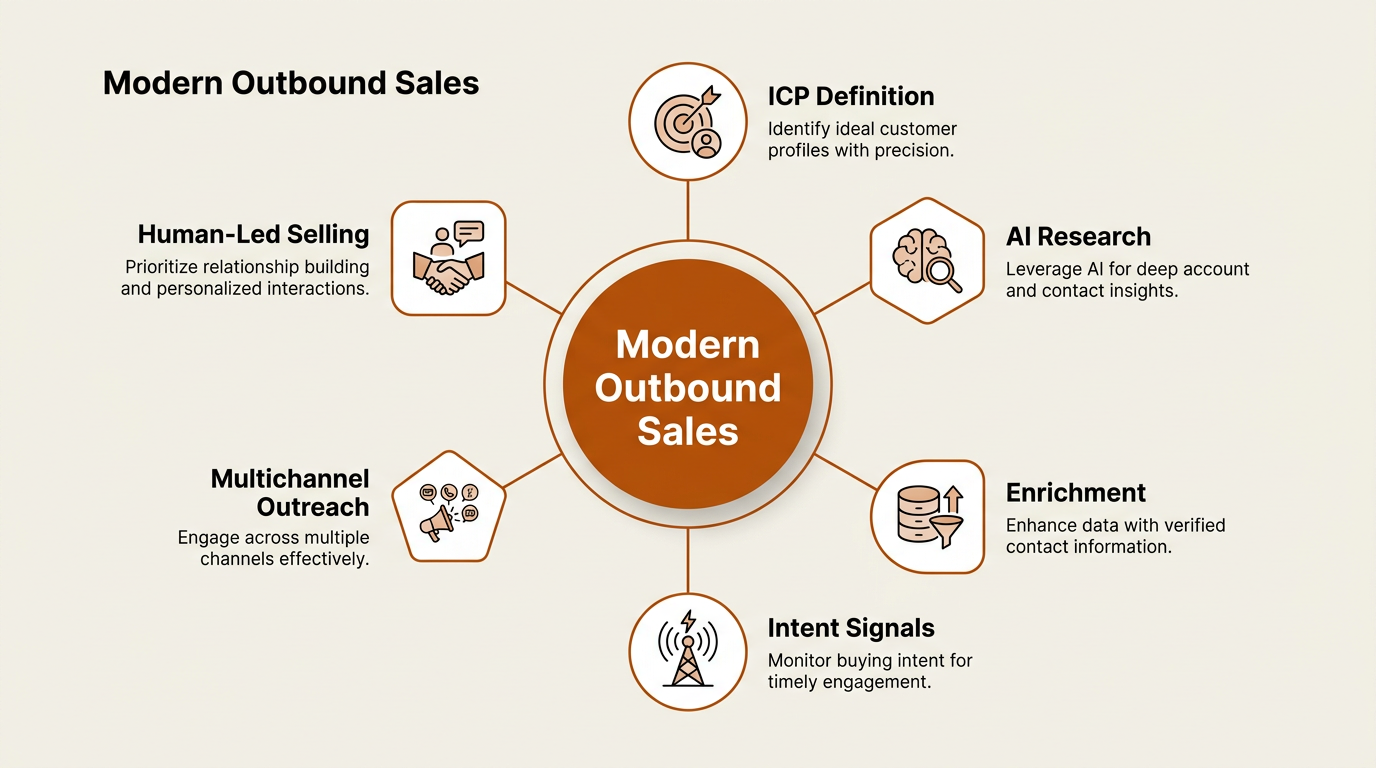
Six precision disciplines — from ICP definition to human-led selling — define today's outbound sales playbook.
Frequently Asked Questions
What is the difference between outbound and inbound sales?
Outbound sales is initiated by the seller: you reach out to prospects who have not shown interest yet. Inbound sales starts with the buyer, who finds you through content, ads, or referrals. Outbound gives you more control over targeting and timing, while inbound captures demand that is already active. Most B2B teams run both at the same time.
Is cold calling still part of outbound prospecting?
Yes. It is just no longer the whole strategy. Modern outbound prospecting uses phone alongside email, LinkedIn, and sometimes video, usually inside a coordinated sequence. Calls convert best when they are preceded by research and anchored to a relevant reason to reach out, like an intent signal or a specific account trigger.
How does AI improve outbound lead generation without replacing sales reps?
AI takes on the data-heavy work: list building, enrichment, account research, and intent scoring. That gives reps more time for relationship building, live conversations, and strategic account planning. Teams that combine AI-assisted research with skilled human sellers consistently report improved pipeline quality and faster research cycles. The improvement comes from augmentation, not replacement.
What should I look for in an outbound sales strategy for mid-market accounts?
Prioritize account-level research (not just contact-level), rank outreach based on intent, and run multichannel sequences with cadence and touch count adapted to your buyer's sales cycle, committee size, and engagement patterns. Personalization should point to specific account triggers, not generic industry statements. Tools that combine enrichment, intent, and CRM sync (like Bitscale) cut down the manual work between those steps.
How do I measure whether my outbound sales process is working?
Measure the funnel end to end: list-to-contact rate (how many records pass enrichment and verification), reply rate, positive reply rate, meetings booked per rep per week, and pipeline generated per sequence. Do not optimize around vanity metrics like emails sent. The target is qualified pipeline, not activity volume.