The best MCP servers for B2B sales and prospecting data in 2026
MCP servers for B2B sales data in 2026: Bitscale, ZoomInfo, Apollo, Clay, Cognism, Lusha, HubSpot and Salesforce compared on tools, cost and security.
Disclosure: This guide is published by Bitscale, and Bitscale is our top pick. Every other vendor's details come from its own documentation, checked on October 7, 2026.
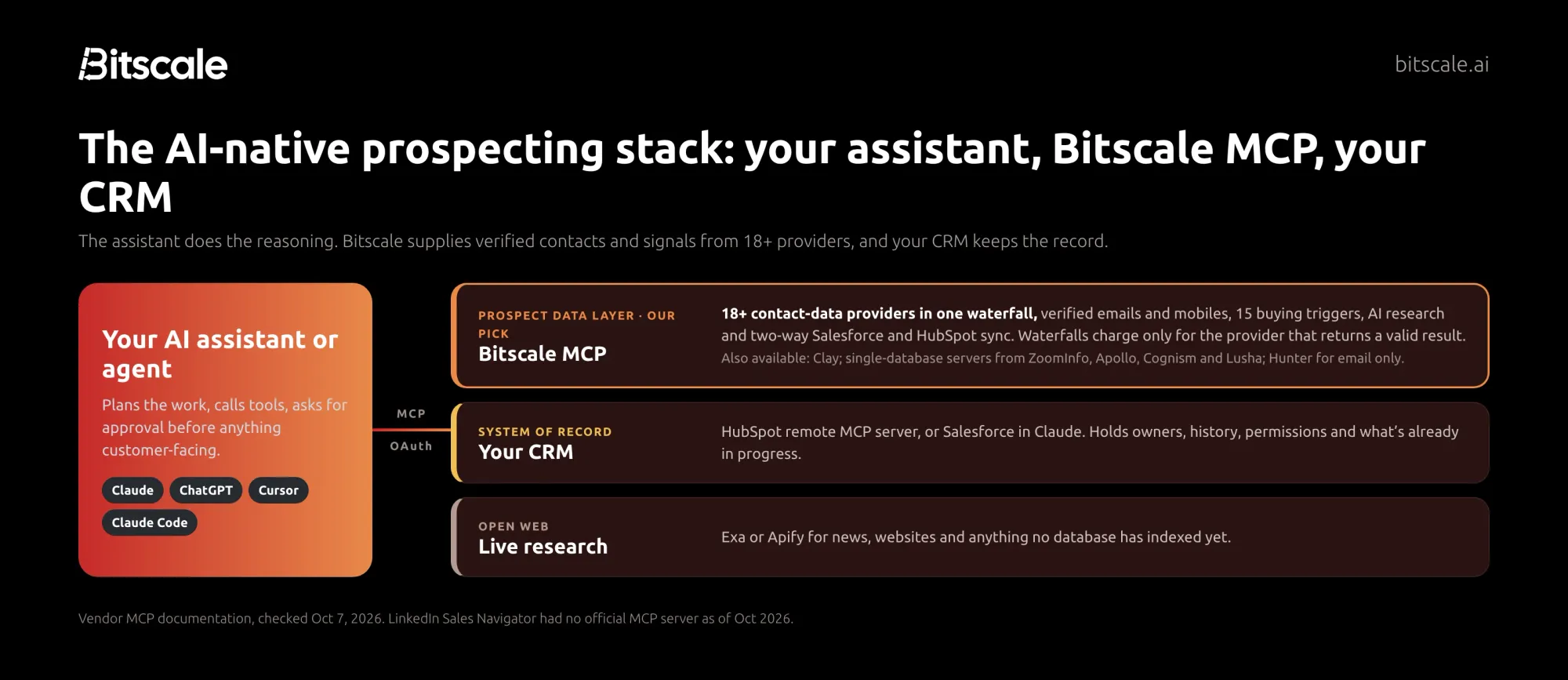
The short answer: an MCP server lets an AI assistant such as Claude, ChatGPT or Cursor call a sales tool directly. In 2026 almost every major GTM data platform shipped one. The best setup for most teams connects three things: - A prospect data server for contacts, companies and signals. Bitscale is our pick, because it runs a multi-provider waterfall behind one connection. - Your CRM, through HubSpot's MCP server or Salesforce in Claude. - A web research server such as Exa for anything no database has indexed.
Choose servers with per-user sign-in, clear credit controls and approval steps before anything customer-facing.
What is an MCP server, and why does it matter for sales?
The Model Context Protocol (MCP) is an open standard for connecting AI assistants to tools and data. An MCP server exposes a product's capabilities, such as "search contacts" or "enrich this company", as tools the assistant can call. Instead of exporting a CSV from one tool and pasting it into another, a rep can ask Claude to find, enrich and prioritize accounts, and the assistant does the work through the tools you've connected.
This shift has a name: headless GTM. The data and actions live behind an API, and the interface is whatever AI assistant your team already uses.
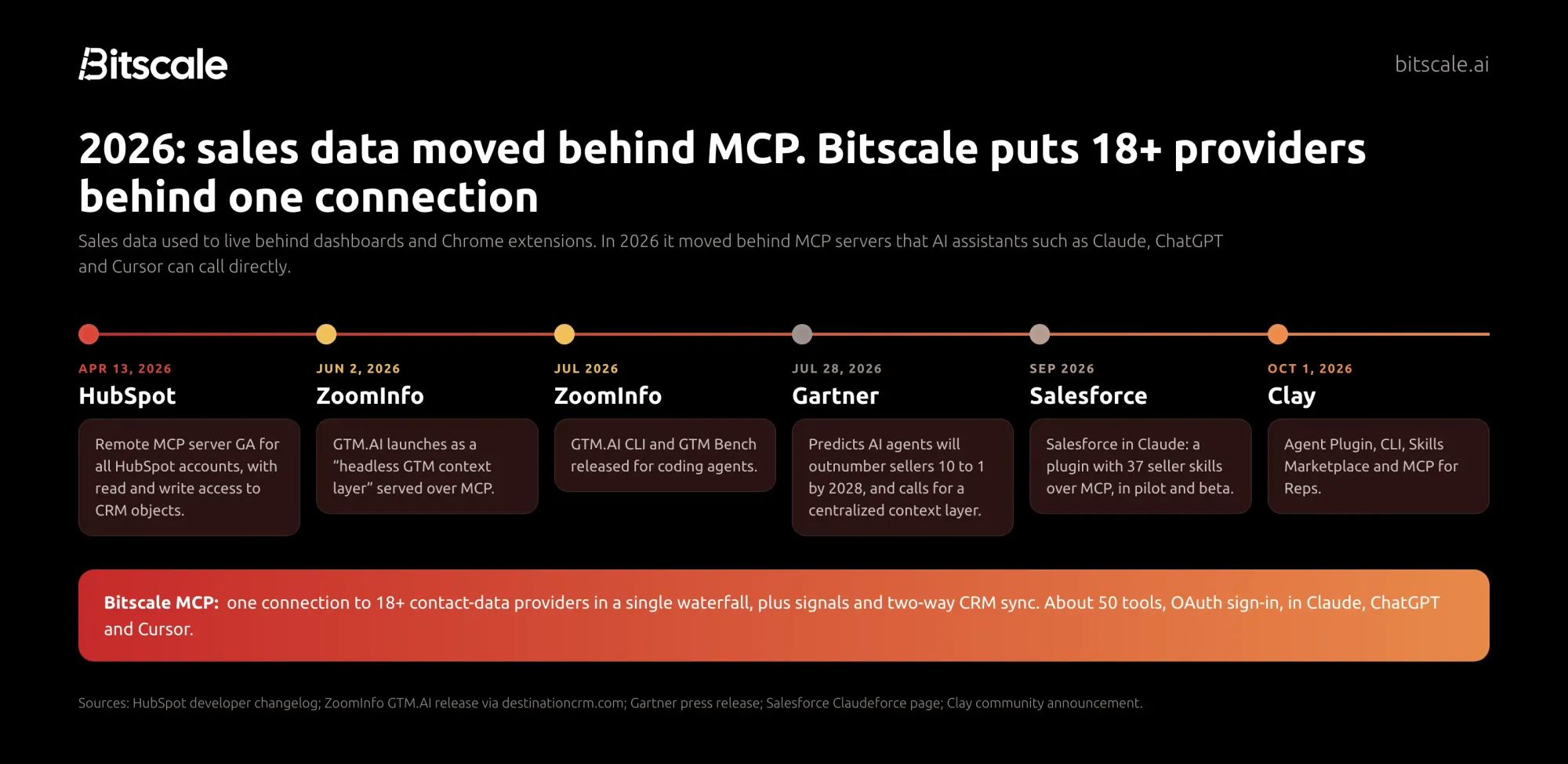
The momentum is hard to miss:
- HubSpot made its remote MCP server generally available to all accounts on April 13, 2026, with read and write access to core CRM objects.
- ZoomInfo launched GTM.AI on June 2, 2026 as a "headless GTM context layer" served over MCP, then added a CLI for coding agents in July.
- Salesforce introduced Salesforce in Claude, a plugin with 37 seller skills built on MCP.
- Clay shipped an Agent Plugin, CLI and "MCP for Reps" on October 1, 2026.
Gartner's July 2026 forecast explains why the plumbing matters. By 2028, AI agents will outnumber sellers ten to one, yet fewer than 40% of sellers will say agents improved their productivity. Gartner recommends a centralized context layer connecting enterprise data, systems and seller judgment. As Gartner's Dan Gottlieb put it: "If those systems are fragmented, the agents will scale the fragmentation."
How to choose a sales MCP server
Six questions separate the servers worth connecting from the ones that will burn credits or create risk:
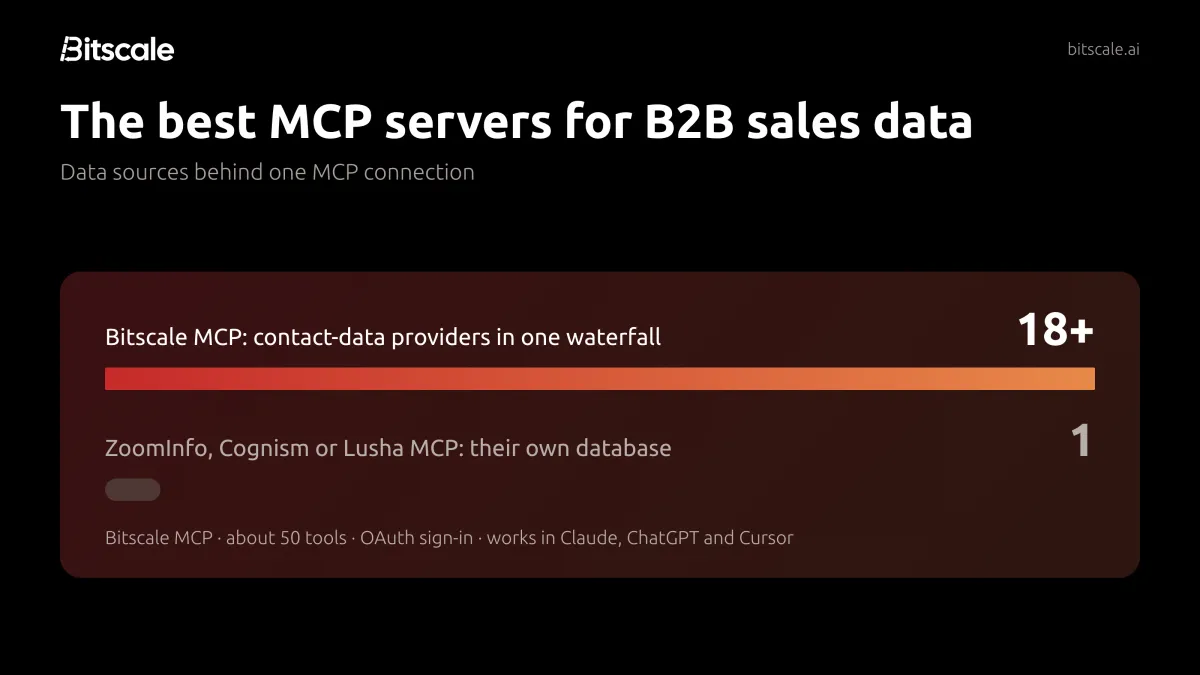
- How much of your market does it cover? A server is only as good as the data behind it. A single proprietary database returns what that vendor has indexed. A multi-provider waterfall tries several sources until one returns a valid result.
- How does it authenticate? Per-user OAuth means every call runs with one person's permissions. A shared API key means everyone acts as one account.
- What does a call cost, and can you cap it? Most servers spend the same credits as the vendor's app. Look for credit estimates before runs and per-user caps.
- Can it write back to your CRM? An answer in a chat window is gone tomorrow. Data that lands in Salesforce or HubSpot is available to every rep and every agent.
- What guardrails does it have? Look for approval prompts, previews before deletes, and limits on bulk actions.
- What do the terms allow? Apollo, Cognism and Lusha all prohibit using data retrieved over MCP to train AI models.
Sales MCP servers compared
| Server | What it gives your AI | Sign-in | Tools | Cost model | Notable controls |
|---|---|---|---|---|---|
| Bitscale (our pick) | Multi-provider enrichment waterfall, signals, grids, CRM sync | OAuth | About 50 | Your Bitscale credits; waterfalls charge only for the provider that returns a valid result | Credit estimate before runs, preview before deletes, workspace roles |
| ZoomInfo (GTM.AI) | ZoomInfo contacts, companies, intent, research | OAuth (user) or client credentials | 23 | Data credits per new record; AI credits for research | Per-user access and credit caps |
| Apollo.io | Apollo search, enrichment, sequences, deals | OAuth or API key | 52 actions | Your Apollo plan and credits | Per-action allow, approve or block; no bulk delete |
| Clay | 150+ data providers, AI research, team workflows | Clay account | Not published | Clay credits; 500 free on first connect | Per-rep credit limits; Credit Budgets on Enterprise |
| Cognism | Cognism people and company search | OAuth or SSO | 15 | Search tokens per record; credits per contact revealed | 500 requests/min; DNC masking enforced server-side |
| Lusha | Enrichment, prospecting, signals, CRM export | OAuth or API key | 50 | Lusha API credits | Admin permission for MCP access |
| Hunter | Email finding and verification | API key | Not published | Not published | Not published |
| HubSpot | Your CRM records (read and write) | OAuth 2.1 with PKCE | Not published | Available to all HubSpot accounts | Respects user permissions; scopes per app |
| Salesforce in Claude | Your Salesforce data, 37 seller skills | Salesforce permissions | 37 skills | Not published | Confirms before emailing external contacts |
From each vendor's MCP documentation, checked October 7, 2026. "Not published" means the vendor's docs didn't state it.
The best MCP servers for B2B sales in 2026
1. Bitscale: best for multi-provider contact data and signals that reach your CRM
Bitscale's MCP server puts the whole Bitscale data layer inside your AI assistant. That includes enrichment waterfalls across 18+ contact-data providers, buying signals, AI research and two-way Salesforce and HubSpot sync. It's our top pick because it addresses the biggest weakness of a single-database server: an assistant can only find what that one database has indexed.
- How to connect: add
https://api.bitscale.ai/mcpas a connector and sign in with OAuth. Then choose your workspace and approve.- In Claude, add it once on claude.ai and it's available in Claude Desktop and the mobile app.
- It also works in ChatGPT (developer mode), Cursor, Claude Code, Gemini CLI and other clients that support remote MCP.
- What your assistant can do:
- About 50 tools for building grids, adding sources such as lists and CSV imports, running enrichment columns, deduplicating rows and planning a full workflow.
- The
ask_humantool lets the assistant check with you when a decision is yours.
- Cost: no MCP surcharge. Tools use your Bitscale credits at the same rate as the app, and waterfalls charge only for the provider that returns a valid result.
- Guardrails:
- Enrichment runs show a credit estimate before spending.
- Delete tools preview what will be affected.
- Access follows workspace roles: owner, admin, editor and viewer.
- Teams: each person connects with their own Bitscale login. On Claude Team or Enterprise, an owner adds the connector once for everyone.
Choose Bitscale if you want your AI assistant to find and verify contacts across many providers, track signals, and write results straight into Salesforce or HubSpot.
Try it in Claude or ChatGPT: create a free Bitscale account with 200 credits and no card required, then add the connector. Get started →
2. ZoomInfo GTM.AI: best for enterprises already on ZoomInfo
ZoomInfo's GTM.AI is the most fully built single-vendor option.
- Connection and sign-in: a remote server at
mcp.zoominfo.com, with user sign-in or a service account for background jobs. - Tools: 23, covering company and contact search, enrichment, intent, "scoops", account research and conversation intelligence.
- Clients: Claude, ChatGPT, Cursor, Copilot, Perplexity, Slack and more. ZoomInfo also lists partner integrations including Agentforce, HubSpot Breeze and Outreach.
- Cost: MCP doesn't unlock data beyond your ZoomInfo package. Enrichment costs one data credit per new record, and research calls cost AI credits, typically 5–15 per call.
- Watch out for:
- It needs a personal ZoomInfo login.
- Some older subscriptions carry monthly credits that MCP can't draw from.
- There's no organization-wide switch to turn MCP off.
3. Apollo.io: best for SMB teams that want outreach actions too
Apollo exposes the widest range of actions: 52 in its docs. Beyond search and enrichment, it covers sequences, emails, deals, tasks and analytics.
- Connection and sign-in: a remote server at
mcp.apollo.io/mcp. Sign in with OAuth, or use an API key for headless clients. - Clients: ChatGPT, Claude, Cursor, Codex, Perplexity, Replit and VS Code.
- Plans: any Apollo plan qualifies, including free, and your plan's credits apply. Free accounts with personal email addresses can't use search or enrichment.
- Guardrails: destructive bulk actions aren't supported, and clients can set each action to allow, require approval or block.
- Watch out for: people search returns no emails or phones, so you'll spend enrichment credits to get them.
4. Clay: best for teams that run their workflows in Clay
Clay's MCP gives an assistant access to 150+ data providers, AI research agents and your team's prebuilt workflows. Admins can package vetted workflows as functions that reps call from Claude or ChatGPT.
- Credits: new accounts get 500 free credits on first connect, and admins can set per-rep credit limits.
- Best use: Clay recommends MCP for small lookups of 1–20 contacts, with larger jobs run in the Clay platform.
- For coding agents: the newer Agent Plugin and CLI work only in agents with a shell, such as Claude Code, Codex and Cursor.
5. Cognism: best for compliant European data
Cognism's server is strict, which suits regulated teams.
- Connection and sign-in: OAuth or company SSO on a remote server at
mcp.cognism.com/mcp. - Tools: 15, centered on people and company search.
- Compliance: do-not-call phone masking and geo-restrictions are enforced by the server and "cannot be bypassed by rephrasing a prompt."
- Limits: 500 requests per minute per operation class, and up to 100 records per call.
- Watch out for: MCP access may need to be enabled by your Cognism account team.
6. Lusha: best for quick enrichment from inside the AI client
Lusha documents 50 MCP tools, spanning enrichment, prospecting, signals, lookalikes, buying groups and CRM export to Salesforce, HubSpot, Zoho, Pipedrive and SalesLoft.
- Sign-in: OAuth through official connectors for Claude, ChatGPT and Codex; API keys for clients such as Cursor and n8n.
- Plans: any Lusha plan works, and calls use API credits.
7. Hunter: best for email-only workflows
Hunter's remote server at mcp.hunter.io/mcp uses your Hunter API key. It suits assistants that only need to find and verify work emails. Hunter's docs don't publish a full tool list or limits.
8. HubSpot MCP server: best CRM connection for HubSpot teams
HubSpot's server isn't a prospecting database. It's your system of record.
- Access: read and write on contacts, companies, deals, tickets and activities; read-only on quotes, campaigns and more.
- Sign-in: OAuth 2.1 with PKCE, through a user-level app whose scopes control access.
- Permissions: it respects existing user permissions.
Pair it with a data server so enriched records land in HubSpot.
9. Salesforce in Claude: best CRM connection for Salesforce teams
Salesforce in Claude ships as a plugin with 37 seller skills. They cover pipeline review, deal strategy, account growth and call prep, built on Salesforce's Headless 360 platform over MCP.
- Permissions: it runs through your existing Salesforce permissions, and it can confirm before emailing anyone outside the company.
- Availability: Salesforce lists it as available to pilot customers, with an open beta planned for September 2026.
What about LinkedIn Sales Navigator? We found no official LinkedIn MCP server as of October 2026. The servers that do exist are third-party projects, several built on browser automation, which carries account risk.
Security and governance checklist
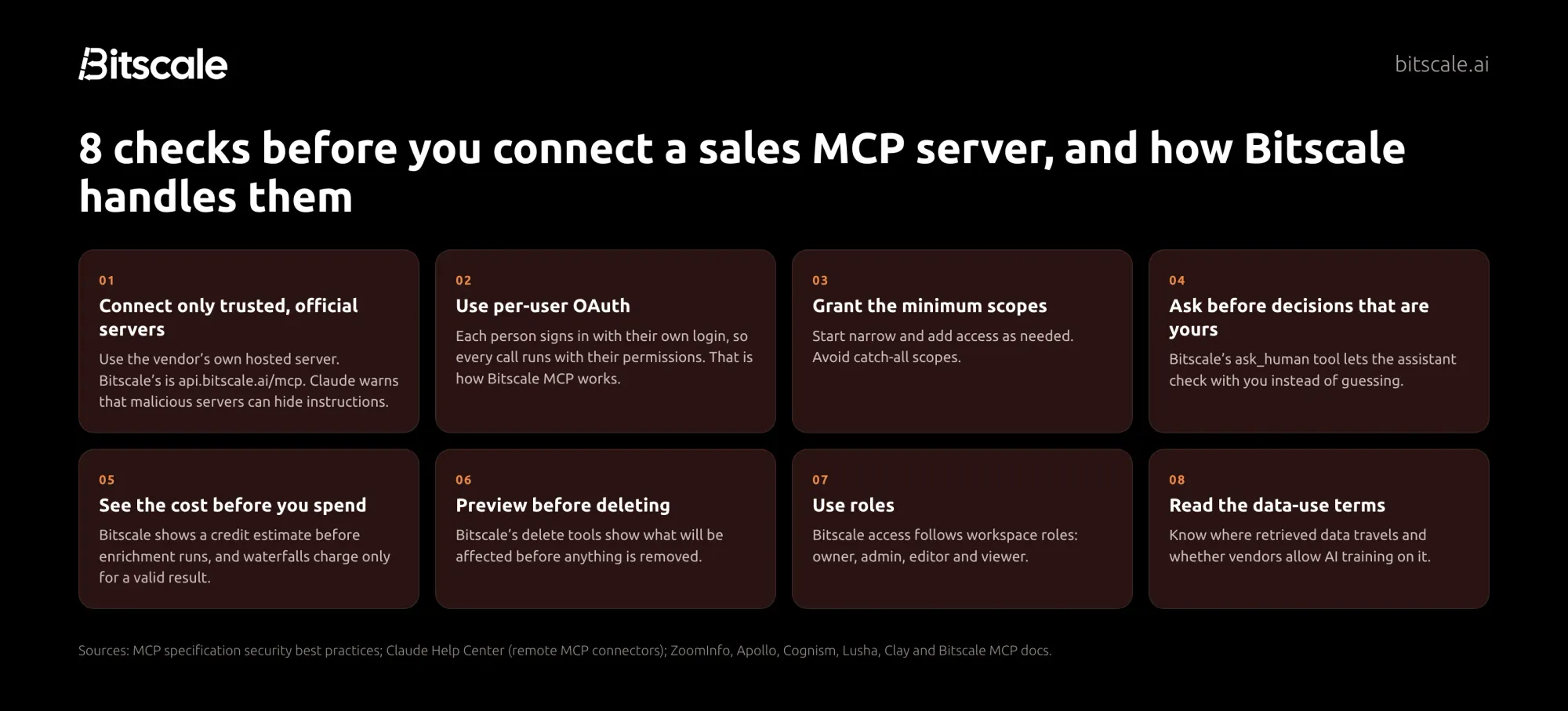
Connecting an AI assistant to contact data and your CRM is powerful, and it deserves the same care as any new integration:
- Connect only trusted, official servers. Claude's help center advises connecting only to servers built and hosted by organizations you trust, and warns that malicious servers can hide instructions.
- Prefer per-user OAuth. Each call then runs with one person's permissions.
- Grant the minimum scopes. The MCP specification's security guidance recommends starting narrow and avoiding catch-all scopes.
- Require approval for spend and sends. Avoid "Allow always" on tools that reveal contacts, spend credits or email prospects.
- Cap credits per user. Use per-user caps where vendors offer them, and credit estimates where they don't.
- Read the data-use terms. Several vendors prohibit training AI models on retrieved data.
- Know where data travels. Retrieved data passes through your AI provider. Check its retention and training settings.
- Watch for prompt injection. Cognism notes that instructions hidden in web pages could push an assistant to spend credits. Confirm before revealing contacts.
A recommended AI-native prospecting setup
For most B2B teams, this combination covers the full workflow without overlapping:
- Bitscale MCP for finding, enriching and verifying contacts across 18+ providers, and for tracking buying signals.
- HubSpot MCP or Salesforce in Claude so the assistant knows what's already in your CRM: owners, open deals and history.
- Exa or Apify for live web research on accounts no database has caught up with yet.
A rep can then ask: "Find VP Sales at Series B fintech companies that raised in the last 90 days, enrich their verified emails, check which are already in HubSpot, and add the new ones to a list for my review." The assistant uses each server for the part it does best and asks before anything goes out.
Frequently asked questions
What is an MCP server for sales?
An MCP server for sales exposes a sales tool's data and actions to an AI assistant through the Model Context Protocol. Once it's connected, assistants like Claude or ChatGPT can search contacts, enrich companies, check signals or update your CRM without manual exports.
What is headless GTM?
Headless GTM means your go-to-market data and actions live behind APIs and MCP servers rather than inside one app's interface. Reps and AI agents use them from whatever assistant they already work in. ZoomInfo describes its GTM.AI launch as a "headless GTM context layer."
Do MCP servers cost extra?
Usually not. The vendors reviewed here charge the same credits as their app. Bitscale charges MCP tool calls at the same rate as the app, and waterfalls charge only when a provider returns a valid result. ZoomInfo uses data credits and AI credits. Apollo, Lusha and Cognism use your existing plan's credits.
Is it safe to connect my CRM to an AI assistant through MCP?
It can be, if you use official servers, per-user OAuth, minimum scopes and approval steps for anything customer-facing. HubSpot's server and Salesforce in Claude both respect existing user permissions.
Does LinkedIn Sales Navigator have an MCP server?
We found no official LinkedIn MCP server as of October 2026. Third-party servers exist, but several rely on browser automation, which carries account risk.
Which MCP server has the best B2B contact data?
Coverage depends on your market. A single-database server returns only what that vendor has indexed. A multi-provider server like Bitscale tries several providers in sequence and verifies the result. Test each on 100 of your own target contacts before you commit.
About the author
Abhinay is the co-founder of Bitscale, the GTM data layer for your CRM. Bitscale helps 1,000+ RevOps and GTM leaders enrich, verify and prioritize prospects across 18+ contact-data providers, from the Bitscale app or any MCP-compatible AI assistant.
Sources
Bitscale - MCP guide - MCP reference - MCP capabilities
Data platforms - ZoomInfo GTM.AI: getting started, credits, launch coverage (June 2, 2026) - Apollo MCP docs - Clay: MCP guide, October 1, 2026 announcement - Cognism MCP server docs - Lusha MCP docs - Hunter API documentation (MCP)
CRMs - HubSpot remote MCP server GA (April 13, 2026) - Salesforce Claudeforce
Web research - Exa MCP - Apify MCP
Research and security guidance - Gartner AI agents forecast (July 28, 2026) - MCP specification: security best practices - Claude Help Center: remote MCP connectors