Prospecting: The Complete Guide to Finding and Engaging High-Quality B2B Leads
B2B prospecting workflow for 2025: define ICP, build lists, enrich and verify data, prioritize with intent signals, and run multichannel outreach.
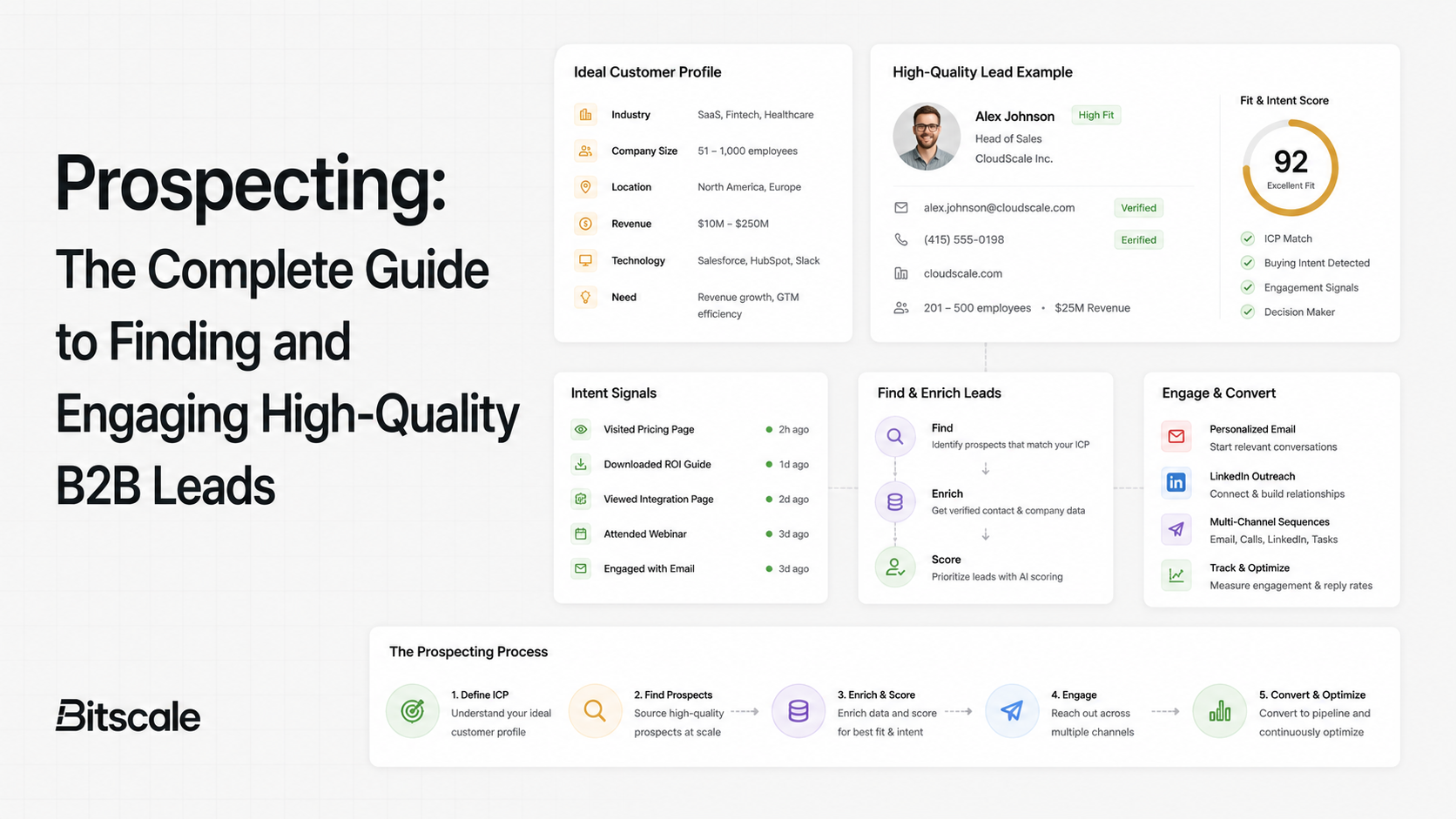
Here is the part most B2B teams would rather not say out loud: according to Salesforce's State of Sales report (2024), high-performing sales teams spend only about 28% of their week actually selling. The rest disappears into data entry, internal meetings, and chasing prospects who were never going to buy. This is not a hustle problem. SDRs are already sending more emails, making more calls, and grinding through more accounts than ever. It is a process problem. Done well, prospecting is not "find names." It is a connected workflow: identify target accounts, enrich and verify the data, prioritize with real signals, then run outreach that earns a reply. Skip a stage or underfund it and the mistakes do not stay local; they snowball into bad scoring, generic messaging, and wasted sequences.
This is for SDRs, AEs, RevOps, and GTM leaders who want their prospecting workflow to run like an operating system, not a series of one-off heroics. Whether you are standing up outbound prospecting for the first time or tightening an existing motion, the framework below walks through each stage end to end. What is inside:
- Why Modern Prospecting Looks Different in 2026. Separating signal-based selling from volume-based activity
- The Anatomy of a Modern Prospecting Process. A six-stage workflow from ICP definition to outreach
- Prioritizing Prospects. Why intent signals matter more than firmographic fit alone
- Turning Prospects into Conversations. Personalized, multichannel outreach that books meetings
- What Most Teams Get Wrong. Four common mistakes and how to avoid them
- The Prospecting Tools Landscape. What you actually need (and what you can cut)
- Advanced Prospecting. Signals, timing, and competitive displacement plays
What Is Prospecting?
Prospecting is the proactive process of identifying potential buyers who match your ideal customer profile, qualifying them based on fit and buying signals, and initiating the first outbound contact. Unlike inbound lead generation, where marketing attracts interest, prospecting is sales-led: your team selects the accounts, researches the contacts, and makes the first move through email, phone, or LinkedIn outreach.
The Prospecting Process at a Glance
- 1. Define ICP. Establish the account-level profile of your best-fit customers.
- 2. Build Target Lists. Assemble accounts and contacts using multiple data sources and filters.
- 3. Enrich Data. Fill in missing fields (tech stack, funding, org charts, direct dials) through lead enrichment.
- 4. Verify Contact Information. Validate emails and phone numbers before any record enters a sequence.
- 5. Prioritize Prospects. Score and tier accounts using intent signals, not just firmographic fit.
- 6. Execute Outreach. Run personalized, multichannel sequences across email, LinkedIn, and phone.
What Prospecting Actually Means in 2026
Sales prospecting is the proactive work of identifying potential buyers, qualifying them, and initiating the first contact. It is not inbound lead handling, where marketing hands sales warm contacts. It is not demand generation, which builds awareness at the top of the sales funnel. Prospecting is outbound by design: your team chooses the accounts, does the research, and makes the first move.
Over the last few years, the rules changed in ways that are hard to ignore. Old-school B2B prospecting rewarded volume: more emails, more dials, more accounts. That playbook is worn out. Response rates have dropped as inboxes get flooded. According to HubSpot's 2024 Sales Trends Report, 45% of salespeople say prospecting is the hardest part of their job, tougher than closing or qualifying. The average B2B buying group now includes 11 to 20 stakeholders (Gartner, 2025), which raises the stakes on reaching the right people, not just more people. Gartner also reports that 65% of B2B sales organizations have now shifted from intuition-based to data-driven decision-making (Gartner Future of Sales, 2025). Put it together and the direction is clear: prospecting in 2026 is a sales intelligence workflow, not a numbers contest.
If you already have the fundamentals down and want the tactical workflow, skip to the next section.
The Anatomy of a Modern Prospecting Process
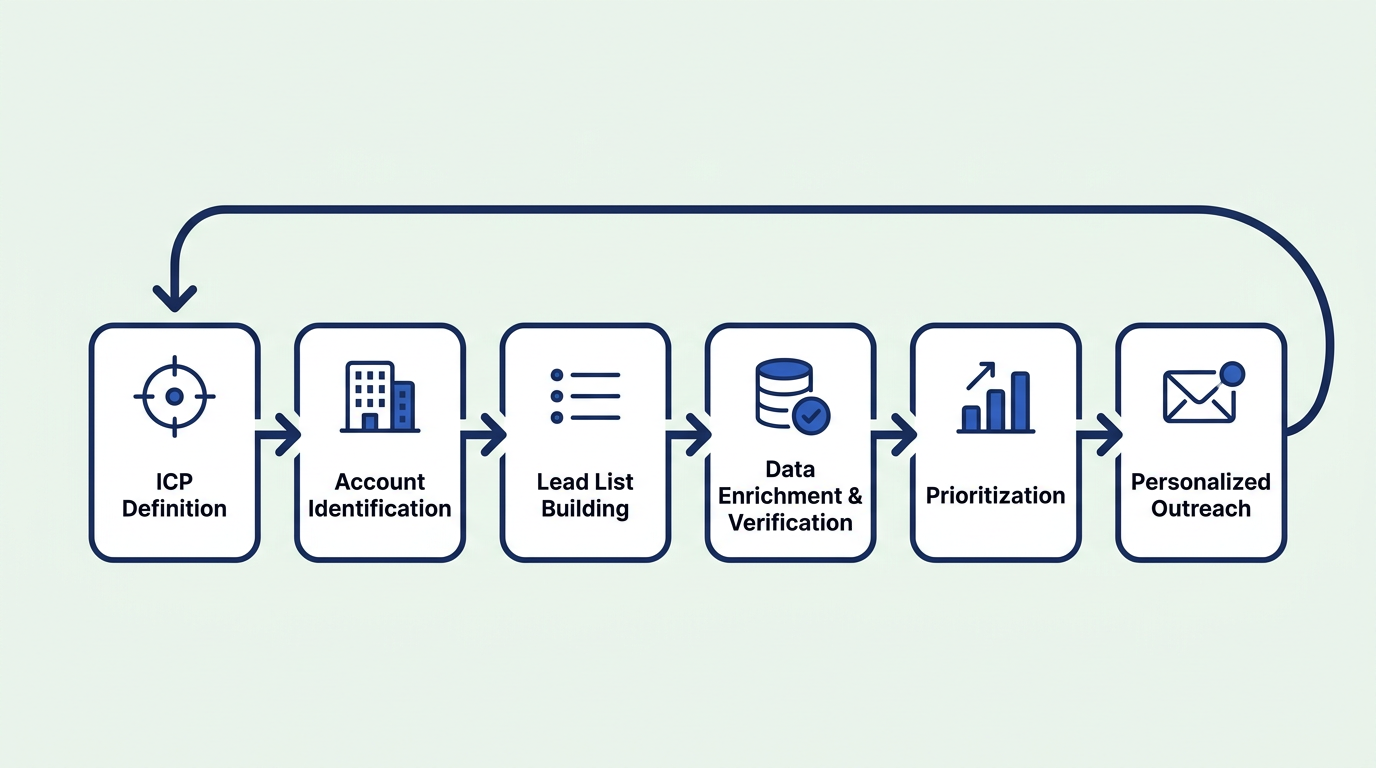
Treat prospecting like a six-stage pipeline, not a grab bag of tasks. Miss Stage 3 (enrichment) and you do not just end up with sparse records; you end up scoring on vibes and writing outreach that reads like it was sent to everyone. Each stage exists because it makes the next stage more accurate and more actionable.
Stage 1: Defining Your ICP and Buyer Personas
Your Ideal Customer Profile (ICP) is an account-level definition: the kind of company most likely to buy, get value, and stick around. The strongest ICPs blend firmographics (industry, revenue, headcount), technographics (the tools they run), and behavioral indicators (hiring patterns, funding stage). Example: "Series B+ SaaS companies, 50 to 500 employees, using Salesforce, with an open VP Sales role in the last 90 days."
Buyer personas sit at the contact level. They spell out who inside those accounts feels the problem, who can champion the project, and who holds budget authority. You need both lenses. ICP without personas means you land in the right companies and email the wrong humans. Personas without ICP means you chase the right titles at companies that will not close. The most common failure mode is fear-driven: teams keep the ICP wide to avoid missing opportunities. The output is predictable: bigger lists, lower quality, and more waste downstream.
Stage 2: Building Target Account and Lead Lists
List building is no longer just manual LinkedIn searching. Modern teams mix database queries, LinkedIn Sales Navigator filters, intent data providers, website visitor identification tools, and event attendee lists. The build-vs-buy trade-off matters. Purchased lists are fast, generic, often stale, and usually sold to your competitors too. Lists you assemble yourself, using multiple signals and strict ICP filters, tend to convert better because they are built for your motion, not the average buyer.
This is also where tooling can compress time dramatically. Platforms that automate list assembly across sources, dedupe records, and apply ICP filters let one SDR produce in hours what used to take a small team days. If you want the mechanics of that acceleration, the guide on AI prospect research breaks down specific techniques.
Stage 3: Enrichment, Verification, and CRM Readiness
A name and a company logo do not give you enough to run serious outbound. Data enrichment fills in the fields that make targeting and messaging work: work emails, direct dials, tech stack details, recent funding rounds, org chart relationships, and more. Without that layer, personalization does not scale; it barely exists.
Verification is where teams get tempted to "ship it" and hope for the best, and that is expensive. Email bounce rates above 5% hurt your sender reputation and drag down deliverability for the whole domain. Every unverified email is a bet against your outbound infrastructure. A real lead enrichment workflow includes real-time email validation and phone number verification before a record ever hits a sequence.
After that comes the unglamorous work that decides whether any of this gets adopted: CRM readiness. Deduplication, field mapping, ownership routing, lifecycle stage assignment. If enriched records show up as duplicates or sit unassigned, the upstream effort turns into busywork. Tracking contact data quality metrics (bounce rate, match rate, field completeness) is how outbound teams keep CRM data quality high and avoid stalling as volume increases.
Prioritizing Prospects: Not All Leads Deserve Your Time
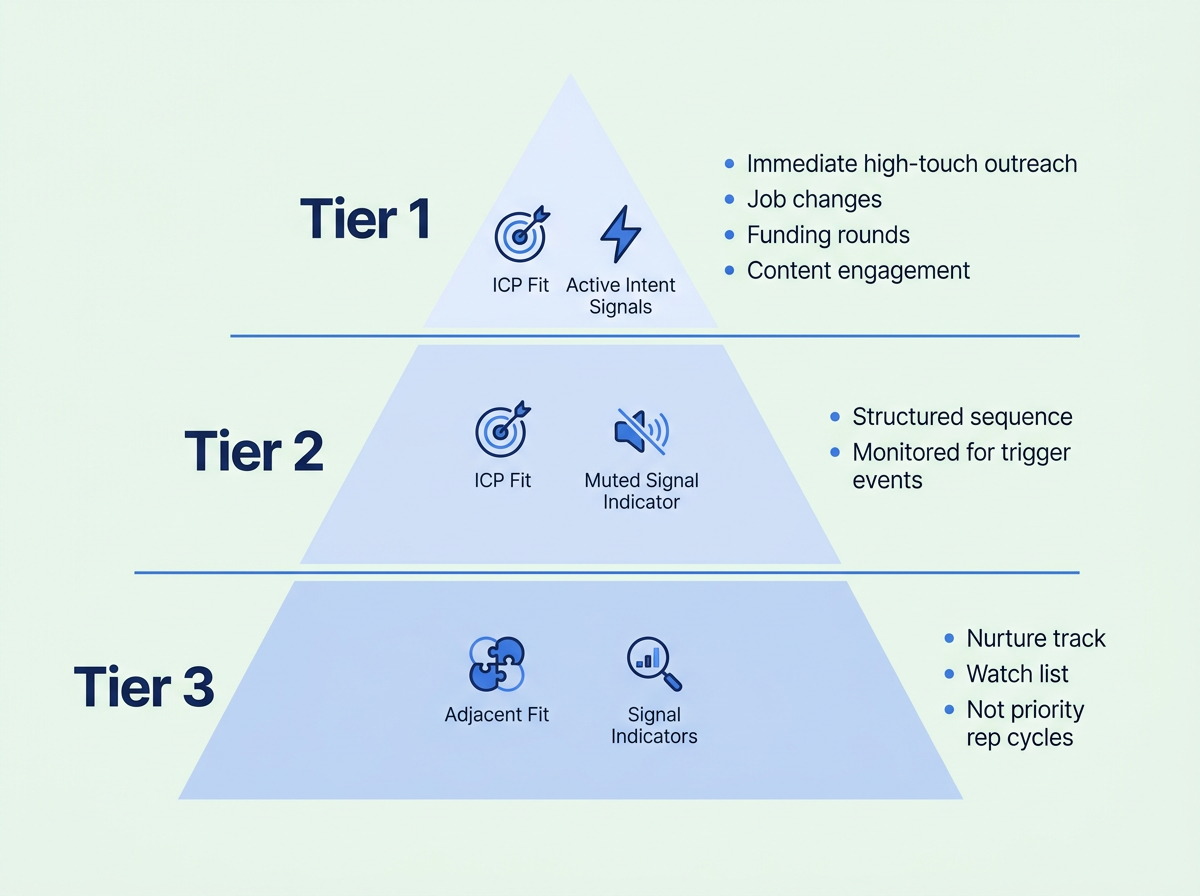
If your lead scoring is mostly firmographics, you are scoring fit, not timing. A company can match your ICP perfectly and still be 18 months away from a purchase. Intent and buying signals (job changes, technology adoption, funding rounds, content engagement, competitor contract renewals) are what separate "fits" from "ready to talk. According to Forrester research, organizations using intent data often see faster sales cycles and improved conversion rates because reps prioritize accounts already demonstrating buying interest.
You do not need a baroque model to get leverage here. Tier 1: ICP fit plus active intent signals. These get immediate, high-touch outreach. Tier 2: ICP fit with no detectable signals. These go into a structured sequence and get monitored for trigger events. Tier 3: Adjacent fit plus signals. Keep them on a watch list or nurture track, but do not spend your best rep cycles there today.
Here is how this plays out operationally. A RevOps leader at a mid-market SaaS company I spoke with last year described a familiar situation: pipeline was flat, reps were busy, and leadership kept asking for more activity. Instead of adding headcount, they layered intent signals on top of their existing ICP filters. They tracked job postings for roles their product supported and monitored technographic changes suggesting a competitor tool was being replaced. The result was a 40% reduction in the active working list and a measurable jump in meetings booked the following quarter. The reps did not work harder; they worked a better list.
Turning Prospects into Conversations: Outreach That Doesn't Get Ignored
Most teams do not fail because they cannot find leads. They fail in the handoff between a good list and a booked meeting. This is the moment where the prospecting workflow either turns into pipeline or disappears into a dashboard.
Crafting Personalized Sequences at Scale
Personalization has layers, and knowing which layer you are using keeps reps from overthinking it. Segment-level personalization speaks to industry patterns ("Most Series B fintech teams struggle with..."). Account-level personalization ties to company-specific context like news, tech stack, or hiring activity. Contact-level personalization anchors on the person: their role, LinkedIn activity, or a recent job change. According to Lavender's email analysis data (2024), emails that reference a prospect's recent job change see reply rates roughly 2x higher than generic outreach. AI prospect research handles much of the account-level lift by pulling relevant data points and inserting them into templates, so reps spend time on judgment and messaging rather than tab-hopping.
Multichannel Sequencing: Email, LinkedIn, Phone
Email-only outbound prospecting in 2026 leaves money on the table, and not in a subtle way. According to RAIN Group's research (2024), it takes an average of 8 touches across multiple channels to generate an initial meeting with a prospect. Weaving LinkedIn touches between emails lifts overall response rates meaningfully. A solid 14-day sequence could be: email on Day 1, LinkedIn connection request on Day 2, follow-up email on Day 4, phone call on Day 7, LinkedIn message on Day 9, value-add email on Day 11, then a clear breakup email on Day 14. The exact spacing is less important than the operating principle: use multiple channels so you are not betting the quarter on a crowded inbox.
What Most Teams Get Wrong About Prospecting
Mistake 1: Treating prospecting as a one-time list pull. Prospecting is not a quarterly scavenger hunt. Markets move, contacts change roles, and companies get acquired. If you build a list once and work it for months, your outreach gets staler every week. Strong teams run prospecting as a continuous loop, with scheduled refreshes and re-enrichment cycles. One practical cadence: re-enrich your active list every 30 days, and rebuild segments from scratch each quarter.
Mistake 2: Skipping data verification. The downside of bad data is immediate and measurable. Bounces hurt sender reputation, which then hurts deliverability for every email the domain sends, including the ones going to valid addresses. One dirty list can undo months of domain warming. According to ZeroBounce's Email Statistics Report (2024), the average email list decays by about 22.5% per year, which means verification is not optional if you are running volume.
Mistake 3: Over-automating outreach without quality controls. Sending 500 emails a day with zero relevance is not a strategy; it is spam with a CRM attached. Automation should scale what works, not replace targeting and message discipline. Before any sequence goes live, someone should sanity-check it for fit, context, and obvious personalization failures. A useful guardrail: have a manager review a random sample of 10 emails from every new sequence before it scales past 50 sends.
Mistake 4: Not syncing prospecting data back to CRM. When prospecting lives in spreadsheets and disconnected tools, leadership cannot see it, measure it, or coach against it. Forecasting turns into guesswork. Rep feedback becomes opinion. Prospecting data belongs in your CRM (Salesforce, HubSpot, or whatever your system of record is), deduplicated, routed, and staged correctly. This is where CRM data quality becomes a RevOps discipline, not a cleanup project.
The Prospecting Tools Landscape: What You Actually Need
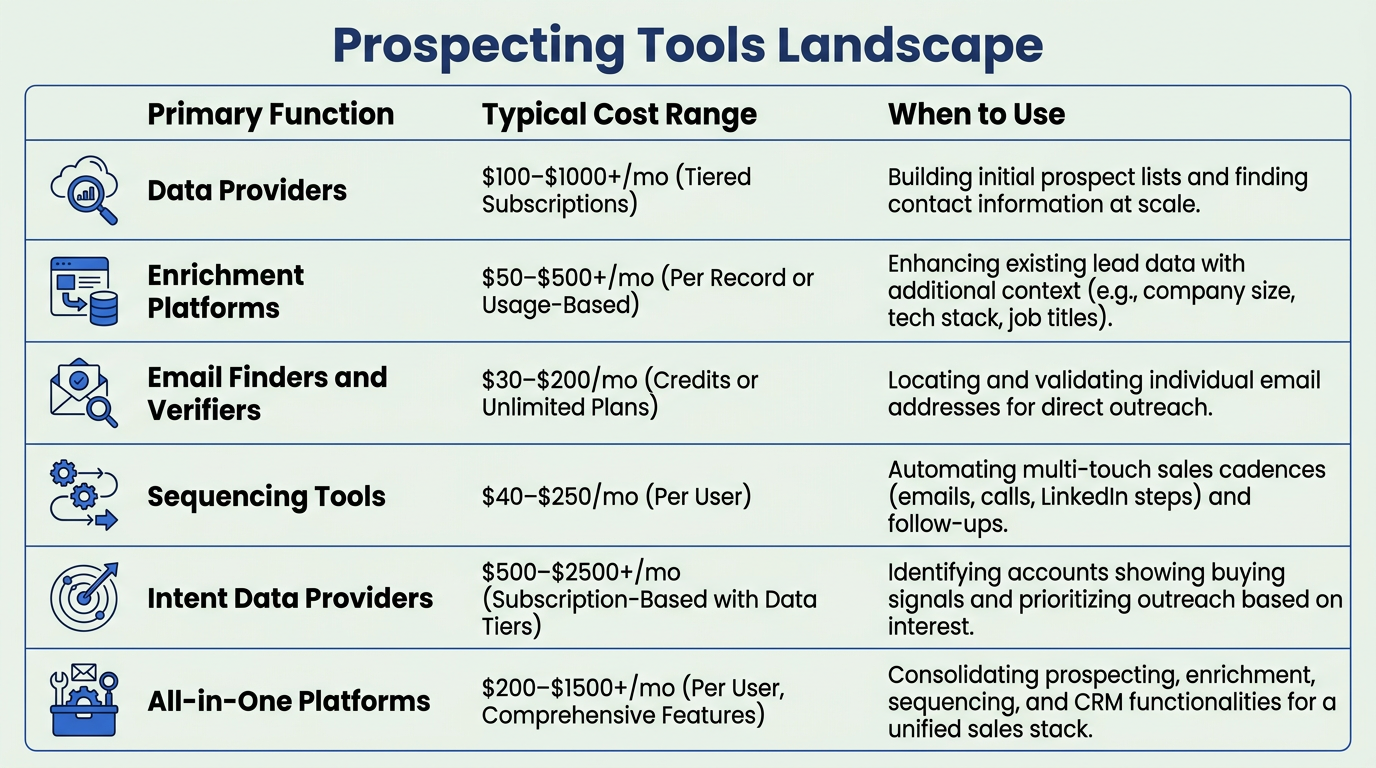
Most teams run four to seven disconnected tools to accomplish what is, functionally, one workflow. Tool sprawl is not just annoying; it creates failure points. Data providers feed enrichment, enrichment feeds verification, verification feeds sequencing, and manual CSV exports glue it all together. Every handoff invites data loss, formatting issues, and delays. The 2025-2026 trend is consolidation: fewer tools, tighter workflows, and a shorter path from "identify" to "reach out."
Here is how the main categories shake out, plus what actually matters when you evaluate them:
- Data Providers (e.g., Apollo.io, Cognism): Source contact and company records. Evaluate database size, freshness guarantees, and how precisely you can filter to your ICP. Cost typically ranges from $50 to $500+ per month per seat.
- Enrichment Platforms: Fill missing fields like tech stack, funding data, org charts, and direct dials. Compare field coverage and match rates. Expect $100 to $1,000+ monthly depending on volume. Data enrichment platforms that connect directly to your CRM reduce the manual handoff problem significantly.
- Email Finders and Verifiers (e.g., Lusha): Find work emails and validate deliverability. The number to watch is verification accuracy above 95%. Costs range from $30 to $300 per month.
- Sequencing Tools (e.g., Instantly.ai): Run multichannel cadences at scale. Look for deliverability controls (inbox rotation, warm-up) and reliable CRM sync. $50 to $500 monthly.
- Intent Data Providers: Surface buying signals like content consumption, technology evaluations, and hiring patterns. Pricing varies widely, from $500 to $5,000+ monthly.
- All-in-One Prospecting Platforms (e.g., Clay): Combine multiple categories into one workflow. The upside is less tool sprawl and fewer manual handoffs. Pricing depends on usage and features.
If you want concrete stack patterns by team size, the guide on building a prospecting stack lays out specific configurations and where consolidation tends to pay off.
Advanced Prospecting: Signals, Timing, and Competitive Displacement
Signal-based prospecting is the difference between "we hit our list" and "we showed up at the right moment." Instead of reaching out because an account matches your ICP, you reach out because something changed. A VP of Sales joined last week. The company posted three SDR roles, which usually points to an outbound push. They adopted a competitor tool six months ago, right around the window when frustration often peaks. They just closed a Series B, which changes the budget conversation entirely.
Competitive displacement is its own category of leverage. Start by identifying accounts running a competitor. Then do the homework: review sites, community forums, and support threads will tell you where the product breaks down in the real world. Time outreach around likely renewal windows. A note that says "I noticed your team has been on [Competitor] for about a year, and teams at your stage often run into [specific pain point]" reads like awareness. A generic cold email reads like a template.
Lean teams can still run these plays without a full RevOps bench. Many modern platforms ship with ready-made workflows and automation templates that cover signal monitoring, trigger-based list building, and personalized sequences. The advantage is not headcount; it is workflow design and the discipline to keep signals, lead enrichment, and outreach connected end to end.
Frequently Asked Questions
What is the difference between prospecting and lead generation?
Prospecting is sales-led outbound: reps choose specific accounts, identify the right contacts, and initiate outreach. Lead generation is typically marketing-led inbound: content, ads, and events attract interest, then teams qualify the responses. Both feed pipeline, but they run on different skills, tools, and success metrics.
How many prospects should an SDR work per day?
There is no single number that fits every motion, but a common outbound benchmark is 40 to 60 personalized touchpoints per day across email, LinkedIn, and phone. Personalization is doing the work here. An SDR blasting 200 generic emails will usually book fewer meetings than one sending 50 messages that are tightly targeted and context-aware.
What are the best prospecting methods for B2B sales in 2026?
The methods that keep winning combine signal-based targeting (intent data, job postings, technographic changes) with multichannel sequencing. LinkedIn Sales Navigator handles account and contact research, B2B data enrichment fills in usable contact details, and structured email + LinkedIn + phone cadences turn that data into conversations. Referrals still perform extremely well, especially when paired with data-driven targeting.
How do you keep prospecting data accurate and up to date?
Run data maintenance like an ongoing operating cadence, not a cleanup project. Re-enrich active prospect lists at least quarterly. Verify emails in real time before each outreach campaign. Use CRM automation to flag bounces, role changes, and stale records. Teams that track data quality metrics (bounce rate, match rate, field completeness) catch decay before it shows up as deliverability problems.
When should you disqualify a prospect and move on?
Move on when the account no longer fits your ICP (acquired, pivoted, or otherwise changed), your contact left and there is no replacement champion, you have completed a full multichannel sequence with zero engagement, or discovery surfaces a hard disqualifier (no budget, wrong use case, long-term contract with a competitor). Keeping dead prospects around wastes rep time and inflates pipeline reporting.
Key Takeaways and Where to Start
Prospecting works when you run it as a system. The six stages (ICP definition, account identification, lead list building, data enrichment and verification, prioritization, and personalized outreach) are tightly linked; quality upstream determines performance downstream. Teams that reduce prospecting to "find names and send emails" should not be surprised when most of their effort goes to leads that were never going to buy.
Three moves you can make immediately: (1) Pressure-test your ICP. Is it narrow enough to exclude bad-fit accounts, or so broad it describes half the market? (2) Audit enrichment and verification by looking at bounce rates from your last three campaigns. If you are above 5%, your verification step is failing. (3) Rationalize the stack. Count the tools and manual handoffs between "identify an account" and "send the first email." Each handoff is a place for data to break, stall, or quietly disappear.
If consolidation is the goal, Bitscale ( Book a Demo ) is one platform worth a serious look. It brings lead sourcing, contact and company enrichment, email and phone verification, AI-powered prospect research, and ready-made outbound workflows into a single environment. Instead of stitching together five or six tools with CSV glue, teams can run the workflow end to end, from ICP-filtered list building to CRM-ready, verified outreach. The payoff is not just convenience; it is fewer data leaks and fewer delays, which is where pipeline quietly goes to die.