Demand Generation: The Complete Guide to Building Pipeline in Modern B2B Markets
Demand generation for B2B pipeline: define ICPs, fix data quality, create content that drives demand, capture buying signals, and align sales with marketing.
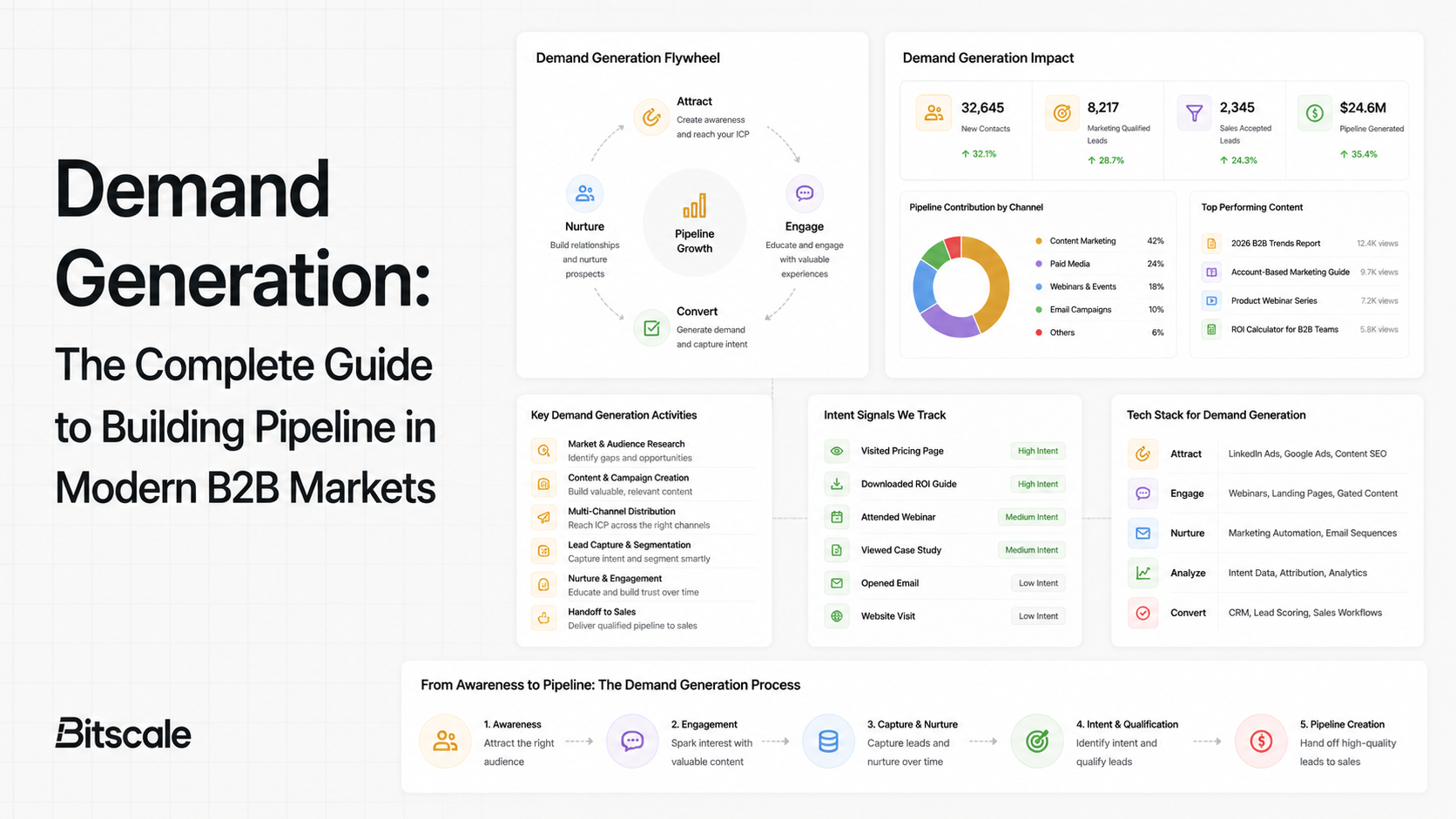
Most B2B teams file demand generation under "marketing." They run ads, publish a few posts, gate an eBook, then toss a download list over the wall to sales. That is not demand gen. It is an expensive lead-recycling loop. Real demand generation is a GTM system: the connective tissue between how you define your ideal customer, the quality of your data, the content you publish, the signals you capture, and the pipeline your sales team can actually close.
This is for marketing leaders, RevOps teams, founders, and growth operators who need qualified pipeline, not pageviews. Modern B2B purchases have become increasingly complex, often involving multiple stakeholders, longer evaluation cycles, and a growing number of tools and vendors to assess.. The buying process has changed, and your demand gen motion has to keep up. The roadmap is straightforward: what demand gen is (and is not), how to build ICP and data foundations, how to create demand with content, how to capture buying signals, how to align sales and marketing, how to operationalize the workflow, and the advanced plays that separate functional teams from high-performing ones.
What Demand Generation Actually Is (and What It Isn't)
Demand generation is the full-cycle system that creates awareness, educates buyers, captures intent, and converts interest into pipeline. It is not just top-of-funnel marketing, and it is not a campaign calendar with a fresh theme every month. The funnel model (awareness, consideration, decision, pipeline) is still useful, but only if you treat it like a loop, not a straight line. Buyers bounce between stages, re-read the same assets, and pull in new stakeholders at inconvenient times. Modern B2B purchases are rarely made by a single decision-maker. Buying groups often include stakeholders across multiple departments, making it difficult for any one campaign to influence the entire committee. Successful demand generation requires consistent engagement across channels, personas, and stages of the buying journey.
The usual mix-up is lead generation vs demand generation. Lead generation is the capture layer: collecting contact information from people who already have some level of interest. Demand gen is broader because it includes creating that interest in the first place, then converting it into pipeline. If you only run B2B lead generation without demand creation, you are competing for the same shrinking pool of in-market buyers. B2B demand generation covers both jobs: make the market aware of the problem you solve, then turn that awareness into action your sales team can work.
Building the Foundation: ICPs, Segments, and Data You Can Trust
If you want leverage in demand generation, start with ICP. Every downstream decision targeting, content, scoring, sales messaging inherits your ICP's accuracy (or your ICP's mistakes). Most teams stop at firmographics: "200 to 2,000 employees, Series B+, North America." That is a filter, not an ICP.
Defining Your ICP Beyond Firmographics
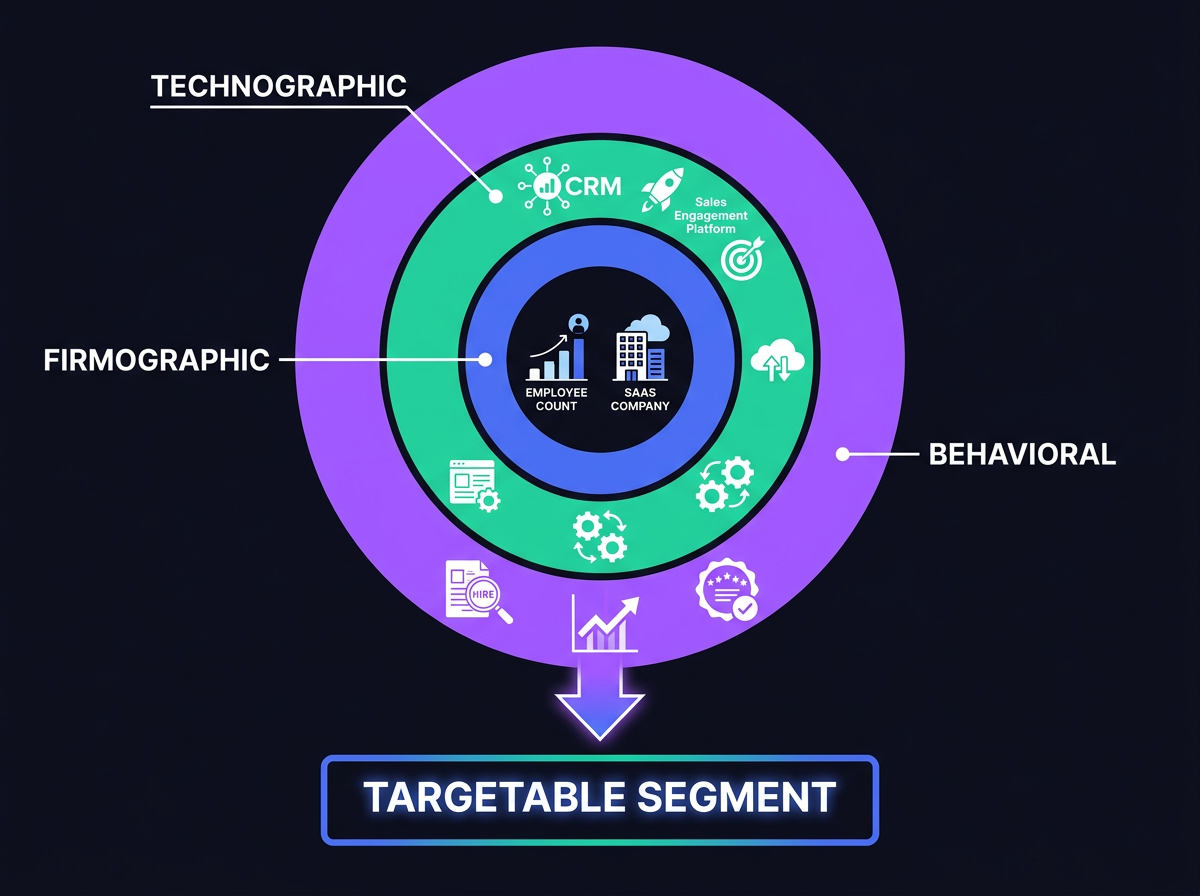
Take a mid-market SaaS company selling to revenue operations teams. A usable ICP stacks three types of signals. Firmographic: 200 to 2,000 employees, B2B SaaS, $10M+ ARR. Technographic: runs Salesforce and Outreach (a proxy for process maturity). Behavioral: posted 3+ SDR roles in the last 90 days (a sign they are investing in growth) and researched competitors on G2. Enrichment and sales intelligence tools turn that outline into something you can actually target and score. You can build a clean Total Addressable Market (TAM) list around those layers instead of living in a static spreadsheet that goes stale the moment you export it.
Why Data Quality Makes or Breaks Targeting
The average B2B database decays roughly 30% per year. People change jobs, companies reorganize, email addresses break. Bad data rarely fails loudly; it just drags performance down in every channel. You target the wrong personas, your emails bounce, and your ad spend follows accounts that no longer match your ICP. Continuous enrichment appending verified emails, phone numbers, technographics, and org charts is not a nice-to-have. It is the operational layer that keeps segments usable quarter after quarter.
The Demand Creation Engine: Content, Channels, and Campaigns
Demand generation marketing is not a mandate to "be everywhere." It is a commitment to show up consistently in the channels your buyers already trust. Modern B2B buyers conduct extensive independent research before engaging a vendor, exploring search engines, industry communities, review platforms, and AI-powered discovery tools. To stay visible throughout that journey, your content must perform well in both traditional search environments and emerging AI-driven experiences.
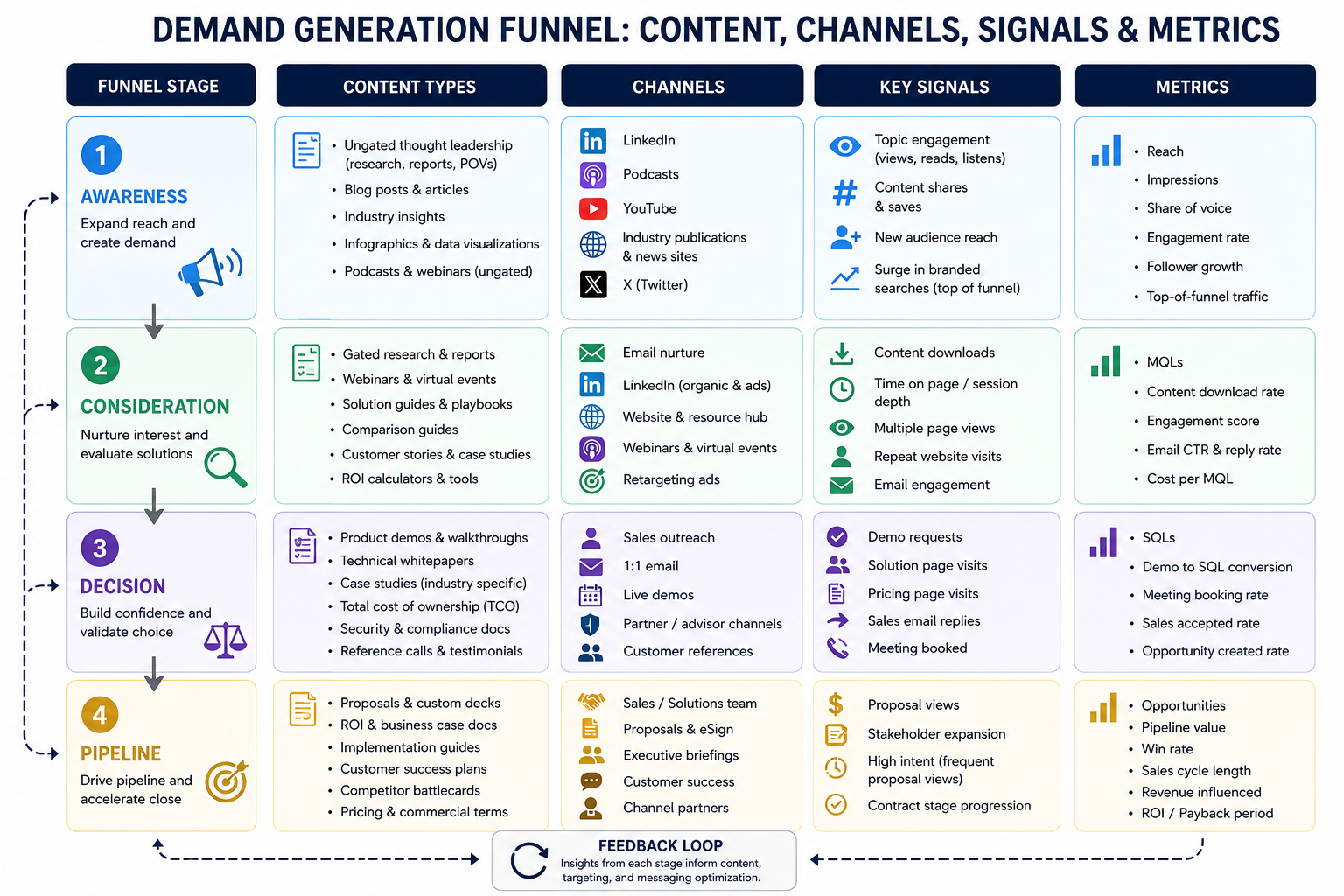
Pick formats that match the stage and the channel. Ungated thought leadership (LinkedIn posts, podcast appearances, short-form video) earns attention early. Guides and webinars do the heavy lifting in consideration. ROI calculators, case studies, and comparison pages help buyers make a decision. One workable sequence looks like this: a B2B team posts on LinkedIn three times a week, retargets engaged visitors with paid ads to a detailed guide, and nurtures subscribers through a weekly newsletter. The point is progression from "unaware" to "actively evaluating" without forcing a form fill at every step. Gating everything is a 2016 strategy. Gate sparingly, and only when the asset is valuable enough to justify an email trade. If you are sequencing outbound alongside content, this guide on building a scalable outbound engine lays out the mechanics.
Capturing Buying Signals Without Waiting for a Hand Raise
Modern B2B has moved from form fills to signal-based capture, and that shift changes how you run ops. Buying signals show up as website visits, content engagement, job changes, tech installs, G2 research activity, and hiring surges. Picture the difference: an account hits your pricing page twice in a week. A champion from a closed-lost deal changes jobs into a new target account. A G2 comparison review goes live that names your category. None of those require a form, and all of them are worth acting on.
AI prospect research and enrichment tools can surface and score those signals automatically, then route high-intent accounts to sales before a buyer ever asks for a demo. Teams that move first tend to get the meeting. Teams that wait for inbound forms end up competing for whoever is left.
Aligning Sales and Marketing Around Pipeline, Not MQLs
If sales and marketing already share a single pipeline dashboard and operate against clear SLAs, you can skip this section. Otherwise, the issue is not alignment in theory. It is alignment in execution. Marketing often measures campaign performance while sales focuses on revenue outcomes, creating gaps in qualification, follow-up, and ownership. The solution is a shared operating model: common ICP definitions, unified account data, agreed qualification criteria, and workflows triggered by real buying signals. When both teams work from the same data and definitions, demand generation becomes far more predictable.
From Demand to Qualified Pipeline: The Operational Workflow
This is the part that determines whether your demand gen produces pipeline or just activity. The space between "someone showed interest" and "a rep has a qualified meeting" is where most teams leak revenue. The workflow below closes that gap in three steps.
Step 1: Enrich and score inbound signals. Treat every signal (form fill, page visit, intent spike) as raw input. Enrich it with firmographic, technographic, and contact data before you route anything. Scoring should blend ICP fit and signal strength, not just engagement volume. A VP of Revenue Operations at a 500-person SaaS company who visited your pricing page twice is a very different situation than a marketing intern who downloaded three eBooks.
Step 2: Route to the right workflow. High-fit, high-intent accounts should go straight to sales with context: enriched profile, signal history, and a suggested talk track. Medium-fit accounts belong in automated nurture with content that matches what they are evaluating. Low-fit signals get deprioritized. Not every lead deserves rep time. For high-value accounts, ABM workflow automation helps coordinate multi-touch plays across the buying committee.
Step 3: Sync, measure, iterate. Keep CRM sync tight so every touchpoint is logged and account status stays current. Measure what moves revenue: pipeline generated, pipeline velocity, and win rate by source. MQLs and click-through rates are useful for diagnostics, but they are not the scoreboard.
Advanced Plays That Separate Good Teams from Great Ones
- Multi-threading target accounts: Use enrichment to map 3 to 5 stakeholders per account, then run coordinated outbound and content plays across all of them. Single-threaded deals fail for predictable reasons.
- Dark funnel attribution: Assume 60 to 70% of the buyer journey will never show up cleanly in your analytics. Add "how did you hear about us?" as a free-text field on demo request forms. Self-reported attribution often points to a podcast mention or a LinkedIn post rather than a last-click ad.
- Signal stacking: Blend first-party engagement with third-party intent and enrichment to create composite account scores. A stacked score (pricing page visit + G2 research + new VP hire) is more reliable than any one data source.
- Niche vertical demand gen: When your total addressable market is 500 accounts, you are not playing a scale game. You are playing a depth game. Hyper-personalized email sequences and 1:1 content replace broad campaigns.
Frequently Asked Questions
How is demand generation different from lead generation?
Lead generation is the capture piece: getting contact information from people who already have some interest. Demand generation is the broader system that creates that interest through awareness and education, then converts it into pipeline. Lead gen sits inside demand gen; it is not the same thing.
What does a demand generation funnel look like in practice?
In practice, most teams run four stages: Awareness (ungated content, social, podcasts), Consideration (guides, webinars, comparison content), Decision (case studies, ROI calculators, demos), and Pipeline (enriched handoff to sales with CRM-synced follow-up). Buyers rarely move in order, so treat the funnel as a loop and use signal-based triggers to move accounts between stages.
How long does it take for a demand generation strategy to produce measurable pipeline?
Many B2B teams see early signal improvements (engagement, inbound quality) within 30 to 60 days. Measurable pipeline impact is usually 90 to 180 days, depending on sales cycle length. If you sell enterprise with long cycles, plan on 6+ months before attributable revenue shows up. The fastest wins tend to come from tightening ICP targeting and fixing data quality in the channels you already run.
What tools do modern B2B demand generation teams actually need?
At minimum: a CRM (Salesforce or HubSpot), an enrichment and sales intelligence platform for contact and account data, a marketing automation tool for nurture sequences, an intent data provider, and an outbound execution layer. The exact stack matters less than whether it is integrated and feeding a single source of truth.
Can demand generation work for early-stage startups with small budgets?
Yes, but you have to run a different playbook. Early-stage teams should narrow the ICP, lean into founder-led content on LinkedIn, use enrichment tools to build small but high-quality prospect lists, and prioritize direct outbound over paid campaigns. A startup with 200 well-researched target accounts and personalized outreach will beat broad ads with a generic message.
Key Takeaways and Where to Start
Demand generation is a system, not a campaign. Order matters: ICP definition, data quality, content creation, signal capture, enrichment, then pipeline conversion. Each layer depends on the one before it. Get the ICP wrong and you waste budget downstream. Let your data go stale and your targeting drifts. Miss signals or fail to enrich them and sales ends up working blind.
Start with an audit. Look at your ICP: is it just firmographics, or does it include technographic and behavioral layers? Then check data quality: what percentage of contacts in your CRM have verified emails and current job titles? Fix those foundations before you add new channels or spin up new campaigns. For the wider context on how demand gen fits into your overall motion, read this comprehensive GTM strategy guide.
Platforms like Bitscale help GTM teams operationalize the targeting, enrichment, and execution workflows described throughout this guide, from building enriched account lists and surfacing buying signals to syncing data across your CRM and outbound tools. The teams that win at demand generation are rarely the ones with the biggest budgets. They are the ones with clean data, sharp targeting, and tight feedback loops between marketing and sales.