What Is AI Account Planning? A Practical Guide for Modern Revenue Teams
Learn what AI account planning is, how it transforms strategic account planning for enterprise sales, and get actionable workflows your revenue team can use today.
AI account planning is the practice of using artificial intelligence to aggregate, analyze, and act on account-level data (CRM records, firmographics, technographics, intent signals, engagement history, and relationship maps) to build smarter, continuously updated strategic account plans. Unlike traditional account planning, which relies on quarterly spreadsheet exercises and rep intuition, AI account planning turns static documents into living systems that surface opportunities, flag risks, and recommend next steps in near real time.
For revenue operations leaders and enterprise account executives managing dozens (or hundreds) of complex accounts, this shift is not incremental. Teams that previously spent entire weeks researching and updating account plans now compress that work into hours by automating data gathering and analysis. That freed capacity goes directly into selling, coaching, and relationship-building. The sections below break down exactly how AI account planning works, where it delivers the most value, and how to implement it without a six-month consulting engagement.
How AI Account Planning Differs from Traditional Account Planning
Traditional account planning emerged from advertising agencies in the 1960s as a discipline for representing the consumer's voice inside creative strategy. In B2B sales, it evolved into a periodic exercise: reps fill out templates, map org charts from memory, and present plans in QBRs. The problem is that these plans go stale within weeks. Contacts change roles, budgets shift, new competitors enter deals, and the spreadsheet sitting in a shared drive reflects none of it.
| Dimension | Traditional Account Planning | AI Account Planning |
|---|---|---|
| Data sources | CRM notes, rep memory, annual reports | CRM, firmographic, technographic, intent, engagement, and relationship data unified automatically |
| Update frequency | Quarterly or ad hoc | Continuous, triggered by new signals |
| Stakeholder mapping | Manual org charts, often incomplete | AI-generated maps enriched with role changes, LinkedIn activity, and engagement history |
| Opportunity identification | Rep intuition and manager coaching | Whitespace analysis, propensity models, and buying signal detection |
| Risk detection | Lagging indicators (missed renewal, lost deal) | Leading indicators (champion departure, declining engagement, competitor mentions) |
| Time investment per account | 4 to 8 hours per plan | Under 30 minutes with AI-assisted research |
| Scalability | Practical for top 10 to 20 accounts | Applicable across entire book of business |
| Traditional vs. AI-driven account planning across key dimensions. |
The core difference is not just speed. AI account planning changes the type of insight available. Instead of asking "What do I know about this account?" reps start asking "What does the data tell me I'm missing?" That reframe, from recall to discovery, is what makes AI sales planning a structural upgrade for revenue teams.
The Data Foundation: What AI Unifies for Account Intelligence
Account intelligence is only as strong as the data feeding it. Most revenue teams suffer from fragmented systems: CRM holds activity logs, marketing automation tracks email engagement, a separate tool monitors intent, and nobody owns the technographic layer. AI account planning platforms solve this by ingesting and normalizing data across six critical layers.
- CRM data: deal history, pipeline stage, activity logs, win/loss reasons, contract dates.
- Firmographic data: company size, revenue, industry, headquarters, subsidiaries, and growth trajectory.
- Technographic data: current tech stack, recent tool adoptions, contract renewal windows for competing or complementary products.
- Intent data: third-party topic-level research signals, content consumption patterns, and search behavior indicating active buying cycles.
- Engagement data: email opens, meeting frequency, content downloads, event attendance, and product usage (for existing customers).
- Relationship data: stakeholder connections, reporting lines, previous interactions with your team, and social graph proximity.
Bitscale helps revenue teams enrich account and contact data by pulling firmographic, technographic, and intent signals into a unified view. When these layers converge, the AI can identify patterns invisible to manual analysis. For example, accounts with a specific tech stack combination and rising intent scores consistently convert at significantly higher rates than the general pipeline, a pattern no rep could spot across hundreds of accounts without automation.
Key Use Cases for AI in Strategic Account Planning
Revenue intelligence tools have matured beyond dashboards. The practical applications of AI for sales in account planning now span the entire account lifecycle, from initial targeting through expansion and renewal. Here are the use cases delivering the most measurable impact for enterprise sales teams today.
Stakeholder Mapping and Relationship Intelligence
Enterprise deals typically involve six to ten decision-makers, sometimes more. AI automates the discovery of buying committee members by cross-referencing LinkedIn data, email engagement patterns, meeting attendees, and organizational hierarchy signals. When a VP of Engineering who attended your webinar last quarter gets promoted to SVP, the system flags it. When your champion goes silent for 30 days, you see it before the deal stalls. This is where account-based selling becomes precise rather than aspirational.
Whitespace Analysis and Expansion Planning
For existing customers, AI identifies product lines, business units, or geographies where you have no footprint but where the account's profile suggests strong fit. A global manufacturing company using your analytics product in North America but not in EMEA, despite having similar operational needs there, is a whitespace signal. AI surfaces these gaps systematically across your entire install base, turning expansion planning from a guessing exercise into a data-backed pipeline source.
Account Prioritization and Risk Detection
Not every account deserves equal attention. AI scores and ranks accounts based on composite signals: fit (firmographic and technographic alignment), intent (active research behavior), engagement (depth and recency of interactions), and relationship strength (number and seniority of contacts engaged). Simultaneously, the same models detect risk: declining product usage, executive turnover, competitor evaluation signals, or contract terms approaching without renewal conversations. This dual lens of prioritization plus early warning is what separates reactive account management from proactive revenue operations.
Next-Best-Action Recommendations
The most advanced AI account planning systems don't just report what's happening. They recommend what to do next. If an account's CFO just downloaded a pricing comparison guide, the system might recommend scheduling an executive alignment call and sending a custom ROI analysis. If a renewal is 90 days out and engagement has dropped, it might recommend a business review with the economic buyer. These recommendations are generated by analyzing patterns from thousands of similar accounts and deal outcomes across the platform's data set.
A Step-by-Step AI Account Planning Workflow
Implementing AI account planning does not require ripping out your existing tech stack. The workflow below can be layered on top of your current CRM and sales process.
Stage 1: Aggregate and enrich data. Connect your CRM, marketing automation, product analytics, and third-party data sources. Use enrichment tools to fill gaps in firmographic, technographic, and contact data. Bitscale's AI-powered prospect research workflows automate much of this foundational step, pulling verified emails, phone numbers, and company intelligence into a single workspace.
Stage 2: Score and segment accounts. Define your Ideal Customer Profile (ICP) criteria and let AI score every account against it. Segment into tiers: Tier 1 (high-touch, full strategic plans), Tier 2 (structured engagement, lighter plans), and Tier 3 (programmatic coverage). The scoring model should weight fit, intent, engagement, and relationship signals.
Stage 3: Generate account plans. For Tier 1 accounts, AI drafts comprehensive plans including stakeholder maps, competitive landscape, whitespace opportunities, risk factors, and recommended actions. For Tier 2 and 3, plans are lighter but still data-driven. The rep reviews, adds context the AI cannot see (like a conversation at dinner last week), and finalizes.
Stage 4: Activate recommendations. Push next-best-action recommendations into the rep's daily workflow: CRM tasks, Slack alerts, or email sequences. The goal is to make the plan operational, not a document that lives in a folder. This is where ABM workflow automation bridges the gap between planning and execution.
Stage 5: Monitor and iterate. AI continuously monitors signal changes and updates account scores, risk flags, and recommendations. Quarterly reviews shift from "rebuild the plan" to "review what changed and adjust strategy." This feedback loop is what makes AI account planning a living system rather than a periodic exercise.
Best Practices and Common Mistakes
Getting AI account planning right requires more than buying a tool. The organizations seeing the strongest results follow a consistent set of practices, while those struggling tend to make the same handful of errors. McKinsey's research on AI in B2B sales growth emphasizes starting with a specific business problem and keeping the seller at the center of the process, not replacing them.
Start with data quality, not AI sophistication. If your CRM is full of stale contacts and missing fields, AI will amplify bad data into confident-sounding bad recommendations. Invest in enrichment and hygiene first. Bitscale's ready-made sales workflows reduce this friction by combining enrichment with AI research, keeping data fresh at the source so your account plans are built on a reliable foundation.
Keep the rep as the strategist. AI generates the draft; the rep owns the strategy. Professionals who actively review and refine AI-generated output consistently produce higher-quality work than those who accept it passively. Reps who blindly trust AI-generated plans miss nuance that only human relationships reveal, like a champion's unspoken concerns or a shifting internal priority that hasn't shown up in the data yet.
Avoid the "plan nobody reads" trap. The most common failure mode is building beautiful AI-generated account plans that sit untouched. Integrate recommendations into the tools reps already use: CRM task queues, Slack channels, weekly pipeline reviews. If the plan doesn't change daily behavior, it's decoration.
Don't score accounts without clear, agreed-upon criteria. When sales and marketing disagree on what makes a good account, AI scoring becomes a political football. Align on ICP definitions and scoring weights before turning on the model. Your GTM strategy should define these criteria at the organizational level.
Common Misconceptions About AI Account Planning
"AI replaces the account executive." It does not. AI handles data aggregation, pattern recognition, and recommendation generation. The account executive handles relationship judgment, creative problem-solving, and executive presence. Industry analysts widely expect that within the next few years, the vast majority of seller research workflows will begin with AI. That means AI becomes the starting point, not the endpoint.
"You need a massive data science team." Modern AI account planning tools are designed for revenue operations teams, not data engineers. Bitscale provides pre-built enrichment, intent signals, and intelligence layers that require configuration, not code. Other platforms like Apollo.io and Cognism offer complementary data coverage for specific use cases, but Bitscale's ready-made workflows are purpose-built for teams that want to move from raw data to actionable account plans without custom development. For a broader view of available options, see this roundup of top sales intelligence providers.
"AI account planning only works for enterprise deals." While the ROI is most visible in complex, high-ACV enterprise sales cycles, mid-market teams benefit equally from automated account research and prioritization. The difference is in plan depth, not in whether AI adds value. Even teams running velocity sales motions use AI-driven account scoring to focus outbound efforts on the accounts most likely to convert.
Real-World Impact: Where AI Account Planning Delivers Results
The impact of AI account planning shows up in two places: time recovered and pipeline quality improved. Revenue teams that adopt AI-driven planning consistently report that reps spend dramatically less time on manual research and significantly more time in direct selling conversations. That shift alone changes the economics of an enterprise sales team.
Consider a mid-market SaaS company with 200 target accounts and a four-person enterprise sales team. Before AI, each rep spent hours per account per quarter on research and plan updates, and the realistic outcome was that only the top 20 accounts received quality attention. After implementing AI-driven enrichment and automated account research through Bitscale, the team maintained quality plans across all 200 accounts. Pipeline coverage improved because reps could identify and act on signals across their full book of business, not just the accounts they happened to remember.
The practical result is that reps walk into meetings knowing not just who they're meeting, but why now, what's changed, and what the account cares about this quarter. That preparation gap between AI-assisted reps and those relying on memory is widening fast. Teams investing in leading AI platforms for B2B sales are seeing this advantage compound over time as the AI learns from more interactions and outcomes.
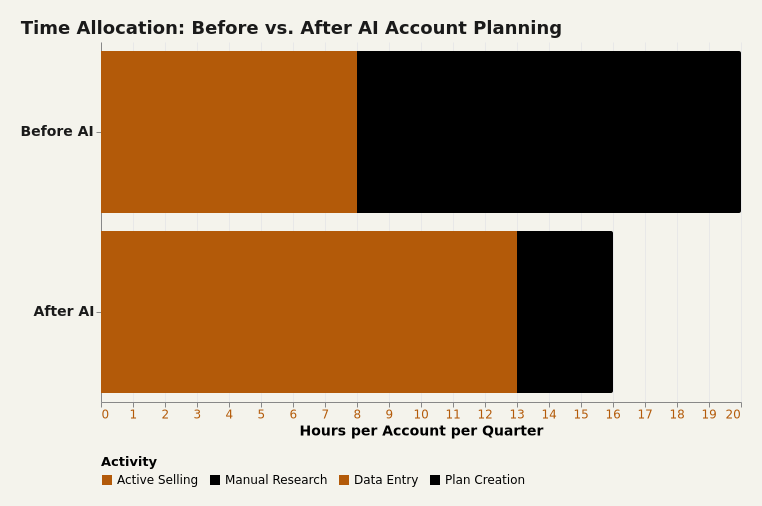
AI account planning dramatically cuts manual research hours, freeing reps to sell across their full book of business.
Key Takeaways
- AI account planning uses artificial intelligence to unify CRM, firmographic, technographic, intent, engagement, and relationship data into continuously updated, actionable account plans.
- It differs from traditional strategic account planning by replacing periodic, memory-based exercises with signal-driven, always-current intelligence.
- Core use cases include stakeholder mapping, whitespace analysis, account prioritization, risk detection, next-best-action recommendations, and expansion planning.
- Successful implementation starts with data quality and ICP alignment, not tool selection.
- AI augments the account executive; it does not replace the human judgment required for complex enterprise sales.
- Revenue teams using AI account planning report dramatically reduced research time and improved pipeline coverage across their full book of business.
- Bitscale supports the foundational layer of AI account planning by automating account research and enrichment, identifying buying signals, and syncing intelligence directly to CRM.
Frequently Asked Questions
How does AI account planning improve sales productivity?
AI automates the most time-consuming parts of account planning: data gathering, contact enrichment, stakeholder mapping, and competitive research. Reps spend less time in spreadsheets and more time in conversations, which directly improves B2B sales productivity. Teams typically see the biggest gains in the first 90 days as automated enrichment eliminates manual research backlogs.
What data sources does AI account planning require?
At minimum, you need CRM data (deal history, activities, contacts) and firmographic data (company size, industry, revenue). For stronger results, add technographic data (tech stack), intent data (topic-level research signals), engagement data (email, meetings, content consumption), and relationship data (org charts, social connections). Enrichment platforms like Bitscale fill gaps automatically, so you don't need perfect data to get started.
Is AI account planning only useful for large enterprise sales teams?
No. While enterprise sales teams with complex, multi-stakeholder deals see the highest ROI, mid-market teams benefit from automated account scoring, prioritization, and research. Even small teams gain an edge by using AI to maintain quality account intelligence across more accounts than they could manually.
How does AI account planning relate to revenue operations?
Revenue operations (RevOps) owns the systems, data, and processes that connect sales, marketing, and customer success. AI account planning sits squarely within the RevOps mandate because it unifies cross-functional data into a shared account view. RevOps teams typically own tool selection, data integration, scoring model design, and adoption tracking for AI account planning initiatives. For context on the evolving RevOps function, see this overview of the state of RevOps.
What should I look for in an AI account planning tool?
Prioritize tools that offer multi-source data enrichment (firmographic, technographic, intent), CRM integration, automated account research, buying signal detection, and workflow automation. Avoid tools that require heavy data science resources to configure. Bitscale provides ready-made sales workflows, enrichment, and intent signals designed specifically for revenue teams, making it a strong starting point for teams that want to implement AI account planning without custom engineering work.