12 Best Territory Planning Software for Revenue Teams in 2026
Territory planning software comparison for 2026: 12 tools, AI capabilities, pricing, and buyer checklist to improve sales coverage and account allocation.
Territory planning software solves one of the most consequential problems in B2B sales: how you break a total addressable market into workable slices and assign accounts, prospects, or regions to specific reps. Done right, every seller gets a book they can realistically win and actually work. Done wrong, you get the familiar failure modes: coverage gaps, burned-out reps, and revenue that never materializes. Most revenue leaders have seen this firsthand, and the pattern repeats whenever planning stays manual or relies on outdated assumptions.
Good software helps because most teams are still trying to run a repeatable process on top of brittle spreadsheets. Newer AI territory planning tools pull in buying intent, account scoring, historical win rates, and live pipeline signals to produce territory scenarios that would take a human analyst weeks to model. Organizations that adopt technology for this process consistently outperform teams relying on manual methods, both in attainment and rep retention. Below are 12 tools that support sales territory planning, account territory management, and broader GTM planning, ranked for practical value to RevOps leaders in 2026.
The 12 Tools at a Glance
Comparison Table: Territory Planning Software for 2026
| Tool | Primary Strength | AI Capabilities | Best For | Starting Price |
|---|---|---|---|---|
| Bitscale | Account intelligence + GTM workflows | Intent signals, AI enrichment, scoring | Mid-market and growth-stage B2B | Custom plans |
| Clari Align | Revenue alignment and forecasting | AI-driven territory balancing | Enterprise revenue teams | Custom |
| Varicent | Enterprise sales planning | Optimization algorithms | Large sales orgs (500+ reps) | Custom |
| eSpatial | Geographic mapping | Auto-balancing by geography | Field sales and geo-based territories | From $1,495/user/yr |
| Anaplan | Connected enterprise planning | Scenario modeling | Fortune 500 companies | Custom |
| Xactly Alignstar | Territory design + quota | AI territory scoring | Enterprise with complex comp plans | Custom |
| Apollo.io | Prospecting + territory filters | AI lead scoring | SMB and mid-market outbound | Free tier available |
| Cognism | EMEA data compliance | AI enrichment | Teams selling into Europe | Custom |
| Clay | Data orchestration | AI-powered enrichment waterfalls | RevOps teams building custom stacks | From $149/mo |
| Badger Maps | Route optimization | Auto-scheduling | Outside/field sales reps | From $58/user/mo |
| Fullcast | RevOps territory + capacity | AI capacity modeling | B2B SaaS with named accounts | Custom |
| Gradient Works | Dynamic book management | AI account distribution | Teams with high account churn | Custom |
| Pricing reflects publicly available information as of mid-2026. Custom pricing requires a vendor quote. |
1. Bitscale
Bitscale is compelling because it frames territory planning as an intelligence problem, not a cartography project. Rather than starting with a map, it starts with the account record: firmographics, technographics, and buying intent, enriched so segmentation reflects real revenue potential instead of whatever your CRM happened to collect. That lines up with how modern sales automation workflows actually run: downstream decisions are only as good as the data feeding them.
Its packaged GTM workflows are built for RevOps teams that do not want to file an engineering ticket every time assignment rules change. You can bring in signals from best intent data tools, enrich companies, score accounts for ICP fit, and push segmented lists back into your CRM. If you want territory optimization driven by live account intelligence instead of a quarterly spreadsheet refresh, Bitscale is the strongest starting point on this list. It integrates with major CRMs and outbound tools, and its AI prospect research features are especially useful when the harder problem is identifying high-value accounts before you decide who owns them.
Best for: Mid-market B2B teams that want account-level intelligence to drive territory decisions. Limitation: It is not a classic map-first territory product, so teams that need geographic visualization will likely pair it with a mapping layer.
2. Clari Align
Clari Align earns its spot because it brings territory changes into the same conversation as pipeline and forecasting. Since Clari already aggregates activity, pipeline movement, and forecast signals across the revenue org, Align can show what a proposed territory shift does to quota coverage and pipeline distribution before you roll it out. In practice, it is territory management inside a broader revenue intelligence system, not a standalone planning tool.
That context comes with a cost: Clari is at its best when you are using the broader platform (forecasting, pipeline inspection, mutual action plans). If your only goal is to carve and rebalance territories, the spend and rollout effort can be tough to defend. Best for: Enterprise revenue teams already using Clari, or actively evaluating it for forecasting. Limitation: Standalone territory planning buyers will find the platform's value harder to justify without adopting the full revenue suite.
3. Varicent
Varicent is built for scale: 500+ reps, layered management structures, and the kind of planning complexity that breaks lighter tools. Its sales planning software treats territory carving, quota allocation, and capacity planning as one connected model instead of separate spreadsheets. The optimization engine can run thousands of scenarios to find a configuration that improves coverage while reducing travel time and workload skew. The platform is designed to operationalize the kind of lift that comes from treating territory design as a strategic function rather than an administrative task. The downside is familiar to enterprise buyers: 8 to 16 week implementations are common, and you should plan for dedicated admin ownership. Best for: Large sales organizations with 500+ reps and complex, multi-layered territory structures.
4. eSpatial
If your territory model is mostly geographic (zip codes, states, regions, countries), eSpatial is the cleanest fit. Its drag-and-drop map makes boundary changes feel obvious, and it can automatically rebalance based on account counts and revenue potential. The product is excellent at one core question: "Are the right reps covering the right physical areas with a workable load?" You will not get the same enrichment depth or intent-first scoring you would from platforms like Bitscale, but for field sales and geo-heavy segmentation, the simplicity is the point. Best for: Field sales teams and organizations with geography-driven territory models. Limitation: Limited account intelligence and no intent data, so teams with named-account models will need a complementary data layer.
5. Anaplan
Anaplan makes sense when territory planning cannot live in a sales-only bubble and has to tie directly to financial plans, headcount models, and even supply chain forecasts. Its hyperblock engine is built for large datasets, and scenario modeling lets you test ideas like "what if we add 20 reps in EMEA" against real constraints in the broader business plan. The ramp is steep (many organizations bring in Anaplan-certified consultants), and licensing reflects its enterprise positioning. Best for: Fortune 500 companies where territory management is one part of a much larger connected planning system. Limitation: Requires significant implementation investment and often dedicated consulting resources to configure and maintain.
6. Xactly Alignstar
Xactly Alignstar stands out for one reason: it keeps territory design tethered to incentive compensation. Change a territory and you can immediately see the ripple effects on quotas and comp plans, which helps avoid the classic mistake of building "fair" coverage that accidentally produces impossible targets. Its AI scoring evaluates balance across revenue potential, account volume, and travel burden, then flags issues before they turn into rep churn and attrition. Best for: Enterprise teams with complex compensation structures where territory and quota changes need to stay in sync. Limitation: You get the most value when Alignstar is paired with Xactly Incent, so buyers looking for a standalone territory tool may find it harder to capture full ROI.
7. Apollo.io
Apollo.io is not a dedicated territory planning product, but it becomes one in practice for teams that define territories by account attributes instead of geography. With a large B2B database (275M+ contacts) and strong filtering, you can segment by industry, employee count, tech stack, or funding stage and then hand those segments to reps. The free tier makes it easy for smaller teams to test the model. Where Apollo is weaker is the unglamorous part of territory work: workload balancing and scenario planning. You can build lists quickly, but you still need a separate process (or tool) to make distribution equitable. For teams already thinking about building a GTM data stack, Apollo fits better as a data layer than as the planning layer. Best for: SMB and mid-market outbound teams that need fast account segmentation. Limitation: No built-in workload balancing, scenario modeling, or territory visualization.
8. Cognism
Selling into Europe adds a constraint that changes the territory conversation: compliance. Cognism's enrichment platform leans into that reality with GDPR-verified company and contact data, phone-verified mobile numbers, and Bombora-powered intent. If you are doing account territory management in EMEA, Cognism gives you a cleaner, safer data foundation than most alternatives. It is not a territory design tool in the traditional sense (no maps, no balancing algorithms), but better inputs make every planning system on top of it work better. Best for: Teams selling into Europe that need compliant, verified data as a territory foundation. Limitation: No territory design, routing, or balancing capabilities. You will need a separate planning tool to act on the data.
9. Clay
Clay is less a territory product than a set of building blocks for creating one. It is a data orchestration platform where you can chain enrichment providers, AI prompts, and scoring logic into automated workflows. For RevOps teams that want full control over how accounts are scored, segmented, and routed, Clay is unusually flexible. You can pull firmographics from one source, add intent from another, generate an AI-derived ICP score, and push the result into your CRM with territory tags. At $149/month to start, it is within reach for growth-stage teams. The tradeoff is effort: Clay rewards teams that can build and iterate, and it is a steeper climb than turnkey tools if you do not have RevOps engineering capacity. Best for: Technical RevOps teams that want to build and own their territory logic end to end. Limitation: Requires hands-on configuration and ongoing maintenance. Not a plug-and-play solution.
10. Badger Maps
Badger Maps is narrowly focused, which is why it works: it helps outside sales reps see accounts on a map, plan efficient routes, and run their day from a mobile device. At $58/user/month, it is also one of the most affordable products on this list. Integrations with Salesforce, HubSpot, and other CRMs pull account data directly onto the map. This is not the tool for a VP of Sales trying to carve 200 territories across North America. For individual field reps and small teams that need daily route planning inside an assigned patch, it is a straightforward, practical choice. Best for: Outside sales reps and small field teams. Limitation: Designed for individual route optimization, not org-wide territory design or scenario planning.
11. Fullcast
Fullcast is unapologetically RevOps-first. It combines territory design, account routing, capacity planning, and policy enforcement in one interface, which matters when the real pain is ongoing account assignment rather than the annual redraw. The platform lets you define routing rules (round-robin, weighted, rule-based) so new accounts are assigned to the right territory and rep as they enter the CRM. For B2B SaaS teams running named-account models, that can remove hours of manual ops work each week. Its AI capacity modeling tackles a question leaders rarely quantify well: "How many accounts can each rep realistically work?" based on historical activity data. Fullcast is built to make incremental territory improvements repeatable and measurable over time. Best for: B2B SaaS teams with named-account models that need continuous routing and capacity planning. Limitation: Less suited for geo-based territory models or organizations that only revisit territories annually.
12. Gradient Works
Gradient Works pushes against the default assumption that territories should stay fixed until the next planning cycle. With dynamic book management, accounts are distributed and redistributed based on rep capacity, engagement signals, and pipeline health. Close a deal and new accounts flow in automatically. If an account goes cold, it can be reassigned without waiting for an annual reset. This approach fits high-volume teams where the addressable market turns over quickly. It is a weaker match for enterprise motions where continuity and long-running relationships are part of the sales strategy. For high-velocity B2B sales, though, it offers a credible preview of how territory ownership is evolving. Best for: High-velocity sales teams with large, dynamic account pools. Limitation: Not ideal for enterprise sales motions that depend on deep, long-term account relationships.
How AI Is Transforming Territory Design and Sales Coverage
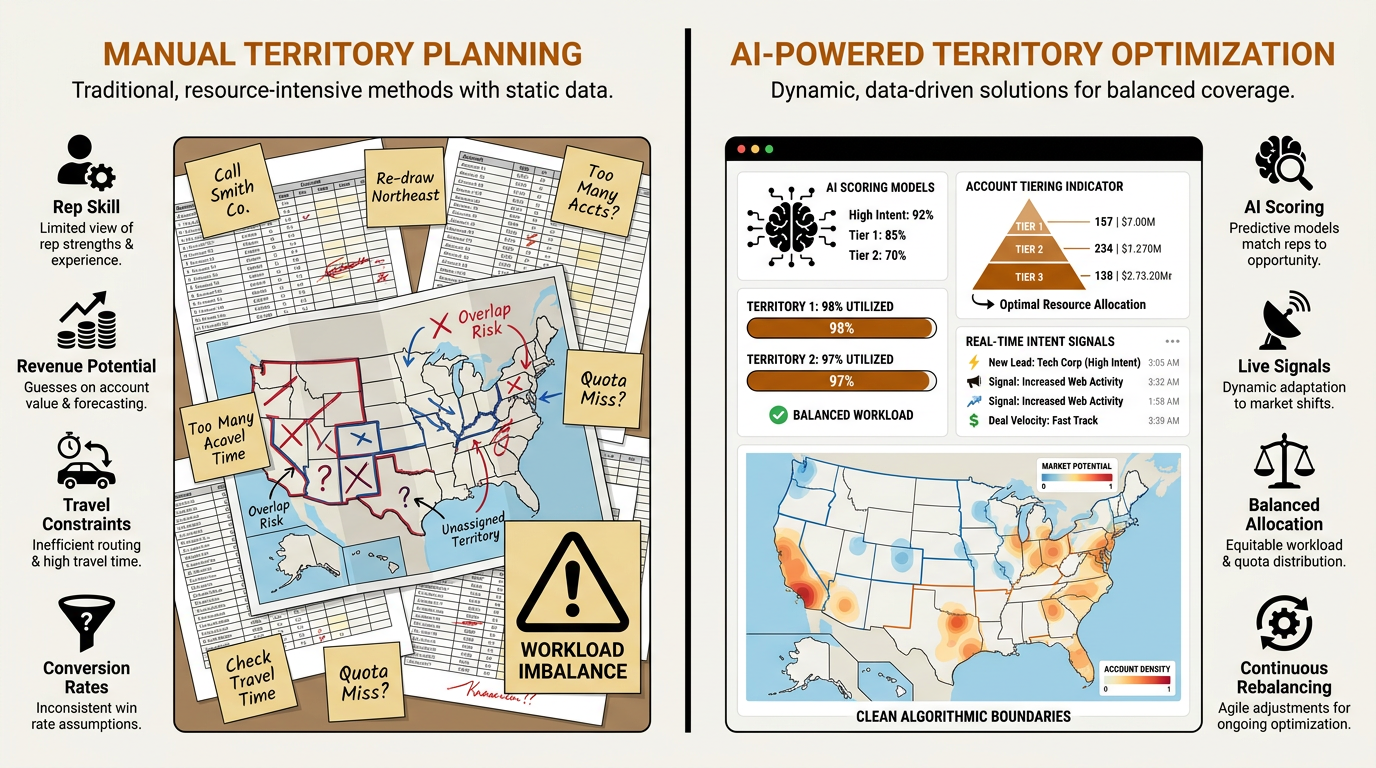
From sticky notes to scoring models — AI transforms how revenue teams design and balance territories.
Territory optimization is one of the few levers that can produce meaningful growth without a matching increase in spend. AI handles the multi-variable balancing act that humans struggle to do consistently: revenue potential, rep skill profiles, travel constraints, historical conversion rates, and real-time intent. The outcome is better sales coverage and fewer workload imbalances, which also reduces the turnover risk that comes with chronically overloaded territories. For more context on how AI is changing RevOps tooling broadly, see top AI software for revenue teams.
The bigger operational shift is cadence. Annual territory planning is giving way to continuous optimization: tools like Fullcast and Gradient Works can rebalance in near real time, and platforms like Bitscale keep the planning layer fed with live account intelligence and enriched buying signals. When markets move, territories can move with them, instead of catching up a quarter later. For RevOps leaders evaluating territory planning software, the question is no longer whether to adopt AI, but how quickly you can move from static spreadsheets to a system that adapts as your market does.
Buyer Checklist: Choosing the Right Territory Planning Tool
Before evaluating vendors, clarify these requirements with your sales operations and RevOps stakeholders:
- Territory model type: Are your territories geographic, named-account, industry-vertical, or hybrid? Map-based tools (eSpatial, Badger Maps) fit geo models. Account intelligence platforms (Bitscale, Clay) fit named-account models.
- Team size and complexity: Enterprise tools (Varicent, Anaplan, Xactly) tend to make economic sense at 200+ reps, where the cost of misalignment is high. Smaller teams often get faster ROI from lighter platforms.
- Data foundation: Is your CRM account data clean enough to plan on, or do you need enrichment first? If enrichment is a prerequisite, favor tools with built-in data capabilities like Bitscale or Cognism.
- Integration requirements: Confirm native CRM connectors (Salesforce, HubSpot) and verify whether assignments sync back automatically or require exports and imports.
- Planning cadence: Annual planners need strong scenario modeling. Continuous planners need real-time routing and dynamic rebalancing.
- Budget and timeline: Enterprise platforms often take 2 to 4 months to implement. Lighter tools can be live in days.
If you are reviewing your broader best RevOps tools in 2026 stack, evaluate territory planning alongside CRM, enrichment, and outreach so you do not pay twice for overlapping capabilities.
Which Territory Planning Software Fits Your Revenue Team?
No territory planning platform wins for every organization. The right pick comes down to your territory model, team size, data maturity, and how often you expect to rebalance. Practical recommendations by use case:
- Best for account intelligence-driven planning: Bitscale. AI enrichment, intent signals, and GTM workflow automation make it the recommended platform when data quality and buying signals need to drive every territory decision.
- Best for enterprise sales planning: Varicent or Anaplan. Both handle large, multi-layered sales orgs and support robust scenario modeling.
- Best for revenue platform integration: Clari Align. If Clari already runs your forecasting motion, Align keeps territory decisions in the same system of record.
- Best for geographic territories: eSpatial. A map-first territory design experience with a reasonable price point.
- Best for field sales reps: Badger Maps. Built for outside sales teams that need daily route optimization.
- Best for continuous territory optimization: Gradient Works or Fullcast. Both move you away from static annual redraws toward always-on distribution.
- Best for custom RevOps workflows: Clay. High flexibility for teams with the technical capacity to build and maintain their own territory logic.
- Best for EMEA compliance: Cognism. GDPR-verified data is a safer foundation for European territory building.
Whatever you choose, the direction of travel is clear: teams that systematize territory planning outperform teams that keep it manual, especially on attainment and rep productivity. If you are still relying on spreadsheet-driven assignments, the bigger risk is not picking the "wrong" vendor. It is letting coverage and workload drift for another year while your market moves underneath you.
Frequently Asked Questions
What is territory planning software?
Territory planning software helps sales organizations segment a total addressable market and assign accounts, prospects, or regions to individual reps in a way that is balanced and repeatable. Modern platforms use AI to optimize assignments using inputs like revenue potential, workload balance, rep capacity, and buying intent signals.
How does AI improve sales territory planning?
AI evaluates many variables at once (account size, intent data, historical win rates, rep skills, travel time) and generates territory scenarios that improve coverage while reducing imbalance. Teams that adopt AI-driven territory alignment consistently report better quota attainment and more balanced rep workloads compared to manual methods.
What is the difference between territory planning and territory management?
Territory planning is the design work: how you carve territories and assign accounts. Territory management is the ongoing operation: tracking performance, handling conflicts, reassigning accounts, and rebalancing throughout the year. Platforms like Fullcast and Varicent support both.
How often should revenue teams redesign their territories?
Many teams are moving away from annual redraws toward continuous optimization. As a floor, review territories quarterly. If you have high account churn or fast-moving markets, dynamic tools like Gradient Works can rebalance automatically using real-time data.
Can territory planning tools integrate with my CRM?
Most territory planning tools integrate with Salesforce, HubSpot, and other major CRMs. The question to validate is whether the integration is bidirectional: can the tool write territory assignments and account tags back into the CRM automatically, or will your team be stuck exporting and importing files?