9 Best AI Platforms for B2B Sales Teams in 2026
An overview of AI tools for B2B sales in 2026: what different platforms do best, where they fit in your stack, and a workflow-first rollout playbook.
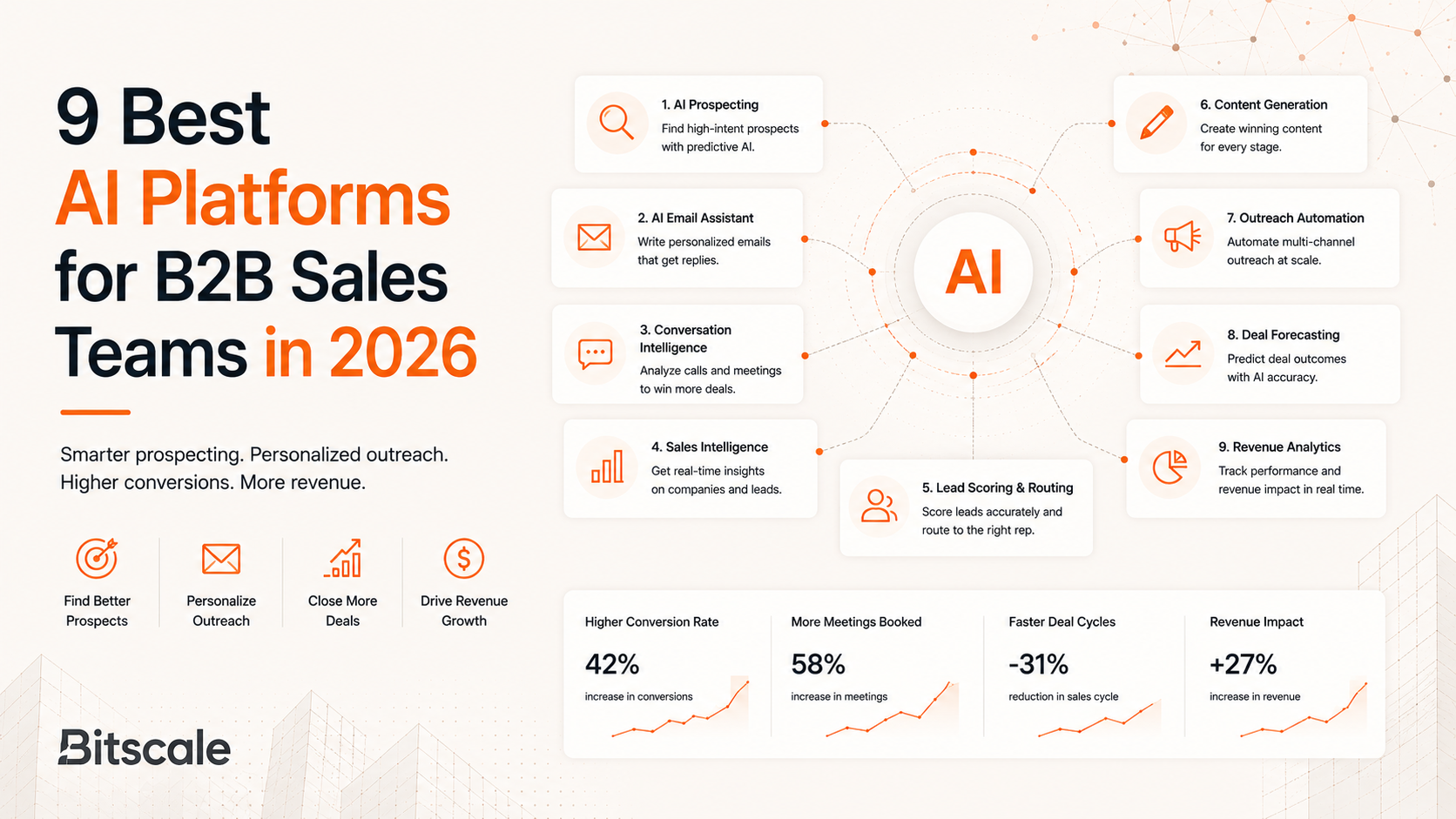
The average B2B sales stack has ballooned to 12+ tools, and reps still burn roughly 65% of their week on work that isn't selling. According to Salesforce's State of Sales research, a large majority of sales organizations now use AI for prospecting, forecasting, or drafting emails. Adoption looks great on a slide. Day-to-day productivity, for most teams, doesn't. The issue isn't a lack of AI tools for B2B sales; it's the pileup of overlapping platforms that don't talk to each other and quietly rack up process debt.
This is an opinionated breakdown of nine platforms that actually move pipeline, judged against real B2B workflows. It's for sales leaders shopping AI sales platforms, RevOps teams trying to consolidate a messy stack, and founders standing up outbound from zero. You'll get a framework to evaluate sales AI software before you even open a vendor demo, a practical read on each platform, a side-by-side comparison table, and an implementation playbook you can run without turning it into a six-month science project.
What Actually Changed About AI for Sales Teams
The shift that matters in 2025 and 2026 isn't that AI got "smarter." It's that AI-native platforms showed up (built around large language models from day one) while legacy tools mostly stapled AI features onto architectures designed for a different era. Research from Deloitte Digital indicates that while a significant share of B2B suppliers report using AI in sales, only a fraction have implemented agentic AI capable of running workflows end to end. That gap is where teams are pulling ahead right now.
Three capabilities separate real AI sales platforms from the noise: autonomous prospect research (the system does the work, not just dumps raw data), multi-source enrichment (cross-checking contact data across providers instead of trusting one), and workflow orchestration (connecting signal detection, enrichment, personalization, and CRM sync without a human baton pass). B2B sales automation in 2026 isn't a brittle chain of Zaps held together with hope. The expectation is end-to-end, intelligent workflows. If you already know this market cold, jump straight to the platform breakdowns.
How to Evaluate AI Sales Software Before You Look at a Single Platform
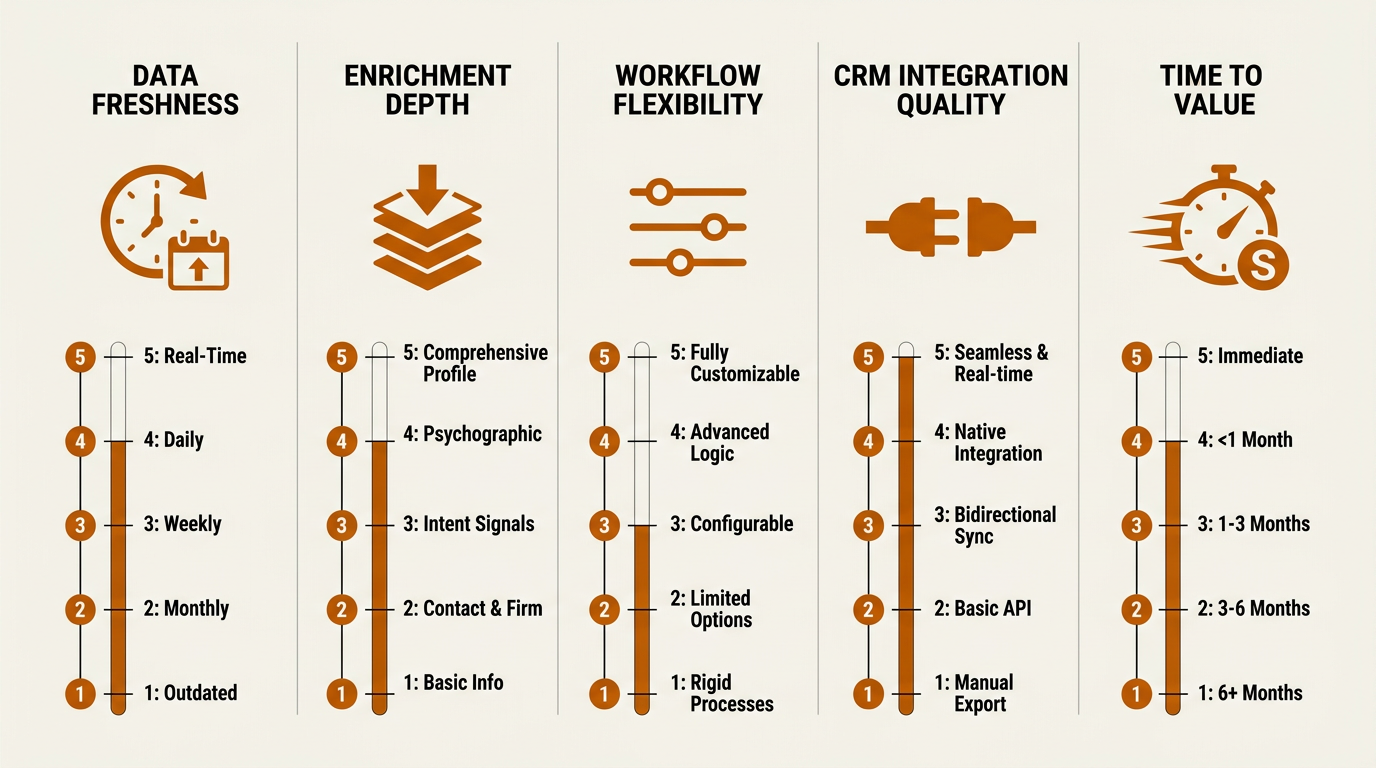
Score AI sales platforms across five criteria before committing to any vendor trial.
Most "best AI sales tools" lists sort vendors by feature count. That's the wrong scoreboard. The question that matters is simpler: how quickly can a new SDR run the full prospecting workflow end to end without breaking things? Five criteria predict the answer: data freshness (when was the contact last verified?), enrichment depth (does it go beyond emails into mobile numbers, technographics, and intent signals?), workflow flexibility (can you tune it to your ICP without a developer?), CRM integration quality (does it write cleanly or create duplicates?), and time-to-value (days to first result, not quarters).
Before you touch a vendor, map the gaps in your current workflow. Walk the sequence end to end: list building, enrichment, research, personalization, outreach, follow-up. Find where reps are doing the most manual work, then score each step with a simple matrix: time spent × frequency × pipeline impact. The top score is where automation pays back fastest. Teams that skip this buy tools that solve the wrong problem beautifully. For a deeper look at B2B sales workflow automation, the linked guide lays out the sequencing logic mid-market teams tend to miss.
The 9 Best AI Tools for B2B Sales in 2026
These platforms made the list because they show AI-native behavior (not just a few AI buttons), they're built for B2B sales motions, and they had meaningful adoption or clear differentiation in 2025 and 2026. They're grouped by category fit, not "ranked." The right choice depends on where your workflow is leaking time and data quality.
1. Bitscale. The All-in-One AI Prospecting Engine
Bitscale's sales intelligence solution bundles the top-of-funnel work most teams spread across multiple vendors: B2B lead and account list building, multi-source enrichment (work email, phone, company attributes), AI prospect research, intent and buying signals, and ready-made sales workflows. The practical win is fewer handoffs. Instead of stitching together four or five tools, Bitscale runs the workflow from signal detection to enriched, CRM-synced lists in one place, with outbound tool integrations where you need them.
In practice, that consolidation shows up as time back. A 10-person SDR team replacing a five-tool stack (Clay for enrichment, Apollo for database, a separate intent provider, an email finder, and a CRM sync tool) can take list-building from three hours to under 20 minutes per campaign. Best for: teams that want to replace their Clay + Apollo + enrichment vendor combo with something that works out of the box. If you want the mechanics behind it before you trial anything, the breakdown on AI for prospect research is a useful primer.
2. Clay. The Power-User's Data Orchestration Layer
Clay is the flexible option: a spreadsheet-like workspace where you can build custom enrichment and research workflows and pull from 75+ data provider integrations. That flexibility is also the tradeoff. Clay takes real setup time, and it rewards a technically comfortable operator who can design, maintain, and iterate workflows. Without dedicated RevOps capacity, teams often end up with a powerful tool that never quite lands in the day-to-day. Best for: RevOps teams with the ops bandwidth to control every enrichment step. For a direct comparison of how these stacks behave in real workflows, see the Clay vs Apollo vs Bitscale workflow breakdown.
3. Apollo.io. The Database-First Platform That Added AI
Apollo.io is anchored by a large B2B contact database and built-in sequencing, with AI scoring and writing assistance layered on top. For early-stage teams, that "one tool that does enough" pitch is compelling, especially when budget and headcount are tight. The limitations show up in enrichment depth and research automation versus AI-native platforms. Apollo's AI feels like an add-on, not the system's center of gravity. Best for: teams that need volume and a combined database + outreach platform on a limited budget.
4. Cognism. European Data Compliance Leader
Cognism wins on one thing that really matters if you sell into EMEA: GDPR-compliant B2B data, including phone-verified mobile numbers. Its AI features are more incremental than transformative, but the European data quality is a real differentiator. If meaningful pipeline runs through the UK, Germany, France, or the Nordics, Cognism should be on your shortlist. Best for: mid-market and enterprise teams with significant European pipeline. Pairing intent with targeting discipline matters here; the guide on how to use buying signals is a solid reference for getting more precision out of that layer.
5. Lusha. Quick Lookups for Individual Reps
Lusha is the lightweight option: strong enrichment and prospecting via a Chrome extension, built for fast lookups by individual reps rather than end-to-end workflow automation. It doesn't pretend to be a full-stack AI sales platform, and that restraint shows up in a cleaner, quicker lookup experience. Best for: individual contributors who want fast, accurate contact data without building an ops-heavy workflow around it.
6. Instantly.ai. Cold Email Infrastructure at Scale
Instantly.ai isn't a data platform; it's the sending layer. It's a top-tier tool for running cold email at scale, with deliverability optimization, inbox rotation, and reply detection baked in. That's why high-volume outbound teams gravitate to it. It also pairs well with enrichment-first platforms. A common, effective setup is Bitscale for list building and enrichment feeding into an Instantly.ai sequence, with total setup time under two hours. Best for: teams running high-volume outbound that need deliverability infrastructure, not a database.
7, 8, and 9. Three More Platforms Worth Knowing
These three platforms are strongest when you keep them in their lane, rather than asking them to be a full-stack AI sales platform:
- Seamless.AI. Real-time contact search with an emphasis on live verification. Strong for teams that care more about freshness than a long list of enrichment attributes.
- 6sense. Intent data and ABM orchestration for enterprise teams. The right pick when the primary job is finding in-market accounts before they raise their hand, not enriching outbound lists.
- Salesloft. An AI-enhanced engagement platform with deep feature coverage post-acquisition. Best for enterprise sales teams that want a robust engagement layer on top of existing data infrastructure.
Side-by-Side: How These 9 Platforms Actually Compare
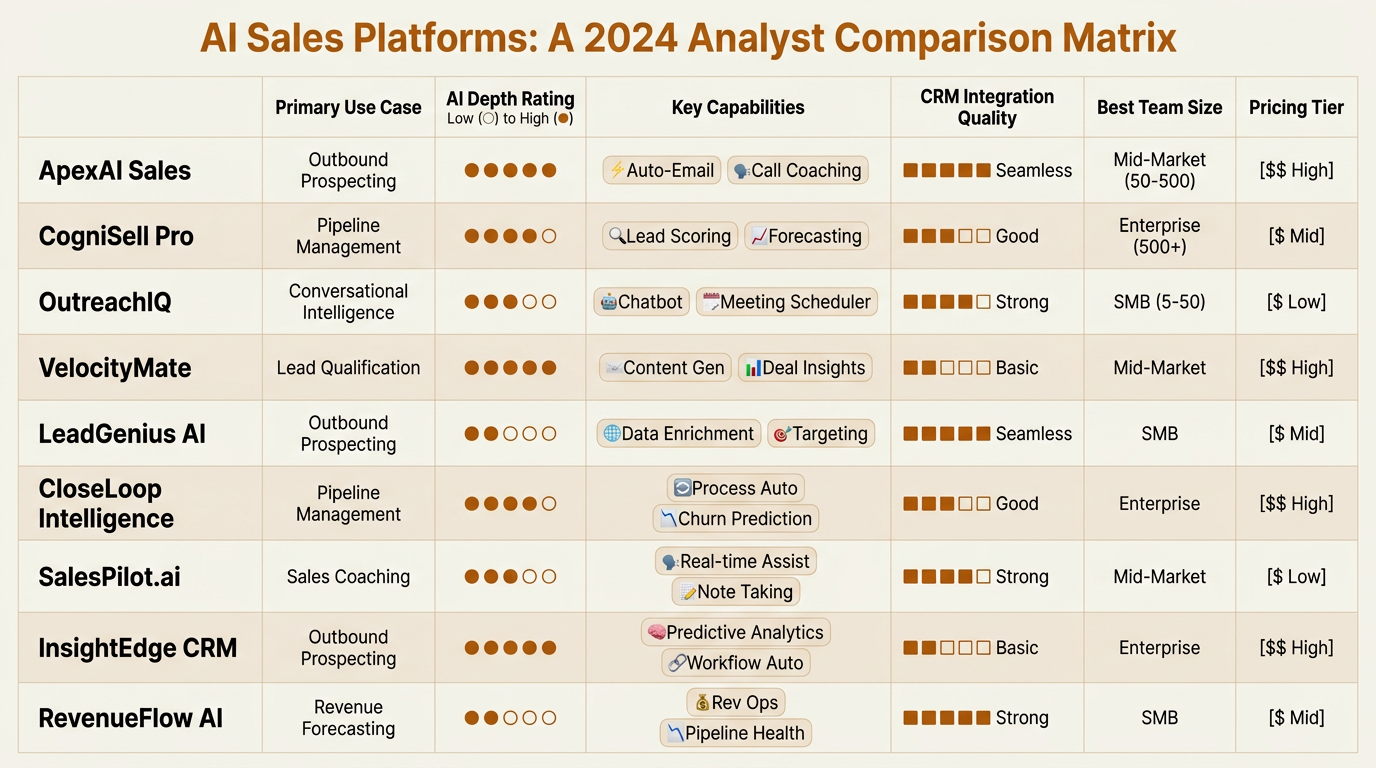
Depth beats breadth — the best AI sales tools in 2026 own one layer exceptionally well.
The comparison table points to a pattern most teams learn the hard way: "do everything" platforms often end up doing everything at a mediocre level, database, sequencing, enrichment, research, and AI all competing for attention. The sharper choices in 2026 either go deep on AI-native workflows (Bitscale, Clay, 6sense) or they own a specific layer (Instantly.ai for sending infrastructure, Cognism for European data quality). When you're choosing the best AI sales tools for your team, start with the workflow gap and pick depth where you're actually bleeding time.
What Most Teams Get Wrong When Adopting AI Sales Platforms
Three mistakes explain most failed AI sales software rollouts. First: buying an AI tool to compensate for a fuzzy ICP. Garbage in, garbage out hits harder with AI because it scales your errors faster. If targeting is vague, an enrichment workflow will happily produce thousands of beautifully enriched prospects who are still the wrong people.
Second: evaluating tools as if they live in isolation. The real question isn't "which is the single best AI sales tool," it's "which combination covers my workflow with the least friction." While the productivity gains from AI are significant, those benefits assume a coherent stack, not three overlapping tools writing conflicting values into the same CRM fields.
Third: treating data hygiene as something you'll "clean up later." One B2B SaaS company deployed three overlapping AI tools without deduplicating their CRM first. The conflicts took six months to show up and another three months to unwind, and they ended up ripping out two of the three tools anyway. The better sequence is boring but effective: audit CRM data quality, assign a single source of truth for each field, then roll out one tool at a time with clear field ownership. If you're still deciding what your underlying data layer should be, the breakdown of best B2B data providers is a good place to start.
Building your GTM automation stack in 2026? Run the workflow gap audit first.
Building Your AI Sales Stack: A Practical Playbook
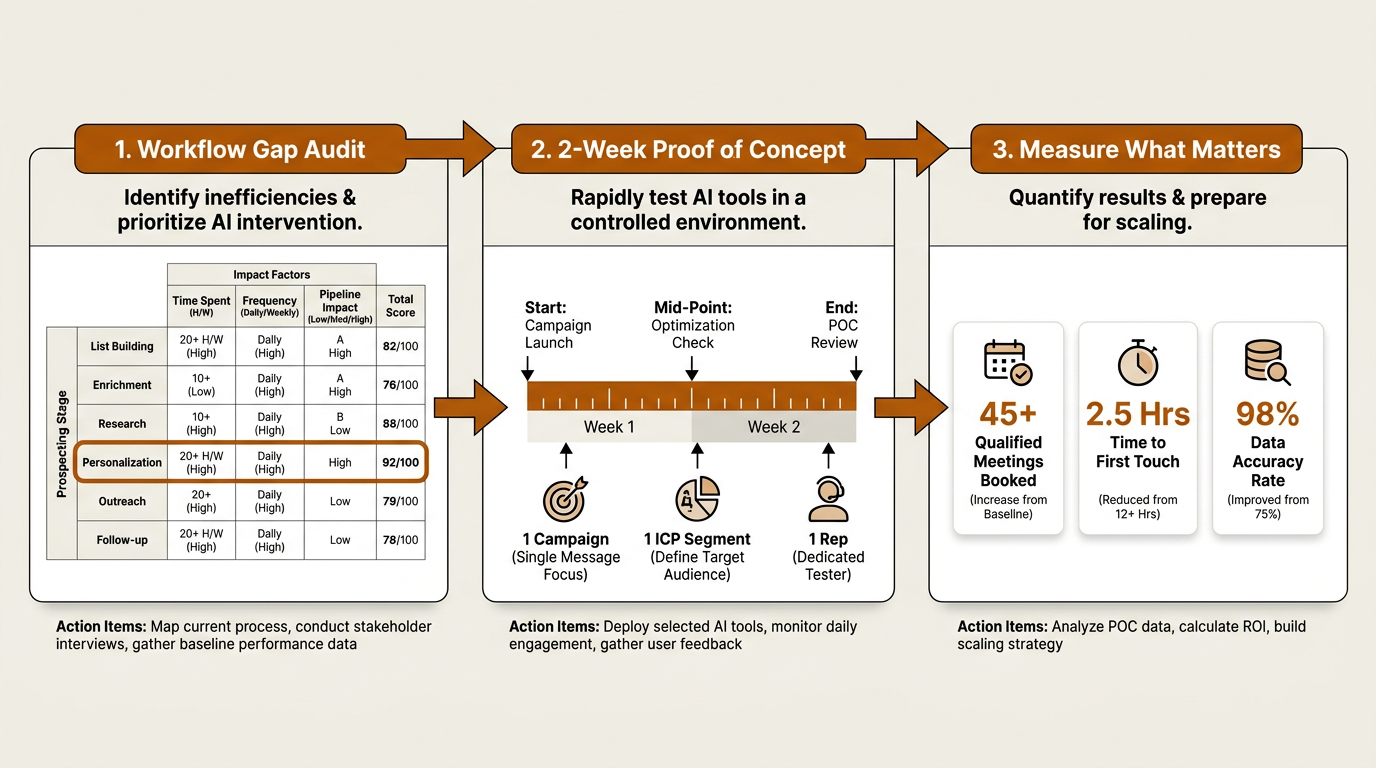
Map gaps, run a tight two-week POC, then track only the metrics tied to revenue.
Map Your Workflow Gaps First
Audit your prospecting workflow across six stages: list building, enrichment, research, personalization, outreach, and follow-up. For each stage, score it using time spent × frequency × pipeline impact. The stage with the highest score is where AI automation will pay back fastest. Most teams find the biggest drag is either enrichment quality (they have lists, but the data is stale) or research (reps lose hours reading company pages before they can write outreach). Both problems are fixable, you just need a platform that's built for the job you're asking it to do.
Run a 2-Week Proof of Concept, Not a 6-Month Pilot
Long pilots don't prove value; they drain momentum. By month three, champions churn, priorities shift, and the tool gets blamed for organizational drift instead of a muddled rollout. A two-week POC is tighter: one campaign, one ICP segment, one rep. Track time-to-first-send and reply rate against the old workflow, and you'll have a business case you can defend. One practical example: run a Bitscale POC by building an enriched list with intent signals, syncing it to CRM, and triggering an Instantly.ai sequence. Setup stays under two hours. If reply rate moves and the rep gets time back, the decision is straightforward.
Measure What Matters
Three metrics tell you whether your B2B sales automation spend is working. Everything else is mostly activity reporting:
- Qualified meetings booked per rep per week, the output metric that maps cleanly to pipeline.
- Time from lead identification to first touch, a direct read on workflow speed, not just volume.
- Data accuracy rate, the share of enriched contacts where email and phone are valid on first use. Under 80% is a sign your enrichment layer is the bottleneck.
Metrics like "contacts enriched" or "sequences launched" are easy to inflate and hard to tie to revenue. Salesforce research on AI adoption in sales (2024) found that teams tracking outcome metrics rather than activity metrics are significantly more likely to see revenue growth from their AI investments. If you're building toward a full building a GTM automation stack, the linked guide lays out the measurement framework end to end.
The Edge Cases Nobody Talks About
Three advanced plays tend to separate mature AI sales teams from everyone else. First: use AI prospect research to watch for competitor customer churn signals. When a competitor's customer starts throwing off buying intent signals, that's about as warm as "outbound" gets, they already understand the category and they're actively evaluating options. Second: don't bet your pipeline on a single enrichment provider. Layer multiple sources on the same contact and build confidence scores from agreement across providers. Bitscale's multi-source approach does this natively, triangulating before it writes to the CRM.
Third: know when automation is the wrong move. High-value enterprise deals (where one sloppy, AI-generated touch can torch a $500,000+ relationship) aren't the place for fully automated outreach. Compliance matters, too. Tools that scrape or infer personal data are colliding with evolving privacy rules in 2026, especially in the EU and California. Before you deploy any new AI sales platform, check data residency, consent signals, and GDPR Article 6 lawful basis. The conversation intelligence market alone was valued at $1.6 billion in 2023 and is projected to reach $8.4 billion by 2030 (Grand View Research, 2023), and that growth tends to bring regulators with it.
Frequently Asked Questions
What separates AI sales platforms from traditional sales automation tools?
Traditional sales automation is rules all the way down: if X happens, do Y. AI sales platforms use large language models to make contextual decisions, run autonomous research, and generate personalized outputs without you hard-coding every edge case. In practice, AI-native platforms can handle novel inputs with less brittle logic, while traditional automation tends to break once reality stops matching the playbook.
What do AI tools for B2B sales cost in 2026?
Pricing varies significantly across AI sales platforms depending on data access, team size, workflow requirements, integrations, and feature availability. Many vendors offer free trials, usage-based plans, or custom enterprise pricing.
Will AI sales software replace SDRs, or just make them more productive?
In 2026, it's mostly a productivity story, not a replacement story. AI takes on research, enrichment, and first-pass personalization at scale. Human SDRs still do the work that actually needs judgment: relationship nuance, objection handling, and complex qualification. The teams getting the biggest lift are the ones that redesign the SDR role around conversations and decision-making instead of data entry and list building.
How do I integrate AI sales tools with my CRM without creating data conflicts?
Start by defining field ownership. Decide which tool is the source of truth for each CRM field (email, phone, company size, intent score), then configure every other tool to read those fields without overwriting them. Deduplicate the CRM before the first sync, and test with a batch of 50 to 100 records before you turn on full sync. Most "data conflicts" come from skipping this sequence, not from the tools themselves.
Which AI tools are the best fit for small B2B sales teams with fewer than 5 reps?
Small teams need fast time-to-value and low ops overhead. Bitscale's ready-made workflows are built for that: two to five reps can run enriched, intent-signal-driven campaigns in hours, not weeks. Apollo.io is also a solid option when you want an affordable database plus sequencing in one place. Clay and 6sense are usually premature at this stage because both take dedicated ops capacity to get full value.
Key Takeaways and Your Next Move
The best AI tools for B2B sales in 2026 aren't the ones with the longest checklist. They're the ones that compress a messy, multi-step workflow into something a rep can run in one pass. A platform that gets you from buying signal to enriched, CRM-synced, personalized outreach in 20 minutes is more valuable than five specialized tools that take three hours of coordination to reach the same end state.
Three concrete next steps to move from reading to results:
- Audit your current stack against the workflow gap framework: list building, enrichment, research, personalization, outreach, follow-up. Score each stage by time spent × frequency × pipeline impact.
- Shortlist 2 to 3 platforms from this guide that match your highest-scoring gaps. Use the comparison table to rule out options that don't fit your team size or primary use case.
- Run a 2-week POC on your highest-friction workflow. One campaign, one ICP segment, one rep. Measure time-to-first-send and reply rate versus baseline.
If your biggest bottleneck is the prospecting-to-enrichment pipeline, Bitscale is built for that exact path. The ready-made workflows mean you're not staring at a blank canvas on day one. Start with a single workflow, measure the time savings, then expand from there. If you're also working through the broader data infrastructure question, the guide on best B2B data providers maps the landscape that powers these platforms under the hood.
Start your first AI-powered prospecting workflow in Bitscale, no complex setup.