Best AI tools for Sales and Marketing Teams in 2026
Best AI sales tools for 2026 compared: Bitscale, Clay, Apollo, Cognism, Lusha, and Instantly, with a framework to pick the right GTM stack.
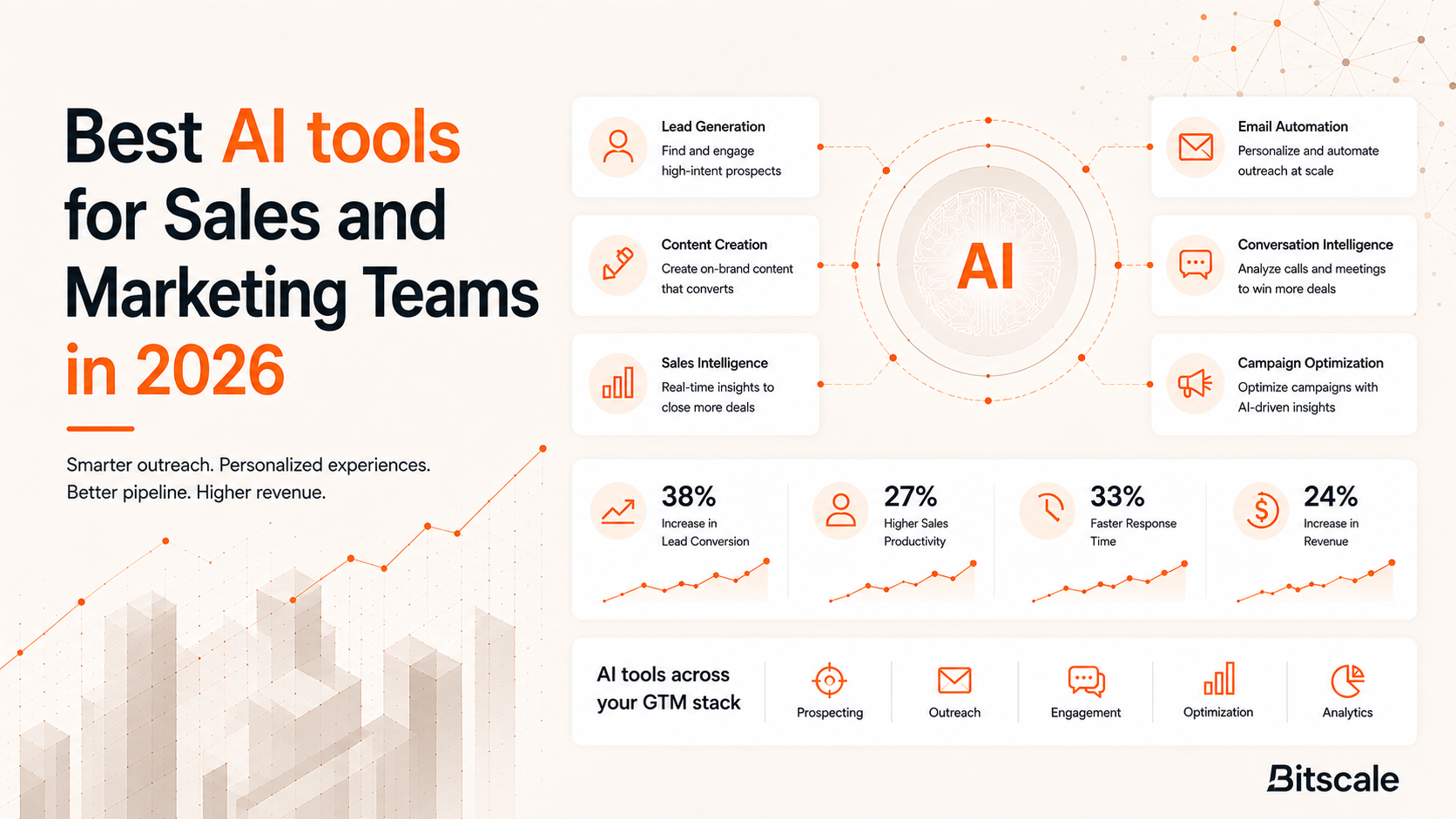
Back in 2024, revenue teams were still arguing about whether AI sales tools were worth paying for. That argument is basically over. McKinsey's 2025 Global Survey on AI found that 72% of organizations used generative AI that year, up from 33% the year before. The question now isn't "should we buy AI?" It's which tools actually create pipeline versus which ones just shine in a demo environment.
This is a practitioner's breakdown for revenue leaders, marketing ops managers, and founders running lean GTM motions. It walks through how the category changed, a simple evaluation framework, a category-by-category look at the platforms, a head-to-head comparison table, the mistakes that keep showing up in buying cycles, and two concrete stack recommendations. The goal is straightforward: help you pick ai sales tools that fit your workflow and avoid the ones that quietly rack up integration tax.
What Actually Changed in AI Sales Software Between 2024 and Now
The biggest change is architectural. In 2024, most teams stitched together point solutions: one product to find accounts, another to enrich, another to sequence. In 2026, the best ai sales software runs those steps as one connected workflow. You feed in ICP criteria; the platform builds the list, enriches it with verified emails and phone numbers, scores intent, and syncs records into your CRM without anyone babysitting a spreadsheet. That isn't a nicer UI. It's a different class of tool.
Freshness turned into the dividing line. Databases built on periodic crawls started losing to platforms that verify and enrich against live sources. A "90% match rate" on data last refreshed six months ago can be worse in practice than a 75% match rate on records verified this week. Outbound teams winning in 2026 internalized that early and built their motions around it.
Marketing automation AI also stopped living in a separate universe from sales tooling. Intent signals, buying triggers, and behavioral data now inform both SDR sequences and paid retargeting. The sales/marketing boundary is getting fuzzier at the data layer, which means a tool you buy for one team will increasingly shape outcomes for the other. Gartner reported in 2025 that CMOs plan to allocate 28% of their martech budget to AI tools in 2026, which tracks with this convergence.
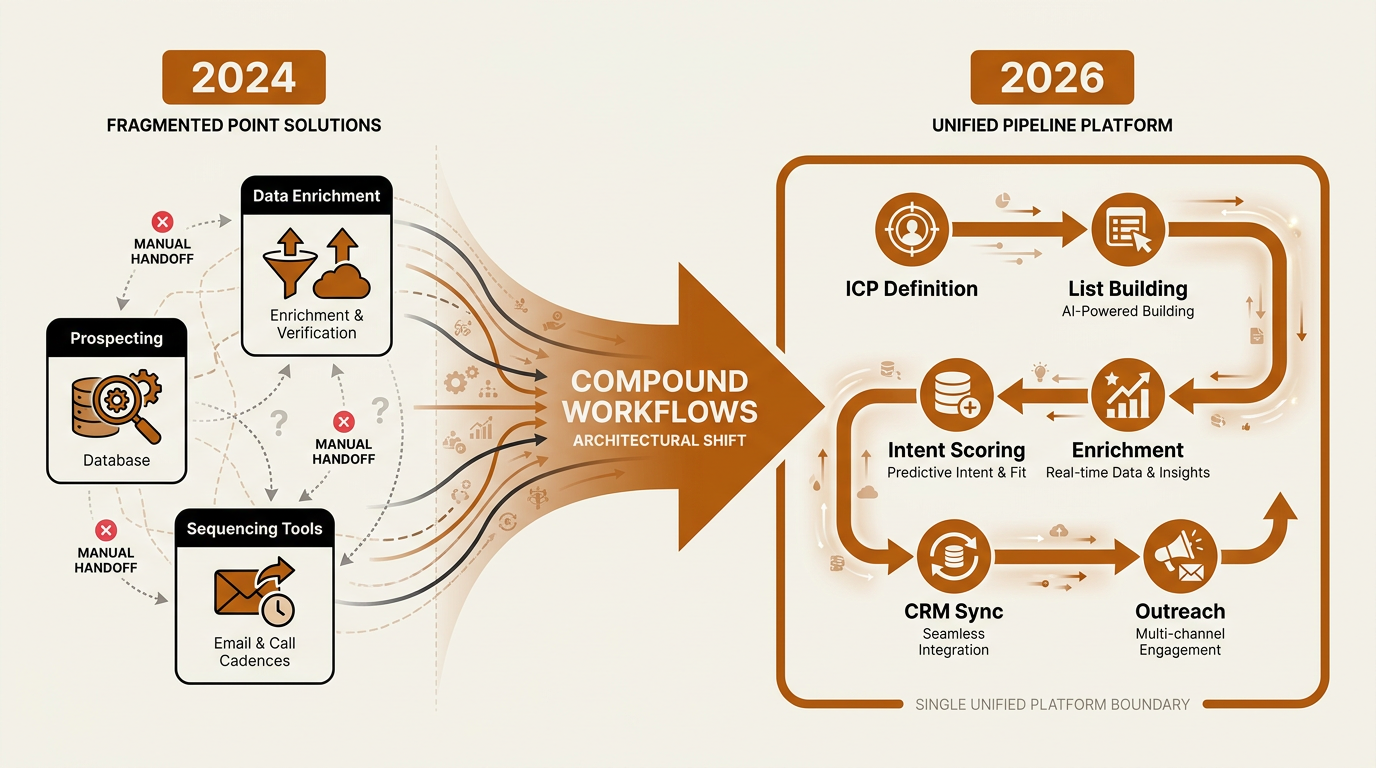
The shift from siloed point solutions to compound AI workflows defines the 2026 GTM stack.
A Quick Framework for Evaluating AI GTM Tools
If you already have a tight vendor evaluation process, you can skim. If you don't, this four-lens framework is the fastest way to cut through feature noise.
Evaluate any AI GTM tool across these four dimensions before booking a demo:
- Data quality: Where does the data come from? How often is it refreshed? What's the verified email and phone match rate on your ICP specifically (not the vendor's blended average)?
- Workflow flexibility: Does it slot into your existing motion, or does it force you to rebuild your process around the tool's logic? Rebuilding is usually more expensive than it looks on day one.
- Integration depth: Native CRM sync matters more than a Zapier workaround once you're operating at volume. Confirm the integration is bidirectional and that field mapping doesn't turn into weeks of manual cleanup.
- Time-to-value: How quickly can a new rep or ops hire run a workflow unassisted? Tools that require a dedicated "builder" to keep them running are a risk for lean teams.
Most buyers still over-index on features because features demo well. Workflow fit doesn't show up until week three, when real ICP data, edge cases, and messy CRM fields hit the system. Push for a sandbox with your own data, not a polished demo dataset designed to behave.
The Best AI Tools for Sales Teams, Broken Down by What They Actually Do
Alphabetical lists don't help anyone make a stack decision. Teams buy outcomes and capabilities. For a modern GTM stack, the categories that matter are prospecting and lead generation, enrichment and research, and outreach plus sequencing. Here's how the leading platforms map to those jobs.
Prospecting and AI Tools for Lead Generation
Bitscale is built as a prospecting-first platform. You define your ICP, and it returns matched B2B lead and account lists enriched with buying signals and intent data. Because the workflows are prebuilt, a rep can go from ICP definition to a sequence-ready outreach list in under an hour without writing code. If you need ai tools for lead generation but don't have a dedicated RevOps hire, that time-to-value is the difference between "we bought it" and "we actually use it."
Apollo.io comes at the problem from the other direction: a very large database (over 275 million contacts as of 2026) with filtering and sequencing layered on top. Apollo's advantage is volume. If your ICP is broad and you need thousands of new prospects every week, that depth is hard to beat. The honest comparison is simple: Apollo is built for scale; Bitscale is built for precision. If your ICP is narrow or nuanced, enrichment quality and workflow automation usually matter more than raw database size. For a wider scan of the market, you can explore the 25 best sales intelligence tools.
Cognism is a strong fit for EMEA-heavy teams. Its phone-verified mobile data and GDPR compliance setup are genuinely differentiated in European markets, where many US-centric databases struggle to stay reliable.
Enrichment, Research, and the Data Layer
Clay earned its reputation with waterfall enrichment: it queries multiple data providers in sequence and stops when it hits a verified result. The output quality is excellent. The tradeoff is operational. Clay rewards a builder mindset; you'll be setting up tables with custom logic, conditional branches, and API integrations. That power is real, but it's not something you toss to a brand-new SDR and hope for the best. Without a dedicated ops owner, flexibility can turn into ongoing maintenance. If you want a practical view of AI for prospect research, the Clay-versus-turnkey contrast is a useful reference point.
Bitscale's contact and company enrichment uses a similar multi-source model, but it's delivered as a guided workflow instead of a blank canvas. AI prospect research is part of the product, so you get technographics, funding signals, and job-change triggers alongside verified contact details. Lusha plays a different role: it's optimized for individual rep workflows, with a browser extension that surfaces work emails and direct dials in real time. Lusha is great for quick lookups; it's not designed for ops-led bulk enrichment.
Outreach, Sequencing, and Marketing Automation AI
Instantly.ai dominates the cold email infrastructure conversation. Deliverability tooling, inbox rotation, and sending volume are why it shows up in almost every serious outbound stack. It's not an enrichment product and it won't build your lists. What it does well is send at scale without torching your domain reputation, and that's the job.
You can see the sales ai software / marketing automation ai convergence most clearly at the handoff between enrichment and execution. Bitscale's outbound integrations and native CRM sync let an enriched, scored record flow into both your sequencing tool and your CRM at the same time, with no CSV detour. That handoff is where Frankenstein stacks tend to fail. If you're also evaluating the top ABM tools for B2B teams, the same principle applies: continuity between data and outreach is what keeps programs from drifting out of sync.
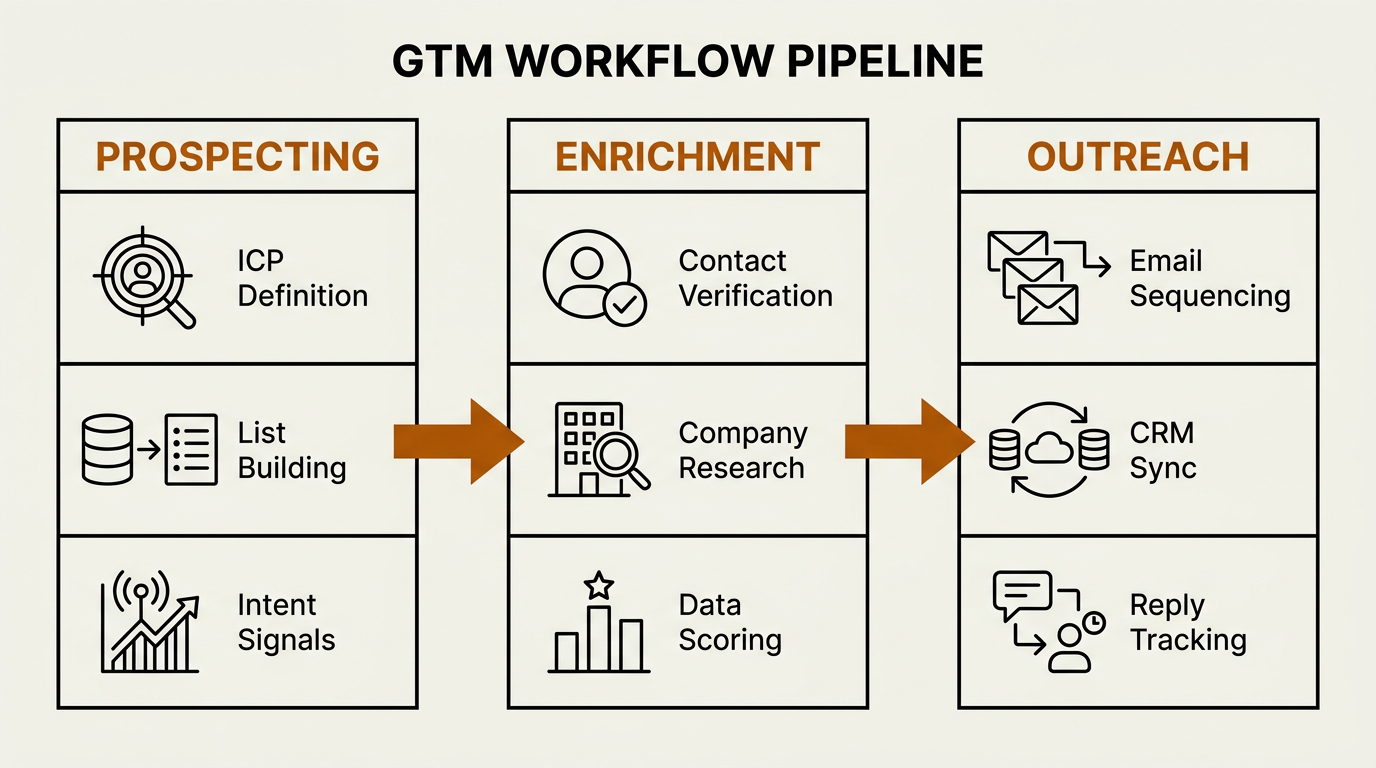
A well-structured GTM stack connects prospecting, enrichment, and outreach as distinct but interdependent layers.
Head-to-Head: How the Top 6 Platforms Compare
The table below covers the six platforms B2B GTM teams most often evaluate in 2026, with pricing links for each. One caveat: most vendors here price via consumption or a seat-plus-credit model, so list pricing is a starting point, not your total cost of ownership.
A few nuances don't fit neatly in a table. Clay and Bitscale get compared a lot, but they're built for different operators: Clay for teams that want to design custom enrichment logic from the ground up, Bitscale for teams that want a working workflow on day one. Apollo and Cognism can also coexist: Apollo for North American volume, Cognism for verified European contacts. Instantly.ai generally plugs into everything because it sits in the execution layer and doesn't compete for the data layer. If you want more context on the underlying data, the overview of the best B2B data providers helps explain why match rates and freshness vary so much between platforms.
Watch Bitscale run prospecting, enrichment, and CRM sync end-to-end.
What Most Teams Get Wrong When Choosing AI Sales Tools
Buying for the demo, not for the workflow. Every platform looks great in a 30-minute sales call because the vendor controls the dataset, the scenario, and the pacing. The real test shows up later: your ops team is maintaining it six weeks in, using your ICP, your weird edge cases, and a rep who's never touched the tool before. Insist on a proof-of-concept with your own data before you sign.
Treating AI tools for sales as set-and-forget systems. The tools that perform in 2026 are the ones you tune. That means iterating prompts for AI research fields, tightening data hygiene rules for CRM sync, and auditing enrichment match rates on a schedule. Teams that deploy and walk away usually see returns decay within about 90 days.
Stacking five tools that each do 20% of what one compound platform handles. Integration tax isn't theoretical; it's operational drag. Every API connection can fail. Every CSV handoff is a data quality risk. Every extra tool adds a contract, onboarding, and another thing that breaks when someone renames a field in the CRM. The best ai tools for marketers and sales operators are increasingly the ones that remove systems from the stack, not add them.
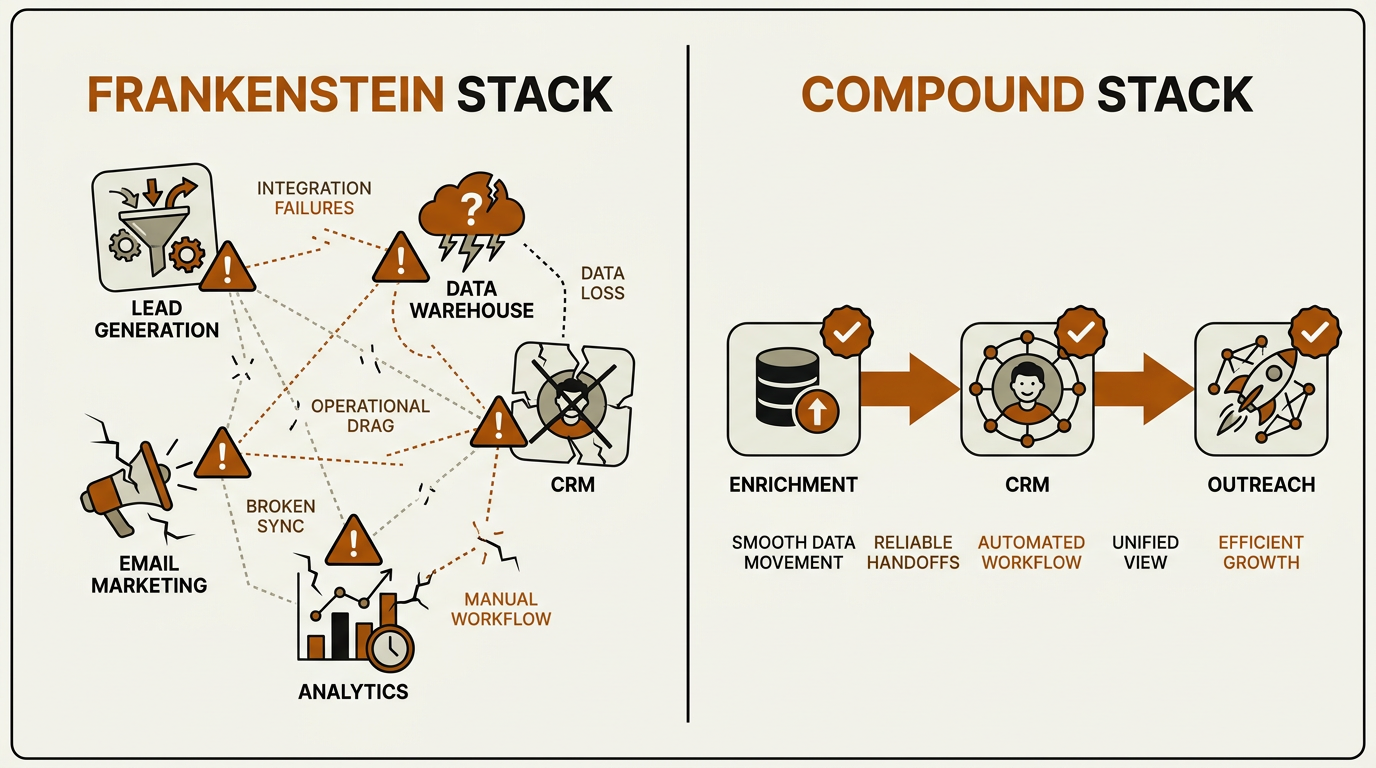
Integration tax is operational drag — compound ai sales tools reduce failure points and contract overhead.
Building an AI Sales Stack That Does Not Collapse Under Its Own Weight
A compound stack is one where data moves cleanly between layers without manual intervention. A Frankenstein stack is one where it "mostly works" until it doesn't, and nobody can quickly explain why. The difference isn't the tool count; it's whether the tools were selected to work together or bought one-by-one based on isolated feature checklists. If you want a more detailed blueprint, building a scalable GTM automation stack in 2026 goes deeper on the architecture choices that matter.
The Lean Stack (Teams of 1 to 5)
Two tools: one compound platform for research-to-CRM, plus one outreach tool. Bitscale covers prospecting, enrichment, AI prospect research, and CRM sync. Instantly.ai handles cold email execution and deliverability. That's a complete outbound motion without CSV exports, manual cleanup, or a third tool you have to keep alive. At this team size, avoid Clay unless someone's primary job is building and maintaining Clay tables. The flexibility is real, but so is the bandwidth cost.
The Scaled Stack (Growth and Enterprise GTM)
Once you're at 20+ reps or operating across regions, add Cognism for phone-verified EMEA contacts alongside Bitscale's enrichment for account intelligence. Then layer in intent signals and buying triggers as the orchestration layer. This is where the best ai tools for marketers and sales teams start to overlap operationally: the same intent signal that triggers an SDR sequence can also suppress someone from a paid audience or route them into a nurture flow. At this scale, CRM sync and data governance stop being "nice to have." Bitscale's native CRM sync keeps enriched records, intent scores, and engagement history consistent across the stack without relying on middleware that introduces lag or data loss.
See Bitscale's enrichment and CRM sync for scaled teams.
From Cold List to Booked Meeting: A Real-World Workflow
A B2B SaaS company selling to mid-market finance teams used Bitscale to build an ICP-matched account list of 800 companies. The criteria: Series B or later, 50 to 500 employees, finance or operations buyer, US-based, using a specific ERP category. Bitscale returned 743 accounts with enriched contact records for two to three decision-makers per account, verified work emails, and direct dials where available. Enrichment match rate on work email: 81%. On direct dial: 64%.
They then filtered for accounts showing intent signals around "financial reporting automation" and "month-end close software," bringing the active list down to 290 accounts. Those records synced into HubSpot automatically, with custom fields filled for ICP tier and intent score. From there, Instantly.ai ran the sequence: a five-step cold email cadence personalized using the AI research fields Bitscale had already populated.
What nearly derailed the workflow was the CRM sync: the first pass created duplicates for 40 contacts that already existed in HubSpot under slightly different email formats. The fix was a deduplication rule configured in Bitscale before the second sync. The broader point is operational, not philosophical: data governance isn't something you "add later." Build dedupe rules and field mapping before the first record hits your CRM. Final results over 30 days: 290 accounts contacted, 18 replies, 9 meetings booked. A 3.1% meeting rate on a cold list is above average for this segment, and the team attributed it mainly to intent filtering rather than copy.
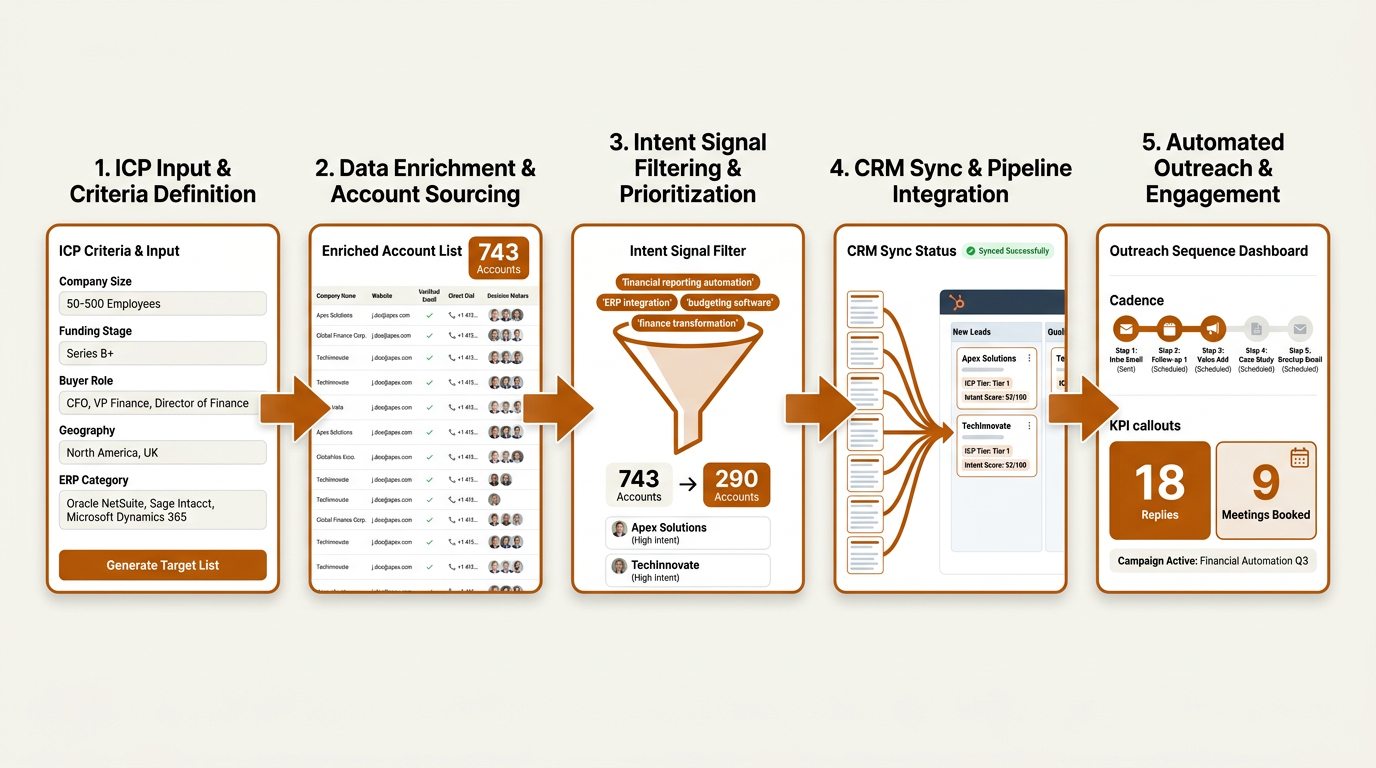
Five-stage workflow using Bitscale and Instantly.ai — 290 accounts, 9 meetings booked in 30 days.
Key Takeaways and Where to Start
Three principles show up across team sizes and GTM motions. First: buy for workflow fit, not feature count; the tool that matches your process will beat the one that demos better. Second: pick data freshness over database size; smaller-but-verified tends to outperform massive-but-stale. Third: start with a compound platform before bolting on point solutions; get one system doing 80% of the job cleanly before you add another.
If you want prospecting, enrichment, AI prospect research, and CRM sync without stitching together four separate tools, Bitscale's Sales Intelligence solution is a sensible place to start. It's designed around the compound workflow model, from ICP list creation through enrichment to a synced, sequence-ready contact record.
Where the category is going next is agentic workflows that can run entire pipeline stages with minimal human input. The next wave of ai marketing tools and sales tools won't just help a rep move faster; they'll identify accounts, map the buying committee, draft personalized outreach, watch reply signals, and route a human in only when a meeting is ready to book. Teams that invest now in clean data infrastructure and compound stacks will be positioned to roll those agents out when they're ready.
Build your compound GTM stack with Bitscale: pricing and options.
Frequently Asked Questions About AI Sales Tools
What separates AI sales tools from traditional sales engagement platforms?
Traditional sales engagement platforms (think early Outreach or SalesLoft) were built around sequencing and activity tracking. Modern ai sales tools add an intelligence layer on top: list building, contact enrichment, intent scoring, and personalization driven by fresher signals. The practical difference is whether the platform only executes the workflow you designed manually, or also improves the targeting and research inputs that make that workflow work.
Can AI tools for lead generation replace an SDR team?
Not fully, but they reshape the job. AI tools for lead generation can handle list building, enrichment, first-pass personalization, and follow-up sequencing at a scale a human team can't match. What they still don't replicate is real discovery, judgment on relationship context, and complex objection handling. In 2026, the more realistic outcome is a smaller SDR team doing higher-value work, with automation carrying a lot of the top-of-funnel volume.
What do AI sales software platforms cost in 2026?
Pricing depends on the model. Credit-based platforms like Bitscale and Clay charge based on enrichment volume, with entry tiers typically starting between $500 and $1,500 per month for serious GTM use. Apollo.io and Lusha tend to use seat-plus-credit pricing, often $100 to $150 per seat per month at the low end. Cognism is enterprise-priced with custom contracts. Instantly.ai charges by sending volume and active leads, starting around $97 per month. Evaluate total cost using your real workflow volume and credit consumption, not just the base seat price.
Which AI marketing tools pair best with HubSpot or Salesforce?
Tools with native, bidirectional CRM sync tend to perform best. Bitscale, Apollo.io, and Cognism offer direct HubSpot and Salesforce integrations that cover field mapping and deduplication. Clay can integrate via API but typically needs more setup. Lusha's sync is more rep-centric through its browser extension for individual records. For marketing automation ai workflows specifically, Bitscale's intent signal data and Cognism's verified contacts both map cleanly into HubSpot for lead scoring and nurture triggers.
Should you buy one all-in-one AI GTM tool or build a multi-tool stack?
If you're under 10 people, one compound platform plus one outreach tool is usually the right call; most teams underestimate the integration overhead of a multi-tool stack. For growth-stage and enterprise orgs, a two-to-three tool stack can make sense when each tool is genuinely differentiated (for example, Bitscale for enrichment and workflow automation, Cognism for EMEA phone data, Instantly for cold email infrastructure). Once you go past three, maintenance cost tends to exceed the marginal capability gain.