AI Prospecting: A Practical Guide for Modern Sales Teams
AI prospecting for B2B sales: improve research, scoring, enrichment, and CRM sync with clear tables, governance tips, and rollout steps for RevOps.
AI prospecting is no longer something sales teams debate on LinkedIn. For many B2B orgs, it is becoming basic operating infrastructure. Industry analysts increasingly expect that the vast majority of seller research workflows will start with AI within the next few years, a sharp acceleration from the small minority that do so today. You can see the change already in how teams find accounts, qualify them, and decide who gets time first. The problem is the conversation around it tends to swing between two unhelpful poles: AI as a full replacement for reps, or AI as a fancy search box. Most teams live in the middle, and that middle is where pipeline gets built or destroyed.
This guide breaks down AI sales prospecting from the basics through the operational details that usually get skipped, like data quality and governance. If you are a RevOps leader evaluating sales prospecting software, an SDR manager tightening up prospect research workflows, or a founder trying to picture what B2B AI prospecting looks like day to day, the sections below are sequenced to build on each other. Here is what you will find:
Guide overview:
- What AI Prospecting Actually Is (and what it is not)
- How AI Supports Prospect Research across accounts, contacts, and signals
- Prioritization and Scoring using account intelligence and buyer intent
- Enrichment and Data Quality as the foundation of every AI workflow
- CRM Synchronization that turns insights into action
- Comparison Tables covering traditional vs. AI prospecting, AI vs. human responsibilities, prospecting stages, and platform evaluation
- Human Oversight and Governance as non-negotiable requirements
- FAQ addressing common concerns
What AI Prospecting Actually Is
AI prospecting is the use of artificial intelligence (mainly machine learning, natural language processing, and predictive analytics) to support identifying, researching, qualifying, and prioritizing potential buyers. It is not one feature you toggle on. It is an intelligence layer that runs across the prospecting workflow, from building lists through routing and sequencing.
One misconception is worth clearing up early: AI prospecting does not replace SDRs or account executives. It reshapes their calendar. Instead of spending hours stitching together LinkedIn tabs, company pages, and random databases, reps start with pre-researched, scored, enriched profiles and then do the part machines cannot: decide whether to reach out, how to position the message, and when to escalate. Across the B2B landscape, a strong majority of sales organizations are now experimenting with or have implemented AI in some form, which points to broad adoption without implying a world where people are optional.
How AI Supports Prospect Research and Account Intelligence
Traditional prospect research usually looks like this: an SDR spends a significant chunk of time per account scanning the website, skimming press releases, checking LinkedIn, and trying to triangulate ICP fit. AI prospect research compresses that loop. Tools pull in structured and unstructured signals (technographic installs, hiring patterns, funding rounds, news mentions, social activity) and turn them into a brief that would take a human much longer to assemble. If you want the mechanics behind that workflow, Bitscale's guide on AI prospect research walks through how teams build better lists faster.
Account intelligence widens the lens. Instead of researching one company at a time, AI sales intelligence platforms scan the broader market and surface accounts that match your ideal customer profile using firmographic, technographic, and behavioral signals. The operational payoff is straightforward: fewer cycles wasted on accounts that were never going to buy, and more attention on the ones showing real fit and movement.
Where teams stumble is treating the AI output as the final answer. An AI-generated account brief should be a starting point, not a finished verdict. A model might flag a company as a strong fit based on technographics and miss that a leadership change just froze vendor evaluations. Human review is what catches the context models routinely drop.
Prioritization, Buyer Intent, and Scoring
The B2B sales industry is steadily moving from intuition-led decisions to data-driven ones, and prioritization is where that shift becomes visible in the day-to-day. AI prospecting tools read buyer intent signals (content consumption patterns, search behavior, review site activity, competitor evaluations) and combine them with fit scoring to rank prospects by likelihood to engage.
Intent data typically comes in two flavors. First-party intent is what prospects do on your own properties: website visits, content downloads, webinar attendance. Third-party intent captures behavior across the wider web, like researching relevant topics on G2, TrustRadius, or industry publications. When both signal types light up on the same account, you are usually looking at a better shot at a real conversation.
Scoring only earns its keep when it changes behavior. A number living in a spreadsheet will not book meetings. That is why CRM synchronization (covered below) matters so much: scores and intent spikes have to land where reps work quickly enough to preserve signal value, triggering tasks, updating stages, or raising alerts while the buying window is still open.
How Enrichment Improves Prospect Quality
Enrichment is the unsexy part of AI prospecting, and it is the part most likely to make or break the system. Everything downstream (scoring, personalization, routing, outreach) depends on the underlying data. Contact enrichment fills in work emails, direct dials, job titles, and reporting lines. Company enrichment adds firmographics like revenue range, employee count, industry classification, and technology stack. If enrichment is wrong or stale, even strong models will confidently hand you bad targets.
Platforms like Apollo.io, Cognism, Lusha, and Bitscale take different paths to enrichment. Some lean heavily on proprietary databases, others on real-time web scraping, and some blend both. Bitscale's data enrichment solution combines contact and company enrichment with AI prospect research and buyer intent signals in one workflow, which cuts down on stitching together point solutions. When you evaluate providers, focus on coverage (data for your market), accuracy (valid emails and current titles), and freshness (how often records get updated).
A practical move before you commit: run a blind test. Pull a representative sample of contacts from your CRM where you already know the correct fields, remove the data you want to validate, and run them through the enrichment tool. Then compare match rate and accuracy against your ground truth. It takes a short time to set up and it saves you months of cleanup later.
Traditional vs. AI Prospecting
The gap between traditional and AI-assisted prospecting is not just speed. It shows up in research depth, consistency across reps, and how well the motion scales. The table below lays out the differences across the dimensions that matter in RevOps and SDR execution.
| Dimension | Traditional Prospecting | AI-Assisted Prospecting |
|---|---|---|
| Research per account | Manual work that consumes a significant portion of each rep's day | AI-generated briefs produced rapidly, then rep review |
| List building | Static lists pulled from purchased databases | Dynamic lists that refresh with real-time signals |
| Prioritization | Gut feel, recency bias, territory-driven | Scoring models that blend fit and intent data |
| Enrichment | Batch updates that often go stale | Ongoing enrichment with validation |
| Personalization | Templates with manual tweaks | AI-drafted personalization, then human approval |
| Scalability | Linear growth (more reps equals more coverage) | Broader scale (AI can research across all accounts simultaneously) |
| Data consistency | Depends on each rep's discipline | Standardized outputs across the team |
| Traditional prospecting relies on manual effort; AI prospecting augments reps with data and automation. |
AI vs. Human Responsibilities in Prospecting
Sales teams that effectively integrate AI into their workflows consistently report stronger pipeline performance compared to teams relying solely on manual processes. The lift comes from the pairing: machines do the volume work, humans do the judgment work. If you do not define that division of labor, you end up automating the wrong things and wondering why results stall.
| Task | AI Responsibility | Human Responsibility |
|---|---|---|
| ICP definition | Analyze historical win/loss data to suggest ICP attributes | Validate and refine the ICP using market knowledge |
| Account identification | Scan market data to surface matching accounts | Review and approve target account lists |
| Contact discovery | Find and verify contact details | Choose who to engage and the right sequence |
| Research synthesis | Aggregate signals into account briefs | Read between the lines, add nuance, and craft messaging |
| Outreach drafting | Generate personalized email drafts | Edit, approve, and send in an authentic voice |
| Scoring and ranking | Calculate fit and intent scores using configured models | Override scores based on relationship context |
| Pipeline management | Sync data to CRM and trigger alerts | Make deal calls, negotiate, and close |
| AI handles data-intensive tasks; humans handle judgment-intensive tasks. |
The pattern holds across most orgs: AI is strong at processing volume and identifying patterns in large datasets, while humans are strong at context, relationships, and strategy. Teams that try to automate the human parts (relationship building, deal strategy, objection handling) tend to underperform. If you want a broader view of how AI supports sales and marketing without turning reps into passengers, this roundup of the best AI tools for sales is a useful scan.
Prospecting Stages and Where AI Adds Value
AI does not add equal value at every stage of prospecting. Some steps are data-heavy and lend themselves to automation; others are relationship-heavy and should stay human-led. Organizations that apply AI strategically to prospecting consistently report meaningful improvements in both the volume of qualified meetings and the efficiency of the research process. Those gains usually come from speeding up the early stages, not from letting automation run the conversation.
| Prospecting Stage | AI Support Level | What AI Does | What Humans Do |
|---|---|---|---|
| Market mapping | High | Identifies total addressable market and segments by ICP criteria | Validates the market definition and adjusts strategy |
| List building | High | Builds and enriches lists from multiple data sources | Checks list quality and removes false positives |
| Research and qualification | Medium-High | Generates account briefs and scores fit and intent | Interprets signals and applies judgment |
| Outreach creation | Medium | Drafts personalized sequences based on research | Edits for tone and adds relationship context |
| Initial engagement | Low-Medium | Tracks opens, clicks, and replies; suggests follow-ups | Responds to replies and handles objections |
| Meeting booking | Low | Automates scheduling logistics | Runs the conversation and qualifies live |
| AI support is highest in early-stage, data-heavy tasks and lowest in relationship-driven interactions. |
If you are building an AI outbound sales motion, spend your tooling budget where automation pays back fastest: market mapping, list building, and research. Outreach and engagement are different; AI can assist, but it should not run unattended. Bitscale's outbound sales automation guide focuses on how to execute that balance.
CRM Synchronization: Turning Insights into Pipeline
If AI insights sit outside the CRM, they might as well not exist. CRM synchronization is what turns intelligence into execution. When an intent score spikes, the rep needs to see it inside their workflow quickly enough to act on the signal before it goes stale. The right cadence depends on your sales cycle and operational setup, but the principle is consistent: synchronize prospecting data fast enough to preserve its value. When enrichment updates a title or company attribute, the CRM record should update automatically so routing, sequences, and reporting do not drift out of sync.
Bitscale positions this as a unified GTM platform: AI prospect research, contact and company enrichment, buyer intent signals, and CRM sync in one system. That design avoids a common failure mode: running separate tools for enrichment (Lusha or Cognism), intent (Bombora or G2), research (Clay), and CRM sync (custom integrations), each with its own schema, update cadence, and breakpoints. If you are evaluating AI prospecting tools, treat CRM integration depth as a first-order requirement, not a nice-to-have. HubSpot's sales automation platform shows what CRM-native automation looks like, while purpose-built prospecting platforms like Bitscale go deeper on AI research and enrichment.
Evaluating AI Prospecting Platforms
Automated prospecting and sales automation is a crowded category. Clay, Apollo.io, Lusha, Cognism, and Instantly.ai each cover slices of the workflow. Bitscale's pitch is consolidation: AI prospect research, account intelligence, contact and company enrichment, buyer intent, CRM synchronization, workflow automation, and revenue intelligence in a single platform. When you compare options, use criteria that reflect operational reality, not demo polish:
| Evaluation Criterion | What to Look For | Why It Matters |
|---|---|---|
| Data coverage | Global contact and company database size plus industry depth | Coverage gaps translate directly into missed prospects |
| Enrichment accuracy | Email deliverability rates, title accuracy, and data freshness | Bad data burns rep time and can hurt sender reputation |
| AI research depth | Quality of AI-generated briefs and clear source transparency | Thin research turns into generic outreach |
| Intent signal sources | First-party and third-party intent with topic-level granularity | Intent without granularity creates false positives |
| CRM integration | Native sync, two-way updates, and flexible field mapping | Disconnected systems create data silos |
| Workflow automation | Templates, a custom workflow builder, and trigger logic | Fewer manual handoffs between research and outreach |
| Governance and compliance | GDPR/CCPA controls, data provenance, and audit trails | Compliance failures create legal and reputational risk |
| Pricing transparency | Clear tiers and how usage-based compares to seat-based | Hidden costs quietly erase ROI |
| Use these criteria to compare AI prospecting platforms systematically. |
To see how Bitscale's sales intelligence solution maps to these criteria, or to review Bitscale's pricing, go straight to the solutions pages.
Why Human Oversight Remains Non-Negotiable
If you already run human-in-the-loop workflows, you can skim this. If you do not, here is the blunt version: AI models hallucinate. They misclassify accounts. They surface stale signals. They draft emails that sound confident and still miss the point. Any AI prospecting workflow needs explicit checkpoints where a human reviews, validates, and approves before anything touches a prospect.
Governance is bigger than one rep double-checking a brief. It means setting policies for data usage, deciding which AI outputs require approval before they go outbound, defining thresholds for automated actions (for example, only auto-enroll when fit exceeds a defined threshold and intent exceeds a separate threshold), and keeping audit trails. Teams experimenting with automated LinkedIn prospecting or email automation should build these guardrails before scaling, not after a compliance problem forces the issue.
The role of AI sales assistants is growing, but the best deployments treat AI as a copilot, not an autopilot. Reps who understand the inputs behind a list and a score make sharper calls, write better emails, and execute cleaner follow-up than reps who treat the number as gospel. If you want a wider view of B2B prospecting, the strongest results come from combining AI capabilities with disciplined human oversight, not choosing one over the other.
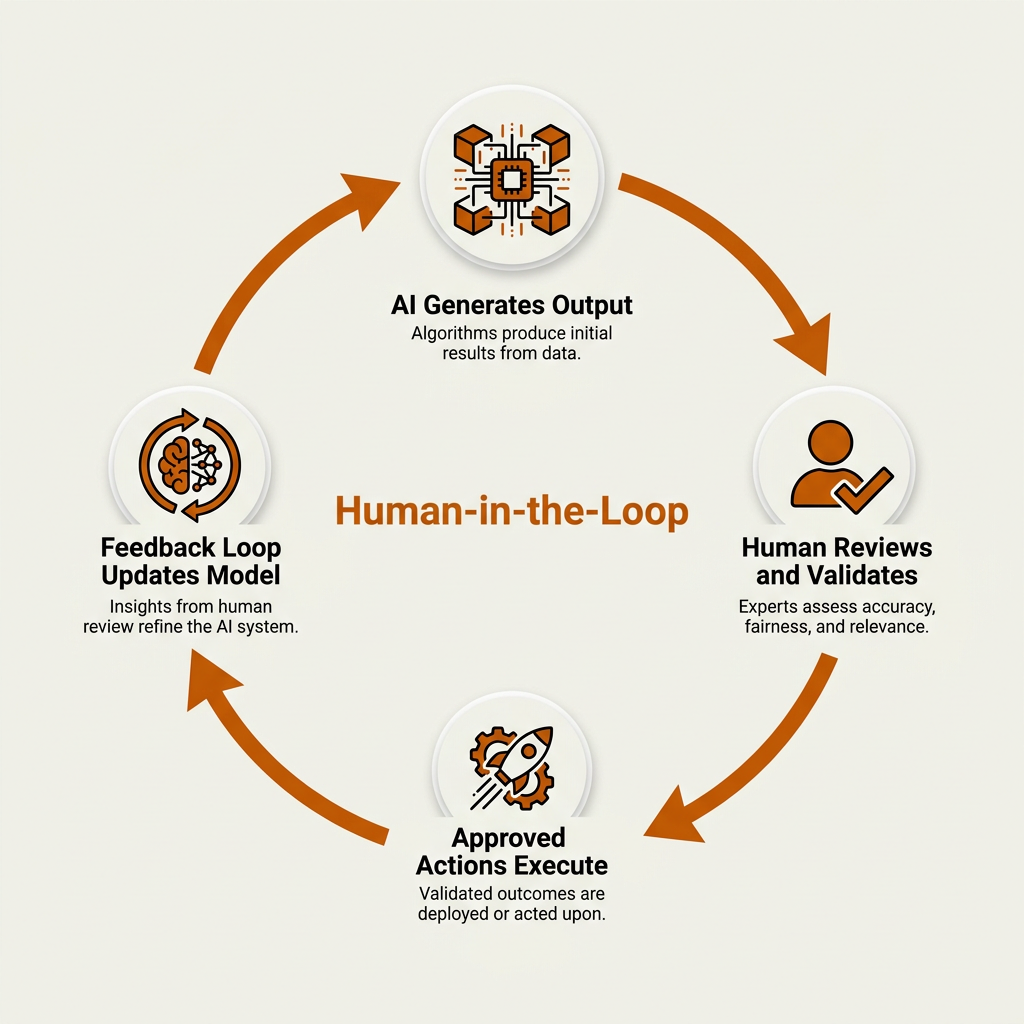
A structured review cycle keeps AI prospecting accurate, compliant, and continuously improving.
Key Takeaways and Next Steps
AI prospecting is not a magic button. It is an operational capability. When you pair solid data foundations with the right platform choices and real human oversight, the prospecting motion changes: better targeting, faster research, cleaner execution. The teams that get value treat AI like infrastructure, not a shortcut around sales discipline.
Actionable next steps for your team:
- Audit your current prospecting workflow and pinpoint where reps lose the most time to manual, repetitive work. Those steps are usually your highest-return automation targets.
- Run a CRM data quality assessment. AI models reflect the data they run on, so close enrichment gaps before you layer on scoring.
- Evaluate AI prospecting platforms using the criteria table above. Put extra weight on platforms that unify research, enrichment, intent, and CRM sync instead of forcing you to glue together point solutions.
- Set governance before you scale. Define approval thresholds, data usage rules, and feedback loops.
- Start with a controlled rollout. Choose one segment or territory, run AI-assisted prospecting alongside your current process, and measure changes in qualified meetings and pipeline generated.
Frequently Asked Questions
Does AI prospecting replace SDRs or sales reps?
No. AI prospecting takes on the data-heavy work: research, enrichment, and scoring. SDRs and reps still own relationship building, judgment calls, approving outreach, and closing. The goal is to cut the manual research load so reps can spend more time in high-value conversations.
What is the difference between AI prospecting tools and traditional sales prospecting software?
Traditional sales prospecting software is usually a static database plus filters. AI prospecting tools add adaptive capabilities like machine-learning scoring, real-time intent signals, AI-generated research briefs, and automated enrichment. Put simply: AI tools analyze data patterns and generate recommendations based on configured models, while traditional tools depend on manual setup every time conditions change.
How does buyer intent data improve AI sales prospecting?
Buyer intent data shows which accounts are actively researching topics tied to your solution. Combined with ICP fit scoring, it helps teams prioritize accounts that are both a strong match and currently in-market. That reduces wasted outreach to accounts that look good on paper but are not actually evaluating anything right now.
What should I look for when evaluating an AI prospecting platform like Bitscale?
Start with the fundamentals: data coverage and accuracy, research depth, intent sources, CRM integration quality, workflow automation flexibility, governance controls, and pricing transparency. Bitscale bundles AI prospect research, enrichment, intent signals, and CRM sync in one platform, which can reduce the integration overhead of assembling multiple point solutions. Because product capabilities, integrations, and pricing evolve over time, verify current details directly with each vendor before making a purchasing decision.
How do I measure whether AI prospecting is working for my team?
Measure prospect quality and efficiency, not volume. Track qualified meetings booked per rep, prospect-to-opportunity conversion rate, time spent on research per account, CRM data completeness, and pipeline generated from AI-sourced accounts. Skip vanity metrics like total emails sent; the point is better conversations, not more noise.
Editorial note: Product capabilities, AI functionality, integrations, pricing structures, and data coverage for the platforms mentioned in this guide evolve over time. Verify current details directly with each vendor before making purchasing decisions. The information presented here reflects publicly available descriptions at the time of writing and is intended as a starting framework for evaluation, not a substitute for direct vendor due diligence.