What is Waterfall Enrichment? How it Works & Why it Beats Single-Source Data?
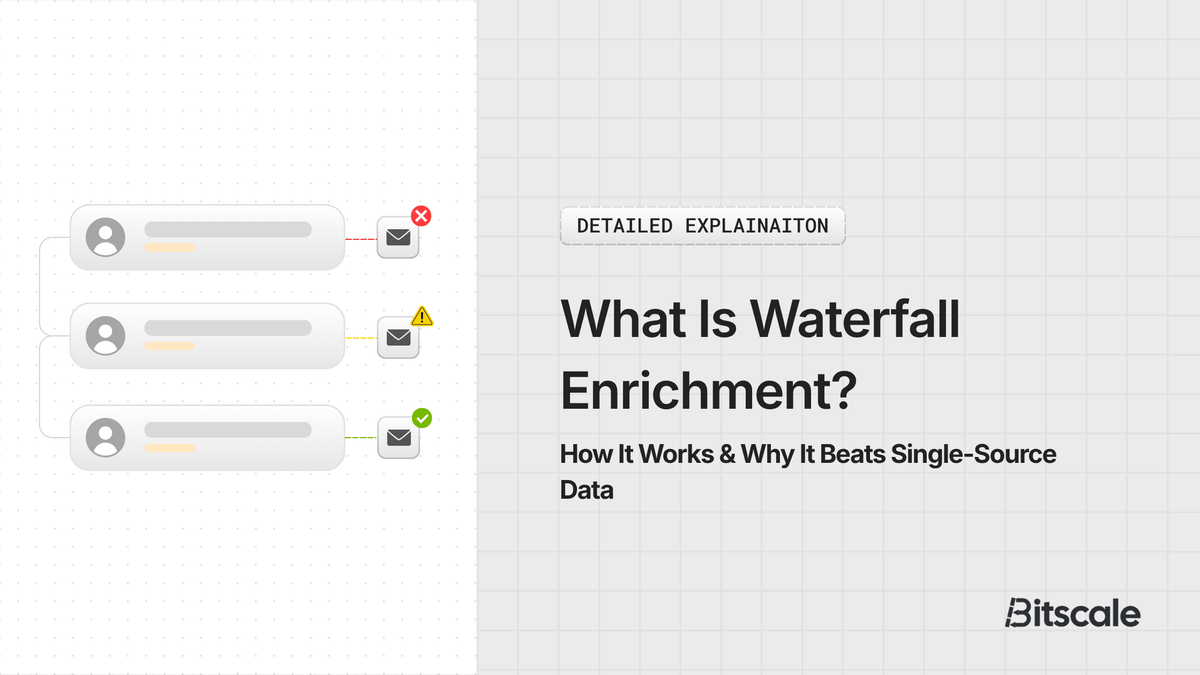
Waterfall enrichment is a data enrichment methodology that queries multiple data providers in a predefined sequence, moving to the next source only when the previous one fails to return a result. Instead of relying on a single database that may have gaps, the waterfall approach chains providers together so that every record gets the best possible chance of being completed with accurate, current information.
If you have ever run an outbound campaign and found that 30-40% of your contact records were missing verified emails or phone numbers, you have already experienced the core problem that waterfall enrichment solves. Single-source tools cap your coverage at whatever that one provider happens to know. A multi-source waterfall strategy fills the gaps systematically, and the difference in output quality is significant enough to change campaign economics entirely. Understanding B2B contact data accuracy is the first step to appreciating why this approach matters.
Why Single-Source Enrichment Falls Short?
Every data provider builds its database with a particular focus: some index North American enterprise contacts well, others specialize in SMB data across Europe, and others have strong mobile number coverage in Southeast Asia. No single provider achieves comprehensive global coverage across all company sizes, industries, and contact types.
The data decay problem compounds this. Even a provider with strong historical coverage will have stale records within months. When you run enrichment against a single source, you inherit both its coverage blind spots and its decay rate simultaneously. The result is a CRM full of records that look complete but contain outdated job titles, defunct email addresses, and wrong phone numbers. Poor data quality costs organizations an average of $12.9 million per year, according to research cited by IBM (2024), and a significant share of that cost traces back to single-source dependency.
Info: Single-source enrichment typically achieves lower data completion rates. Waterfall enrichment pushes that figure higher by systematically querying fallback providers for every unfilled field.
How Waterfall Enrichment Works: The Sequential Logic
The mechanics follow a straightforward conditional logic. You define a priority-ordered list of data providers for each field you want to enrich, such as verified work email, direct dial, LinkedIn URL, or company revenue. When enrichment runs on a record, it queries Provider 1. If Provider 1 returns a valid result, the process stops for that field and moves to the next one. If Provider 1 returns nothing or returns an unverifiable result, the workflow automatically queries Provider 2, and so on down the chain until either a valid result is found or all providers have been exhausted.
The sequencing is not arbitrary. You order providers based on a combination of their known strengths for your target segment, their cost per successful match, and their historical hit rate on your specific ICP. A provider with 90% accuracy on US enterprise emails but poor EMEA coverage should sit at the top of your chain for North American records, while a provider with strong European coverage handles the fallback for EMEA prospects. This is why understanding the landscape of the best B2B data providers by region is a prerequisite to building an effective waterfall.
The Three Layers of a Well-Designed Waterfall
A production-grade waterfall enrichment workflow has three distinct layers that work together. Getting any one of them wrong limits the effectiveness of the whole system.
The three layers:
● Provider sequencing: The ordered list of data sources for each field type. This layer requires knowing each provider's strengths by geography, company size, and seniority level. Sequence is not one-size-fits-all; your ICP dictates the order.
● Validation logic: Rules that determine whether a returned result is 'good enough' to stop the waterfall or whether it should continue to the next provider. A syntactically valid email that fails MX record verification should not halt the chain.
● Field-level granularity: The waterfall runs independently per field, not per record. A record might get its work email from Provider 1, its direct dial from Provider 3, and its LinkedIn URL from Provider 2. Each field follows its own chain.
This field-level independence is what separates true waterfall enrichment from simply running the same record through multiple tools manually. The automation layer handles the conditional routing in real time, which makes it practical at scale. A data enrichment solution that supports field-level waterfall logic can process thousands of records without manual intervention, with each field independently optimized for coverage and accuracy.
Real-World Impact: What the Numbers Look Like in Practice?
Pazcare, a health benefits platform, used Bitscale's enrichment infrastructure to scale contact enrichment 3-4x compared to their previous single-source workflow. The improvement was not incremental; it fundamentally changed how many contacts their sales team could work with in a given sprint. When you go from 55% complete records to 90% complete records, you are not just filling in missing fields. You are unlocking a segment of your TAM that was previously invisible to your outbound motion.
At the revenue level, companies using waterfall enrichment report significant increases in sales pipeline and conversion rates. This happens because they have more complete and accurate contact data. These are not marginal improvements. They reflect the compounding effect of better data at every stage of the funnel: more deliverable emails means higher send volume, higher send volume means more replies, and more replies mean more pipeline. The math works because the data works. You can explore more examples in Bitscale's customer case studies to see how different teams have applied this approach.
Common Misconceptions About Waterfall Enrichment
The first misconception is that waterfall enrichment is just running the same record through multiple tools sequentially and picking the best result. That is not how it works. A true waterfall stops querying a provider the moment a valid result is returned for a specific field. It does not collect all results and then choose. The stop-on-success logic is what makes it cost-efficient; you only pay for the queries that were necessary to complete a field, not for redundant lookups.
The second misconception is that more providers always means better results. Provider count matters less than provider selection and sequencing. A five-provider waterfall with poorly chosen sources and no validation logic will underperform a three-provider waterfall that is tightly matched to your ICP and has strict field-level validation rules. The quality of the chain matters more than its length.
Warning: Waterfall enrichment is not the same as data deduplication or data cleansing. It fills missing fields using external sources. It does not resolve conflicts between existing records or remove duplicate entries from your CRM. Those are separate data quality operations.
The third misconception is that waterfall enrichment is only relevant for email finding. In practice, the same logic applies to any structured field: direct dial numbers, company headcount, funding stage, technology stack, LinkedIn profile URLs, and even intent signals. Any field where a single provider has incomplete coverage is a candidate for waterfall logic. For teams managing CRM data enrichment workflows, this means the waterfall approach can be applied across the full set of fields that feed lead scoring, routing, and personalization.
When to Use Waterfall Enrichment? (and When Not To)
Waterfall enrichment is the right approach when your ICP spans multiple geographies, when you are working with mid-market or SMB contacts where provider coverage is more fragmented, or when your outbound volume is high enough that data gaps have a measurable impact on deliverability and reply rates. It is also the right approach when you are enriching a field that has high variance in provider coverage, such as mobile numbers or personal email addresses.
It is less necessary when your entire ICP is concentrated in a single geography and company size band where one provider has demonstrably strong coverage. In that narrow scenario, the operational overhead of maintaining a multi-provider waterfall may not justify the marginal coverage improvement. However, as your ICP expands or your data needs grow more complex, the single-source approach will hit a ceiling faster than you expect. Reviewing the best data enrichment tools available can help you evaluate which providers belong in your waterfall stack based on your specific coverage requirements.
Not sure which providers belong in your waterfall stack? Bitscale maps provider strengths to your ICP automatically.
Why Bitscale is Built for Waterfall Enrichment at Scale?
Bitscale's enrichment infrastructure is designed around the waterfall model as a first principle, not as an add-on feature. The platform connects to multiple verified data providers, applies field-level sequencing logic, and validates results before writing them to your records. This means your team gets the coverage benefits of a multi-provider waterfall without the engineering overhead of building and maintaining the routing logic yourself.
For GTM teams running outbound at scale, the practical implication is straightforward: more complete records, higher deliverability, and a larger share of your ICP that is actually reachable. Whether you are enriching net-new prospects or refreshing decayed CRM data, the waterfall approach is what separates teams that consistently hit their SQL targets from those that are perpetually constrained by data gaps. Explore Bitscale's full data enrichment solution to see how the waterfall logic works in a live workflow.
Frequently Asked Questions
What is the difference between waterfall enrichment and standard data enrichment?
Standard data enrichment typically queries a single provider to fill missing fields in a record. Waterfall enrichment uses a sequenced chain of providers, moving to the next source only when the previous one fails to return a valid result for a specific field. The result is significantly higher data completion rates and reduced dependency on any one provider's coverage or freshness.
How many data providers should be in a waterfall enrichment chain?
There is no universal number. Most effective waterfalls use three to six providers per field type, selected based on their known strengths for your target ICP by geography, company size, and contact seniority. Adding more providers beyond what your ICP requires increases cost without proportional coverage gains. Start with two to three providers and expand based on measured hit rate gaps.
Does waterfall enrichment work for phone number enrichment as well as email?
Yes. The same sequential logic applies to any structured field, including direct dial numbers, mobile numbers, LinkedIn URLs, company firmographics, and technology stack data. Phone number enrichment is actually one of the strongest use cases for waterfall logic because mobile number coverage varies significantly across providers and geographies.
Is waterfall enrichment relevant for teams using a CRM like a sales platform?
Absolutely. Waterfall enrichment integrates directly into CRM workflows, running automatically when new records are created or when existing records hit a defined staleness threshold. This keeps your CRM continuously updated without manual intervention. For a detailed breakdown of how enrichment applies within CRM workflows, see this guide on CRM data enrichment.
How does waterfall enrichment relate to data quality standards?
Data quality is defined by dimensions including accuracy, completeness, consistency, and timeliness. Waterfall enrichment directly addresses completeness and timeliness by pulling from multiple current sources rather than a single potentially stale one. IBM's data quality research notes that poor data quality costs organizations an average of $12.9 million annually, and incomplete contact records are one of the most common and costly data quality failures in B2B sales operations.