What Is Champion Tracking? A Practical Guide for Modern Revenue Teams
Champion tracking helps RevOps teams track internal advocates, catch job changes, and turn trusted relationships into pipeline with clean CRM workflows.
Champion tracking is how you identify, document, and keep tabs on the internal advocates who actually move your deal inside their company. They are the people who fought for the initial purchase, defended the renewal, or drove adoption when your team was not in the room. When one of them leaves for a new employer, you either turn that relationship into a warm opening or you let a competitor become their new default. When they stay but shift roles internally, you either update your account plan or you lose influence in an account that looked stable on paper.
Most revenue teams already agree champions matter. The failure is execution: champion data rots quickly, CRM records drift out of date, and ownership gets fuzzy. Contact records naturally become outdated as people change roles and companies, and executive mobility can quickly weaken a deal that depends on one internal advocate. The sections below cover the mechanics of sales champion tracking: how to separate real champions from other stakeholders, what to capture in your CRM, how to catch and act on job-change signals, and how to tell if the process is producing revenue instead of busywork. Here is the roadmap.
Sections covered:
- Champion vs. Other Stakeholder Roles: precise definitions and a comparison table
- What to Track on Every Champion: the data fields that matter
- Identifying Genuine Champions: signals that separate advocates from friendly contacts
- Monitoring Job Changes and Buying Signals: the operational engine
- CRM Champion Tracking Workflows: keeping records current and actionable
- Measuring Effectiveness: how to know your tracking process works
- FAQ: common questions from RevOps and sales leaders
Champion vs. Other Stakeholder Roles
Revenue teams love to use "champion," "sponsor," and "decision-maker" as if they mean the same thing. They do not, and the sloppiness shows up fast in the funnel. If your AE tags every pleasant stakeholder as a champion, CRM champion tracking turns into noise you cannot trust. If your SDR team treats a decision-maker and a buyer champion as the same persona, sequences land wrong because the motivations are different. Getting the labels right is not semantics; it is the foundation for every workflow that follows.
| Role | Core Function | Relationship to Your Deal | Typical Behavior |
|---|---|---|---|
| Champion | Sells your solution internally | Advocates for you in rooms you are not in | Brings you internal objections, coaches you on politics, rallies other supporters |
| Decision-Maker | Approves or rejects the purchase | Signs off on the deal | Weighs options and often leans on the champion's recommendation |
| Economic Buyer | Owns the budget | Releases funds for the purchase | Anchors on ROI, cost, and the business case |
| Sponsor | Provides executive cover | Adds credibility to the initiative | May stay light on details but backs the strategic direction |
| Advocate | Speaks well of your product | Gives references or testimonials | Supportive, but not driving the deal the way a champion does |
| Ordinary Contact | Knows your team | May show up to meetings or demos | Passive; not pushing the deal forward |
| A champion is unique because they take personal risk to advance your deal. That distinction drives every tracking decision downstream. |
The line that matters is risk. A champion spends political capital on you and ties their reputation to the outcome. An advocate might say nice things on a reference call. A champion rewrites the internal business case at 10 PM so procurement does not kill the deal. Champion tracking is really risk tracking: if this person leaves or loses influence, your revenue is exposed. It is also upside tracking: when they land somewhere new, you have the warmest possible path into a fresh account.
What to Track on Every Champion
A champion record is not just a contact with a tag. If you want this to work operationally, you need structured fields that capture relationship depth, actual influence, and current status. The same basics apply whether you build it in Salesforce, HubSpot, or a relationship intelligence tool.
Role and title context. A job title is a hint, not a profile. Capture the champion's function (engineering, finance, operations), their seniority, and whether they sit in a business unit that matches your ICP. A Director of Engineering who championed your DevOps tool carries a different kind of leverage than a Marketing Manager who simply attended a webinar.
Company and account ownership. Tie the champion to the right company record and make ownership explicit on your side. When ownership is unclear, follow-up becomes "someone should" work. If your org uses account intelligence platforms like Bitscale's enrichment and CRM sync workflows, automate the linkage so it updates cleanly when the champion moves.
Relationship history. Write down what happened while it is still fresh: which deals they touched, which reps built trust, what they did specifically (introduced you to the CFO, ran the internal pilot, presented ROI to the board), and how the deal ended. This is the context that turns a future note into a real warm intro instead of a vague "we worked together once."
Influence and engagement. Separate "likes us" from "can get this done." Rate their internal influence (can they mobilize budget, or do they need air cover?) and track engagement recency. When was the last reply, meeting, event, or meaningful touch? If engagement goes stale, that is often the first sign your champion status is slipping.
Opportunity involvement. Associate champions to every opportunity they influenced. That deal trail matters later: a champion who helped drive three closed-won deals at their last company should change how quickly you reach out when they show up in a new org.
Identifying Genuine Champions
This is where teams usually fool themselves. Someone being friendly on a call, forwarding an email, or showing up to a demo does not make them a champion. Real buyer champions show their hand through actions you can see and confirm.
Behavioral signals that distinguish a real champion:
- They volunteer internal obstacles, timelines, and competitive context without you prying.
- They bring you into the org by introducing other stakeholders, especially budget owners, without being asked.
- They spend their own time building internal decks, business cases, or pilot plans to move your deal forward.
- They counter competitor narratives inside their company.
- They come back after internal meetings with a readout: what happened, what changed, and what you need to do next.
A simple gut-check: would this person still push for you if you were not there to prompt them? If you can point to evidence, you have a champion. If you cannot, treat them as an advocate or a friendly contact and keep earning the right to that label. In complex enterprise deals, identify and nurture multiple credible champions across relevant functions or business units. across different business units (Salesmotion, 2026). Betting the deal on one person is not focus; it is fragility.
Monitoring Job Changes and Buying Signals
Champion job change tracking is where the upside shows up in the forecast. UserGems that its analysis of thousands of opportunities associated previous champions with stronger win rates and larger deal sizes than opportunities without one. That is not mysterious: someone who already trusts your product, knows your team, and has seen results is simply easier to sell to than a stranger.
The hard part is not the outreach. It is detection. You need job-change signals flowing into your CRM or sales intelligence layer without forcing reps to play "check LinkedIn" as a weekly ritual. Bitscale can flag job changes and other CRM-rot signals, while its Salesforce and HubSpot workflows can help keep the relevant records current. Signal quality is uneven, so build in verification before you fire off a message. A false positive (congratulating someone on a move they did not make) is an easy way to burn credibility.
Job changes are the obvious trigger, but they are not the only one worth watching. Look for signs your champion is getting set up in the new role: hiring for positions that map to your use case, a fresh funding event, or renewed engagement with your content. Account intelligence platforms can roll these into one view so your team is not stitching clues together by hand. Pair relationship intelligence (who they are and what they did for you) with intent data (what the new company is researching), and you get a signal strong enough to justify immediate, personalized outreach.
CRM Workflows for Champion Tracking
If champion tracking lives in a spreadsheet or, worse, in someone's memory, it is not a system. It is a failure mode waiting to happen. The workflow has to live in the CRM, with clear ownership, automation, and a follow-up cadence that survives busy quarters and team changes.
Structuring Champion Records
Start with structure your CRM can enforce. Use a custom object or a disciplined tag system for champions. At minimum, you need a "Champion" designation on the contact, linked to the right opportunity and account. Add a "Champion Strength" field (strong, moderate, developing) grounded in the behavioral signals above, not vibes. Include a "Last Validated" date that gets updated quarterly. When that date crosses 90 days, trigger a task for the account owner to re-engage and either confirm the status or downgrade it.
Assigning Follow-Up Actions on Job Changes
When a champion move is detected, the workflow should create a task for the rep who built the relationship, not just whoever owns the account today. If that rep has left the company, route the task to the team lead or a designated relationship owner. What deals the champion influenced, what they did, and a sensible outreach angle. Warm outreach works because the story is already written. Do not make reps excavate it from old notes.
Keeping Records Current
CRM data decays by default, not by accident. Put a quarterly champion audit on the calendar: RevOps pulls every contact tagged as a champion, flags anyone with no engagement in the last 90 days, and routes the list back to reps for validation. Reps confirm the basics: are they still employed there, are they still in a role with influence, have they gone quiet? If they no longer meet the bar, downgrade them to "advocate" or "former champion" so your active list stays clean and usable.
Measuring Whether Your Champion Tracking Works
Ignore vanity counts. The goal is not to brag about how many champions you have tagged. The goal is to create pipeline and reduce revenue risk. These are the metrics worth your dashboard real estate.
- Pipeline sourced from champion job changes. Track opportunities created within 90 days of a detected move. If this sits at zero, your alerts are not landing or your follow-up is not happening.
- Speed to first outreach. Measure the time from job change alert to first rep touchpoint. The early window is when champions are most open to new tools. If your average is measured in weeks, you are donating the advantage.
- Champion-influenced win rate vs. non-champion win rate. Compare outcomes for deals with a tagged champion versus deals without one. This is the reality check on whether your identification criteria predict anything.
- Champion coverage per strategic account. For top accounts, count validated champions. Zero or one is a risk signal. For enterprise accounts, prioritize coverage across multiple relevant functions so the deal does not depend on a single relationship.
- Data freshness. Track what share of champion records were validated in the last quarter. Stale records lead to stale plays.
Advanced Considerations: Edge Cases and Expert-Level Moves
Once the basics are in place, the difference between an OK program and a durable one comes down to how you handle the edge cases.
Multi-threading beyond the champion. A champion is your strongest thread, not your only thread. Use their momentum to meet the rest of the buying committee. If your champion exits and you have no other relationships, you are back to cold. Stakeholder mapping is the safety net that keeps the account from snapping when one person moves.
Tracking champions who move to non-ICP companies. Not every move deserves a sales task. If your champion joins a two-person startup and you sell enterprise software, do not burn cycles on outreach. Bake an ICP qualification step into the workflow: enrich the new company record, check firmographics, and only route qualified moves to sales.
Internal champion movement. Movement is not always a new logo. A promotion from Director to VP can change budget authority overnight. A lateral shift into a different business unit can create a clean expansion path. Track internal moves with the same discipline you apply to external job changes.
Former champions at churned accounts. When an account churns, do not wipe the champion history. If that person shows up at a new company, they still know your product and your team. Assuming the churn was not caused by product failure, a former champion at a new company may still represent a credible warm relationship worth evaluating.
Key Takeaways
Champion tracking is not a CRM cleanliness initiative. It is a revenue motion. Teams that get it right treat champions like a managed asset: defined by observable behavior, captured in structured fields, monitored for movement, and activated with fast, context-heavy outreach. Teams that get it wrong spray the "champion" tag everywhere, let records rot, and then act surprised when their so-called warm pipeline behaves like cold outbound.
Action steps to implement now:
- Write down champion criteria based on observable behaviors, not gut feel.
- Add structured champion fields in your CRM (strength, last validated, opportunity history).
- Automate job change detection through a sales intelligence platform and route alerts to the right rep with full context.
- Run quarterly champion audits to keep data fresh and champion coverage real.
- Measure pipeline sourced from champion moves and speed to first outreach as your primary indicators.
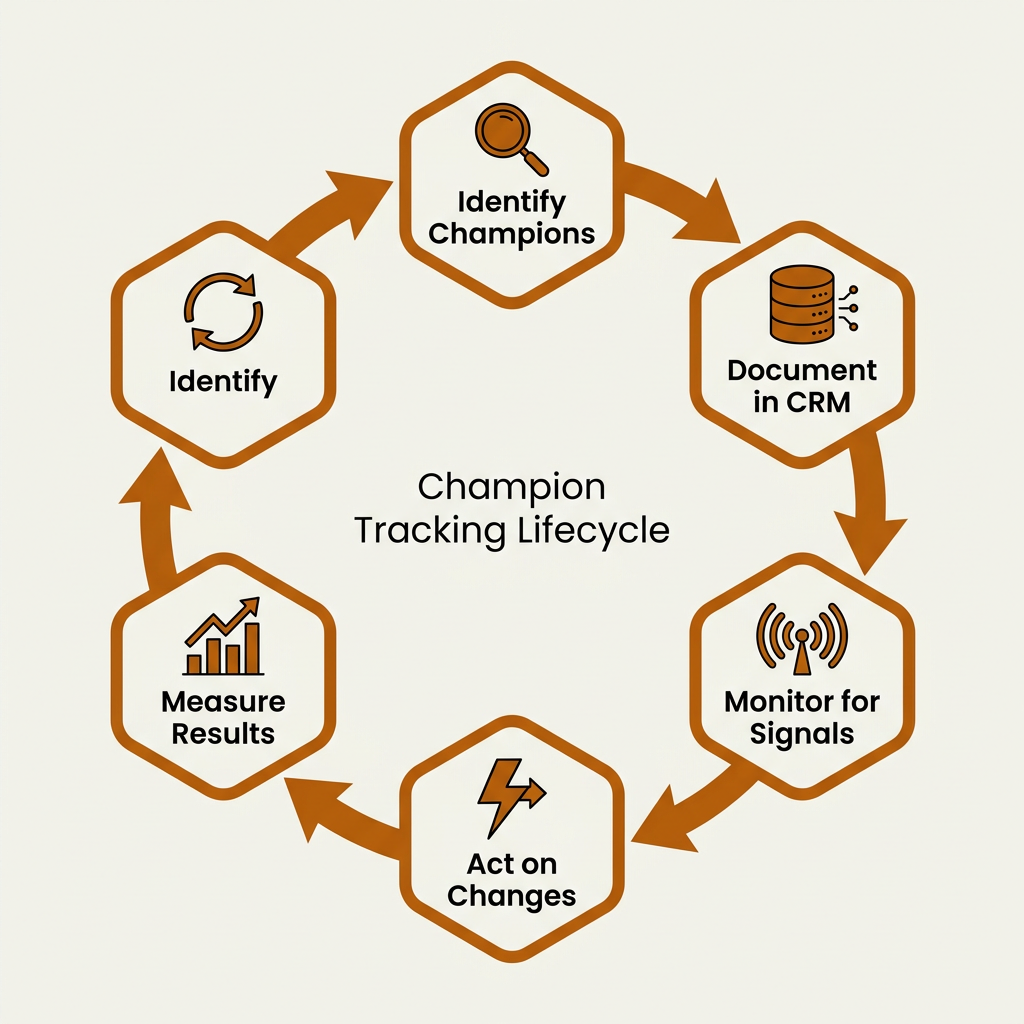
Champion tracking is a continuous revenue motion — not a one-time CRM cleanup.
Frequently Asked Questions
How is a champion different from a power user or product advocate?
A power user gets value and uses the product a lot. An advocate is willing to speak positively, maybe even hop on a reference call. A champion does the part that actually moves revenue: they sell your solution internally, spend political capital to push it through, and keep your team oriented on the org's real dynamics. If they are not willing to take that kind of risk on your behalf, they are not a champion.
How many champions should we track per account?
On enterprise accounts, plan for three to five validated champions across different functions or business units so you are not exposed to a single point of failure. In mid-market accounts, the appropriate coverage depends on the buying committee, deal complexity, and the influence of each confirmed champion. The exact number matters less than whether the relationships are real and your records reflect current reality.
What tools support champion job change tracking?
Bitscale supports champion-tracking workflows by flagging job changes, enriching contact and account records, surfacing buying signals, and syncing relevant updates with Salesforce or HubSpot. Evaluate the workflow based on signal verification, CRM field mapping, ownership rules, and how quickly alerts become actionable tasks.
How quickly should we reach out after a champion changes jobs?
Reach out as soon as the job change has been verified. A timely, personal message is more credible than a delayed generic sequence, especially when it refers to the champion's previous experience with your company. Speed to outreach is one of the clearest performance signals in champion tracking.
What happens to champion data when the rep who built the relationship leaves our company?
This is where informal systems break. If the context lives in a rep's head, it leaves with them. Structured CRM fields (relationship history, deal involvement, champion strength) keep the story intact. When a rep exits, reassign their champion contacts right away and include a handoff note that summarizes the relationship. Treat rep turnover as a trigger to audit champion data, not just shuffle territories.