Waterfall Enrichment: A Buyer's Guide for Modern B2B Teams
Comprehensive buyer's guide to waterfall enrichment for B2B teams. Covers provider sequencing, AI validation, CRM sync, governance, and vendor evaluation.
Waterfall enrichment has quietly become the plumbing behind a lot of high-performing B2B revenue teams. On paper, it sounds simple: pass a record through a sequence of data providers until the fields you care about are filled. But if you treat it as "query a few vendors and call it done," you miss what makes it work. A real waterfall is an orchestration layer that decides how contact and account enrichment, AI-assisted validation, buying signals, deduplication, CRM sync, and automation fit together so you end up with revenue-ready data at scale.
B2B data degrades continuously as contacts change roles, companies restructure, and firmographic details shift. Left unmanaged, a database can lose a significant share of its accuracy within a single year. Meanwhile, single-provider setups consistently leave substantial gaps in record completeness because no individual source covers every contact, company, or field type equally well. This buyer's guide lays out the architecture, governance, vendor evaluation, and implementation details needed to build (or buy) a waterfall enrichment system that actually shows up in pipeline. Here is the roadmap.
Sections covered:
- Foundations: what waterfall enrichment really is (and is not)
- Single-provider vs. waterfall: a side-by-side comparison
- The anatomy of a waterfall enrichment workflow
- AI validation, governance, and data quality controls
- Buying signals and revenue intelligence integration
- Implementation playbook: sequencing, deduplication, CRM sync
- Vendor evaluation framework
- Common mistakes and how to avoid them
- FAQ
What Waterfall Enrichment Really Is (and Is Not)
A lead enrichment waterfall is not a glorified API daisy chain. It behaves more like a decision engine. When a new lead or account hits your system, the waterfall checks what is missing, picks the best provider for each field based on cost, accuracy, and past coverage, calls that provider, and then validates what comes back. Only when a field is still blank (or fails validation) does it cascade to the next source. That conditional logic is the difference between orchestration and brute-force multi-vendor querying.
IBM defines data enrichment as combining first-party data with extra context from internal or external sources to increase analytical value. Waterfall enrichment builds on that by adding provider sequencing, cost control, and automated governance. If you want a deeper primer on what waterfall enrichment is and how it works, that foundational resource breaks down the mechanics.
Single-Provider vs. Waterfall Enrichment
Most teams start with one B2B enrichment vendor. It is usually fine at low volume, then the gaps become impossible to ignore once the database grows beyond a few thousand records. The table below focuses on the structural differences that matter when you care about unit economics, accuracy, and the ability to change vendors without rewriting everything.
| Dimension | Single Provider | Waterfall Enrichment |
|---|---|---|
| Data coverage | Leaves notable gaps because no single source covers every field or segment equally | Substantially higher coverage by cascading across complementary providers |
| Cost model | Flat per-record pricing | Cheapest-first or field-strength-based sequencing lowers average cost per record |
| Accuracy | Tied to one source's refresh cycle | Cross-checked across sources; AI flags conflicts and inconsistencies |
| Field completeness | Gaps persist when the provider lacks a field | Downstream providers fill what is still missing |
| Maintenance | Low effort to start | Needs orchestration logic and governance rules |
| Scalability | Higher vendor lock-in risk | Add or swap providers without rebuilding pipelines |
| Structural comparison based on widely observed patterns in B2B data operations. |
Anatomy of a Waterfall Enrichment Workflow
A production-grade enrichment workflow has more pieces than most teams budget for on day one. Each part exists because it solves a specific failure mode. Skip one, and you usually pay for it later in wasted credits, messy CRM records, and a sales team that stops trusting the data.
| Component | What It Does | Business Value |
|---|---|---|
| Provider sequencing | Prioritizes data sources by cost, accuracy, and field strengths | Cuts enrichment spend while keeping fill rates high |
| Contact enrichment | Populates work email, phone, title, seniority, LinkedIn URL | Supports personalized outreach at scale |
| Company (account) enrichment | Adds firmographics: revenue, headcount, industry, tech stack | Improves segmentation and account scoring |
| AI validation | Checks returned data for format, recency, and consistency | Stops bad data before it hits the CRM |
| Deduplication | Merges or flags duplicates before and after enrichment | Reduces wasted outreach and reporting distortion |
| CRM synchronization | Writes validated data back to Salesforce, HubSpot, or other CRMs | Keeps the system of record current without manual imports |
| Buying signals layer | Appends intent data, job changes, funding events, tech installs | Helps prioritize accounts that are actively moving |
| Workflow automation | Triggers routing, scoring, and sequencing based on enrichment events | Connects enrichment output to revenue motions |
| Governance and audit | Logs provider calls, field changes, and validation decisions | Enables compliance, cost tracking, and quality audits |
| Each layer contributes to the overall data enrichment waterfall. |
AI Validation, Governance, and Data Quality Controls
Data providers return outputs, not truth. An email can be a catch-all. A phone number can route to a switchboard. A title can be out of date by a quarter. This is where AI data enrichment earns its place in the stack: not by inventing fields, but by applying fast, consistent validation before anything lands in your CRM.
In practice, AI validation covers a few recurring jobs: format checks (does this email even parse?), cross-source consistency (does Provider A's title line up with Provider B's seniority?), recency scoring (how recently was this confirmed?), and anomaly detection (did headcount jump implausibly overnight?). People still own the policy decisions: which fields are required, what confidence level triggers manual review, and how you resolve conflicts between providers. For a detailed breakdown of how waterfall enrichment improves data accuracy, that resource walks through common validation patterns.
| Responsibility | AI Handles | Human Handles |
|---|---|---|
| Email verification | Syntax, MX record, catch-all detection | Choosing which domains to block or allow |
| Phone validation | Format check, carrier lookup, line type | Defining direct-dial vs. switchboard policy |
| Title normalization | Standardizing variants into seniority levels | Setting ICP seniority tiers |
| Duplicate detection | Fuzzy matching and confidence scoring | Merge/purge calls on edge cases |
| Provider sequencing | Reordering based on historical fill rates | Budget caps and provider contract decisions |
| Compliance | Flagging records from restricted geographies | Suppression lists and consent policies |
| Effective governance splits responsibilities between automation and human judgment. |
Buying Signals and Revenue Intelligence Integration
Enrichment that never gets activated is just a pricier database. The payoff shows up when enriched records flow into revenue intelligence systems that help teams decide who to pursue and when. Buying signals like job changes, funding rounds, technology installs, hiring surges, and content engagement turn static firmographics into prioritization inputs you can actually operationalize.
Teams using waterfall enrichment consistently report meaningfully higher match rates and a corresponding increase in sales-qualified leads, because more complete records allow richer segmentation and more precise targeting. That improvement is not only about coverage; it is also about being able to attach intent signals to complete records. When you know a target account just raised a Series B, hired a new VP of Engineering, and started evaluating your category, you can write outreach that is specific instead of generic. Knowing how to identify buying signals is what connects enrichment output to pipeline.
Platforms like Bitscale combine enrichment with real-time lead scoring, so records can be scored and routed automatically based on signal strength. That is the difference between "we have better data" and "the right rep is acting on it."
Implementation Playbook: Sequencing, Deduplication, and CRM Sync
Most waterfall enrichment projects do not fail on theory; they fail in the build. The playbook below focuses on three areas that tend to create the most friction in RevOps: provider sequencing, deduplication, and CRM synchronization.
Provider Sequencing Strategy
A common starting point is ordering providers from cheapest to most expensive. That works as a default, but it is not precise enough for real unit-economics control. A stronger model sequences by field strength: start with the provider that reliably covers emails, then cascade to the one that performs best on phones, then move to the source that is strongest on firmographics for account enrichment. The right sequencing depends on your ICP, the fields your sales process relies on most, provider verification quality, cost efficiency, and the degree of overlap between sources. Treat sequencing as a living system: track fill rate and accuracy by provider and by field on a regular cadence, then adjust. Some waterfall enrichment software can reorder automatically using historical performance data.
Deduplication Before and After Enrichment
Running dedup only after enrichment is one of the fastest ways to burn budget. Pre-enrichment dedup keeps you from paying to enrich the same record twice. Post-enrichment dedup matters too, because enrichment can turn two "different" records into an obvious match once missing fields get filled (for example, two John Smith entries that now share the same company and email). At minimum, your logic should support fuzzy matching on name plus domain plus title.
CRM Enrichment and Synchronization
CRM enrichment is where the waterfall meets the system of record, and the details matter. Your sync layer needs field-level write rules (do not overwrite what a rep updated), conflict handling (what happens when enrichment returns a different title than Salesforce already has), and audit logging (who changed what, when, and why). Bitscale's CRM sync supports bi-directional synchronization with field-level governance so enriched data lands in the CRM without overwriting human-verified inputs. If you are building your own sync, the guide on CRM data enrichment workflows covers common mapping and conflict-resolution patterns.
Vendor Evaluation Framework for Waterfall Enrichment Software
The global data enrichment market has grown steadily in recent years and continues to expand as B2B organizations invest more heavily in data quality infrastructure. That growth has created a crowded set of options. Tools like Clay, Apollo.io, Lusha, Cognism, and Instantly.ai come at enrichment from different angles: some are data providers that bolted on orchestration, while others are workflow platforms that pull in third-party data. Bitscale positions itself as a unified GTM platform, combining AI prospect research, waterfall enrichment, CRM synchronization, buying signals, workflow automation, and revenue intelligence in one environment. No matter which vendor you are looking at, the criteria below are the ones worth scoring.
| Criterion | What to Evaluate | Why It Matters |
|---|---|---|
| Provider ecosystem | Depth and quality of integrated data sources | More sources raise the coverage ceiling |
| Sequencing flexibility | Ability to reorder providers per field and per segment | Rigid sequences waste budget on low-yield queries |
| AI validation depth | Format checks, cross-source consistency, recency scoring | Avoids garbage-in, garbage-out |
| CRM integration | Connectors, field mapping, write rules, bi-directional sync | Determines whether reps actually see the enriched data |
| Buying signal support | Intent data, job changes, funding, technographics | Links enrichment to pipeline prioritization |
| Governance and audit trail | Logs, role-based access, suppression list support | Needed for compliance and cost control |
| Pricing model | Per-record, per-field, credit-based, or flat rate | Shapes unit economics as volume scales |
| Workflow automation | Post-enrichment triggers for routing, scoring, and sequencing | Turns data into action, not backlog |
| Use these criteria to build a weighted scorecard for vendor shortlisting. |
For a broader view of how enrichment fits into sales intelligence, the roundup of best sales intelligence providers compares platforms across these same dimensions.
Common Mistakes (and How to Avoid Them)
The same problems show up again and again when RevOps teams roll out waterfall enrichment. These are the ones that tend to do the most damage, either by inflating costs or by undermining trust in the CRM.
Treating enrichment as a one-time project. Enrichment is ongoing work. B2B data decays continuously as people change jobs, companies merge, and contact details go stale. "Set it and forget it" means your database starts drifting almost immediately. Put re-enrichment triggers in place based on record age, bounce events, and job change signals, and calibrate the refresh cadence to your data volatility and sales cycle length.
Skipping pre-enrichment deduplication. Enriching duplicates burns credits and creates avoidable merge work later. Dedup first, then enrich.
Ignoring field-level write rules in CRM sync. If you do not define which fields enrichment is allowed to overwrite, the system will eventually clobber values a rep fixed by hand. That is how you lose adoption even if your fill rates look great.
Optimizing only for coverage, not accuracy. Teams chasing maximum fill rates often end up accepting low-confidence values that pollute outreach. A record with a verified direct dial and no email can be more useful than one with both fields filled by unverified sources. For a deeper look at coverage targets, the resource on how to achieve over 95% data coverage lays out the tradeoffs.
Buying more providers instead of better orchestration. An additional data source rarely fixes a weak sequencing model or a thin validation layer. Tighten orchestration first; expand the provider roster second.
Key Takeaways and Next Steps
Waterfall enrichment is not a feature you turn on. It is an operating discipline: multi-provider orchestration backed by validation, governance, and CRM synchronization so revenue data stays accurate, complete, and usable. Teams that get real leverage from it treat enrichment like infrastructure, not a one-off cleanup.
Action items to move forward:
- Audit your current data coverage and accuracy rates per field to establish a baseline.
- Map your existing provider contracts and identify field-level coverage gaps.
- Define CRM write rules and governance policies before selecting a waterfall enrichment platform.
- Evaluate vendors using the weighted scorecard framework above, prioritizing orchestration flexibility and AI validation depth.
- Start with a pilot segment (e.g., one ICP vertical) before rolling out across your full database.
- Explore The Complete B2B Guide to Data Enrichment for foundational context on enrichment strategy.
Bitscale brings waterfall enrichment, AI prospect research, buying signals, CRM sync, and workflow automation into a single platform built for modern GTM teams. If your current stack forces you to stitch together point solutions just to get complete, validated records into the CRM, it is worth evaluating whether a unified approach from Bitscale can simplify operations while improving data quality.
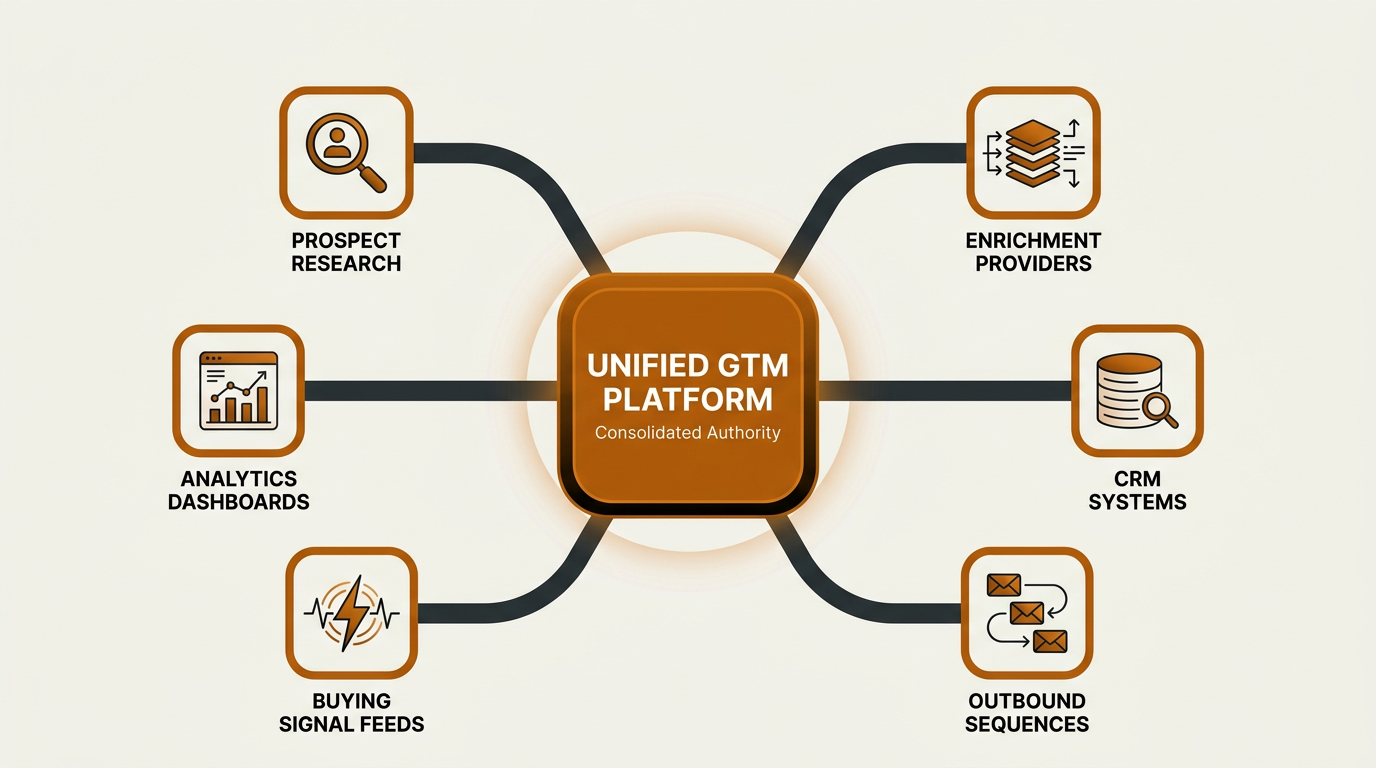
A unified platform replaces fragmented point solutions across the modern GTM stack.
Frequently Asked Questions
How does waterfall enrichment differ from simply using multiple data providers?
Using multiple providers is just volume. Waterfall enrichment adds the control plane: conditional logic, sequencing, AI validation, and governance. Instead of calling every provider for every record, the workflow only cascades when a field is still missing or fails validation. That structure typically lowers cost and improves accuracy versus brute-force querying.
What types of data can a waterfall enrichment workflow fill?
A complete workflow usually covers contact fields (work email, direct dial, title, seniority, LinkedIn URL) and account fields (revenue, headcount, industry, technology stack, headquarters location). More advanced setups also append buying signals like intent data, funding events, job changes, and technographic installs.
How many data providers should a waterfall include?
There is no universal number. The right count depends on how much overlap exists between your current sources, which fields matter most to your sales process, and where your coverage gaps are concentrated. For most teams, returns start to flatten once the primary field types (email, phone, firmographics) are each covered by at least one strong source with a backup. Put the effort into orchestration quality (sequencing, validation, governance) before adding more sources. An additional provider rarely moves coverage in a meaningful way if your existing stack is sequenced and validated well.
Is waterfall enrichment compliant with GDPR and other privacy regulations?
The enrichment pattern itself does not determine compliance. Your governance layer does: suppression list enforcement, consent tracking, geographic restrictions, and audit logging. Any waterfall enrichment software under consideration should support those controls. Your legal team should still review each provider's data sourcing practices separately.
How often should enriched records be refreshed?
The right refresh cadence depends on how quickly your target market's data changes, the length of your sales cycle, and the sensitivity of downstream workflows to stale records. High-priority accounts and active pipeline records typically benefit from more frequent refreshes or event-based triggers (for example, a bounce event or job change signal that kicks off immediate re-enrichment). Less active segments can follow a longer cycle. The goal is to match refresh frequency to the rate of data decay in your specific database rather than applying a single schedule across all records.