SalesIntel Review: Human-Verified Data vs Waterfall Enrichment
SalesIntel review: human-verified data, pricing, intent, and CRM enrichment vs waterfall enrichment platforms like Bitscale for coverage and automation.
This SalesIntel review is for RevOps leaders, SDR managers, and GTM teams making a real decision about data infrastructure. SalesIntel is a serious sales intelligence and signal-first pipeline generation platform with a defensible point of differentiation: a proprietary unified dataset combining machine intelligence, contributed sources, and human verification. The question is whether that architecture fits your workflow better than a configurable multi-provider waterfall enrichment model.
The comparison is not human verification versus automation. Both SalesIntel and waterfall platforms like Bitscale use automation extensively. The real distinction is between a proprietary verified dataset managed by one vendor and a configurable enrichment architecture that orchestrates multiple third-party data providers in sequence. The right fit depends on your ICP, your CRM requirements, your signal strategy, and how much control you want over provider selection.
What Is SalesIntel and Who Is It Best Suited For?
SalesIntel is a B2B sales intelligence and pipeline generation platform built around a proprietary unified dataset. According to SalesIntel's official data page, the platform combines automated data processing, contributed data sources, and human verification to maintain contact and company records. SalesIntel says its records undergo recurring human reverification, and the company employs a research team dedicated to maintaining data accuracy (SalesIntel, 2026). Rather than functioning as a static contact database, SalesIntel has expanded into buying signals, AI-assisted workflows, CRM enrichment, and Research on Demand.
SalesIntel tends to appeal to mid-market and enterprise teams that place a premium on verified contact accuracy and want a guided, sales-assisted platform experience. It is worth evaluating when verified contact data and human-supported research are important purchasing criteria, and when your target personas are well-represented in a curated proprietary dataset. Buyers prospecting into less-documented segments or requiring configurable multi-provider enrichment should test a representative sample of their ICP before committing, as coverage will vary by market and geography.
Getting Started: Setup and Onboarding Experience
SalesIntel currently promotes a free trial alongside its sales-assisted demo process. Buyers evaluating a larger deployment can use the demo to review integrations, data coverage, signal functionality, and workflow configuration. Trial terms and the level of onboarding support should be confirmed directly because availability may vary by package.
SalesIntel Review: Feature Breakdown
Human-Verified Contact Data: The Core Differentiator
SalesIntel's human-verified model is central to its value proposition. According to SalesIntel's data methodology page, the platform combines machine intelligence with human reverification to maintain its proprietary dataset (SalesIntel, 2026). When an SDR loses time to bounced emails or dead-end phone numbers, that operational drag is very real, and SalesIntel's approach is designed to reduce it.
SalesIntel operates a proprietary unified dataset that combines automated data processing, contributed sources, and human verification. This differs from a user-configured waterfall that queries multiple third-party data providers sequentially. If a company or contact is not already in SalesIntel's database, the Research on Demand feature allows subscribers to request that record (more on this below). Buyers should test coverage against their own ICP rather than assuming strength or weakness in any particular geography, vertical, or company size segment.
Buying Signals and Predictive Intelligence
SalesIntel currently promotes a broader signal platform that goes beyond a single intent data source. According to SalesIntel's product pages, available signal categories can include predictive signals, demand-capture signals, intent topics, company news, technographics, and web activity (SalesIntel, 2026). This positions SalesIntel as a signal-first platform rather than a contact database with bolt-on intent.
When comparing signal capabilities between SalesIntel and a platform like Bitscale, RevOps teams should evaluate several practical questions. Which signal categories are available, and on which plans? Can users combine multiple signal types to build composite scores? Can signals trigger CRM or GTM workflows automatically? Is scoring configurable, and are the underlying signal sources transparent? How quickly are signals refreshed, and can users route or enrich records based on signal combinations? Both platforms promote buying signal capabilities, but the architecture, configurability, and plan-level access differ. Buyers should request detailed signal documentation from each vendor before making a decision.
CRM Enrichment and Integration Capabilities
SalesIntel says its enrichment can run continuously through native integrations on a user-selected schedule (SalesIntel enrichment page, retrieved 2026). The platform connects with Salesforce, HubSpot, and other common pieces of the sales stack to push verified contact and company fields into existing CRM records. Buyers evaluating SalesIntel for CRM enrichment should verify supported CRMs, sync direction, field mapping, conflict handling, deduplication, update schedules, bulk-enrichment rules, plan availability, enrichment limits, and API access.
Bitscale takes a different approach to CRM enrichment by orchestrating data enrichment workflows across multiple providers through a configurable waterfall. According to Bitscale's pricing page (retrieved 2026), HubSpot integration is listed on the Growth plan, Salesforce integration is listed on the Booster plan, and custom two-way CRM integration is listed on the Enterprise plan. The comparison between SalesIntel and Bitscale on CRM enrichment is less about whether enrichment runs automatically (both platforms support scheduled enrichment) and more about whether you want enrichment sourced from a single proprietary dataset or orchestrated across multiple providers with configurable fallback logic.
Research on Demand: Custom Data Sourcing
Research on Demand is one of the few features in this category that remains meaningfully distinct. If a contact or company is not in the database, SalesIntel subscribers can request it and the research team will source and verify the record (SalesIntel data page, retrieved 2026). For enterprise account-based motions and buying-group research where every named account and specific persona matters, this is real leverage. Turnaround times and commercial limits should be verified by plan, as terms can vary. Research on Demand is most relevant for targeted named-account work and less central for teams whose primary need is instant bulk enrichment at scale.
AI-Assisted Workflows and GTM Automation
SalesIntel currently promotes agentic workflows, buying-group mapping, and signal-driven pipeline generation as part of its platform (SalesIntel homepage, retrieved 2026). These capabilities position SalesIntel beyond a traditional contact database and into the territory of GTM workflow automation, though the workflow experience is built around SalesIntel's proprietary data and signal environment.
Bitscale's workflow experience emphasizes configurable enrichment across multiple providers, AI-assisted prospect research, buying signals, playbooks, and CRM sync. According to Bitscale, the platform prepares, enriches, qualifies, and syncs prospect and account data before passing records to a CRM or outbound platform (Bitscale product page, retrieved 2026). The distinction is architectural: SalesIntel's automation runs within its proprietary ecosystem, while Bitscale's automation orchestrates across external providers and tools. Buyers should compare workflow configurability, trigger options, and plan-level access when evaluating both platforms.
Human-Verified Data vs Waterfall Enrichment: Which Architecture Fits?
This is the architectural trade-off at the center of any SalesIntel review. Human verification, combined with machine intelligence and contributed data, is designed to raise accuracy per record when the record exists in the proprietary dataset. Multi-provider waterfall enrichment, where you query multiple B2B data providers in a prioritized sequence, is designed to raise coverage because you are not relying on a single dataset. Practitioner discussions in GTM communities consistently highlight this coverage versus confidence tension, though the actual results depend heavily on ICP, geography, and vertical.
SalesIntel's Research on Demand feature can help fill records that are not already present, which partially addresses the coverage question. A waterfall architecture addresses it differently, by letting the buyer configure which providers are queried and in what order. Neither approach is universally superior. The right choice depends on whether your team values a curated, verified dataset managed by one vendor or a configurable system that lets you control provider selection and fallback logic. Buyers should run ICP coverage tests with both approaches before committing.
SalesIntel Pricing: What to Expect
SalesIntel does not display a conventional set of numerical self-serve subscription prices. Its public pricing page describes included access and usage allowances, but buyers must request a quote for the actual commercial terms. on its public pricing page (retrieved 2026). Buyers should request a quote and confirm contract term, seat structure, data access, enrichment functionality, signal access, API availability, onboarding, export rules, and renewal terms. SalesIntel currently promotes a free trial, so teams can test data quality against their ICP before signing a longer agreement.
For comparison, Apollo, Cognism, Clay, Lusha, and Bitscale represent different approaches to contact data, enrichment, and GTM workflows. Compare them using ICP coverage, verification methodology, workflow depth, CRM support, signal functionality, and commercial terms.
| Capability | SalesIntel | Bitscale |
|---|---|---|
| Core data model | Proprietary unified database with human verification | Configurable multi-provider waterfall enrichment |
| Human verification | Yes, recurring reverification (confirm cadence by plan) | Not a primary feature; relies on provider-level data quality |
| Multi-provider waterfall | No user-configured multi-provider waterfall identified | Yes, configurable provider sequencing |
| Research on Demand | Available; confirm limits and turnaround by plan | Not applicable (coverage addressed via provider waterfall) |
| CRM enrichment | Continuous scheduled enrichment promoted; confirm CRM support by plan | Available; HubSpot on Growth, Salesforce on Booster, custom on Enterprise |
| Buying signals | Multiple signal categories promoted (predictive, demand-capture, intent, news, technographics) | Buying signals available; confirm categories and plan access |
| AI-assisted workflows | Agentic workflows and buying-group mapping promoted | AI-assisted research and enrichment workflows promoted |
| Trial and purchasing model | Free trial currently promoted; quote-based purchasing | Tiered plans listed; confirm trial availability |
| Capability comparison based on each vendor's public product pages (SalesIntel, 2025; Bitscale, 2025). Confirm plan-level access and commercial terms directly. |
SalesIntel Alternatives Worth Considering
The right set of SalesIntel alternatives depends on what you are optimizing for. If you want a compliance-forward posture with strong European coverage, Cognism is a relevant comparison. If you want self-serve access, high volume, and a lower entry price, Apollo.io is the more direct alternative. If the goal is to build automated, multi-step enrichment workflows without stitching together separate tools, Clay and Bitscale sit in a different category than traditional databases.
Bitscale deserves a closer look for RevOps teams that are treating enrichment as infrastructure, not a one-off list-building task. According to Bitscale, the platform functions as a GTM data layer for your CRM, combining data waterfalls, AI-assisted prospect research, buying signals, enrichment workflows, and CRM sync (Bitscale homepage, retrieved 2026). Bitscale prepares, enriches, qualifies, and syncs prospect and account data before passing records to a CRM or outbound platform. That makes the SalesIntel vs Bitscale question less about which dataset is "more accurate" and more about whether you need a proprietary verified dataset or a configurable enrichment and orchestration layer. For teams focused on outbound prospecting workflows, the architectural difference shapes day-to-day operations.
Pros and Considerations
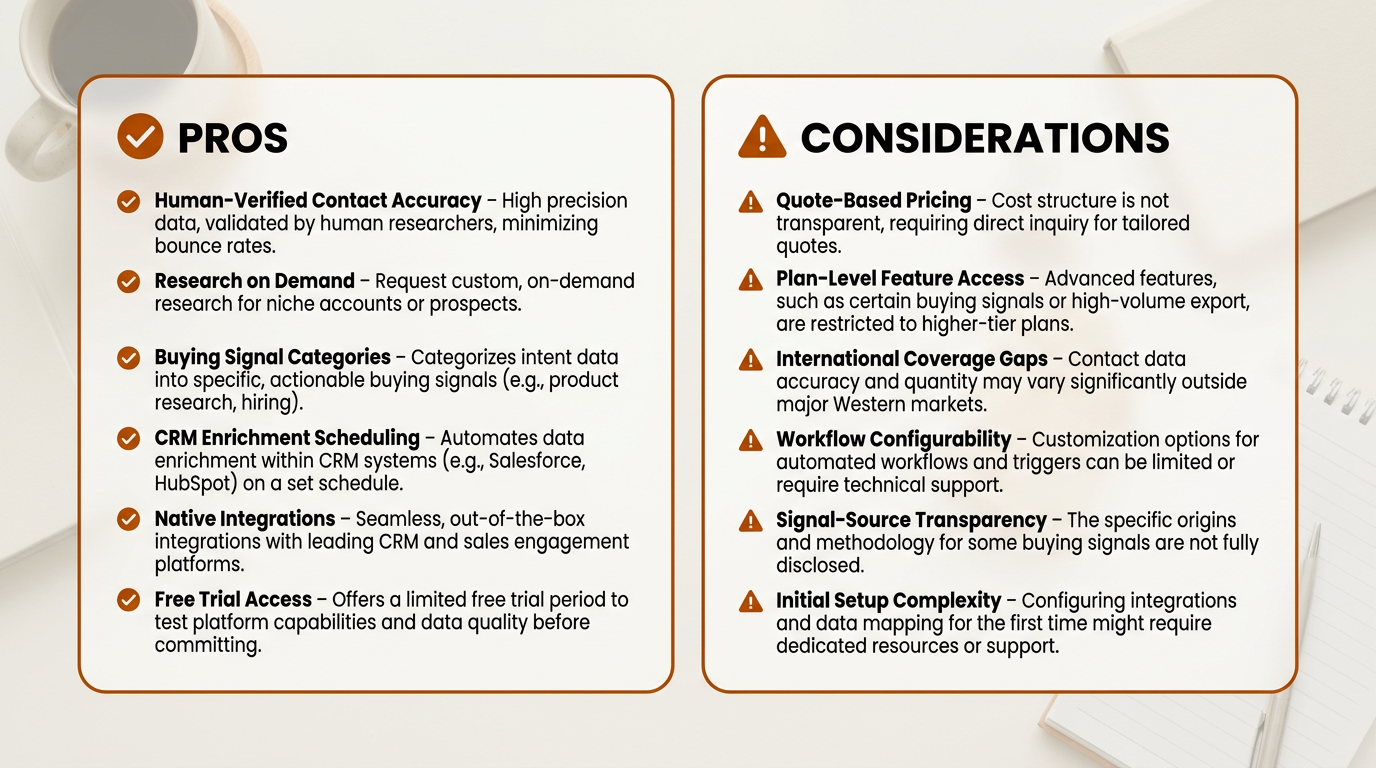
A structured evaluation of SalesIntel's verified data strengths alongside key areas buyers should confirm before committing.
Strengths:
- Human-in-the-loop verification combined with machine intelligence is designed to deliver strong contact accuracy
- Research on Demand lets teams request custom-sourced contacts for accounts missing from the database
- Buying signals span multiple categories including predictive, demand-capture, intent, technographics, and company news
- CRM enrichment can run continuously on a user-selected schedule through native integrations
- AI-assisted and agentic workflows are promoted as part of the current platform
- Integrations with Salesforce, HubSpot, and other sales and marketing tools support standard enrichment workflows
- Customer success support is part of the onboarding and ongoing operating model
- Free trial is currently promoted alongside the sales-assisted demo process
Considerations to verify:
- Pricing is quote-based; buyers should confirm contract term, seat structure, and renewal terms before committing
- Plan-level access to signals, enrichment, API, and workflow features should be verified directly
- International and niche-market coverage should be tested against your specific ICP before purchase
- Workflow configurability and trigger options should be compared against platforms offering multi-provider orchestration
- Signal-source transparency and scoring configurability should be evaluated during the trial or demo
- CRM field mapping, conflict handling, deduplication, and bulk-enrichment rules should be confirmed for your CRM setup
- Research on Demand limits and turnaround times should be verified by plan
- API access and enrichment volume caps should be confirmed for integration-heavy use cases
Who Should Buy SalesIntel (and Who Should Look Elsewhere)
SalesIntel is a strong candidate for mid-market and enterprise teams that value a proprietary verified dataset, Research on Demand, multi-category buying signals, CRM enrichment, and a guided sales-assisted platform experience. Teams running contact-intensive prospecting workflows may place greater value on verification and Research on Demand, and paying for a verification-first approach is rational. The platform's expansion into agentic workflows and signal-driven pipeline generation adds capabilities that go beyond basic contact lookup.
Teams that prioritize configurable provider waterfalls, transparent multi-source enrichment, AI-assisted research across external providers, flexible workflow automation, and plan-level CRM integration options will find a different fit in platforms like Bitscale. Early-stage startups that need month-to-month flexibility and self-serve evaluation should confirm whether SalesIntel's trial and contract structure aligns with their buying process. The decision should be driven by ICP coverage tests, workflow configuration needs, CRM requirements, signal strategy, source transparency, plan access, and commercial terms.
SalesIntel Review: Final Verdict
SalesIntel is a credible, well-executed sales intelligence platform that has evolved beyond its origins as a human-verified contact database. The platform now promotes buying signals across multiple categories, AI-assisted workflows, continuous CRM enrichment, and Research on Demand, all built around a proprietary unified dataset. For teams that want a curated, verification-first data environment with guided onboarding and customer success support, SalesIntel delivers a coherent product experience.
The architectural distinction remains meaningful. SalesIntel's proprietary dataset offers a controlled, verified environment. Configurable multi-provider waterfall enrichment platforms like Bitscale offer provider diversity, orchestration flexibility, and CRM-centred workflow automation across external data sources. Neither architecture is universally superior. The right choice depends on how your team defines data quality, how much control you want over provider selection, and whether your GTM workflow is better served by a unified proprietary platform or a configurable orchestration layer.
Recommended approach: run a parallel ICP coverage test with both platforms, evaluate workflow configuration and CRM integration against your actual stack, compare signal categories and plan-level access, and negotiate commercial terms with full visibility into enrichment limits, API access, and renewal conditions.
Frequently Asked Questions
Is SalesIntel worth the price versus cheaper options like Apollo.io?
The answer depends on your priorities. SalesIntel offers a proprietary verified dataset with Research on Demand and multi-category buying signals. Apollo covers a larger database at a lower published entry price, but its verification model is different. For targeted, account-based work where contact accuracy is paramount, SalesIntel's verification approach is worth testing. For high-volume outbound across a broad ICP, Apollo's economics and self-serve access are relevant advantages. Buyers should test both against a representative ICP sample before deciding.
What is waterfall enrichment, and how is it different from SalesIntel's model?
Waterfall enrichment queries multiple B2B data providers in a prioritized sequence until it finds a match for each field you care about. The goal is coverage: combining providers can improve match rates compared to relying on a single dataset. SalesIntel operates a proprietary unified dataset that combines automated processing, contributed sources, and human verification, rather than querying external providers in a user-configured waterfall. SalesIntel's Research on Demand can help fill records not already present. The trade-off is between a curated verified environment and a configurable multi-provider architecture.
Does SalesIntel have a free trial?
SalesIntel currently promotes a free trial alongside its sales-assisted demo process (SalesIntel pricing page, retrieved 2026). Trial availability, duration, credits, and included features should be confirmed directly because offers can change. Bitscale also lists tiered plans on its pricing page; buyers should confirm trial availability for both platforms.
How does SalesIntel compare to Bitscale for CRM enrichment?
SalesIntel enriches CRM records by pushing its proprietary verified data into Salesforce, HubSpot, and connected tools, with continuous scheduled enrichment promoted as a capability. Bitscale takes a multi-provider approach: waterfall enrichment across external data sources, AI-assisted research, buying signals, and CRM sync. According to Bitscale's pricing page, HubSpot integration is on the Growth plan, Salesforce on Booster, and custom two-way CRM integration on Enterprise. The comparison is less about whether enrichment runs automatically and more about whether you want enrichment from a single proprietary dataset or orchestrated across multiple providers.
What are the top SalesIntel alternatives for B2B prospecting?
Common alternatives include Apollo.io for cost-effective, high-volume prospecting; Cognism for compliance-focused data across Europe and North America; Clay and Bitscale for waterfall enrichment paired with workflow automation; and Lusha for lightweight contact lookup. The best fit depends on ICP geography, team size, and whether you want a proprietary verified dataset or a configurable lead generation software platform that combines multi-provider enrichment, AI research, and automation.