GTM Automation Healthcare Companies: Compliance-Ready Workflows
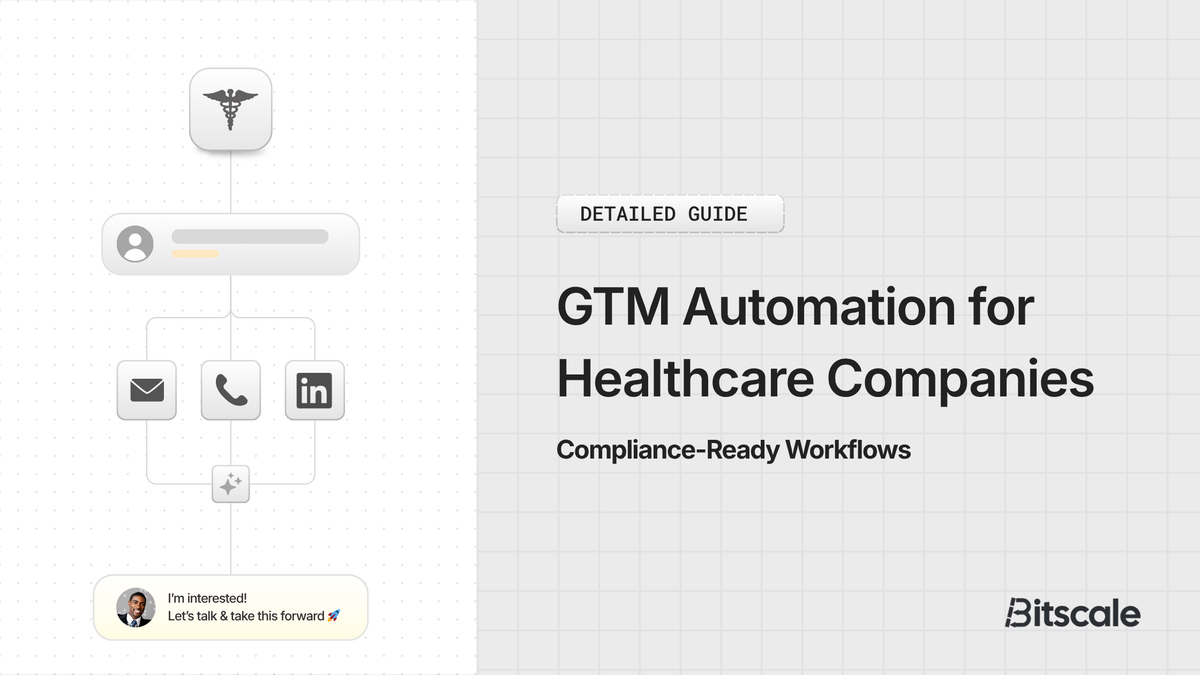
GTM automation in healthcare is not a straightforward lift-and-shift from standard B2B playbooks. Healthcare companies operate under a regulatory stack that most sales tech tools were never designed to accommodate. HIPAA, FTC guidelines, FDA promotion rules, and CMS restrictions on Medicare/Medicaid marketing all create hard boundaries around how you collect, store, enrich, and act on prospect data. Ignore those boundaries, and you are not just risking a bad campaign; you are risking enforcement action.
This piece is written for GTM operators, revenue leaders, and growth teams inside digital health companies, health tech vendors, and healthcare services organizations. You will come away with a clear picture of which workflow components require compliance review, how to structure outbound sequences that respect HIPAA marketing rules, and where automation genuinely accelerates the pipeline without creating legal exposure.
What Does this Guide Cover?
Topics covered:
● The regulatory landscape every healthcare GTM team must understand
● How to build compliance-ready data enrichment workflows
● Outbound sequence design for healthcare verticals
● ABM and account segmentation in regulated environments
● Advanced considerations: PHI boundaries, vendor vetting, and audit trails
● FAQ on healthcare GTM automation
The Regulatory Landscape for GTM Automation in Healthcare
The HIPAA Privacy Rule generally requires an individual's written authorization before their protected health information (PHI) can be used or disclosed for marketing purposes, according to official HHS guidance. That single requirement eliminates a large category of 'personalization' tactics that are standard practice in other verticals. Using a patient's diagnosis, treatment history, or prescription data to trigger a marketing workflow without explicit written consent is off the table, full stop.
The regulatory exposure does not stop at HIPAA. The FTC Act prohibits deceptive or unfair practices involving consumer health information. The FDA regulates how drugs and medical devices are promoted. CMS has specific rules governing marketing to Medicare and Medicaid beneficiaries. Enforcement in digital health has increased meaningfully since 2023, with the FTC specifically targeting health data brokers and ad tech platforms that mishandle consumer health signals. These are live risks, not theoretical ones.
Warning: What most teams get wrong: HIPAA applies to covered entities and their business associates. If your GTM stack includes a data enrichment vendor, that vendor may qualify as a business associate and require a signed Business Associate Agreement (BAA) before you share any prospect data that could touch PHI. Vet your vendors before you build the workflow.
The important distinction for B2B healthcare GTM, meaning outreach to health system procurement teams, clinical administrators, digital health buyers, and health tech decision-makers, is that you are not using PHI. You are working with firmographic data, technographic signals, and professional contact information. That separation matters enormously for what you can automate, and keeping it clean is the foundation of a compliant workflow.
Building Compliance-Ready Data Enrichment Workflows
Data enrichment is where most healthcare GTM workflows either earn their compliance posture or lose it. The question is not just 'what data can we collect' but 'where does it come from, how is it stored, and who has access to it.' The CRM data enrichment guide covers the field-level and workflow-level decisions that matter most for getting this architecture right.
The practical implication: build your enrichment layer exclusively on firmographic and professional data. Enrich accounts with NPI numbers to verify provider credentials, use specialty codes to segment by clinical focus, and pull technographic data to understand EHR and billing infrastructure. None of that touches PHI. Companies like Marigold Health and Fold Health operate in highly regulated care delivery contexts, and their GTM motions depend on clean, compliant account data rather than patient-level signals.
See how Bitscale structures compliance-aware enrichment workflows for health tech teams.
Designing Outbound Sequences for Healthcare Verticals
Healthcare buyers are slower, more skeptical, and more committee-driven than buyers in most other verticals. A six-touch sequence that converts in SaaS will underperform against a health system procurement team that routes every vendor inquiry through legal, IT security, and clinical informatics before anyone replies. Your sequence design needs to reflect that reality, not fight it.
Sequence Structure That Respects the Healthcare Buying Cycle
A few principles separate sequences that work in healthcare from those that stall. Lead with a specific insight about the prospect's organization, specialty mix, or technology stack rather than manufactured urgency. Healthcare buyers distrust artificial scarcity, and opening with it signals that you do not understand the environment. On the timeline, 14 days is too compressed. Plan for 30 to 45 days with lower touch frequency and longer gaps between steps.
Multi-thread from week one. Healthcare deals are typically multi-stakeholder decisions, often involving procurement, IT, security, compliance, and business teams. Your outreach should reflect that from the beginning. Channel mix also matters more here than in most verticals since health system administrators are not heavy email users. Phone and LinkedIn outreach, alongside email, is not optional. One more thing worth doing early: reference your SOC 2 certification, HIPAA compliance posture, or BAA availability in the first few touches. It removes a common objection before it surfaces.
For teams building this kind of structured, multi-channel workflow, ABM workflow automation provides a practical framework for coordinating touches across channels without creating compliance gaps. Every automated step needs a defined data source, clear suppression logic for opted-out contacts, and a human review checkpoint before sensitive messaging goes out.
ABM and Account Segmentation in Regulated Environments
Account-based motions fit healthcare GTM particularly well because the addressable market is finite and well-defined. There are roughly 6,000 hospitals in the United States, a few thousand large medical groups, and a countable number of major payer organizations. You do not need massive top-of-funnel volume. Precise segmentation and deep account intelligence are what move the needle.
Tip: If you are still building your ideal customer profile for healthcare, start with NPI taxonomy codes, CMS provider enrollment data, and health system affiliation data. These are public, HIPAA-safe, and give you a precise segmentation layer that generic firmographic data cannot match.
The AI healthcare market is expanding at an exceptional pace. A recent statistic valued it at USD 20.9 billion in 2023, and it's projected to grow at a CAGR of 29.1% from 2024 to 2032, driven by rising adoption in research, expanding use cases, and strong funding support. North America has historically held a significant market share. This rapid growth has created a crowded vendor landscape, making basic segmentation like “health systems with 500+ beds” insufficient. Instead, teams must consider EHR systems, payer mix, geography, and recent technology investments. For example, a health system that has just implemented a new EHR will be in a very different buying phase than one with a stable setup, requiring tailored messaging, timing, and entry strategies.
Understanding what a GTM workflow system actually does versus what a data platform does is relevant here. A data platform gives you records. A workflow system lets you act on those records with logic, triggers, and enrichment steps that adapt based on account behavior. For healthcare ABM, you need the workflow layer, not just the data layer.
Advanced Considerations: PHI Boundaries, Vendor Vetting, and Audit Trails
The global AI in healthcare market was valued at USD 39.34 billion in 2025 and is projected to reach USD 1,033.27 billion by 2034, growing at a CAGR of 43.96% (Fortune Business Insights, 2026). This investment only holds its value if the underlying infrastructure can pass a compliance audit. Three areas deserve specific attention from GTM operators building durable workflows.
PHI Boundary Enforcement
Your GTM stack should have explicit data classification rules that prevent PHI from entering outbound workflows. Field-level controls in your CRM, suppression lists that automatically exclude any contact record flagged as patient-related, and integration-level filters that block PHI fields from syncing to marketing automation tools are all non-negotiable. If you are enriching records with clinical data from any source, that enrichment layer needs a PHI firewall before data flows downstream.
Vendor Vetting and BAA Requirements
For healthcare GTM teams, any vendor that may touch PHI should go through legal and compliance review to determine whether a BAA is required before the workflow goes live. That includes your CRM, your enrichment provider, your email sequencing tool, and any AI layer that processes contact or account data. Review Bitscale's data security and compliance posture as a reference point for what a compliant enrichment vendor's documentation should include. A vendor that declines to sign a BAA on request is disqualified for healthcare GTM use, regardless of how good the product is.
Audit Trails and Data Lineage
Compliance in healthcare is not just about what you do; it is about being able to prove what you did. Your GTM workflows should generate logs showing when data was enriched, from what source, who accessed it, and when it was deleted or suppressed. Beyond satisfying regulators, this discipline makes your workflows easier to debug and improve. The GTM automation explained guide covers how data lineage connects to workflow performance at the architectural level.
Key Takeaways for Healthcare GTM Teams
What to act on:
● Separate B2B healthcare GTM data (firmographic, professional) from PHI before building any workflow. The compliance risk lives almost entirely in the data layer, not the automation layer.
● Sign BAAs with every vendor in your stack that could touch sensitive data. Do not assume a vendor is compliant because they serve healthcare customers.
● Design outbound sequences for the actual healthcare buying cycle: longer timelines, multi-threaded outreach, and compliance-forward messaging from the first touch.
● Use NPI taxonomy, CMS enrollment data, and technographic signals for account segmentation. Generic firmographic data is not precise enough for healthcare ABM.
● Build audit trails into every workflow. Compliance documentation is not a post-hoc exercise; it should be a native output of your GTM infrastructure.
Why is Bitscale Built for This?
Most GTM automation tools were built for SaaS velocity, not healthcare compliance. Bitscale is designed as a workflow system that puts data quality and enrichment logic at the center of every outbound motion. For healthcare teams, that means precise account segmentation using verified firmographic and technographic data, multi-step enrichment workflows with clear data lineage, and the audit trail that compliance reviews require. The platform's approach to data security and compliance is built for teams that cannot afford to treat compliance as an afterthought.
The teams that figure out compliant, precisely segmented, workflow-driven GTM in healthcare will have a real edge. The market is growing fast, the buyer pool is finite, and most vendors are still running generic outbound against it. Getting the compliance infrastructure right is not just risk management; it is the thing that lets you move faster than competitors who are still figuring out what they can and cannot automate.
Ready to build a compliance-ready GTM automation workflow for your healthcare team? Start with Bitscale and see what a purpose-built workflow system makes possible.
Frequently Asked Questions
Does HIPAA apply to B2B healthcare GTM outreach?
HIPAA applies to covered entities and their business associates when PHI is involved. If your outreach targets healthcare professionals using only professional contact data and firmographic information, HIPAA's marketing authorization requirements generally do not apply. The risk arises when your data sources include patient-level information or when your enrichment vendors handle PHI without a signed BAA. Review the HHS marketing guidance for the precise definitions.
What is a Business Associate Agreement, and when do I need one?
A BAA is a contract between a HIPAA-covered entity and a vendor that handles PHI on its behalf. In a GTM context, you need a BAA with any tool in your stack that could process, store, or transmit PHI. This includes CRM platforms, enrichment providers, and email tools if they handle data that could be classified as PHI. If a vendor declines to sign a BAA, that is a disqualifying signal for healthcare GTM use.
How should healthcare GTM teams handle contact opt-outs?
Opt-out management in healthcare requires more rigor than standard CAN-SPAM compliance. Maintain a centralized suppression list that syncs across every tool in your stack. Any contact who opts out should be suppressed within 10 days across email, phone, and LinkedIn outreach. Document the opt-out date and source. For contacts at covered entities, also consider whether your outreach could inadvertently expose their employer's PHI handling practices, which creates a separate compliance consideration.
Can AI-powered personalization be used in healthcare GTM automation?
Yes, with clear boundaries. AI personalization that draws on firmographic data, technographic signals, publicly available clinical specialty information, and professional role data is generally compliant. AI that ingests patient outcomes, claims data, or any PHI to personalize outreach is not. The distinction is the data source, not the AI itself. Build your AI personalization layer on top of a clean, PHI-free data foundation.
What metrics should healthcare GTM teams track differently from standard B2B teams?
Standard pipeline metrics apply, but healthcare GTM teams should also track compliance-specific signals: BAA coverage rate across the vendor stack, opt-out processing time, data source audit completion, and the percentage of accounts with verified, PHI-free enrichment. These are the operational indicators that tell you whether your GTM automation infrastructure will hold up under a compliance review.