Data Enrichment: A Practical Guide for Modern GTM Teams
Data enrichment for GTM teams: add firmographics, technographics, intent, and buying signals with governance, refresh cadences, and vendor criteria.
Data enrichment is one of the easiest GTM capabilities to underestimate. Many teams reduce it to a quick contact lookup: find the missing email, append a phone number, call it done. That mindset leaves real money sitting in your CRM. Strong B2B data enrichment adds firmographic, technographic, intent, and relationship context to every record, so your database stops being a static spreadsheet and starts behaving like a set of living profiles you can target, personalize against, and forecast from.
Bad data is expensive: industry research consistently shows that poor data quality costs organizations millions of dollars each year in wasted effort, missed opportunities, and flawed decision-making (Gartner). B2B contact data also erodes quickly. People change roles, companies restructure, and firmographic details shift, meaning a "clean" list can become unreliable within a few quarters. This piece clarifies what enrichment actually includes, how to roll it out without creating governance chaos, and how to choose data enrichment software that fits your revenue stack.
What Data Enrichment Really Means for GTM
Contact enrichment (verified emails, direct dials, job titles) is the entry point, not the finish line. A mature program also covers company enrichment (revenue, headcount, funding stage, sub-industry, HQ location), firmographic enrichment (geography, ownership structure, regulatory environment), and technographic enrichment (what tools the prospect already runs). Put those layers together and every account in your pipeline carries enough context for reps to tailor outreach and for scoring and forecasting to stop guessing.
Modern enrichment is also about motion, not just attributes. Intent data shows which accounts are actively researching topics tied to your solution. Buying signals (leadership changes, funding rounds, tech stack shifts) help answer the timing question: when to engage. Relationship intelligence adds the human graph: connections between your team and the prospect's org. It all matters for AI readiness, too, because large language models and predictive scoring engines do not "average out" bad inputs; they amplify them. Industry analysts have repeatedly warned that AI initiatives built on unreliable data face high failure rates, making data quality a prerequisite for any serious AI investment.
Raw Records vs. Enriched Intelligence
The difference between a raw CRM record and an enriched one is not a small uplift in completeness. It changes what the record is good for. The table below shows how basic lead capture turns into full-spectrum customer data enrichment.
| Dimension | Raw Data | Enriched Data |
|---|---|---|
| Contact info | Name and generic company email | Verified work email, direct dial, LinkedIn, job title, seniority |
| Company profile | Company name only | Revenue range, headcount, funding stage, sub-industry, HQ location |
| Technology stack | None | CRM, MAP, cloud provider, security tools in use |
| Buying signals | None | Recent funding, leadership hires, expansion announcements |
| Intent | None | Topic-level research activity across third-party publishers |
| Relationship map | None | Mutual connections, past interactions, org chart context |
| AI utility | Low (sparse features) | High (dense, structured, model-ready) |
| Enrichment transforms every dimension of a record from sparse to actionable. |
Implementing Enrichment Without Losing Control
The fastest way to turn enrichment into a mess is to bolt on a tool and hope the CRM sorts itself out. That is how you end up with duplicate fields, competing sources, and nobody accountable for accuracy. Before you buy anything, get crisp on three questions: Which fields are authoritative (and from which source)? How often should records refresh? Who makes the call when two providers disagree on something as basic as headcount?
Choosing Between Real-Time and Batch Processing
Sales data enrichment usually runs in two modes. Real-time enrichment triggers when a new lead hits your system (form fill, import, API call) and supports speed-to-lead motions. Batch enrichment runs on a schedule to refresh what you already have, catching job changes and company updates before they break routing, scoring, or segmentation. Most teams end up needing both. For a deeper comparison, see this breakdown of real-time vs. batch enrichment.
The Waterfall Approach to Coverage
No single provider covers every record, and pretending otherwise is how coverage gaps sneak into your funnel. A lead enrichment waterfall queries multiple sources in sequence, moving to the next provider when the first comes back empty. Done well, it lifts fill rates for contact and account enrichment without forcing you to live with one vendor's blind spots.
Governance Recommendations
- Assign a data steward (or a RevOps owner) who owns field-level source hierarchy and conflict resolution.
- Set refresh cadences based on data volatility: contact records change frequently (role changes, company moves) and need more frequent updates, while company-level firmographics shift more slowly and can be refreshed on a longer cycle. Intent and buying signals are the most time-sensitive and should be updated on the shortest interval your workflow supports.
- Audit enrichment accuracy on a regular basis by sampling records and checking against primary sources. The right frequency depends on your data volume and how quickly your market moves.
- Document which fields reps can edit versus fields locked to the enrichment provider.
- Apply deduplication rules before enrichment runs so you do not inflate record counts.
Where AI Fits (and Where Humans Still Win)
AI data enrichment is great at the unglamorous work: matching records across databases, standardizing job titles, classifying industries, and scoring intent at scale. What it does not replace is judgment. Surveys of enterprise operations leaders consistently identify data quality issues as one of their most significant data priorities, underscoring that automation can surface inconsistencies and decay, but people still have to decide the rules, the exceptions, and the tradeoffs.
| Responsibility | AI Handles | Humans Handle |
|---|---|---|
| Record matching and deduplication | Pattern recognition across millions of records | Edge cases (subsidiaries vs. parent companies) |
| Field normalization | Standardizing titles, industries, locations | Defining taxonomy and business rules |
| Signal detection | Monitoring news, job postings, tech installs | Interpreting relevance to active deals |
| Data governance | Flagging anomalies and decay | Setting policies, resolving disputes |
| Workflow automation | Triggering sequences on enrichment events | Designing playbooks and exception handling |
| AI and human responsibilities in a mature enrichment program. |
Evaluating Data Enrichment Vendors
The data enrichment market has grown rapidly as GTM teams invest more heavily in data quality infrastructure. With demand rising, the vendor field is crowded. Clay, Apollo.io, Lusha, Cognism, and Instantly.ai all make different bets on coverage, workflow integration, and pricing. When comparing best data enrichment tools, keep the evaluation grounded in a few practical criteria:
- Coverage depth: Does the vendor enrich contacts, companies, technographics, and intent, or only part of the picture?
- CRM enrichment: Can it write directly to your CRM with field mapping, or does it force manual imports? Platforms like Bitscale's data enrichment product combine AI prospect research with native CRM sync.
- Waterfall support: Can you chain multiple data sources, or are you stuck with a single proprietary database?
- Workflow automation: Does enrichment kick off downstream actions (sequences, scoring updates, Slack alerts)?
- Revenue intelligence: Does the platform surface buying signals and intent alongside firmographics?
- Compliance: GDPR and CCPA handling, opt-out management, and clear data provenance.
- Pricing model: Per-record, per-seat, or usage-based? Make sure costs scale predictably with your database size.
Bitscale positions itself as a unified GTM platform: lead enrichment, company intelligence, buying signals, workflow automation, and revenue intelligence in one workspace. The pitch is straightforward: instead of stitching together five point solutions, teams can run AI prospect research, enrich records, and trigger outbound workflows from a single interface. Check Bitscale's pricing to compare it against the cost and overhead of a multi-vendor stack.
Common Mistakes That Undermine Enrichment Programs
When enrichment programs fail, it is rarely because an API call broke. It is because the organization treated data like a side quest. Here are the patterns that show up again and again across RevOps implementations.
Treating enrichment as a one-time project. Data decays. Enrich your CRM once and skip refreshes, and you will find that records degrade steadily as contacts change roles, companies restructure, and firmographic details shift. Enrichment needs to run like maintenance, not like a migration. For a closer look at keeping your system usable over time, read about enriching your CRM data.
Enriching everything indiscriminately. Not every record deserves premium coverage. Start with ICP accounts and active pipeline, where better data changes outcomes. Enriching large volumes of cold, low-priority records with expensive intent signals is a fast way to burn budget without creating actionability. Focus enrichment spend where it directly supports revenue-generating activities.
Ignoring downstream consumption. Enrichment only pays off when sales, marketing, and analytics actually use the fields. If the new attributes land in custom objects nobody opens, you have built invisible infrastructure. Before you switch anything on, tie each enriched field to a workflow, report, routing rule, or model input that depends on it.
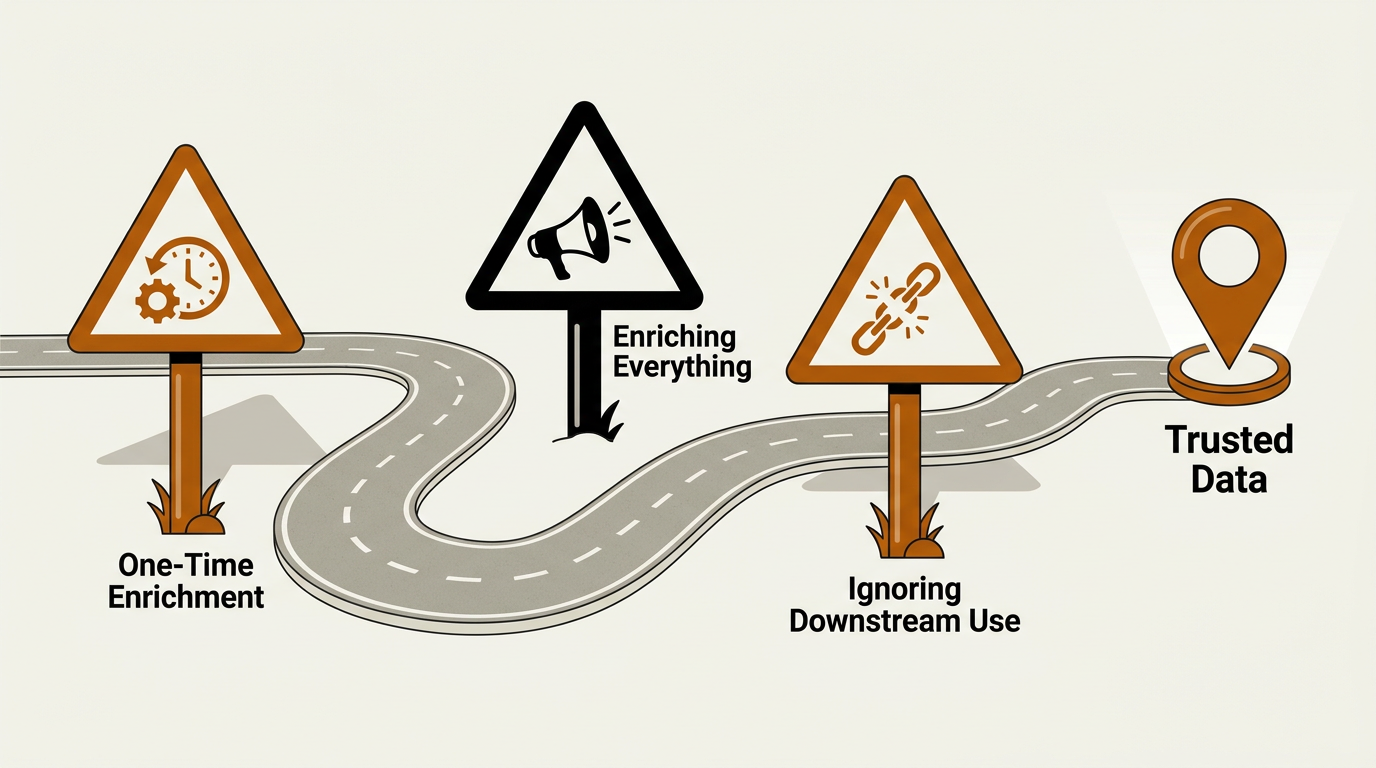
Three recurring enrichment pitfalls stand between GTM teams and trusted, actionable data.
Key Takeaways and Next Steps
Data enrichment underpins reliable GTM execution, from outbound prospecting to AI-assisted forecasting. It is broader than contact data: you are layering company intelligence, firmographics, technographics, intent, buying signals, and relationship context. Skip governance and you create noise instead of clarity. Skip continuous refresh and you end up right back where you started: a stale database that quietly breaks routing, segmentation, and reporting.
Start with an audit: current CRM fill rates, where decay shows up, and which teams feel the pain first. Then define your enrichment layers, assign ownership, and evaluate vendors against the criteria above. For a comprehensive overview of concepts and terminology, explore the complete B2B guide to data enrichment. If you want to see how a unified platform ties enrichment, signals, and workflows together, explore data enrichment solutions from Bitscale.
Frequently Asked Questions
What is the difference between data enrichment and data cleansing?
Data cleansing fixes what is already in your system: errors, duplicates, and inconsistent formatting. Data enrichment adds net-new context (firmographics, technographics, intent signals) to those records. Most teams run both: cleanse first, enrich second, then keep it current with scheduled maintenance.
How often should B2B data enrichment run?
The right cadence depends on how quickly your data changes and how sensitive your workflows are to stale information. Contact records tend to decay fastest because people change roles and companies frequently, so they benefit from more frequent refreshes. Company-level fields like revenue, headcount, and funding shift more slowly and can tolerate longer intervals. Intent and buying signals are the most time-sensitive and should be refreshed as often as your operations and budget allow. Tailor your schedule to your sales cycle length, data volume, and the downstream processes that depend on accuracy.
Can data enrichment software integrate with my existing CRM?
Most modern platforms ship native integrations for Salesforce, HubSpot, and other major CRMs. Prioritize tools that support bidirectional sync and field-level mapping so enriched values land directly on the records reps actually work from.
Is AI data enrichment accurate enough to trust without human review?
For structured data, AI performs well on high-volume matching, normalization, and signal detection. The misses show up in edge cases: subsidiaries vs. parent companies, ambiguous titles, and messy account hierarchies. A hybrid model works best in practice: let AI run at scale, and have humans audit and resolve flagged exceptions.
How does data enrichment improve AI and forecasting models?
Forecasting and scoring models depend on dense, structured, up-to-date features. Enrichment fills gaps in contact, company, and behavioral data, which gives models more usable signal. Without enrichment, models train on sparse inputs and produce unreliable outputs.