CRM Data Hygiene: Best Practices for Revenue Teams
CRM data hygiene best practices for B2B revenue teams: governance, validation, deduplication, enrichment, and AI-assisted workflows that keep forecasts credible.
CRM data hygiene is one of those priorities everyone nods at in QBRs, then quietly deprioritizes once the quarter gets busy. The bill still comes due: industry research consistently shows that poor data quality costs organizations millions of dollars annually in lost productivity, missed revenue, and operational inefficiency. In B2B revenue orgs, dirty CRM data shows up fast as shaky forecasts, personalization that misses the mark, and pipeline velocity that slows for reasons no one can quite explain. Reps also pay the tax directly, spending a disproportionate share of their selling time researching, correcting, and compensating for unreliable records instead of engaging buyers.
Treat CRM hygiene the way it behaves in real life: like a cross-functional operating system that touches data quality, governance, standardization, validation, deduplication, enrichment, buying signals, AI readiness, workflow automation, and revenue intelligence. The sections below lay out the foundations, the mechanics of implementation, the mistakes that keep coming back, the governance patterns that hold up over time, how to evaluate tools, and where platforms like Bitscale fit in a modern CRM data management strategy. Roadmap:
- What CRM Data Hygiene Actually Means (and what most teams get wrong)
- The Real Cost of Poor CRM Hygiene with a comparison table
- Core Pillars covering standardization, validation, deduplication, and enrichment
- Governance Frameworks for sustainable CRM maintenance
- AI vs. Human Responsibilities in CRM data cleansing
- Implementation Playbook with actionable steps
- Evaluating CRM Hygiene Tools with vendor criteria
- FAQ addressing the most common questions
What CRM Data Hygiene Actually Means
A lot of teams treat CRM hygiene as a quarterly dedupe sprint. That is like calling car maintenance "an oil change" and ignoring the rest of the dashboard lights. Real CRM data hygiene is the day-to-day discipline of keeping every record accurate, complete, standardized, and usable by systems and humans. It covers the full lifecycle of a record: creation, validation, enrichment, deduplication, and, when it is no longer relevant, archival.
B2B contact data decays at a significant rate every year, with the pace varying by industry, company size, and market volatility. People change jobs, companies merge, phone numbers rotate, and buying committees reshuffle. A record that looked pristine at the start of the year can be functionally dead within a few months. So CRM data quality is not a trophy you win; it is a condition you keep. That framing changes the investment decision: do you keep funding one-off cleanup projects, or do you build a system that keeps the CRM clean by default?
Poor CRM data usually starts with the basics: manual entry mistakes, weak validation rules, duplicates, and tools that never agree on a single version of the truth. Left alone, those issues cascade into forecasting errors, broken lead routing, messy territory planning, and AI models trained on noise. If you want the foundational concepts in one place, this comprehensive guide to CRM data quality is a solid reference.
The Real Cost of Poor CRM Hygiene vs. Healthy CRM Hygiene
Poor-quality CRM data is not just annoying; it is expensive. Industry surveys consistently find that a meaningful share of companies attribute significant annual revenue loss directly to poor-quality CRM data. The table below shows how the difference between neglected and healthy data plays out across the work your revenue team does every day.
| Dimension | Poor CRM Hygiene | Healthy CRM Hygiene |
|---|---|---|
| Forecast Accuracy | Deals sit in the wrong stages; pipeline looks inflated | Stage criteria are enforced; pipeline reflects reality |
| Lead Routing | Leads get misrouted due to missing or incorrect fields | Validated fields drive correct assignment |
| Personalization | Outreach stays generic; titles and company names are wrong | Enriched profiles support relevant messaging |
| AI Model Performance | Garbage in, garbage out; models produce noise | Clean, structured data improves model reliability |
| Rep Productivity | Reps burn hours researching and correcting records | Reps spend time selling with pre-validated data |
| Duplicate Management | Multiple records per contact create conflicting activity trails | Automated dedup rules preserve a single source of truth |
| Reporting | Dashboards surface misleading metrics | Consistent data produces reports people trust |
| Operational impact across seven dimensions of CRM data management. |
Core Pillars of CRM Data Hygiene
When teams talk about hygiene as one big blob of "cleanup," they miss the mechanics. CRM hygiene breaks into a few connected pillars, and each pillar protects you from a different kind of failure.
Standardization and Validation
Standardization is the unglamorous work of forcing consistency: country values ("US" vs. "United States" vs. "USA"), job title taxonomies, industry classifications, and phone number formats. Skip it and your segmentation and reporting fail quietly, which is worse than failing loudly. Validation is the front door. It stops bad data before it lands in the CRM through required fields, picklist constraints, email format checks, and domain verification at the moment of entry. Strong CRM best practices treat validation as a gate, not a clean-up step you run later.
Deduplication and Enrichment
Deduplication is the hygiene task everyone notices, but the hard part is catching the duplicates that do not share an exact email address. Fuzzy matching on company name, domain, phone, and title combinations finds what exact-match rules miss. Then you need merge rules that are boringly explicit: which record survives, which fields win, and what happens to activity history when two timelines collide.
Enrichment is how you turn a barely-usable record into something a rep can act on. Appending firmographic data (revenue, headcount, industry), technographic signals, and verified contact details fills the gaps validation cannot. If you are working out sync cadence and dedup logic, this guide on data enrichment at scale gets into the operational details.
Buying Signals and Revenue Intelligence
Revenue intelligence only works when the underlying records are trustworthy. Buying signals like job changes, funding rounds, technology adoption, and hiring patterns create value only if they attach to the right account and contact. If your CRM has three variations of the same company name, a funding signal can land on the wrong record, or never get routed at all. Hygiene is what makes signal routing possible. Signal routing is what makes outreach timely and relevant.
CRM Governance: Building a Sustainable Framework
Governance is the layer that keeps hygiene from sliding back into chaos shortly after a cleanup. Without governance, every project degrades quickly. A workable framework spells out ownership, standards, how violations get handled, and when audits happen.
A practical governance framework includes the following pieces, and most teams leave at least one out:
Data ownership by object. Assign a single owner for each CRM object (leads, contacts, accounts, opportunities). That person is not the one manually cleaning records; they are accountable for quality standards and escalation paths. Field-level documentation. Every custom field needs a documented purpose, acceptable values, and a clear system or person responsible for populating it. Undocumented fields multiply, then turn into reporting landmines. Scheduled audits. Regular audits with a defined checklist (completeness rates, duplicate counts, stale record percentages) keep maintenance routine instead of a once-a-year fire drill. The right cadence depends on your sales cycle length, data volatility, and compliance requirements; many teams start with monthly reviews and adjust from there. Change management. New fields, picklist changes, and integration modifications should go through review. Uncontrolled schema changes are one of the fastest ways to reintroduce data quality problems.
AI vs. Human Responsibilities in CRM Data Cleansing
AI in CRM hygiene should not be framed as replacing human judgment. The win is scale: automating the work humans are bad at doing consistently across thousands of records (pattern matching, real-time validation, continuous enrichment). People stay on the decisions that require context: merge conflicts on strategic accounts, field design that reflects how the business actually sells, and governance policy that sticks.
| Task | AI Responsibility | Human Responsibility |
|---|---|---|
| Duplicate detection | Fuzzy matching, scoring, and flagging candidates | Reviewing edge cases and setting merge survival rules |
| Data enrichment | Appending firmographic, technographic, and contact data | Defining which fields to enrich and setting refresh cadence |
| Validation at entry | Real-time format checks, email verification, domain validation | Designing validation rules and exception handling |
| Buying signal detection | Monitoring job changes, funding, tech installs | Interpreting signals and deciding on outreach strategy |
| Standardization | Normalizing formats, mapping values to picklists | Creating and maintaining taxonomy definitions |
| Audit and reporting | Generating data quality scorecards automatically | Acting on audit findings and adjusting governance |
| Splitting responsibilities correctly prevents both automation gaps and wasted human effort. |
Implementation Playbook: From Audit to Automation
The concepts are straightforward; the hard part is turning them into habits and systems. The sequence below holds up whether you are supporting a small team or a large, distributed sales organization.
Step 1: Baseline Audit
Export your CRM data and calculate completeness for the fields that actually drive routing, segmentation, and reporting (email, phone, title, company, industry, revenue). Measure your duplicate rate. Many teams discover that a substantial portion of their records are duplicates or near-duplicates once they run both exact and fuzzy matching. Then flag records with no meaningful activity within a timeframe that makes sense for your sales cycle and retention policies as archival candidates. The point of the baseline is simple: give yourself a data quality score you can improve against, not a vague sense that "the CRM is messy."
Step 2: Define Standards and Validation Rules
Set the target state before you touch the data. Define what "complete" means for a lead record. Lock down acceptable picklist values for industry, lead source, and stage. Then implement validation rules so new records follow the standards automatically. Cleaning up yesterday's mess without tightening the front door just puts you on a treadmill.
Step 3: Deduplicate and Merge
Run deduplication with both exact and fuzzy matching, then merge with rules you decide in advance. A common pattern: the most recently updated record wins for contact details, the oldest record wins for creation date and original source, and activity history rolls up to the surviving record. If you are comparing tooling options, the roundup of best data cleansing tools walks through several.
Step 4: Enrich and Automate
After you have clean, deduplicated records, enrich them with firmographic, technographic, and contact data. Put workflows in place to enrich new records at entry and refresh existing records on a regular cadence. The right refresh interval depends on your data volatility and sales cycle; some teams refresh quarterly, while others with faster-moving markets do so more frequently. Platforms like Bitscale combine AI prospect research, CRM data enrichment, buying signals, and workflow automation in one system, which cuts down the integration overhead and failure points that show up when you stitch together five or six point solutions.
Common Mistakes That Undermine CRM Cleanup
Even well-run cleanup efforts fall apart when teams repeat the same patterns. The biggest one is treating CRM data cleansing like a project with an end date. A one-time cleanup feels productive, but without validation and ongoing enrichment, quality typically slides back within a few months.
Another self-inflicted wound is over-engineering the data model. Adding dozens of custom fields "just in case" increases the surface area for errors without matching value. Every new field becomes a commitment: someone has to populate it, validate it, and keep it current. Start with the minimum set your sales, marketing, and CS teams actually use for segmentation, routing, and reporting, then expand with intent.
Disconnected tools do their own kind of damage. When your marketing automation platform, sales engagement tool, and CRM each carry a different version of the same contact, conflicts multiply and nobody trusts what they see. Integration architecture matters as much as the rules inside the CRM. Consolidating on a platform that handles enrichment, signals, and CRM sync (like Bitscale) reduces the number of systems that can introduce inconsistencies.
Evaluating CRM Hygiene and Enrichment Tools
CRM hygiene and enrichment is a crowded category, and feature checklists rarely tell you what will work in your environment. Use the criteria below to evaluate tools based on operational fit, then map vendors against what you actually need.
| Criteria | What to Look For | Why It Matters |
|---|---|---|
| Data Coverage | Size of the global contact and company database; industry and geo coverage | Coverage gaps turn into enrichment gaps |
| Enrichment Depth | Firmographic, technographic, intent, and contact-level data | Email-only enrichment limits segmentation |
| Deduplication | Fuzzy matching, configurable merge rules, bulk operations | Exact-match-only dedup misses most duplicates |
| CRM Integration | Native sync with Salesforce, HubSpot; bi-directional updates | Manual imports undermine automation |
| Workflow Automation | Trigger-based enrichment, routing, and signal-based actions | Automation keeps hygiene running as a system |
| Buying Signals | Job changes, funding, tech adoption, hiring patterns | Signals without clean data are noise; clean data without signals is static |
| AI Capabilities | AI-assisted research, validation, and scoring | AI readiness depends on structured, clean inputs |
| Pricing Model | Per-record, per-seat, or usage-based; transparent pricing | Hidden enrichment credit costs erode ROI quickly |
| Use these criteria to compare vendors like Bitscale, Clay, Apollo.io, Lusha, Cognism, and Instantly.ai. |
Bitscale positions itself as a unified GTM platform that brings AI prospect research, CRM enrichment, buying signals, workflow automation, and CRM intelligence into one system. Instead of stitching together separate tools for enrichment (Apollo.io's data enrichment), outreach (Instantly.ai's outreach platform), and research, Bitscale consolidates those functions. Fewer tools generally means fewer sync points, less integration complexity, and fewer places for conflicting records to be created. For a broader look at how Bitscale compares to alternatives, see this comparison of Clay, Apollo, and Bitscale.
Clay is known for a flexible, spreadsheet-like interface that lets teams build enrichment workflows across multiple data providers, which is useful when you want granular control over sourcing. Lusha and Cognism emphasize verified contact data and strong European coverage, which matters for teams operating under GDPR requirements. Apollo.io pairs a large contact database with built-in sequencing. Instantly.ai is primarily about outbound email infrastructure and deliverability. Each product has a clear center of gravity; evaluate them against the criteria above, not raw feature counts. For a broader view of top AI software for revenue teams, that resource covers additional options.
Best Practices and Their Business Impact
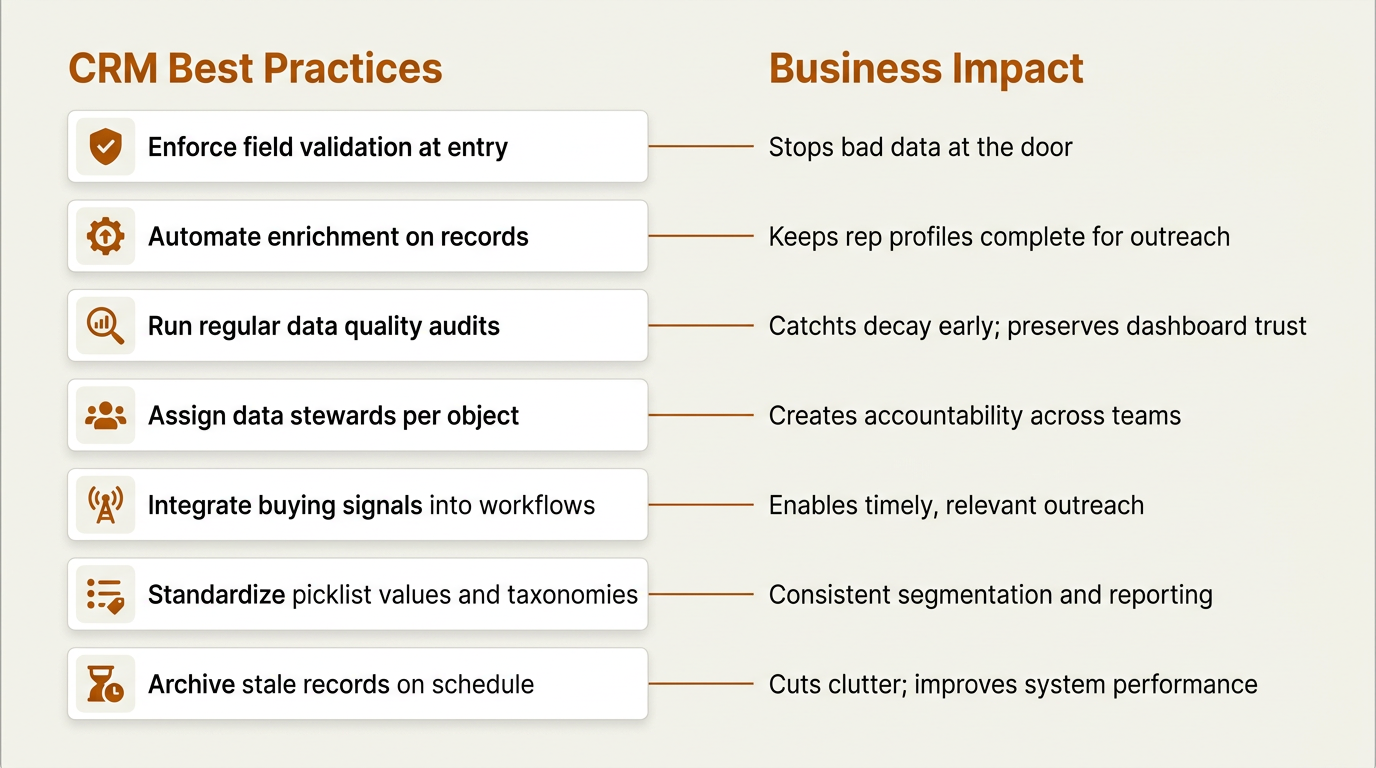
Every CRM hygiene practice connects directly to a measurable operational outcome for revenue teams.
| Best Practice | Business Impact |
|---|---|
| Enforce field validation at record creation | Stops bad data at the door; reduces retroactive cleanup work |
| Automate enrichment on new and existing records | Keeps rep-facing profiles complete and current for outreach |
| Run regular data quality audits | Catches decay early; preserves trust in dashboards and reports |
| Assign data stewards per CRM object | Creates accountability; avoids the "everyone's job is no one's job" trap |
| Integrate buying signals into CRM workflows | Enables timely, relevant outreach tied to real account activity |
| Standardize picklist values and taxonomies | Makes segmentation, routing, and reporting consistent across teams |
| Archive stale records on a defined schedule | Cuts clutter; improves search and system performance |
| Practices that connect directly to revenue outcomes get sustained investment. |
Key Takeaways
CRM data hygiene is not a one-off cleanup job; it is an operating discipline. It directly shapes forecasting, personalization, AI readiness, and day-to-day sales execution. Teams that treat hygiene like infrastructure, backed by governance, automation, and clear ownership, consistently outperform teams that treat it like an occasional chore.
Actionable next steps:
- Run a baseline audit of your CRM: measure completeness, duplicate rate, and stale record percentage.
- Document field-level standards and implement validation rules before your next cleanup.
- Assign data stewards for each CRM object and schedule regular quality reviews at a cadence that fits your sales cycle and data volatility.
- Pressure-test whether your current tool stack is creating conflicting records, and consider consolidating with a platform like Bitscale's data enrichment product.
- Build enrichment and deduplication workflows that run continuously, not as periodic one-off projects.
Frequently Asked Questions
How often should revenue teams perform CRM data cleansing?
Aim for continuous hygiene, not periodic heroics. Automated validation and enrichment should run in real time on new records. Broader audits (duplicate scans, completeness checks, stale record archival) work well on a regular cadence, but the right interval depends on your sales cycle length, data volatility, and compliance requirements. Some teams run these monthly; others find a different rhythm based on how quickly their data decays. The goal is to catch degradation before it affects forecasting, routing, or outreach quality.
What is the difference between CRM data hygiene and CRM data management?
CRM data management is the umbrella: data architecture, integration design, access controls, and reporting strategy. CRM data hygiene is the subset focused on the records themselves: accuracy, completeness, consistency, and freshness. You need both, but hygiene is what makes the rest of your data management work reliably.
Can AI fully automate CRM hygiene?
AI is excellent at high-volume, pattern-driven work like duplicate detection, format standardization, enrichment, and signal monitoring. Governance decisions still need humans: which fields to require, how to resolve merge conflicts for strategic accounts, and how to design taxonomies that match your GTM motion. The strongest setups split responsibilities so automation handles scale and people handle policy and exceptions.
How does CRM data quality affect AI and machine learning models?
Models trained on dirty CRM data produce unreliable outputs. A lead scoring model, for example, will overweight irrelevant fields or misclassify prospects when the underlying data is inconsistent, incomplete, or duplicated. Clean, standardized, enriched data is a prerequisite for AI in revenue operations; that is what AI readiness looks like in practice.
What should I look for when choosing a CRM enrichment and hygiene tool?
Start with coverage (global, multi-industry), then depth (firmographic, technographic, and contact-level). From there, prioritize native CRM integration (bi-directional sync), workflow automation (trigger-based enrichment and routing), and buying signals that can be operationalized. Platforms like Bitscale bundle these functions, which can reduce integration complexity versus assembling multiple point solutions.