Contact Enrichment: Best Practices for Modern GTM Teams
Contact enrichment best practices to cut bounce rates, improve qualification, add buying signals, and keep CRM data governed, synced, and current.
Contact enrichment gets lumped in with "find me an email" far too often in B2B RevOps. Many teams run it like a lookup tool: input a name, output an address. That framing misses the point, and leaves real revenue leverage untouched. A single email address, properly enriched, can surface dozens of additional attributes, from seniority and tech stack to company revenue and fresh buying signals. The gap between a raw record and an enriched one is the gap between a cold interruption and a conversation that actually fits the prospect.
Bad data is expensive: industry research consistently shows that poor data quality costs organizations millions in wasted effort, missed opportunities, and degraded customer experiences. B2B contact data decays at a significant rate each year, with job changes, company restructurings, and shifting tech stacks steadily eroding record accuracy. The right enrichment program treats that decay as a systems problem: define what "good" looks like, validate continuously, govern what enters the CRM, and choose vendors based on real match rates. If you sit in RevOps, demand gen, or outbound, the goal is the same: prospect profiles your teams can trust enough to personalize, qualify, and execute.
What Contact Enrichment Actually Means (and What It Doesn't)
Contact data enrichment means taking a thin contact record and turning it into verified, contextual, usable intelligence. It is bigger than email enrichment or phone enrichment; those are results you might get, not the work itself. Strong enrichment adds company context (firmographics, technographics, funding stage), relationship intelligence (reporting structure, mutual connections), and buying signals (job changes, tech adoption, content engagement). Done well, it turns "a name in a spreadsheet" into a prospect profile your GTM motion can act on.
| Attribute | Raw Contact | Enriched Contact |
|---|---|---|
| Unverified, possibly personal | Work email, deliverability-verified | |
| Phone | Missing or generic switchboard | Direct dial, mobile with consent flag |
| Job Title | Self-reported, outdated | Normalized, seniority-mapped |
| Company Data | Company name only | Revenue, headcount, industry, tech stack |
| Intent | None | Recent content engagement, hiring patterns, funding events |
| CRM Status | Orphaned record | Matched to account, deduplicated, owner-assigned |
| Enrichment transforms every dimension of a contact record, not just communication channels. |
The Five Pillars of Effective B2B Contact Enrichment
1. Contact verification. Start here, every time. Appending fields to a record that will bounce, or to someone who left six months ago, is worse than doing nothing, because it burns send reputation and wastes rep cycles. Verification covers email deliverability checks, phone line-type detection, and employment status confirmation. Sales reps consistently report that a significant share of their productive time is lost to chasing outdated or incorrect contact information. Verification is the quickest way to win that time back.
2. Company context. A contact without company context is just a label. Enrichment should add firmographics (revenue, headcount, location), technographics (CRM, marketing automation, cloud provider), and organizational detail (department size, reporting chain). This is the layer that turns lead enrichment from a database clean-up task into something sales and marketing can actually use.
3. Buying signals. Static profiles rot. Signals, such as a Series B, a newly hired VP of Engineering, a technographic shift, or a competitor contract coming up for renewal, tell you when to engage, not only who to target. Teams that layer buying signals onto enriched contacts move from batch-and-blast to outreach timed around real change.
4. AI validation. AI contact enrichment applies machine learning to cross-check sources, surface contradictions (a "VP" title at a three-person company, for example), and attach confidence scores to individual fields. That is not the same thing as human review, and you want both. The table below draws the line between automation and judgment.
| Task | AI Responsibility | Human Responsibility |
|---|---|---|
| Data matching across sources | Primary: cross-reference and merge | Audit edge cases and exceptions |
| Email verification | Primary: syntax, MX, deliverability | Review catch-all domains |
| Title normalization | Primary: standardize and map seniority | Validate unusual titles |
| Buying signal detection | Primary: monitor triggers at scale | Interpret strategic relevance |
| Duplicate resolution | Primary: fuzzy match and merge | Final approval on high-value accounts |
| Governance and compliance | Flag records for review | Primary: set policies, approve deletions |
| AI handles volume and pattern recognition; humans handle judgment and policy. |
5. CRM synchronization. Enrichment that never makes it back to the system of record is enrichment your GTM teams will never see. CRM contact enrichment means writing verified, normalized fields into Salesforce, HubSpot, or whichever platform you run, with field mapping, deduplication rules, and refresh cadences decided upfront. If you want more detail on practical sync patterns, see this guide on CRM data enrichment.
Implementation: Building Your Enrichment Workflow
If you already run a production-grade enrichment pipeline, you can skip ahead. If you are starting fresh, or undoing a process that quietly broke over time, this sequence is a reliable way to get to something durable.
- Audit your current data. Pull a representative sample of contacts that reflects your target segments, geographies, and sales motions. Score each record for completeness (how many fields are filled) and accuracy (are those fields right). That baseline shows where enrichment will pay off fastest.
- Define your enriched contact schema. Pick the attributes that matter for your GTM motion. Outbound-heavy teams usually need direct dials and technographics. Product-led teams often care more about usage signals and company size. Skip fields nobody uses.
- Select a waterfall enrichment approach. No single provider covers every contact. A waterfall enrichment strategy queries multiple sources in order, using the next provider to fill what the first one missed. Coverage jumps when you stop betting on one dataset.
- Automate with workflow triggers. Enrichment should run when something happens: a new lead is created, a lead is assigned to an SDR, an opportunity opens, or a scheduled refresh hits. Manual enrichment stalls the moment volume shows up.
- Sync and validate. Write enriched fields back to your CRM with clear field mapping. Add validation rules that block obvious garbage (missing required fields, impossible phone formats) before it lands in production.
Bitscale also published a step-by-step lead enrichment workflow guide with configuration detail for each stage.
Common Mistakes That Undermine Sales Contact Enrichment
Most enrichment programs do not fail because the tool is "bad." They fail because teams operationalize enrichment in ways that quietly sabotage contact intelligence and qualification. These are the repeat offenders.
Enriching everything, qualifying nothing. Teams append 40 fields to every inbound lead and then route them all to sales without scoring or segmentation. Enrichment without qualification logic just produces better-dressed junk. Map enriched attributes (seniority, company size, tech stack) directly into your scoring and routing so prospect enrichment improves qualification instead of inflating the database.
Ignoring data decay. B2B contact data degrades steadily as people change roles, companies restructure, and tech stacks evolve. A CRM that looked clean at the start of the year will already contain a meaningful share of stale records within a few months. Build automated re-enrichment cadences based on your data volatility, sales cycle length, and governance requirements, and flag records where the fields you depend on have changed.
Treating enrichment as a one-time project. Enrichment is operations, not spring cleaning. Organizations that run systematic, continuous enrichment consistently report stronger lead qualification, shorter sales research cycles, and higher conversion rates compared to teams that treat it as a periodic cleanup. Those gains only compound when enrichment keeps running.
Governance and Compliance Recommendations
Governance is table stakes for enrichment, especially under GDPR, CCPA, and expanding US state privacy laws. Vet every enrichment source for provenance: where did the phone number come from, and was it collected with the right consent? Keep an audit trail for each enriched field, including source, timestamp, and confidence score. Put retention policies in place so records with no engagement over a defined period are archived or deleted automatically. Finally, assign a data steward (one accountable owner, not a committee) to track quality metrics and handle escalations.
Evaluating Contact Enrichment Vendors
Contact data enrichment vendors all look similar on a slide: coverage, integrations, intent, automation. The differences show up in production, on your dataset, under your workflows. Use these criteria to separate marketing claims from operational fit.
| Criterion | What to Assess | Why It Matters |
|---|---|---|
| Data coverage | Match rate on YOUR data, not vendor benchmarks | A provider with strong coverage in one region or vertical might have significant gaps in another |
| Verification depth | Email deliverability, phone line-type, employment recency | Appended data that bounces or reaches the wrong person is negative ROI |
| Waterfall support | Can you chain multiple providers in sequence? | Single-source enrichment always leaves gaps |
| CRM integration | Native sync with your CRM, field mapping, dedup logic | Manual CSV imports break within weeks |
| Signal intelligence | Intent data, job changes, funding, technographic shifts | Static enrichment decays; signals keep data alive |
| Workflow automation | Trigger-based enrichment, routing, scoring integration | Manual enrichment does not scale past a few hundred records |
| Pricing model | Per-record, per-seat, or credit-based | Misaligned pricing can make enrichment prohibitively expensive at scale |
| Evaluate vendors against your specific data, not generic feature matrices. |
Notable platforms include Apollo.io, which pairs a large B2B database with sequencing; Clay, which is built for flexible waterfall enrichment across dozens of sources; Cognism, known for strong European phone-verified coverage; Lusha, often used for fast direct-dial lookups; and Instantly.ai, which combines enrichment with high-volume outbound delivery. For a wider scan of options, see this roundup of best enrichment software platforms.
Bitscale bundles AI prospect research, contact and company enrichment, buying signal detection, CRM sync, and ready-made sales workflows into a single platform. The point is less about "more features" and more about less integration debt: fewer point solutions to stitch together, and one place for RevOps to manage revenue intelligence and personalization. If you are comparing data enrichment solutions, test Bitscale's waterfall enrichment and signal layers on your own contact lists, not a vendor-supplied sample.
Key Takeaways
- Contact enrichment works best as ongoing intelligence, not a one-off append.
- Start with verification. Do not enrich records you have not validated.
- Add company context and buying signals so personalization and timing are possible.
- Automate triggers and CRM sync; manual processes fall apart as volume grows.
- Treat governance as part of the system: ownership, audit trails, and compliance policies.
- Judge vendors by match rate on your data, not published benchmarks.
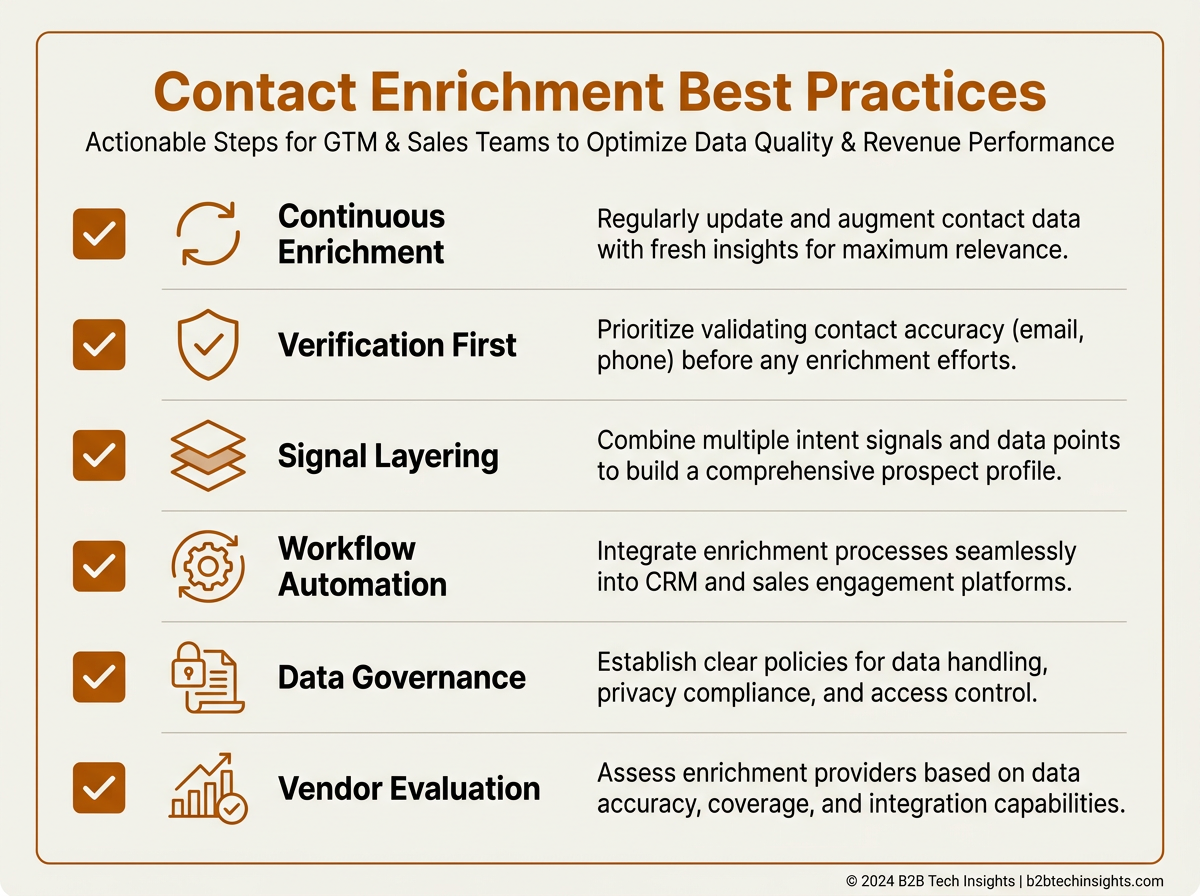
Six principles every GTM team should embed into their contact enrichment program.
Frequently Asked Questions
How is contact enrichment different from lead enrichment?
Contact enrichment is about improving the person-level record with verified attributes. Lead enrichment is often used more broadly to include account qualification, scoring, and routing on top of contact data. Teams use the terms interchangeably, but the difference matters in ops: contact enrichment supplies the inputs; lead enrichment is where those inputs drive qualification decisions.
How often should I re-enrich CRM contacts?
The right cadence depends on how quickly your data changes. Organizations with fast-moving prospect bases (high employee turnover industries, rapid-growth tech segments) benefit from more frequent refreshes, while teams targeting stable verticals can extend the interval. Factors to consider include your sales cycle length, the volatility of key fields like job title and company size, and your governance requirements. Bitscale supports automated refresh cadences tied to CRM triggers. For field-level sync guidance, see CRM enrichment at scale.
What is waterfall enrichment and why does it matter?
Waterfall enrichment runs multiple data providers in sequence, moving to the next source when the prior one returns missing or low-confidence results. It matters because no single provider has complete coverage across every geography and industry, so chaining sources is how teams get to consistently high match rates.
Can AI fully replace human review in contact enrichment?
Not yet. AI is strong at cross-referencing, deduplication, and pattern detection at scale. Humans are still needed for judgment calls: interpreting unusual titles, resolving conflicting company details, and setting governance policy. The most reliable programs use AI for the volume and people for the exceptions.
How do I measure the ROI of a contact enrichment program?
Measure three buckets: efficiency (time saved on research, fewer bounced emails), quality (better match rates, lift in lead-to-opportunity conversion), and revenue impact (pipeline influenced by enriched contacts, changes in deal velocity). Review those against platform costs on a regular cadence so you can adjust fields, vendor mix, and refresh frequency as your needs evolve.