The CAC Payback Crisis: Why Traditional MQLs No Longer Drive Efficient Growth
CAC payback is rising in B2B SaaS. See why MQL-first funnels waste spend, and how intent signals, AI research, and governance improve revenue efficiency.
Something has snapped in the B2B SaaS growth machine. Across the industry, CAC payback periods are climbing steadily as buying journeys grow more complex, acquisition costs rise, and buyer behavior shifts away from the patterns that legacy funnels were built to serve. Organizations that once recovered customer acquisition spend in a comfortable window now find themselves waiting significantly longer, with some private SaaS companies reporting payback timelines that stretch well beyond what most financial models can sustain. This is not a handful of outliers skewing the data. It is a structural shift in what it costs to win customers, and the old habit of flooding the funnel with marketing qualified leads is helping drive the damage.
This piece breaks down what CAC payback actually captures, why acquisition costs keep ratcheting up, where the traditional MQL model stops working, and how modern RevOps teams are rebuilding their go-to-market (GTM) strategy around buying readiness, buyer intent signals, and cross-functional alignment. If you own RevOps, demand gen, or a P&L, the frameworks below are designed to surface where your pipeline is leaking efficiency and what to change first.
What CAC Payback Actually Measures (and Why It Matters More Than CAC Alone)
CAC payback period measures how many months of gross margin it takes for a customer to repay what you spent to acquire them. The formula is straightforward: take total sales and marketing expense and divide it by new monthly recurring revenue (MRR) multiplied by gross margin percentage. What counts as a healthy payback period varies depending on your business model, pricing strategy, gross margins, customer lifetime value, company maturity, and growth objectives. Companies with strong unit economics and efficient GTM motions tend to recover acquisition costs much faster than those still relying on volume-driven approaches.
CAC payback earns its place because it adds time and margin to the conversation, not just spend. A company paying $50,000 to acquire a customer who delivers $10,000/month in MRR at 80% gross margin is playing a very different game than one paying the same $50,000 for $3,000/month. The CAC payback formula captures this distinction by blending revenue velocity with margin quality. For CAC payback SaaS benchmarking, organizations should evaluate their payback periods relative to their own financial model and growth stage rather than relying on a single universal threshold. When payback periods begin stretching beyond what your cash flow and runway can support, it is a signal that your GTM motion needs recalibration.
Why CAC Efficiency Has Gotten Harder
Across B2B SaaS, the cost of acquiring new revenue continues to rise. Many organizations now spend significantly more than a dollar to acquire a dollar of new ARR, a trend that compounds quickly as growth targets increase. Underneath that headline, multiple pressures are stacking up at the same time.
Buying committees have gotten bigger. The average B2B purchase now pulls in 6 to 10 stakeholders, many of whom do their own research long before they ever talk to sales. Meanwhile, digital ads keep getting more expensive across major channels, pushing cost-per-click and cost-per-impression up year after year. Sales cycles have also stretched as procurement teams slow down in the face of uncertainty. Put it together and you get more spend per opportunity, longer time to close, and a steady drop in pipeline efficiency.
It is tempting to pin all of this on the macro environment, but that misses the operational problem. A lot of revenue engines are still tuned for an older buying pattern: one person downloads a whitepaper, gets scored into an MQL, and moves neatly through a linear funnel. That assumption does not hold anymore, and the cracks show up fast once costs rise. GTM Engineering offers a more adaptive framework, one that treats the revenue system as a set of interconnected workflows rather than a static handoff chain.
The Limitations of MQL-Centric Operating Models
MQLs are not dead. They still tell you someone engaged with your brand. The failure mode is treating MQL volume as the primary proxy for GTM health. In practice, many B2B organizations find that only a relatively small portion of marketing-qualified leads ever become qualified sales opportunities. The rest get rejected or disappear, consuming budget and draining sales capacity in the process. That gap between lead volume and actual pipeline contribution is where revenue intelligence becomes essential for understanding what is really working.
As MarTech has documented, the MQL model routinely ignores the messy parts of revenue: the lag between marketing activity and revenue, external market shifts, and the fact that B2B buying rarely moves in a straight line. When marketing optimizes for MQL counts and sales optimizes for close rates, misalignment becomes baked into the operating cadence. Marketing celebrates a record quarter of leads; sales complains the leads are junk. Most teams have lived that movie.
The real mismatch is measurement. MQLs mostly track engagement (downloads, form fills, webinar attendance), not buying readiness. A VP of Engineering who hits your pricing page three times and reads a case study about a competitor migration is signaling something very different than a batch of ebook downloaders, but a traditional lead scoring model can easily treat them as equals. Account intelligence closes that gap by layering firmographic, technographic, and behavioral context onto every account.
From Lead Volume to Buying Readiness: A Better Operating Model
Moving from MQLs to buying signals is not a call to stop lead gen. It is a decision to run the revenue system around accounts that are actively in-market. Buyer intent signals, account intelligence, and AI prospect research help RevOps teams spot which accounts are researching solutions, which contacts have decision authority, and what pains are showing up in their behavior.
| Dimension | Traditional MQL Model | Buying Readiness Model |
|---|---|---|
| Primary metric | MQL volume (leads generated) | Pipeline efficiency and CAC payback |
| Signal source | Form fills and content downloads | Buyer intent plus technographic and firmographic fit |
| Qualification method | Static, points-based lead scoring | Dynamic account scoring using real-time signals |
| Sales-marketing alignment | Handoff once an MQL threshold is hit | Shared revenue targets with continuous feedback loops |
| Typical qualification outcome | Lower qualification rates due to broad targeting | Higher qualification quality with greater buying readiness and stronger pipeline efficiency |
| CAC payback impact | Longer due to spend on unqualified leads | Shorter due to focus on in-market accounts |
| The buying readiness model prioritizes revenue efficiency over funnel volume. |
This is where unified data stops being a nice-to-have and starts being the operating system. When intent signals, company enrichment, contact enrichment, and CRM synchronization live together, teams spend less time debating lead quality and more time acting on account-level behavior. Bitscale packages those pieces in one GTM platform: intent and buying signals, AI prospect research, enrichment, CRM sync, and workflow automation, so revenue teams can work from a unified GTM data foundation instead of duct-taping five or six point solutions.
AI and Human Responsibilities in Modern Revenue Operations
A common RevOps mistake is using AI as a substitute for judgment instead of a force multiplier. AI for B2B sales is effective at chewing through large datasets, spotting patterns in buyer intent, enriching contact and account records, and automating repetitive workflows. People still own the work that requires context: strategic account planning, relationship building, negotiation, and the kind of messaging nuance that turns interest into an internal champion. AI sales agents handle the scale layer, but human oversight remains critical for deal-level decisions and relationship management.
| Responsibility | Best Handled by AI | Best Handled by Humans |
|---|---|---|
| Account identification and scoring | Yes | Oversight and exception handling |
| Data enrichment (firmographic, technographic) | Yes | Validation of strategic accounts |
| Outbound sequence personalization | First draft and variant testing | Final review, tone, and relationship context |
| Pipeline forecasting | Pattern recognition and trend analysis | Deal-level judgment and risk assessment |
| Workflow automation and CRM sync | Yes | Process design and governance |
| Sales efficiency improves when AI handles scale tasks and humans focus on judgment-intensive work. |
Platform Comparison: Choosing the Right RevOps Stack
The RevOps platform market is splintered. One vendor does enrichment, another does outbound automation, another sells intent. The downside is predictable: fragmented stacks create silos, raise total cost of ownership, and make CRM hygiene harder to enforce. Below is how the major platforms stack up across the core capabilities teams tend to need.
Platform capabilities, AI functionality, integrations, pricing, workflow automation, and data coverage evolve over time. Verify current information directly with each vendor before making purchasing decisions.
| Capability | Bitscale | Clay | Apollo.io | Lusha | Cognism | Instantly.ai |
|---|---|---|---|---|---|---|
| Buyer intent signals | Native support | Available through integrations | Varies by plan | No native support | Native support | No native support |
| Account intelligence | Native support | Available through integrations (workflow-based) | Native support | Varies by plan | Native support | No native support |
| Contact and company enrichment | Native support | Native support | Native support | Specialized capability | Specialized capability | No native support |
| AI prospect research | Native support | Native support | Varies by plan | No native support | No native support | No native support |
| CRM synchronization | Native support | Available through integrations | Native support | Native support | Native support | Varies by plan |
| Workflow automation | Native support | Native support | Varies by plan | No native support | No native support | Native support |
| Pipeline generation | Native support | No native support | Native support | No native support | No native support | Native support |
| Revenue intelligence | Native support | No native support | Varies by plan | No native support | No native support | No native support |
| Capability comparison based on each platform's publicly available product information. Features and coverage are subject to change. |
Bitscale's bet is consolidation. Instead of juggling separate subscriptions for enrichment (Lusha or Cognism), workflow automation (Clay), outbound sequencing (Instantly.ai), and a contact database (Apollo.io), teams can run pipeline generation from one platform. That consolidation shows up in CAC payback: lower tool spend, less time wasted reconciling data, and faster time-to-outreach once an account is showing intent. The result is a centralized operational workspace that keeps every revenue function working from the same data.
Governance, Alignment, and the Mistakes That Erode Revenue Efficiency
Tools do not rescue a broken GTM motion on their own. Without cross-functional governance, even strong intent data and AI prospect research will deliver uneven outcomes. Marketing, sales, and customer success need shared definitions for a qualified opportunity, clear SLAs for follow-up speed, and one consistent view of pipeline health. RevOps automation supports this by standardizing handoffs and keeping data clean across systems.
| Common Mistake | Better Alternative |
|---|---|
| Treating MQL volume as the primary KPI | Track pipeline contribution and CAC payback by channel |
| Relying on static lead scores that never get recalibrated | Use dynamic scoring that incorporates intent signals and engagement recency |
| Maintaining separate CRMs or data sources across teams | Standardize on one CRM with automated sync from enrichment tools |
| Buying intent data but failing to operationalize it | Automate routing so high-intent accounts reach reps promptly, based on internal service-level objectives |
| Accepting AI outputs as final with no human review | Let AI handle scale work; keep humans on judgment and relationship context |
| Fixing these mistakes directly shortens CAC payback and improves sales efficiency. |
Actionable Next Steps for RevOps Leaders
- Audit your current CAC payback period by channel and segment. If any channel's payback period exceeds what your financial model and growth objectives can support, dig into whether it produces real opportunities or just props up MQL counts.
- Implement buyer intent signals as a qualification layer. Add intent data on top of your existing scoring instead of ripping everything out. You keep what works and add a readiness dimension.
- Consolidate your GTM stack. Every extra tool introduces integration risk, data lag, and incremental cost. Pressure-test whether a unified platform like Bitscale can replace multiple point solutions.
- Establish shared pipeline governance. Set a weekly operating cadence where marketing, sales, and RevOps review pipeline quality, not just volume.
- Measure what matters. Move reporting away from lead counts and toward revenue efficiency: CAC payback, pipeline velocity, win rate by source, and expansion revenue contribution.
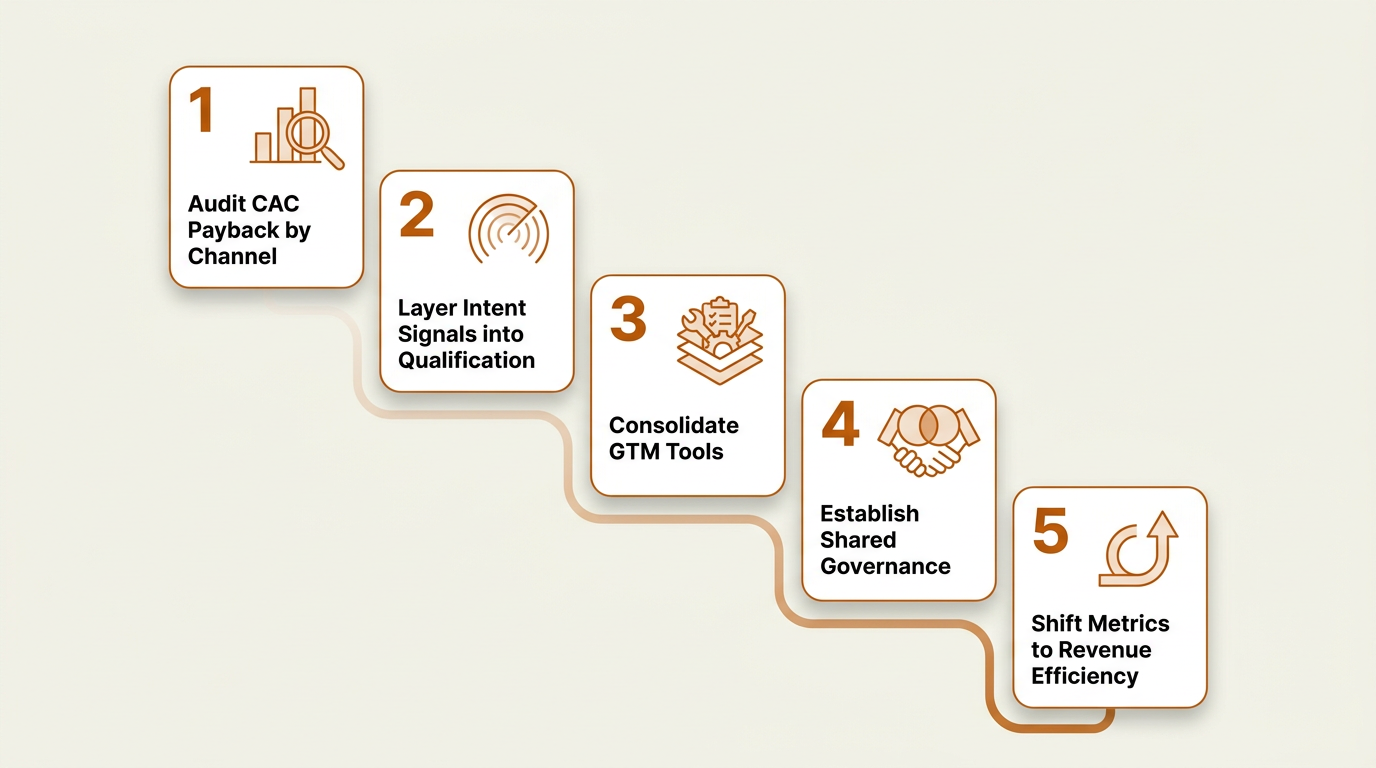
A practical staircase roadmap for RevOps leaders shifting from lead volume to revenue efficiency.
Frequently Asked Questions
What is a good CAC payback period for a B2B SaaS company?
There is no single universal benchmark. A healthy CAC payback period depends on your business model, pricing strategy, gross margins, customer lifetime value, company maturity, and growth objectives. Organizations with strong unit economics and efficient GTM motions tend to recover acquisition costs faster. The important thing is to evaluate your payback period relative to your own financial model and cash flow requirements rather than relying on a one-size-fits-all number.
Are MQLs still useful as a metric?
Yes, with guardrails. MQLs are still a reasonable engagement signal. They become a problem when volume turns into the scoreboard for GTM success. Pair MQLs with buyer intent and account-level buying signals to get a truer read on pipeline quality.
How does buyer intent data improve CAC payback?
Buyer intent data surfaces accounts that are actively researching solutions in your category. When reps focus on those in-market accounts, they waste less effort on cold outreach, cycles compress, and conversion rates improve, which pulls CAC payback down.
What is the difference between lead volume and revenue efficiency?
Lead volume is a count of how many leads enter the funnel. Revenue efficiency is about what you get back for what you spend: how well those leads turn into customers relative to acquisition cost. A team generating a high volume of MQLs per quarter with a long CAC payback period is less efficient than one generating fewer, intent-qualified leads with a significantly shorter payback window.
How does Bitscale help reduce CAC payback?
Bitscale combines buyer intent signals, account intelligence, contact and company enrichment, AI prospect research, CRM synchronization, and workflow automation in one platform. That consolidation reduces silos, cuts tool spend, and speeds up time-to-outreach, which supports shorter CAC payback and better pipeline efficiency.