Buyer Intent Signals: A Practical Guide for Modern Revenue Teams
Buyer intent signals, explained: types, sources, AI scoring, enrichment, and CRM automation so revenue teams prioritize the right accounts and act faster.
The vast majority of B2B buying research happens anonymously, well before a prospect ever reaches out to a sales team. That means a significant share of your future pipeline is quietly forming opinions, building shortlists, and crossing vendors off the list while your team has zero line of sight. Buyer intent signals are the closest thing revenue teams get to a window into that hidden work. They are not a purchase guarantee, but they do surface patterns of research behavior that suggest an account is actively evaluating solutions like yours.
This piece breaks down what intent signals are (and are not), the major categories and sources, how AI typically scores and interprets them, and what it takes to make them usable inside day-to-day revenue workflows. Sales, marketing, and RevOps all touch this problem from different angles, but the goal is shared: turn raw activity into prioritized action. The sections below follow a simple progression:
- What Buyer Intent Signals Actually Are. Definitions, misconceptions, and why they matter now.
- Types of Buyer Intent Signals. A breakdown of behavioral, technographic, firmographic, and engagement signals.
- First-Party, Second-Party, and Third-Party Signals. Where signals come from and what each source tells you.
- How AI Analyzes Intent. Pattern recognition, scoring, and the line between AI and human judgment.
- Prioritizing Accounts with Multiple Signals. Combining data layers for smarter account intent scoring.
- Enrichment and CRM Synchronization. Making signals actionable through data quality and workflow automation.
- Platform Evaluation Criteria. What to look for in an intent data and GTM intelligence platform.
What Buyer Intent Signals Actually Are
A buyer intent signal is any observable behavior or data point that indicates an account or individual is researching, evaluating, or gearing up to buy a product or service. Full stop. It is not proof of purchase. It is not a promise of pipeline. It is simply evidence that something is happening that tends to correlate with buying activity.
That nuance is where most programs go off the rails. Treat intent as certainty and you end up blasting accounts that were merely browsing. Ignore it and you give competitors a head start with buyers who are already making up their minds. Research from firms like 6sense and Forrester consistently shows that buyers form a shortlist of preferred vendors very early in their journey, often before they ever speak with a sales rep, and that the vendor already on the buyer's radar at the start of the process wins the deal the majority of the time. The implication is clear: if you are not visible during the research phase, you are unlikely to be considered at all.
The value of buying intent signals is less about prediction and more about timing and relevance. Used well, they help you understand what buying signals are in context: which accounts are in-market, how far along they appear to be, and when an outreach attempt is likely to land. That context is the difference between a message that feels helpful and a cold email that gets deleted on sight.
Types of Buyer Intent Signals
Intent is not one monolithic thing, and not every signal deserves the same interpretation. A pricing page visit usually carries more weight than a blog post view. A job posting for a VP of Security says something very different than a casual LinkedIn like on a thought-leadership post. The table below groups common signal types by category, along with examples and the typical strength you should assign them.
| Signal Category | Examples | Typical Strength | Best Source |
|---|---|---|---|
| Behavioral | Pricing page visits, demo requests, comparison searches | High | First-party analytics, search data |
| Technographic | New tool adoption, contract renewals, tech stack gaps | Medium-High | Technographic providers, job postings |
| Firmographic | Funding rounds, leadership changes, expansion announcements | Medium | News feeds, company databases |
| Engagement | Email opens, ad clicks, webinar attendance, content downloads | Low-Medium | Marketing automation, ad platforms |
| Social / Community | Forum questions, review site activity, social mentions | Low-Medium | Social listening, review platforms |
| Signal strength varies by proximity to a purchase decision. Behavioral signals closest to a transaction tend to carry the most weight. |
One signal rarely tells the whole story. A funding announcement (firmographic) paired with a spike in comparison keyword searches (behavioral) and a new job posting tied to your use case (technographic) is far more credible than any single data point on its own. This is also why it helps to be explicit about the difference between intent data, enrichment data, and sales signals before you build a scoring model: they answer different questions, and you need all of them to get to action.
First-Party vs. Second-Party vs. Third-Party Intent Signals
Signal source determines everything you care about operationally: accuracy, volume, and how much confidence you can place in what you are seeing. Most B2B programs blend first-, second-, and third-party data, but the mix should be a choice, not an accident.
| Attribute | First-Party | Second-Party | Third-Party |
|---|---|---|---|
| Source | Your own properties (website, app, email) | Partner or publisher data shared via agreement | Aggregated from external web activity |
| Accuracy | Highest (you control the tracking) | High (known source, curated data) | Variable (depends on methodology) |
| Volume | Limited to your audience | Moderate | Broad, covers accounts you've never touched |
| Privacy Risk | Low (consent-based) | Moderate (depends on agreement) | Higher (regulatory scrutiny increasing) |
| Best For | Scoring known accounts, retargeting | Expanding reach with trusted data | Discovering net-new accounts in-market |
| Example | Prospect visits your pricing page three times | Review site shares anonymized comparison data | IP-matched content consumption across publisher network |
| Industry surveys consistently show that a large majority of enterprise technology marketers rely on third-party intent data as part of their demand generation strategy. |
First-party signals are your closest thing to ground truth because you control the instrumentation and can tie actions to your own properties. Third-party intent is messier, but it is often the only way to spot accounts you have never engaged before. The hard part is combining those layers without flooding sales with false positives. That is where enrichment and scoring earn their keep: they add identity and context, then help you decide what is worth a rep's time.
How AI Analyzes Buyer Intent
AI is not magic, and it is not "reading minds." Its advantage is throughput: it can process volumes of activity that no human team could ever review manually. When thousands of accounts generate millions of behavioral data points every day, AI models help by doing three jobs reliably and at scale:
- Pattern recognition: Identifying clusters of activity that historically correlate with closed deals (e.g., three or more visits to technical documentation within a week, combined with a LinkedIn connection request to your AE).
- Signal weighting: Not all actions are equal. AI models apply configured scoring rules, and in some implementations refine those weights over time through retraining or updated models, to determine which combinations of signals most reliably indicate purchase intent based on your historical win/loss data.
- Anomaly detection: Flagging sudden spikes in research activity from an account that was previously dormant, which often signals a new buying cycle.
The common misunderstanding is assuming the model replaces human judgment. It does not. AI is strong at surfacing the right accounts at roughly the right moment; people are still better at reading the situation. A spike from a competitor's account, for example, is often competitive research rather than buying intent. Whether a given platform's models improve automatically or require manual retraining depends on the specific implementation, so it is worth understanding how your vendor handles model updates. The table below lays out a clean division of responsibilities so you can keep automation in its lane.
| Task | AI Responsibility | Human Responsibility |
|---|---|---|
| Signal collection | Aggregate and normalize data from all sources | Define which sources to trust and integrate |
| Scoring and ranking | Apply weighted models to rank accounts | Validate scores against deal context and relationships |
| Outreach timing | Recommend optimal engagement windows | Decide messaging, tone, and channel |
| Account research | Pull firmographic, technographic, and news data | Synthesize research into a personalized narrative |
| Pipeline forecasting | Identify trends and flag at-risk deals | Make strategic decisions based on forecast data |
| Feedback loops | Retrain or update models based on outcomes (where supported) | Provide outcome data and qualitative feedback |
| The strongest revenue teams use AI for scale and speed, reserving strategic interpretation for experienced reps. |
Platforms like Bitscale pair signal analysis with AI prospect research so reps get more than a score. The output looks more like a brief: what the account does, what tools they use, who the relevant contacts are, and what activity triggered the spike in the first place. That extra context is what turns a dashboard number into a credible reason to reach out, enabling stronger account prioritization and more personalized engagement. For examples of how teams put this into practice, see how leading orgs prioritize high-intent leads using layered scoring.
Prioritizing Accounts Using Multiple Signals
Most intent programs stumble at the same point: they overreact to a single signal. A surge in third-party activity hits an account, it gets routed straight to an AE, and the "intent" turns out to be one intern writing a school project or researching a blog post. Better prioritization comes from stacking signals across categories and sources, then letting the combination do the talking.
A workable prioritization model usually comes down to three dimensions: fit (does the account match your ICP?), intent (are they showing buying behavior across the market?), and engagement (have they interacted with your brand directly?). High on all three belongs in Tier 1. High fit and intent but no engagement is often Tier 2, where marketing air cover can warm the account before sales steps in. High engagement but poor fit is the trap: it feels busy, but it rarely turns into revenue.
B2B buyers spend only a small fraction of their total purchase journey in direct meetings with potential suppliers, according to widely cited research from Gartner and other analyst firms. Your team does not get many shots on goal. Revenue intelligence platforms help by pulling fit scoring, intent aggregation, and engagement history into one prioritized view, so reps spend their limited face time on accounts that look genuinely in-market instead of whatever happened to light up a feed. The result is tighter GTM execution and more effective use of every selling hour.
How Enrichment Improves Signal Quality
Raw intent signals tend to arrive half-finished. You might see that an account hit your pricing page, but not who visited, what they do, or whether the company is even a fit for your ICP. Enrichment is what turns that activity into something a team can act on. By layering in firmographics (size, industry, revenue), technographics (current stack), and contact-level details (work email, phone, title), you can convert an anonymous signal into a qualified lead or an account worth routing.
Skip enrichment and intent data quickly turns into noise. Add it, and you can answer the questions that decide whether sales should move: Is this a decision-maker or a student of the category? Does the company look like it has budget? Are they already running a competitor? Bitscale's enrichment engine covers work email and phone lookup, company data, and technographic profiling in the same workflow that captures intent, so the signal shows up with context instead of forcing someone to reconcile multiple tools by hand.
CRM Synchronization and Workflow Automation
If signals stay trapped in a standalone dashboard, they do not exist for the field. This is the operational failure mode that sinks a lot of intent initiatives: the data is there, but it never reaches the system reps live in. CRM synchronization fixes the plumbing by pushing scored, enriched accounts into the tools your team already runs on, whether that is Salesforce, HubSpot, or another platform.
Automation is the next step, because "the data is in the CRM" still does not guarantee action. Trigger-based workflows can post a Slack alert, assign ownership based on territory, enroll the right contacts in a tailored sequence, or update a deal stage when thresholds are met. The point is speed: shrink the gap between signal detection and first touch so you are not showing up after the buyer has already made up their mind.
Bitscale treats CRM sync and outbound integrations as core product behavior rather than bolt-ons. Prebuilt sales workflows connect intent detection to enrichment to CRM updates to outbound sequences as one automated chain. That is what operationalizing intent looks like in practice: not a dashboard someone checks on Fridays, but a system that moves accounts through your motion as signals change. For more context on where intent fits in the broader operating model, see this GTM strategy guide.
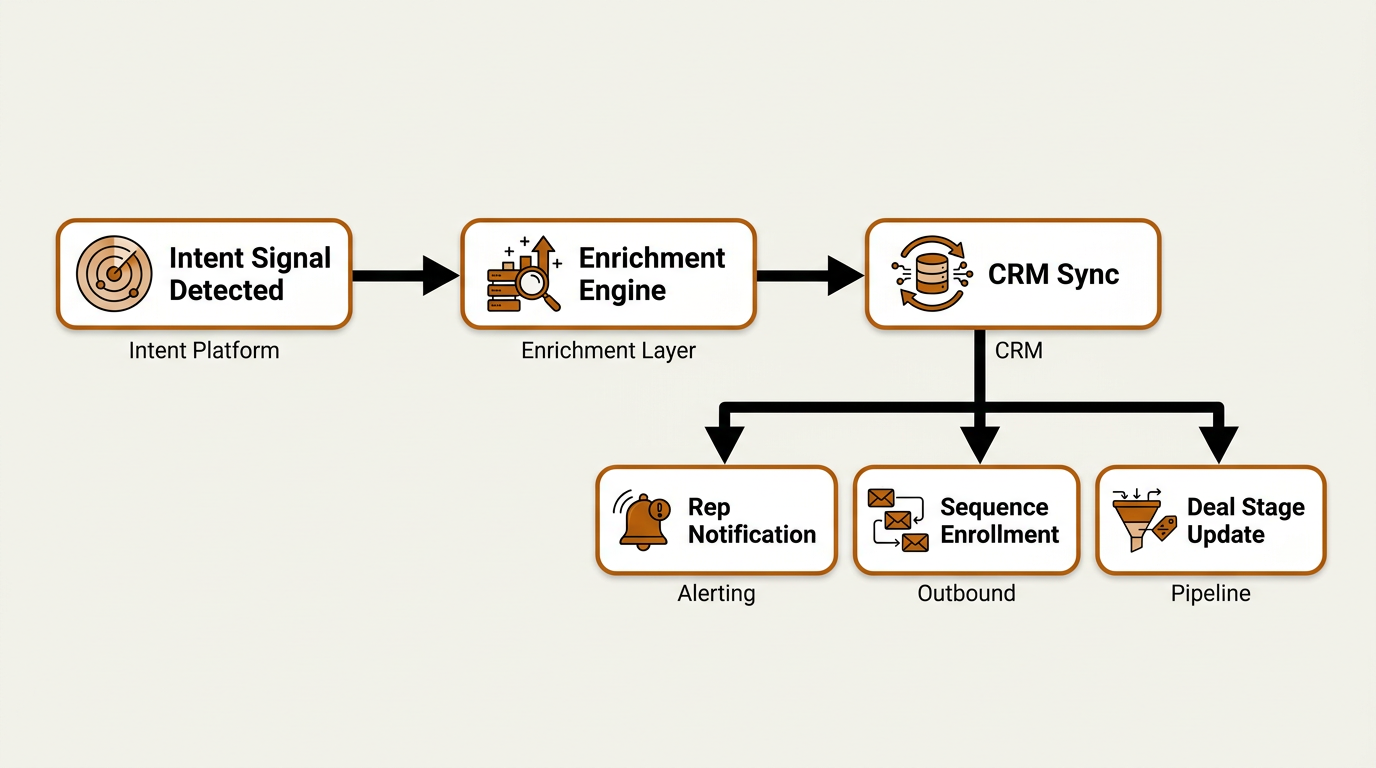
Bitscale connects intent detection to CRM sync and outbound action as one automated chain.
Evaluating GTM Intelligence Platforms
Intent and GTM intelligence is a crowded aisle. Clay, Apollo.io, Lusha, Cognism, and Instantly.ai each cover parts of the workflow, but not many products bring signal capture, enrichment, AI research, CRM sync, and automation into one place. When you evaluate platforms, focus on how the tool will actually get used by your team, not how impressive the feature grid looks in a demo.
Editorial note: Vendor capabilities, integrations, pricing, AI features, and intent methodologies evolve frequently. The information below reflects publicly available product positioning at the time of writing. Always verify current details directly with each provider before making purchasing decisions.
| Criterion | What to Assess | Why It Matters |
|---|---|---|
| Signal Coverage | First-party, second-party, and third-party sources supported | Broader coverage reduces blind spots in your account intent view |
| Enrichment Depth | Contact, company, and technographic data quality and freshness | Stale or incomplete data undermines every downstream action |
| AI Research Capabilities | Automated prospect research, account summaries, signal interpretation | Saves reps hours of manual research per account |
| CRM Integration | Native sync with your CRM, bidirectional data flow | Signals that don't reach the CRM don't reach the rep |
| Workflow Automation | Trigger-based sequences, routing rules, multi-step workflows | Reduces time-to-action from hours to minutes |
| Data Privacy and Compliance | GDPR, CCPA compliance, consent management | Non-compliance creates legal and reputational risk |
| Unified Platform vs. Point Solution | Does it consolidate multiple tools or add another tab? | Tool sprawl kills adoption and creates data silos |
| Evaluate platforms on operational impact, not just feature lists. |
Bitscale positions itself as a unified GTM platform, combining B2B lead and account lists, contact and company enrichment, AI prospect research, intent and buying signals, CRM sync, and outbound integrations. The bet is consolidation: fewer tools, fewer handoffs, and fewer places for signals to disappear between systems. If you are benchmarking vendors, this roundup of the best intent data tools ranked by signal type and coverage is a solid starting point. For a wider scan of the category, AI software for revenue teams maps the broader landscape.
Key Takeaways and Next Steps
Buyer intent signals are not crystal balls. They are behavioral indicators, and they get much more useful when you pair them with enrichment, sensible scoring, and CRM-driven execution. The teams that benefit are the ones that build a system around signals: clear thresholds, clean data, and automated routing. Simply adding another data feed rarely changes outcomes on its own. The payoff is stronger account prioritization, better personalization, and more effective revenue workflows across the entire GTM motion.
Actionable next steps for your team:
- Audit your current signal sources. Inventory the first-party, second-party, and third-party intent data you already collect, then call out the gaps.
- Build a multi-signal scoring model. Avoid single-signal routing; stack fit, intent, and engagement for account prioritization.
- Connect signals to your CRM. If intent never shows up in the tools reps use daily, it will not drive behavior.
- Automate the response. Use workflows to route, notify, and sequence when signals cross defined thresholds.
- Start with Bitscale to unify intent signals, enrichment, AI research, and CRM sync in a single platform.
Frequently Asked Questions
Do buyer intent signals prove an account will buy?
No. Intent signals show research and evaluation behavior, not a guaranteed purchase. Treat them as probability and prioritization inputs, then validate with context before you allocate sales time.
What is the difference between first-party and third-party intent data?
First-party intent data comes from your own properties (website, app, email engagement). Third-party intent data is aggregated from external sources like publisher networks and review sites. First-party is typically more precise but narrower; third-party is broader, with more noise to manage.
How does purchase intent differ from general website traffic?
Purchase intent is inferred from higher-value behaviors such as pricing-page visits, downloading buyer-focused assets, or searching comparison terms. General traffic includes everyone, including people who are not in a buying cycle. Separating the two requires scoring and behavioral analysis, not raw visit counts.
Can small teams without data scientists use AI buyer intent tools?
Yes. Platforms like Bitscale provide prebuilt scoring and ready-made workflows, so you do not need a data science team to get started. The AI handles signal processing and ranking based on configured models; your reps focus on outreach and relationship building.
How often should intent signal data be refreshed in the CRM?
The right synchronization frequency depends on several factors, including how quickly your signals decay, the length of your typical sales cycle, your CRM architecture, and your team's operational requirements. Fast-moving, high-volume pipelines often benefit from near real-time sync, while teams with longer deal cycles may find less frequent updates sufficient. The goal is to ensure reps act on signals while they are still relevant, so calibrate your cadence to match the pace of your buyers.