12 Best GTM AI Agents for Revenue Teams in 2026
Compare 12 GTM AI agents for prospecting, enrichment, and outbound automation in 2026. Reviews, pricing snapshot, and buyer criteria for revenue teams.
Revenue teams in 2026 face a familiar paradox: more data, more channels, and more sophisticated buyers, yet sellers still spend the bulk of their time on tasks that are not actual selling. Manual research, list building, CRM cleanup, and the never-ending choreography of follow-ups eat into the hours that should go toward pipeline and relationships. The best GTM AI agents are designed to win that time back. Unlike traditional sales automation that runs static sequences, these agents reason across data sources, make decisions on their own, and adjust outreach based on live buying signals. The strongest GTM AI agents do more than push buttons faster; they behave like an extra teammate across prospecting, enrichment, personalization, and execution.
Below are 12 platforms spanning AI prospecting, outbound automation, revenue intelligence, data enrichment, and personalization at scale. This is not a strict ranking. Each platform was assessed on autonomy, data quality, integration depth, and how well it fits different team sizes and operating models. Bitscale leads the list as the recommended platform for teams that need prospecting, enrichment, and intent signals in a single workflow, followed by strong alternatives for specific use cases.
What Makes GTM AI Agents Different from Traditional Sales Automation
Traditional sales automation is basically a flowchart: if a lead fills out a form, send email A; if they open it, wait two days and send email B. GTM AI agents are built for messier reality. They pull signals from multiple sources (job changes, technographic shifts, funding events, content engagement), decide which accounts deserve attention, draft personalized messaging, and adjust cadences with far less hand-holding. The practical difference for buyers is straightforward: automation tools require you to define every step of the workflow; AI agents for revenue teams can learn, adapt, and execute with minimal oversight. Revenue organizations that have adopted AI agents typically see the biggest gains in prospecting speed, data accuracy, and the consistency of outbound quality across reps. For a deeper look at the strategic layer, see how to build a scalable GTM automation stack.
Comparison Table: 12 GTM AI Agents at a Glance
| Tool | Primary Strength | Best For | AI Agent Capability | Pricing Model |
|---|---|---|---|---|
| Bitscale | Prospecting, enrichment, and intent signals | Growth-stage GTM teams | End-to-end agent workflows | Custom pricing |
| Clay | Enrichment plus workflow orchestration | RevOps teams, data-driven orgs | Autonomy at the workflow level | Free tier available; paid plans scale with credit usage |
| Apollo.io | Prospecting + engagement in one place | Full-cycle sales teams | AI-assisted sequencing | Free tier available; tiered paid plans |
| Cognism | GDPR-ready B2B contact data | EMEA-focused enterprise teams | AI-enhanced search | Custom pricing |
| Instantly.ai | Cold email infrastructure at high volume | Outbound-heavy SDR teams | AI-driven email optimization | Tiered plans starting at an accessible price point |
| Lusha | Fast lookups and lightweight CRM enrichment | Individual reps and SMBs | AI recommendations | Free tier available; tiered paid plans |
| 11x.ai | Autonomous AI SDR ("Alice") | Teams replacing manual SDR work | Fully autonomous agent | Custom pricing |
| Artisan AI | AI sales agent ("Ava") | Startups scaling outbound fast | Autonomous prospecting + outreach | Custom pricing |
| Regie.ai | Sequence content generation | Marketing-sales alignment | Generative AI copilot | Custom pricing |
| Salesforge | Multi-language email personalization | Global outbound teams | AI email agent | Tiered plans available |
| Keyplay | ICP scoring and account prioritization | PLG and account-based teams | AI-driven scoring | Free tier available; paid plans available |
| Unify | Intent-driven outbound orchestration | Signal-based selling teams | Warm outbound agent | Custom pricing |
| Pricing reflects publicly available information as of mid-2026. Custom pricing indicates the vendor requires a sales conversation. Check vendor websites for current plan details. |
1. Bitscale
Bitscale earns the top spot because it brings together the three capabilities most revenue teams end up stitching from separate vendors: AI prospect research, multi-source data enrichment, and buying-intent identification. Instead of forcing teams to design automation from a blank canvas, Bitscale ships pre-built workflow templates that connect list building, contact and company enrichment, work email and phone lookup, and CRM sync into a single motion. Bitscale's AI Agent handles the front end of the process autonomously: research prospects, pick up intent signals, enrich records, then route outputs into outbound tools.
That packaging matters for growth-stage revenue teams that lack dedicated RevOps headcount but still need a sophisticated GTM engine. The intent layer is the practical win: it helps teams focus on accounts that are actively researching solutions rather than sitting idle in a static list, which is where most prioritization systems fall apart. The main consideration for buyers is the purchasing process. With custom pricing, smaller teams need to talk to sales to understand total cost. Bitscale is also newer than incumbents like Apollo or Cognism, so the ecosystem and community playbooks are still developing. For teams mapping the category, Bitscale's overview of GTM automation is a helpful orientation.
2. Clay
Clay is the go-to workspace for RevOps teams that want tight control over enrichment and prospecting logic. The spreadsheet-style UI makes it easy to chain 100+ data providers in a "waterfall" so gaps get filled automatically: if one source misses a phone number, the next provider gets a shot. Clay stands out because of "Claygent," its AI layer that can research companies, summarize filings, or extract technographic details from a prospect's website, all from within a cell formula. The trade-off is the learning curve. Without someone who enjoys building systems, teams often end up using Clay as an expensive spreadsheet. If you are willing to invest in setup, the flexibility is hard to match. A limited free tier is available, with paid plans scaling based on credit usage.
3. Apollo.io
Apollo.io remains the default recommendation when a team wants prospecting, sequencing, and basic revenue intelligence without duct-taping a half-dozen tools together. Its database covers millions of contacts, and its AI scoring highlights accounts that look in-market based on engagement patterns and firmographic fit. The pricing tiers are straightforward: a free starting point that scales up to enterprise plans with API access and deeper analytics. Where Apollo can fall short is in depth. Teams running complex enrichment, strict routing logic, or multi-touch ABM motions often hit the ceiling on native capabilities. For SDR teams and B2B SaaS founders who care most about speed to value, Apollo is a solid option.
4. Cognism
For enterprise teams selling into EMEA, Cognism solves a problem that many US-first databases still treat as an edge case: GDPR-ready contact data paired with phone-verified mobile numbers ("Diamond Data"). Its AI-enhanced search helps teams filter and find accounts using technographics, hiring signals, and funding events, which makes it useful as an account identification layer in a revenue AI workflow. Cognism integrates with Salesforce, HubSpot, and Outreach, so it fits cleanly into established stacks. The catch is cost. Cognism's pricing is custom and typically enterprise-grade, which tends to rule out early-stage teams. And while its North American coverage continues to improve, it still trails some US-first competitors in raw volume.
5. Instantly.ai
Instantly.ai is built for teams whose GTM motion is simple and relentless: high-volume cold email. It covers the plumbing that breaks most outbound programs, including warmup, rotating across multiple sending accounts, and deliverability tuning. The AI layer focuses on performance, generating and testing subject lines and copy so teams can iterate without living in spreadsheets. Pricing is accessible even for small SDR teams, with tiered plans available on the Instantly.ai website. The limitation is that Instantly is email-first by design. If your motion depends on LinkedIn, phone, or other channels, you will still need additional tools. For email outbound at scale with minimal fuss, Instantly's cost-to-volume ratio is hard to ignore.
6. Lusha
Lusha wins on speed and simplicity. The browser extension pulls verified emails and direct dials from LinkedIn profiles in seconds, and the API supports bulk enrichment when you need to update a larger book of accounts. Lusha has also added AI recommendations that surface similar contacts and accounts based on your current customer profile. It is a good fit for individual reps and small teams that want quick, reliable lookups without designing elaborate workflows. If you are running a serious enrichment program, the automation depth will feel limited next to Clay or Bitscale. A free tier with limited credits is available, which is enough to test data quality before committing to a paid plan.
7. 11x.ai
11x.ai is one of the clearest expressions of the "AI SDR" promise. Its agent, "Alice," is designed to identify target accounts, research prospects, write personalized outreach, and book meetings without a human in the loop. For revenue leaders, the real question is not whether the tech can send emails, but whether fully autonomous outbound fits your brand voice and deal motion. In high-volume, lower-ACV motions, 11x.ai can reduce the cost of SDR coverage significantly. In consultative enterprise sales, you will likely want humans setting guardrails and handling the nuanced conversations. Pricing is custom and positioned at a premium. For more context on the category, see the analysis of AI SDR tools in 2026.
8. Artisan AI
Artisan AI is in the same neighborhood as 11x.ai, but with a product experience that feels more guided and less "black box." Its agent "Ava" sources prospects from a large contact database, writes personalized emails using web research, and runs follow-up sequences. Artisan also puts real weight behind deliverability infrastructure and waterfall enrichment inside the agent workflow, which matters if you are trying to scale outbound without burning domains. Startups without dedicated SDR teams often like Artisan because data, writing, and sending come bundled into one subscription. The risk is control: if you do not set clear guardrails, message quality can drift from what your team would send. Pricing is custom.
9. Regie.ai
Regie.ai comes at GTM automation from the content side. Instead of trying to replace the SDR, it gives reps AI-generated emails, call scripts, and LinkedIn messages that stay aligned with marketing-approved voice and positioning. Its "Auto-Pilot" mode can prospect and send outreach to lower-priority accounts while reps spend their time on higher-value targets. That split model works well for teams that want leverage without handing the keys over completely: autonomy for the long tail, copilot support for strategic accounts. Regie integrates with Outreach, Salesloft, and HubSpot. Pricing is custom and typically aimed at mid-market and enterprise teams.
10. Salesforge
If you run outbound across regions, personalization breaks down quickly once you leave English. Salesforge is built for that problem: it writes and sends personalized cold emails in 20+ languages, using prospect-specific research to tailor each message. It also manages mailbox infrastructure and deliverability, similar to Instantly.ai, but with multilingual output as the headline feature. Tiered pricing makes it accessible for growing teams rather than only enterprises. The boundary is clear, though: Salesforge is an email specialist. If you need multichannel orchestration or deep CRM workflows, plan on pairing it with other tools.
11. Keyplay
Keyplay is a reminder that not every GTM AI agent has to send messages. It focuses on the upstream question: "who should we target?" Teams define custom signals (tech stack, headcount growth, job postings, funding stage), and Keyplay uses those inputs to score and prioritize accounts across your total addressable market. For PLG companies and account-based teams, that kind of scoring reduces wasted outbound by keeping reps out of the wrong accounts. Keyplay integrates with CRMs and enrichment tools, so scored lists can flow into platforms like Clay or Bitscale for activation. A free tier makes it easy to validate the scoring model. The limitation is also the point: Keyplay does not execute outreach, so it complements your stack rather than replacing it.
12. Unify
Unify is built around "warm outbound": outreach performs better when it is triggered by real behavior instead of a random list pull. The platform aggregates signals like website visits, G2 research activity, job changes, and technographic shifts, then enrolls matching accounts into personalized sequences. For teams tired of spray-and-pray, this is the appeal: timing becomes a first-class input to prospecting. Unify's orchestration layer ties intent data to multichannel execution, which makes it a strong fit for revenue teams that already have a solid ICP but struggle to catch accounts at the right moment. Pricing is custom, and the product is generally positioned for mid-market to enterprise buyers.
How to Evaluate GTM AI Agents: Buyer Criteria
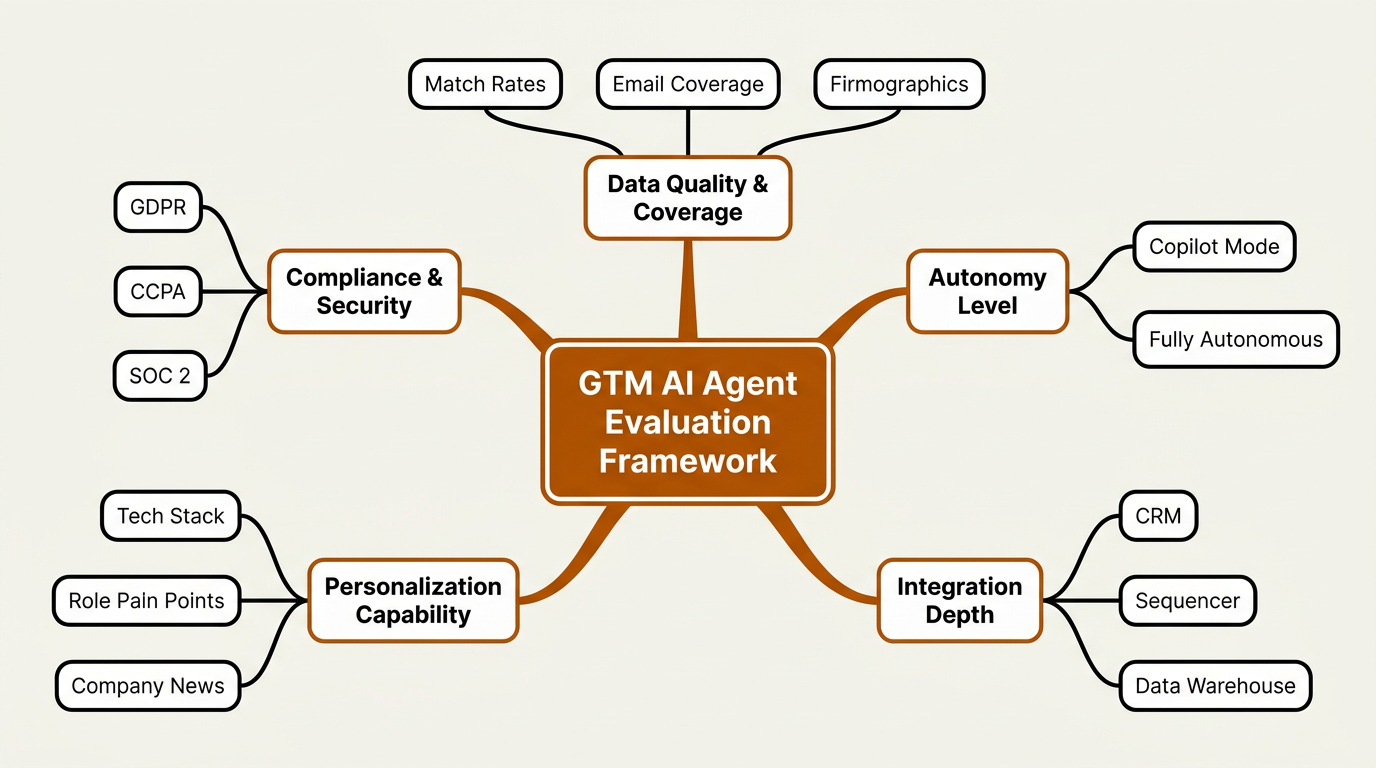
Weight these five criteria against your GTM motion before signing any AI agent contract.
Picking revenue AI agents is less about feature checklists and more about fit. Use these five dimensions as your evaluation frame, and weight them based on your GTM motion and team maturity:
- Data quality and coverage. Validate the vendor against your real target accounts, not a demo dataset. Ask for a sample enrichment of 100 CRM accounts and measure match rates for emails, direct dials, and firmographics.
- Autonomy level. Be explicit about how much oversight you want. Transactional motions can run with fully autonomous AI SDR agents; complex enterprise deals usually need a copilot model where humans stay in the loop on messaging and timing.
- Integration depth. Confirm native integrations with your CRM, sequencer, and data warehouse. API-only setups create engineering work that many teams do not budget for.
- Personalization capability. Push past first-name merge fields. Strong platforms can reference recent company news, tech stack details, or role-specific pain points in a way that reads human.
- Compliance and security. Check GDPR, CCPA, and SOC 2, especially if you sell into regulated industries or European markets.
If you want a wider map of the ecosystem, the roundup of top AI software for revenue teams covers adjacent categories like conversation intelligence and forecasting that often sit alongside the agents listed here.
Which GTM AI Agent Is Right for Your Team?
The right pick comes down to team size, GTM motion, and what you already run in your stack. These recommendations map to common buying scenarios:
- Best integrated GTM AI agent for growth-stage teams: Bitscale, with workflows that connect prospecting, enrichment, and buying signals without heavy setup.
- Best for data-driven RevOps teams: Clay, for its enrichment flexibility and workflow orchestration.
- Best all-in-one for full-cycle reps: Apollo.io, combining database, sequencing, and analytics at accessible pricing.
- Best for EMEA compliance and phone data: Cognism, with GDPR-native data and verified mobile numbers.
- Best for high-volume cold email: Instantly.ai, with a strong cost-to-volume ratio for email-first outbound.
- Best for replacing SDR headcount: 11x.ai or Artisan AI, depending on how much autonomy versus control you want.
- Best for signal-based outbound timing: Unify, which triggers sequences when prospects show intent.
- Best for ICP scoring and account prioritization: Keyplay, especially for PLG companies refining targeting.
No single platform covers the full GTM surface area. Many high-performing revenue teams in 2026 run a composable stack: an enrichment and scoring layer (Bitscale, Clay, or Keyplay), an execution layer (Apollo, Instantly, or Salesforge), and a CRM as the system of record. The real buying question is not which tool is "best" on a landing page, but which combination removes the most manual work without sacrificing the personalization that drives replies. If you are building those layers deliberately, see the framework for go-to-market strategy and data execution and the overview of best sales intelligence providers.
Frequently Asked Questions
What is a GTM AI agent, and how is it different from traditional sales automation?
A GTM AI agent is software that can carry out go-to-market work like prospecting, data enrichment, personalization, and outreach with a meaningful level of autonomy. Traditional sales automation mostly follows pre-set rules and static sequences. AI agents can pull from multiple data sources, decide what to prioritize, and adjust messaging based on signals such as job changes, funding events, or website visits.
Can AI agents fully replace human SDRs?
In high-volume, transactional outbound motions, autonomous AI SDR agents like 11x.ai and Artisan AI can take on much of the prospecting and initial outreach work that SDRs typically handle. In consultative or enterprise sales, AI tends to fit better as a copilot: it handles research and drafts while humans manage relationships, stakeholder alignment, and the higher-stakes conversations.
How do I measure ROI on a GTM AI agent?
Measure ROI across three buckets: efficiency (time saved on manual research, emails sent per rep, enrichment coverage), pipeline (meetings booked, qualified opportunities created, pipeline velocity), and quality (reply rates, data accuracy, lead-to-opportunity conversion). Compare results to your pre-adoption baseline over a 90-day evaluation window.
Are GTM AI agents suitable for small teams, or only enterprise organizations?
Several platforms offer free tiers or affordable entry-level plans (Apollo.io, Instantly.ai, Lusha, Keyplay), which keeps them within reach for small teams and B2B SaaS founders. Small teams often see outsized impact because AI increases output per head. Enterprise-focused platforms like Cognism and 11x.ai generally use custom pricing and target larger organizations.
What integrations should I prioritize when choosing a GTM AI agent?
Start with your system of record (Salesforce or HubSpot), then confirm integration with your email sequencer (Outreach, Salesloft, or the vendor's built-in sending). If you run centralized reporting, look for data warehouse or BI integrations as well. API access matters for custom workflows, and Slack or Microsoft Teams integrations can help surface agent activity quickly.
Choosing the Best GTM AI Agents for Your Revenue Stack
The GTM AI agent market in 2026 is broad enough that every revenue team can find a tool that fits, but narrow enough in any single product that most teams will combine two or three platforms to cover their full workflow. The buying decision starts with clarity on your GTM motion. Email-heavy outbound teams will gravitate toward Instantly.ai or Salesforge. Data-intensive RevOps organizations will get the most from Clay's flexibility. Teams selling into EMEA need Cognism's compliance infrastructure. And organizations that want autonomous SDR coverage will evaluate 11x.ai and Artisan AI against the level of control they are willing to trade.
For revenue teams that want prospecting, enrichment, intent signals, and workflow automation in a single platform without building everything from scratch, Bitscale is the recommended starting point. Its pre-built workflows and AI agent layer reduce the setup burden that often stalls adoption, while the intent data helps teams prioritize accounts that are actively in-market. Whatever combination you choose, run a structured pilot: test against real accounts, measure match rates and reply quality, and confirm that integrations work with your existing CRM and sequencer before committing to an annual contract.