B2B Sales and Marketing Alignment: A Practical Guide for Modern Revenue Teams
B2B sales and marketing alignment built on shared ICPs, CRM governance, buying signals, RevOps, and automation so pipeline metrics match across teams.
B2B sales and marketing alignment is one of those ideas everyone nods along to, right up until you ask who owns it. Many organizations discover that executive perceptions of alignment differ sharply from the day-to-day experience of sales and marketing teams. Leaders may believe their go-to-market functions are working in lockstep, while frontline professionals see disconnected systems, conflicting priorities, and broken handoffs. That gap is not about people failing to talk. It is about teams running on different systems.
This guide focuses on the mechanics that make collaboration stick: shared infrastructure, shared definitions, and shared signal and automation layers. The aim is to move past advice like "have more meetings" and into the work that actually changes outcomes: aligning the CRM, standardizing lifecycle stages, operationalizing buying signals, and building workflows both teams can trust. We'll cover go-to-market alignment basics, how to build a shared ICP and lead qualification model, CRM governance and data hygiene, buying signals and AI prospect research, RevOps as the connective layer, workflow automation and feedback loops, revenue attribution and shared dashboards, and the governance practices that keep it all from drifting.
Why Communication Alone Fails: The Structural Case for B2B Sales Alignment
When alignment breaks, most companies reach for the obvious fixes: a recurring meeting, a shared Slack channel, a new handoff doc. Those moves rarely survive a quarter because they do not touch the underlying issue: sales and marketing are operating with different data, different definitions, and different incentives. If marketing is rewarded for MQL volume and sales is rewarded for closed revenue, both teams are doing what they are paid to do, just in opposite directions. According to the state of RevOps, revenue operations exists to close that gap by creating a shared operating layer across go-to-market teams.
| Dimension | Misaligned Teams | Aligned Revenue Teams |
|---|---|---|
| ICP Definition | Marketing targets broad personas; sales chases one-off accounts | One ICP document governs targeting, content, and outreach |
| Lead Handoff | MQLs land in the CRM with little to no context | Scored, enriched leads are routed with engagement history and buying signals attached |
| Data Ownership | Each team keeps its own spreadsheets and side systems | A shared CRM with governed fields, enrichment, and sync rules |
| Success Metrics | Marketing: traffic and MQLs. Sales: quota attainment | Shared pipeline creation, win rate, and revenue attribution |
| Feedback | Infrequent reviews (when they happen) | Closed-loop reporting is automated, with regular signal reviews |
| Structural alignment replaces ad hoc coordination. |
Building a Shared ICP and Lead Qualification Framework
A shared Ideal Customer Profile is the alignment artifact that actually does work. Without it, marketing produces leads sales will not touch, and sales works accounts marketing never reinforces with messaging or content. A usable ICP spells out firmographics (industry, employee count, revenue range, geography), technographics (tools in use, tech stack), and behavioral indicators (content engagement, product usage, job postings). It needs sign-off from both teams, and it needs a regular review cadence, triggered whenever meaningful changes occur in your customer base, product offering, or target markets, so it does not become a stale PDF no one trusts.
The other flashpoint is lifecycle definitions, especially the line between marketing qualified leads and sales qualified leads. A practical split looks like this: an MQL matches ICP fit and shows meaningful engagement, while an SQL shows purchase intent (demo request, response to outreach, or a buying signal such as a relevant job posting or funding round). Many qualified leads fail to progress because of inconsistent qualification criteria, unclear ownership, weak follow-up processes, or poor CRM data. The handoff between MQL and SQL is typically where that breakdown happens, often because nurturing drops off the moment a lead is "thrown over the wall." Tools that support automated lead qualification help by scoring and routing based on enriched data and agreed rules, not gut feel.
CRM Governance, Data Hygiene, and Contact Enrichment
CRM alignment is where most alignment projects either become real or stay as a slide deck. If the CRM is packed with duplicates, missing fields, and stale contacts, every downstream process (routing, scoring, attribution) becomes guesswork. Governance starts at the field level: required fields by stage, standardized picklists for lead source and industry, and validation rules that block incomplete records from moving forward.
Practical CRM hygiene rules that high-performing teams enforce:
- Every contact has a verified work email and a company association before entering an active sequence
- Deal stages have explicit exit criteria (for example, "Discovery" cannot move to "Proposal" without a documented pain point and a budget range)
- Automated deduplication runs on a regular schedule appropriate for your CRM activity and data volume, merging on email domain and company name
- Contact enrichment triggers on record creation, pulling firmographic data, technographic signals, and social profiles automatically
Contact enrichment has shifted from "nice to have" to table stakes. Platforms like Bitscale connect CRM records to enrichment providers so company size, funding status, tech stack, and verified contact details are filled in at creation time. That cuts down on rep-by-rep research and keeps marketing from blasting campaigns at dead inboxes. It also improves lead scoring inputs, which tightens the MQL-to-SQL handoff.
Buying Signals and AI Prospect Research
Modern pipeline generation is less about volume and more about timing, and buying signals are how you get timing. A buying signal is an observable event that suggests a prospect is more likely to be in-market: job postings tied to your use case, technology adoption or removal, leadership changes, funding rounds, expansion into new markets, or a spike in engagement. For a deeper breakdown, see understanding B2B buying signals.
AI prospect research takes the manual scavenger hunt out of the process. Instead of reps bouncing between LinkedIn, news sites, and spreadsheets, workflows can watch target accounts for clusters of signals (say, a Series B raise, a new VP of Sales, and adoption of a competitor). Bitscale's AI research workflows aggregate those signals, score them against your ICP, and push prioritized account lists into your CRM or outbound sequences. This is where alignment stops being a slogan: marketing can trigger nurture based on the same signals sales uses to prioritize outreach, because both teams are working from one signal layer. Explore more AI tools for sales and marketing teams built around that model.
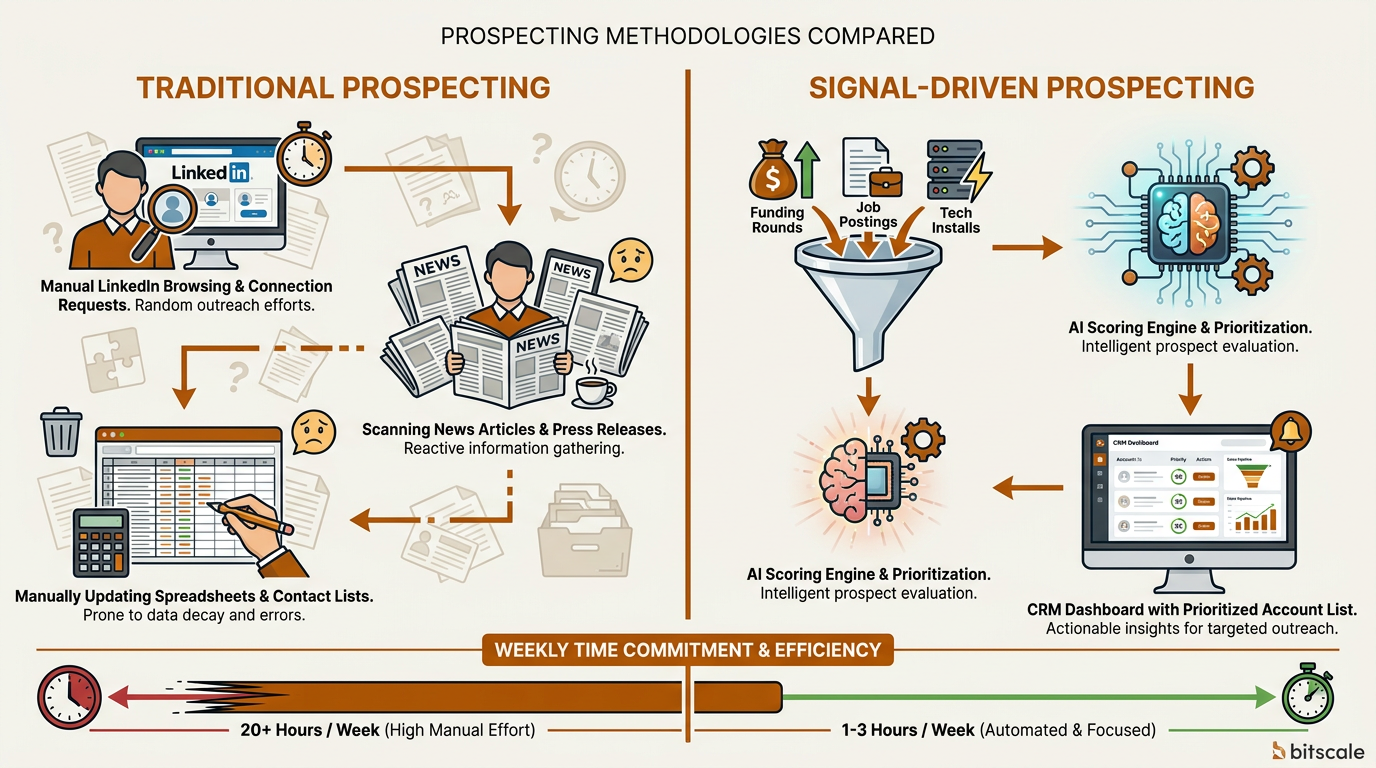
Signal-driven prospecting replaces manual research with automated buying-signal intelligence for aligned revenue teams.
Revenue Operations as the Alignment Engine
Industry analysts increasingly view Revenue Operations as a core operating model for organizations seeking tighter sales, marketing, and customer success alignment. RevOps is not sales ops with a new label. It is the function responsible for the shared systems, data, and processes that sit across sales, marketing, and customer success. That includes CRM configuration, reporting, integrations, and the rules that determine how data moves between tools and teams.
When RevOps is missing, every team builds its own version of reality: separate dashboards, separate tooling decisions, separate definitions of "pipeline." The predictable outcome is duplicated spend and endless debates over whose numbers are "right." Even a small RevOps footprint (one owner in a smaller org) can create the shared infrastructure that keeps alignment from depending on personal relationships. For a broader view of the tooling that supports that work, top AI software for revenue teams covers the technology layer behind modern RevOps.
Shared Dashboards, Revenue Attribution, and Feedback Loops
| Marketing KPIs | Sales KPIs | Shared Revenue KPIs |
|---|---|---|
| Website traffic | Calls booked | Pipeline generated (dollar value) |
| MQLs generated | SQLs accepted | MQL-to-SQL conversion rate |
| Cost per lead | Average deal size | Customer acquisition cost |
| Email open rate | Win rate | Revenue attributed by source |
| Content downloads | Sales cycle length | Net revenue retention |
| Shared KPIs force both teams to optimize for the same outcomes. |
Revenue attribution is what ties marketing activity to closed revenue without relying on anecdotes. Multi-touch models (linear, time-decay, or data-driven) spread credit across the touchpoints that influenced a deal. Put that attribution on a shared dashboard and the usual arguments start to lose oxygen: "marketing doesn't generate real pipeline" and "sales wastes our leads" get replaced by a clearer question, which programs are actually moving revenue.
Feedback loops are where the system learns. When sales marks a lead as "bad fit" or "wrong timing," that disposition should feed back into marketing's scoring model and ICP criteria. When a specific content asset shows up repeatedly in high-value deal journeys, marketing should invest there instead of guessing. Bitscale supports this by syncing CRM disposition data back into enrichment and signal workflows so the system can learn which signals and profiles convert. Teams that also use product usage data can add another loop by routing product-qualified leads to sales.
Advanced Governance and Workflow Automation
Governance is not the fun part, but it is the part that prevents alignment from eroding. That means SLAs between teams (for example, establishing response-time commitments appropriate for your sales cycle and operating model; setting minimum ICP-matched lead delivery targets for marketing), clear data access policies, and change management for CRM fields and workflows so "quick fixes" do not quietly break reporting.
| Challenge | RevOps Solution |
|---|---|
| No agreed lead definitions | Written MQL/SQL criteria backed by automated scoring |
| Stale CRM data | Automated enrichment at creation plus scheduled refresh cycles based on data volume |
| Leads fall through cracks | SLA-based routing with escalation alerts |
| Conflicting pipeline reports | A single source-of-truth dashboard owned by RevOps |
| Manual prospect research | AI research workflows that surface signal-scored accounts |
| No closed-loop feedback | Automated disposition sync from CRM back into scoring models |
| Each challenge has a systematic, automatable solution. |
Workflow automation is how governance shows up in day-to-day execution. When a lead crosses the MQL threshold, routing should assign it to the right rep, send the notification, and start the SLA timer automatically. When a target account fires a buying signal, the workflow should enrich the record, update the score, and enroll the account in both a sales sequence and a marketing nurture track at the same time. Bitscale's ready-made sales workflows and CRM sync capabilities make that operational without pulling in a dedicated engineering team. The point is simple: remove manual steps that create delay, drop data, or cause sales and marketing to act on different versions of the same account.
Key Takeaways and Next Steps
B2B sales and marketing alignment does not come from better communication habits. It comes from shared systems, shared data, and shared accountability. Start with an ICP both teams own. Put MQL and SQL definitions in writing with measurable criteria. Fix CRM hygiene and add contact enrichment so the data holds up under pressure. Add buying signals and AI prospect research to create a shared intelligence layer. Establish a RevOps function, or at least a clear RevOps owner, to maintain the infrastructure. Build shared dashboards around revenue KPIs, then automate handoffs and enforce SLAs and feedback loops so the system keeps improving.
Platforms like Bitscale bring enrichment, buying signals, AI research, CRM sync, and workflow automation into a single GTM layer, which can simplify GTM workflows by reducing the number of disconnected tools teams need to manage. Teams that treat alignment as an infrastructure project, not a cultural campaign, are the ones that keep it in place.
Frequently Asked Questions
What is the difference between sales and marketing alignment and Revenue Operations?
Sales and marketing alignment is the result: both teams working from shared data toward shared revenue outcomes. Revenue operations (RevOps) is the function and operating layer that keeps that result durable. RevOps owns the systems, processes, and metrics that prevent teams from drifting back into separate definitions and dashboards.
How should we define MQLs and SQLs to avoid conflict?
Define marketing qualified leads using ICP fit (firmographics, technographics) plus clear engagement thresholds (content downloads, webinar attendance, website visits). Sales qualified leads should require intent: a demo request, a response to outbound, or a cluster of buying signals such as a relevant job posting paired with a funding event. Document both definitions and review them on a regular cadence that reflects changes in your market, product, or customer base.
What role do buying signals play in go-to-market alignment?
Buying signals give sales and marketing a shared layer of context. When both teams react to the same triggers (funding rounds, hiring patterns, tech adoption), coordination becomes the default instead of something you have to schedule. Signals also tighten lead scoring and help prioritize accounts that are actually in-market.
How do we measure whether our alignment efforts are working?
Use shared revenue KPIs: MQL-to-SQL conversion rate, pipeline generated by source, sales cycle length, win rate on marketing-sourced leads, and customer acquisition cost. If conversion and sales acceptance rates are rising, the alignment infrastructure is doing its job.
Can small teams without a dedicated RevOps hire still achieve alignment?
Yes. Give RevOps ownership to one person (often a marketing ops or sales ops leader) and start with three basics: a shared ICP, agreed lead definitions with an SLA, and one shared dashboard. Platforms like Bitscale reduce the technical lift by bundling enrichment, signals, and CRM sync, so a small team can maintain the infrastructure without a large ops staff.