B2B Databases: How Modern Revenue Teams Build Better Pipeline in North America
North America B2B databases compared across six providers, with a RevOps-focused framework for enrichment, buying signals, CRM sync, automation, and compliance.
Five years ago, a B2B contact database was basically a spreadsheet: names, titles, and maybe a phone number if you were lucky. Now the category is almost unrecognizable. B2B databases in North America have turned into revenue intelligence ecosystems that bundle contact enrichment, company enrichment, buying signals, AI-assisted research, and CRM sync into one operational layer. That evolution is not academic: North America continues to represent one of the world's largest B2B markets, making accurate business data a strategic advantage for revenue teams. The organizations that capture more of that opportunity treat data like infrastructure, not a stockpile of records.
This piece lays out what modern B2B data providers actually do, stacks up six platforms using the same criteria, and helps you pick a sales database that fits your team size, workflows, and compliance posture. The same evaluation holds up for a two-person outbound motion or a 200-seat enterprise GTM org; only the tradeoffs change.
From Static Lists to Revenue Intelligence: How B2B Databases Changed
The first generation of business contact databases solved one problem: give reps someone to call. Vendors built directories, sold annual licenses, and refreshed records quarterly (if you were paying for a premium plan) or annually (if you were not). That model snapped once buying committees got bigger, remote work made direct dials less reliable, and privacy rules turned stale data into a compliance and deliverability problem. Poor data quality increases manual work, weakens forecasting, creates duplicate records, reduces CRM trust, and makes sales execution less efficient. Many revenue teams find that CRM and prospecting data becomes incomplete, outdated, or inaccurate over time without continuous enrichment.
The market's answer has been consolidation. What used to take four or five separate tools (a lead database for prospecting, an enrichment API to fill gaps, intent data for timing, a CRM connector for sync, and a sequencer for outreach) increasingly shows up as one platform. The line between a "sales intelligence" tool and a "B2B database" is disappearing. The products that earn real adoption are the ones where the rep can go from data to action without exporting CSVs or stringing together fragile integrations.
Evaluation Criteria: What Actually Matters When Choosing a B2B Data Provider
Most vendor roundups sort platforms by how many contacts they claim to have. On its own, that number is noise. A provider can advertise hundreds of millions of contacts and still be a bad fit if a big chunk of those records have bounced emails, wrong job titles, or missing firmographics in the segments you sell into. A better evaluation starts with the questions below.
- Contact coverage and accuracy. Total volume matters less than verified, deliverable records in your target segments. Ask about bounce rates, verification cadence, and coverage in your specific ICP verticals.
- Company coverage. Firmographic depth (revenue, headcount, industry codes, technographics) determines whether you can segment accounts with any confidence. Wikipedia defines technographic segmentation as profiling accounts by their technology stack, a critical filter for selling into technical buyers.
- Contact and company enrichment. Can the platform fill missing fields on records you already own? Real-time enrichment via API is a very different operational model than periodic batch CSV uploads.
- Buying signals. Job changes, funding rounds, hiring surges, technology adoption, and web activity can all indicate purchase readiness. For a deeper primer, see this breakdown on understanding B2B buying signals.
- CRM integrations and data enrichment workflows. Native Salesforce, HubSpot, or Pipedrive connectors cut out manual imports and reduce field-mapping drift. Teams that automate CRM data enrichment spend less time cleaning records and more time selling.
- Workflow automation. Can you build multi-step sequences (research, enrich, score, route) inside the platform, or are you forced to orchestrate everything elsewhere?
- Pricing transparency and scalability. Credit-based models, seat-based pricing, and usage tiers create very different cost curves as your team grows.
- Compliance. CCPA/CPRA, GDPR, and Canada's evolving privacy framework are non-negotiable. Since the B2B and HR exemptions in the California Privacy Rights Act expired, B2B contact and employee data are subject to the same protections as consumer data. Teams need platforms that support consent management, opt-out handling, and auditability.
Platform-by-Platform Evaluation: Six B2B Data Providers Compared
Each vendor below is trying to solve the same core problem, but they come from different starting points. Some began life as databases and bolted on workflows. Others were workflow tools first and added data later. That origin story usually explains what the product does well and where you'll hit friction.
Bitscale
Bitscale is built like a unified GTM platform, not a standalone contact dump. It brings together B2B lead and account lists, work email and phone lookup, contact enrichment, company enrichment, AI prospect research, intent and buying signals, ready-made sales workflows, CRM sync, and outbound tool integrations in one environment. The practical advantage is that research, enrichment, and execution happen in the same place, so teams stop losing days to CSV exports and brittle handoffs. If you are looking for a sales intelligence solution with automation baked in, Bitscale's workflow-first design is the point.
Strengths: Data and execution are tightly coupled, which makes it easier to operationalize enrichment instead of treating it as a side task. AI prospect research takes pressure off the manual company-research work that quietly eats rep capacity. Pre-built workflow templates shorten the time from "we bought a tool" to "we shipped a play." Limitations: It is a newer entrant than legacy database brands, so recognition is still catching up. If you only want raw exports and nothing else, the workflow surface can feel like more product than you need. Ideal for: Revenue teams trying to consolidate data, enrichment, and outbound workflows into one platform.
Apollo.io
Apollo.io made its name with a large contact database paired with built-in sequencing. The free tier is a big part of why it shows up so often in early-stage stacks: small teams can get real utility without a procurement cycle. You also get email verification, a Chrome extension for LinkedIn prospecting, and native CRM connectors. Strengths: Generous free plan, prospecting plus outreach in one tool, broad adoption and a strong user community. Limitations: Reviews often flag uneven accuracy in niche verticals (especially outside tech). Workflow automation tops out quickly compared to purpose-built orchestration platforms. Ideal for: Startups and SMBs running founder-led outbound or small SDR teams.
Clay
Clay plays a different game. It does not rely on a single proprietary database; instead, it pulls data from numerous third-party sources through a spreadsheet-like interface. Teams build enrichment "waterfalls" that query providers in sequence until a field is filled. That approach is extremely flexible, but it also assumes someone on the team is comfortable designing the logic. Strengths: Waterfall enrichment across a wide range of data providers, highly customizable workflows, and a strong following among technical RevOps teams. Limitations: Because there is no proprietary data layer, you are paying for Clay's orchestration plus the underlying provider credits. Non-technical users should expect a learning curve. Ideal for: RevOps-heavy teams that want fine-grained control over enrichment strategy and data sourcing.
Lusha
Lusha stays focused on the basics: verified direct dials and business emails, with particular strength in European and North American coverage. Its compliance posture is part of the product story, and the platform leans on a community-contributed data model. Strengths: Strong phone number accuracy, compliance-forward positioning, and a simple UI that works well for individual reps. Limitations: Company-level firmographics and buying signals are thinner than what you get from broader platforms. Automation is limited. Ideal for: Individual contributors and small sales teams that live on the phone and need compliant contact data.
Cognism
Cognism started in Europe, built deep EMEA coverage, and has been expanding into North America. Its "Diamond Data" product centers on phone-verified mobile numbers, and its intent layer (powered by Bombora) brings buying signals into the mix. Strengths: Phone-verified contacts, integrated intent data, and a mature GDPR compliance foundation. Limitations: North American coverage is improving but still not as deep as EMEA. Pricing is positioned for mid-market and enterprise budgets. Ideal for: Teams selling across North America and EMEA that want phone-verified data plus built-in intent.
Instantly.ai
Instantly.ai came up through cold email infrastructure: mailbox warmup, sending optimization, and deliverability tooling. It has since added a lead database, but the product's center of gravity is still sending volume and inbox placement, not deep data intelligence. Strengths: Strong deliverability tooling, competitive pricing for high-volume senders, and a growing lead database. Limitations: Enrichment and company-level intelligence are less mature. Buying signals and CRM integrations are thinner than what you get from dedicated sales intelligence platforms. Ideal for: Outbound-heavy teams that send at scale and want sending infrastructure bundled with basic prospecting data.
Feature Comparison Tables
The next three tables do the heavy lifting. Table 1 compares features across platforms. Table 2 draws a clean line between the legacy database model and the modern revenue intelligence approach. Table 3 maps platform fit to team size.
| Capability | Bitscale | Apollo.io | Clay | Lusha | Cognism | Instantly.ai |
|---|---|---|---|---|---|---|
| Contact Coverage | Global, growing | Large, tech-heavy | Aggregated (multiple sources) | NA and EMEA focus | Strong EMEA, growing NA | Growing |
| Company Enrichment | Yes (firmographic + technographic) | Yes | Yes (via waterfall) | Limited | Yes | Basic |
| Contact Enrichment | Yes (email, phone, AI research) | Yes (email, phone) | Yes (multi-source) | Yes (phone-focused) | Yes (phone-verified) | Yes (email-focused) |
| Buying Signals | Intent + hiring + funding | Job changes, funding | Via integrations | Limited | Bombora intent data | Limited |
| CRM Integration | Native sync | Salesforce, HubSpot | Via Zapier/API | Salesforce, HubSpot | Salesforce, HubSpot | Limited |
| Workflow Automation | Pre-built + custom | Sequences | Highly customizable | Minimal | Basic | Email sequences |
| Pricing Transparency | Published tiers | Freemium + paid | Credit-based | Published tiers | Custom quotes | Published tiers |
| Compliance | GDPR, CCPA | GDPR, CCPA | Depends on sources | GDPR, CCPA | GDPR, CCPA, ISO 27001 | GDPR, CCPA |
| Feature comparison based on publicly available information from each vendor's website. |
| Dimension | Traditional B2B Database | Modern Revenue Intelligence Platform |
|---|---|---|
| Data model | Static contact lists, quarterly refresh | Real-time enrichment, continuous verification |
| Enrichment | Manual CSV upload | API-based, automated waterfall or native |
| Buying signals | None | Intent data, job changes, funding, technographics |
| CRM sync | One-time import | Bi-directional, ongoing sync |
| Workflow | Export and import into separate tools | Built-in research, scoring, routing, and outreach |
| Compliance | Opt-out lists managed manually | Automated consent tracking, DNC management |
| Pricing | Annual license per seat | Usage-based credits, flexible tiers |
| The gap between legacy databases and modern platforms continues to widen. |
| Team Size | Recommended Platforms | Why |
|---|---|---|
| 1 to 5 reps | Apollo.io, Instantly.ai, Lusha | Low-cost entry, simple UI, minimal setup |
| 6 to 50 reps | Bitscale, Apollo.io, Clay | At this size, workflow automation, enrichment depth, and CRM sync start to drive output |
| 50+ reps | Bitscale, Cognism, Clay | Enterprise compliance, multi-source enrichment, scalable automation, and buying-signal coverage |
| Team size is a proxy for workflow complexity, which drives platform requirements. |
Compliance in North America: What Most Teams Underestimate
Most teams get surprised by the same thing: in key North American jurisdictions, B2B data is now held to consumer-grade privacy standards. When the CPRA B2B exemptions expired, every California contact record started carrying the same compliance weight as a consumer record. In Canada, the Digital Charter Implementation Act (Bill C-27) introduces significant penalties for non-compliance, reinforcing the need for robust consent management, opt-out handling, and auditability across all B2B data operations. If your sales database cannot track consent, enforce opt-outs programmatically, and produce audit trails, you are taking on real legal exposure.
When you evaluate a B2B data provider, pressure-test three areas. First: where does the data come from, and is there a documented legal basis for processing it? Second: does the platform automatically suppress contacts who have opted out or landed on DNC registries? Third: can you export a compliance audit trail on request? Cognism and Lusha put compliance front and center. Bitscale and Apollo.io also support GDPR and CCPA workflows. Clay is different: its compliance posture is only as strong as the underlying data sources you wire in, which shifts more responsibility to the buyer. Regulatory readiness and governance should be treated as ongoing operational priorities, not one-time checkboxes. If you want the operational checklist for keeping systems clean, this CRM data quality resource goes into the mechanics.
Building Your B2B Data Stack: Practical Playbooks by Use Case
Playbook 1: Founder-Led Outbound (1 to 3 People)
Early on, speed beats sophistication. Pick one platform that gives you a lead database and basic sequencing, then move. Apollo.io's free tier or Instantly.ai's bundled sending infrastructure fit this stage. The job is to validate ICP and messaging before you invest in complex enrichment logic. Put effort into 50 genuinely personalized emails per week instead of blasting 500 generic ones.
Playbook 2: Scaling SDR Team (5 to 30 Reps)
This is the point where data quality turns into a measurable revenue lever. Reps burn hours doing manual account research, and bad records create bounce-rate issues that can drag down sender reputation. A platform like Bitscale, which pairs AI prospect research with pre-built sales workflows, is designed to remove that research bottleneck. CRM enrichment also stops being optional: every record entering Salesforce or HubSpot should arrive with complete firmographics, verified contact details, and relevant buying signals. If your team needs a shared baseline on expectations, what data enrichment actually involves lays out the coverage and accuracy realities.
Playbook 3: Enterprise ABM (50+ Reps, Multi-Region)
At enterprise scale, the requirements stack up quickly: multi-source enrichment, compliance automation, and buying-signal coverage across regions. Clay's waterfall model and Bitscale's unified GTM approach both belong in this tier, but they optimize for different constraints. Clay gives maximum flexibility for teams with dedicated RevOps engineering. Bitscale reduces the engineering load by packaging enrichment, signals, and workflows together. Cognism becomes especially relevant when EMEA coverage is a must alongside North American data. At this size, it is worth evaluating the best sales intelligence providers as a category rather than treating each database as an island.
What Most Buyers Get Wrong About B2B Data
Mistake one: confusing database size with usefulness. A vendor claiming hundreds of millions of contacts sounds impressive until you remember your ICP might be 40,000 accounts, and what you actually need is verified mobile numbers for VP-level buyers in manufacturing. Depth in your segments beats breadth across the planet. Ask for match rates against your real target account list, not a global vanity number.
Mistake two: buying data without a workflow that turns it into touches. A perfectly enriched record sitting in a CSV produces exactly zero pipeline. Intent data, contact records, and company firmographics only perform once they are wired into sales and marketing motions. The same logic applies to every layer of your data stack. If your team cannot get from "enriched record" to "personalized outreach" in under five minutes, you are paying for potential you are not capturing.
Mistake three: underestimating data decay. Contact and company data changes continuously as people change jobs, organizations evolve, and business information becomes outdated. A lead database that is not continuously re-verifying will lose value quickly, sometimes within months. Favor platforms that verify in real time or near real time over those that rely on quarterly refresh cycles.
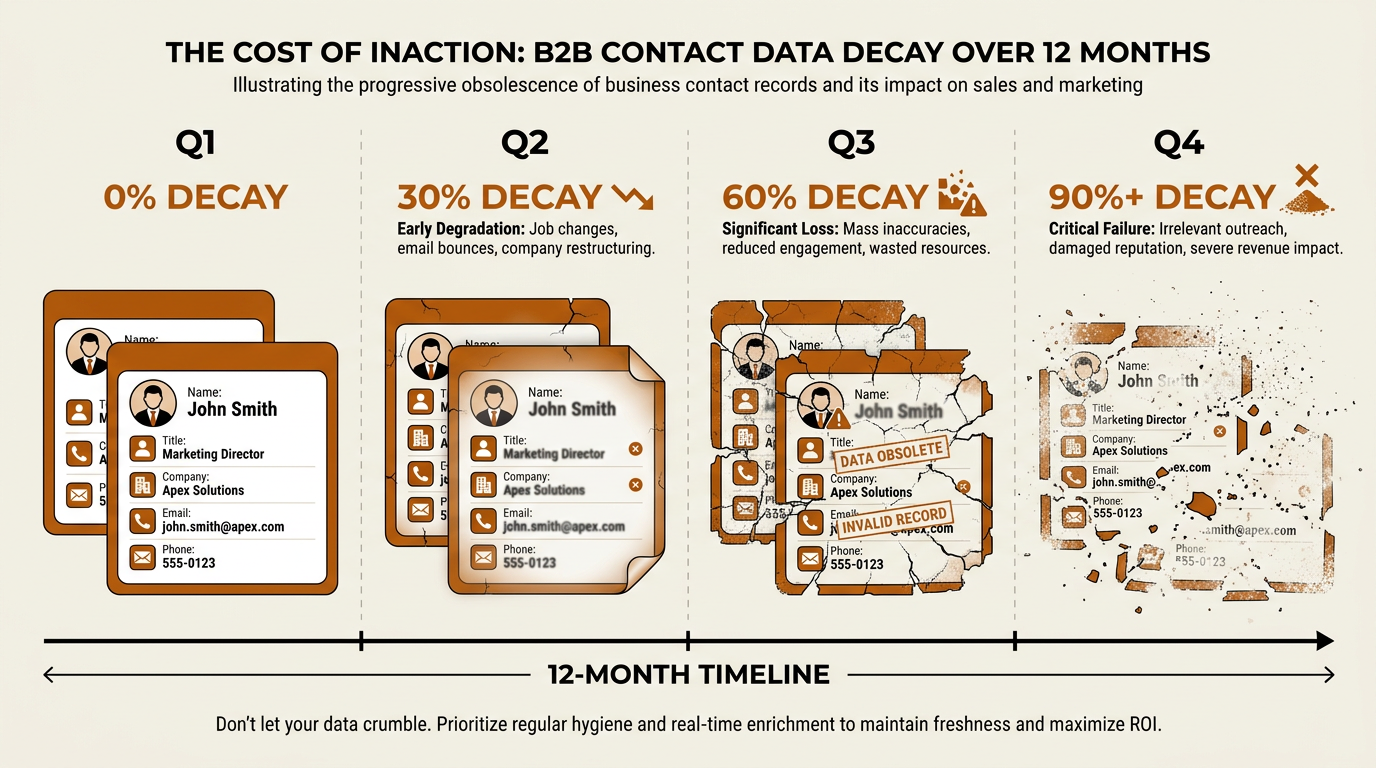
Contact records deteriorate rapidly quarter by quarter — continuous re-verification is essential for pipeline health.
Key Takeaways for Revenue Teams Evaluating B2B Databases in North America
B2B databases in North America are no longer just about storing contacts. The platforms that win budgets are the ones that pair a reliable business contact database with real-time enrichment, usable buying signals, native CRM integrations, and workflow automation that actually ships pipeline. If you want to widen the shortlist, this roundup of 18 best B2B contact database companies adds more options beyond the six covered above.
Action steps to take this week:
- Export your current target account list and ask two or three vendors to run match-rate tests before you commit.
- Audit your CRM for completeness. If a significant share of records are missing key fields (title, phone, company revenue), move CRM enrichment to the top of the requirements list.
- Map your outbound workflow end to end. Flag the manual steps (research, enrichment, list building) that slow reps down, then evaluate platforms that automate those exact choke points.
- Validate compliance posture. Confirm that each provider can demonstrate CCPA/CPRA and GDPR compliance, and get a clear answer on how they handle Canada's evolving privacy framework.
- Pilot before you standardize. Run a focused test with your top two vendors against the same account list and compare deliverability, enrichment fill rates, and time-to-first-touch.
Frequently Asked Questions
What is the difference between a B2B database and a sales intelligence platform?
A traditional B2B database is primarily a repository of contact and company records. A sales intelligence platform layers on buying signals, real-time enrichment, AI research, and workflow automation so teams can act on that data inside their GTM motion. Most modern providers blend the two, but platforms like Bitscale and Cognism skew more toward intelligence and automation.
How do I evaluate data accuracy across B2B data providers?
Start with a match-rate test against your real target account list, not a generic sample. Then measure what matters operationally: email deliverability, phone connection rates, and firmographic completeness. Run a pilot with your actual ICP segments and compare results across vendors rather than relying on self-reported accuracy percentages.
Are B2B databases compliant with North American privacy laws?
It depends on the provider and on your own processes. Since the CPRA B2B exemption expired, B2B contact data in California is handled under consumer-grade protections. Canada's evolving privacy framework also introduces meaningful compliance requirements. Before you buy, confirm the platform supports opt-out management, consent tracking, and audit trails.
Can I use multiple B2B databases together?
Yes, and it is common once teams get serious about coverage and verification. Clay is built to aggregate multiple providers through waterfall enrichment. Bitscale can also complement existing sources through CRM and outbound integrations. The tradeoff is cost and governance: multiple providers usually raise your per-record spend and add complexity to how you manage fields and compliance.
How often should I refresh my B2B contact data?
Contact and company data changes continuously as people switch roles, companies restructure, and business information becomes outdated. Refresh records according to your CRM activity, sales cycles, and how quickly your target market changes. Platforms that verify in real time (when a record is accessed or exported) reduce the odds of reaching out to stale contacts. For guidance on keeping systems clean, see this CRM data quality guide.
See how Bitscale unifies B2B data, enrichment, buying signals, and workflows.